
Before fertilizing onions for green onions, carefully read the basic rules and timing for applying fertilizer. This determines the quality and quantity of green onions, as nutrients significantly affect yield.
When is fertilizing done?
To ensure bulbous plants produce abundant foliage, they need to be fertilized three times per season. Each fertilization method has its own specific characteristics that should be considered:
- First feeding activates feather growth. It is carried out after seedlings have emerged, that is, in the spring, 14-18 days after planting.
If the vegetable is being grown for its bulbs, store-bought nitrogen-containing fertilizers (saltpeter and similar) are added. These can be replaced with urea, fermented slurry, or chicken manure.
When growing a crop for feathers only, urea and saltpeter are not used, but nitroammophoska (NAP) is required. Nutrients are applied under the root system. - Second time Fertilizing is necessary after 28-30 days, when the head is actively forming. Potassium and phosphorus (potassium salt, monophosphate, or superphosphate) are added to the soil.
- Third time Nitroammophoska is required, which promotes bulb filling. About a month should pass after the previous fertilizing.
It's important to fertilize the soil in the fall and early spring, even before planting. Copper sulfate (15 g per 10 liters of water) is added for disinfection, and a mixture of lime dust, dolomite flour, wood ash, and chalk is used to normalize acidity.
Features of fertilizing onions for green onions
The type of fertilizer applied depends on the soil composition and onion variety, so you need to pay attention to signs of deficiency of certain substances:
| Name of the useful substance | Symptoms of deficiency |
| Nitrogen. | Formation of yellow spots, fading of feather color, slow growth. |
| Potassium. | Necrosis of the tips of greenery. |
| Phosphorus. | The presence of brown spots, slow growth. |
| Zinc. | Twisting and loss of feather. |
| Copper. | Thinning of greenery, paleness of color. |
- ✓ Magnesium deficiency manifests itself as interveinal chlorosis on older leaves.
- ✓ Boron deficiency causes feathers to become brittle and crooked.
To ensure that the fertilizers you apply are beneficial, follow these simple recommendations:
- If onions are grown in greenhouse conditions, they will need to be fed with dry mineral fertilizers, which are scattered over the soil near the roots and moistened.
- In case of heavy rainfall, nutrients are applied not at the roots, but at a distance of 10-12 cm from the vegetables.
- When preparing solutions, use only warm, settled water. Some fertilizers require hot liquid for preparation, but the garden bed should be watered with a cooled solution.
- If several ingredients are mixed, the mixture is left to infuse for 50-60 minutes to ensure the beneficial components are fully combined.
- The time for applying fertilizers is morning or evening, that is, when there is no exposure to direct sunlight.
- Be careful not to let the mixture come into contact with the green parts of the plant, as many fertilizers can burn delicate leaves. If this happens, rinse the solution off immediately with clean water.
- After applying fertilizer, residues of ingredients are noted on the soil, which should be washed away with water the next day.
- If you plant onions in sandy soil, increase the frequency of fertilizing, but the concentration should be lower.
- Clay soil requires highly concentrated solutions.
- Mineral substances are applied only to moist soil.
- When sowing onions in the fall, the soil is fertilized with ash and rotted manure.
- Minerals and organic matter should alternate.
- Avoid applying fertilizer in high concentrations or too frequently, as excess nutrients can damage the plants. Avoid watering with undiluted cow manure or bird droppings, as this will burn the onion tops.
Organics
Organic fertilizers are natural, completely safe for humans, animals, and plants. However, they have a significant drawback: the impossibility of accurately determining the presence of any given element.
What can be used:
- Humus has a long-lasting and stable effect. Apply 5 kg of rotted compost per square meter. It's best to apply it in the fall.
- Wood ash contains all the necessary components—sodium, calcium, magnesium, and potassium. To fertilize, simply scatter the ash over your plants, but you can also add it to your watering water.
- To add nitrogen, use a mixture of cow manure (diluted 1:3 with water) and chicken manure (1:15). Add 250 ml of each mixture to 10 liters of water.
- Dilute horse manure in water at a ratio of 0.5 kg of manure per bucket of water. Let the mixture sit for 7-8 days, then dilute again (1 liter of liquid per 5 liters of water).
- Cow manure. Dilute 500 g of pure cow manure with 5 liters of water. Let it sit for a week, then combine the mixture with clean, warm water in a 1:5 ratio.
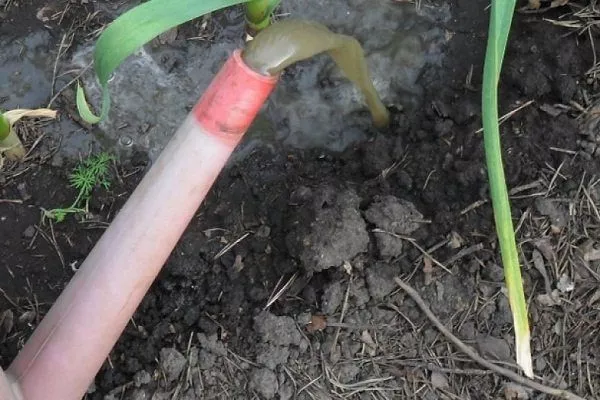
It is not recommended to pour organic fertilizers under the roots; it is better to apply them between the rows.
Minerals
Key microelements for feather growth:
- Potassium It normalizes the water balance in greens, increases sugar concentration (prevents the leaves from becoming too bitter and pungent), and strengthens the plant's immune system, developing resistance to diseases. The ingredients used are potassium salt and nitrate, potassium magnesium sulfate, and potassium chloride.
- Phosphorus Accelerates metabolic processes. Contained in superphosphate, nitroammophoska, Thomas slag, and rock phosphate.
- Nitrogen Activates green growth. Urea, ammonium nitrate, ammophoska, and ammonium carbonate are used.
Potassium salt, saltpeter, and superphosphate are used as mineral fertilizers. These elements can be purchased in powder form and mixed together in the following ratio: 2 tablespoons of superphosphate, 1 tablespoon each of salt and saltpeter. Dissolve all of this in 10 liters of water. This is a universal recipe, but there are many other mixed products that are equally effective:
- For 5 liters of settled water you will need 2 tablespoons of Vegeta, the same amount of Effecton-O and 1 teaspoon of Agricola.
- For half a bucket of water, take 1 tablespoon of ammonium nitrate and potassium salt, 2 tablespoons of superphosphate, 1.5 tablespoons of ammonia.
- Mix Effecton-O (2 tbsp.) with Superphosphate (1 tbsp.), sprinkle between the rows.
- Dry mix: sodium chloride – 20 g, ammonium nitrate – 25 g, potassium chlorine – 30 g.
- Ammonia – 3 tbsp., ammonium nitrate – 1 tbsp., superphosphate – 2 tbsp., potassium permanganate solution – 2 crystals per 1 tbsp. of water.
- Baikal EM-1. Diluted with water at a ratio of 1:1000. Helps reduce forcing time and increase yields.
Mixed fertilizers
You can separately purchase preparations that promote the development of onion greens, containing various microelements at the same time:
- Granulated nitrophoska Contains nitrogen, potassium, and phosphorus compounds. It is used in spring to accelerate feather growth. The proportions are: 1 bucket of water per 40 g of product.
- Effecton-O liquid The composition is identical to the previous product. To dilute 200 ml of liquid, 10 liters of water are required.
- Vegeta Contains humates and microelements. To accelerate the growth of green mass, dilute the product in water (2 tablespoons per bucket).
- Oxyhumate – a growth stimulator based on amines, acids, humates, etc. Dilute strictly according to the instructions.
Folk recipes
Traditional medicine involves using readily available natural materials. They have long been popular. What you need for green onions:
- Nettle infusion. Fill a bucket halfway with nettles, add warm water, and let steep until fully fermented. Then strain and dilute with water at a ratio of 1:5, and water between the rows.
- Prepare any weeds, dandelions, or nettles. Finely chop them with a knife and place them in a container, filling it 1/3 full with the grass. Fill the rest with warm water and let it ferment for 3 days. After this time, add wood ash (1.5 kg per 5 liters of solution). Before watering, dilute the mixture again with water (1:10).
- The infusion can be made from a mixture of the following herbs: clover, chamomile, mustard, and nettle. The preparation and use method are identical to the previous one.
- Yeast supplements consist of microscopic fungi rich in minerals. The yeast stimulates the growth of both the green and underground parts, resulting in the growth of not only the feathers but also the bulb.
Use 10 g or 500 g of dry or fresh yeast, 5-6 tbsp of granulated sugar, and 10 liters of warm (not hot) water. For a better effect, add 2 cups of wood ash. After mixing the ingredients, let the mixture ferment for 3 days. Before watering, dilute with water at a ratio of 1:10. - Ammonia helps replenish nitrogen deficiency. It prevents yellowing of the foliage. Use 3 tablespoons of the solution per bucket of water. If the foliage is already yellow, water the plants daily (morning or evening). Ammonia also repels onion flies and other insect pests.
- Complex fertilizer: Heat water (10 liters) to lukewarm, add 0.5 kg of soft bread crumbs, 500 g of live yeast, and the same amount of chopped herbs (nettles, weeds, etc.). Let it steep for a couple of days. Before watering, dilute with water (1:10).
Use wood ash frequently, as it contains many nutrients, especially potassium. Dilute the ash with water or sprinkle it dry around the roots, but be careful not to overload the soil with micronutrients.
Another recipe for feeding onions for green onions can be seen in the following video:
Useful tips for gardeners
Be sure to follow the proper agricultural practices. Otherwise, you won't be able to get much greenery.
Other useful tips:
- Fertilize generously with nitrogen and phosphate during planting, plume formation and thinning.
- Nitrogen is required in minimal quantities in the future, so do not overdo it with its application.
- Feed the bulbs after watering or rain – this way the nutrients are better absorbed by the soil.
- In autumn, yellowing of feathers is considered normal, so at this time do not apply fertilizers in the form of preparations, but use folk remedies.
- Don't add yeast to unheated soil, as this will prevent fermentation and, consequently, the desired effect. The best time for yeast is summer, late spring, and early fall.
- Fresh manure is contraindicated, as the bulbs will not form and the vegetable will be susceptible to fungal diseases.
- For feather growth, the most important thing is to add organic fertilizers, which negatively affects the growth of the head.
- To avoid diseases, soak the onions in a weak solution of potassium permanganate for 15-20 minutes before planting.
- Many gardeners apply the first fertilizer when soaking the planting material. Add ammonium nitrate to the water (1 teaspoon per bucket of water). Leave it for 15 minutes.
- You can disinfect the bulbs for planting with Ellin Extra.
- Avoid overwatering the soil, as the plumes will become too watery and tasteless, and the head will rot. Water generously only until July. Then, gradually reduce the frequency and amount of watering.
When growing green onions, apply fertilizer correctly, following the requirements and recommendations. If you purchase mixed fertilizers, read the instructions carefully—the same product cannot be used at the same dosage for different soil types.