
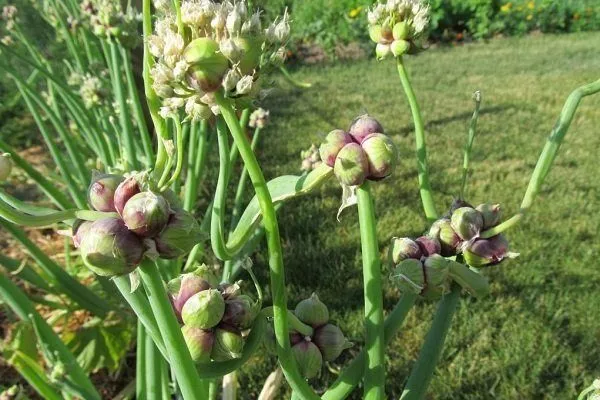
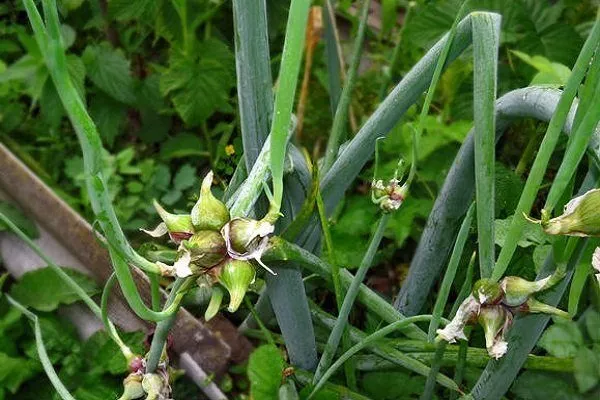
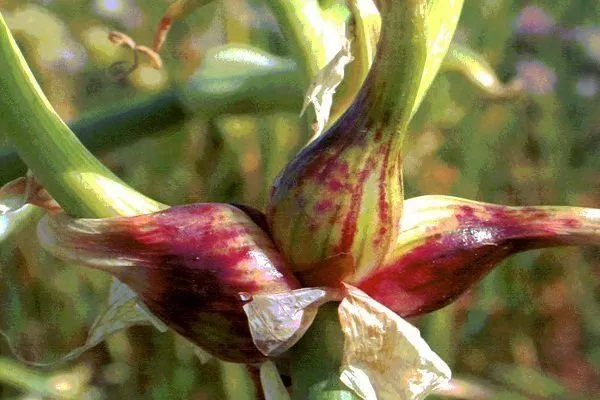
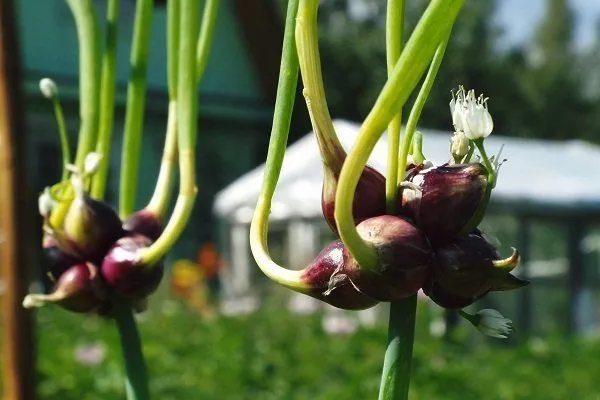
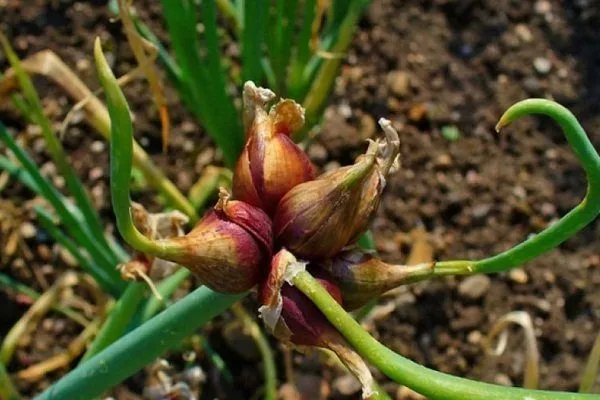
The multi-tiered onion is also known as the viviparous, horned, and Egyptian onion. It is believed that the plant originated in China. A distinctive feature of this crop is its unusual appearance: the shoots form aerial bulbs that hang above the ground rather than inflorescences. These bulbs form several successive tiers.
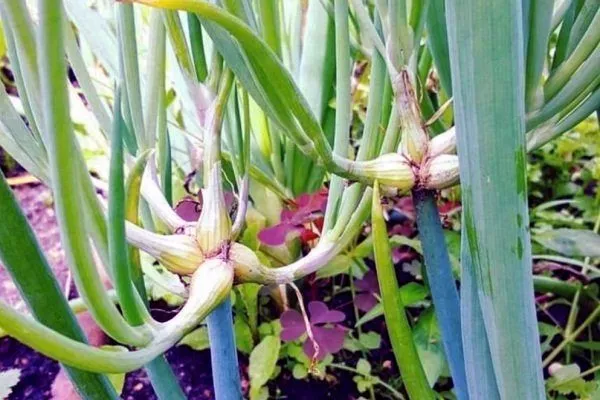
The multi-tiered onion is a perennial plant.
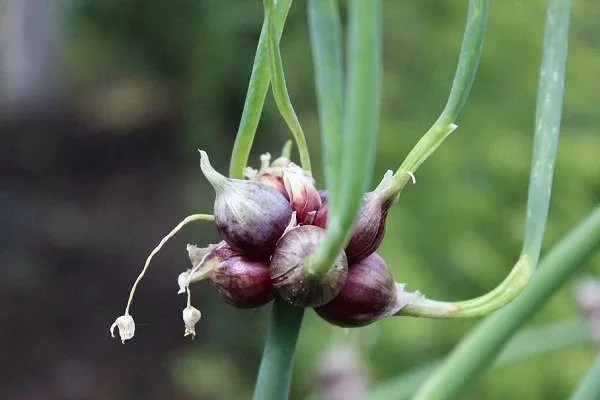
Multi-tiered bow
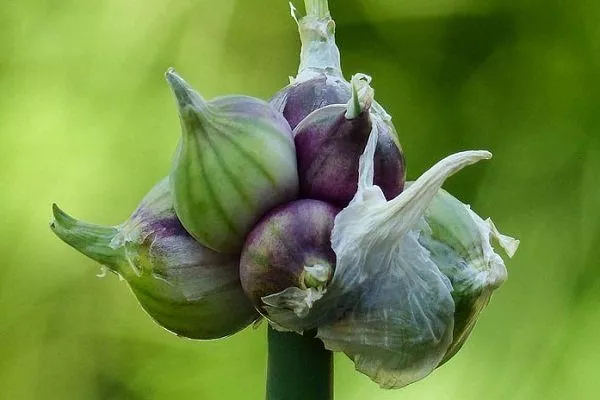
Multi-tiered onions tolerate frost well
Plant characteristics
Multi-tiered onion is a hybrid crop. The plant does not produce seeds. It is propagated by bulblets that form on the scapes.
The multi-tiered onion is a perennial plant. Its main vegetative organ is the underground bulb. After planting in the soil, it develops a large rosette with dark green leaves up to 40 cm tall. A flower stalk forms during the first summer after planting.
Small bulblets emerge directly from the flowers, arranged in 2-4 tiers. The first tier produces up to 10 bulblets, with fewer appearing in subsequent tiers. If there is a fourth tier, it bears no more than four oat-sized fruits.
The underground bulb divides into several more daughter bulbs each year. After 3-4 years, a robust nest and a green bush consisting of 20-30 stems form.
Distinctive features of the culture:
- Onion leaves are tubular, reaching 35 cm in height;
- During the growing season it produces up to 3 shoots with aerial bulbs 1 m high;
- bulbs formed on shoots do not require a dormant period, so they can be grown at any time;
- small above-ground bulbs are colored yellow, purple or brown;
- the underground bulb ripens in September;
- the weight of one underground bulb is 40-50 g;
- onions produce a lot of juicy greens that retain their flavor until the first frost and do not become tough;
- the crop is frost-resistant and can withstand temperatures down to -50 degrees under a thin layer of snow (up to 20 cm);
- the root system does not die off in winter;
- the crop grows in one place without losing the formation of abundant green mass for up to 6-7 years, subject to proper care;
- the plant is resistant to common pests that usually affect onions – thrips and onion flies;
- The crop has a developed root system that goes to a depth of 50 cm.
Under normal conditions, multi-tiered onions are propagated only vegetatively, using small bulblets formed on the shoots.
Common varieties
| Name | Greenery yield (kg/sq.m) | Taste | Cold resistance |
|---|---|---|---|
| Chelyabinsk | 3.5 | Spicy | High |
| Odessa Winter 12 | 2.4 | Spicy | Average |
| Memory | 3 | Spicy | High |
| Likova | 3.6 | Spicy | High |
| Gribovsky 38 | 3 | Spicy | Very high |
Popular varieties of the crop:
- ChelyabinskA high-yielding, low-maintenance variety. Over the course of a season, you can harvest up to 3.5 kg of fresh greens and up to 1 kg of bulblets (air bulbs) per square meter. They are firm, crisp, and have a distinctly pungent flavor. The variety ripens in 20 days.

- Odessa Winter 12Up to 30 aerial bulbs form on the peduncle. The green leaves reach 40 cm in length. Up to 2.4 kg of greens can be harvested from 1 square meter. The flavor is pungent.
- MemoryAn early variety, the onion grows quickly. Up to 3 kg of green leaves can be harvested per square meter per season. Each onion produces an average of 4 green leaves.
- LikovaThe advantage of this variety is its ability to develop foliage even in low-light conditions. A single inflorescence produces 2-8 aerial bulbs. Yields up to 3.6 kg per square meter.
- Gribovsky 38This multi-tiered onion variety is cold-resistant, making it suitable for cultivation in the Urals and Siberia. This crop is early maturing: the first harvest is harvested three weeks after the snow melts. The onion plants are compact and dense.
- ✓ Chelyabinsk: high drought resistance.
- ✓ Odessa Winter 12: requires more frequent watering during dry periods.
- ✓ Memory: quick recovery after cutting greenery.
- ✓ Likova: tolerates low light better than other varieties.
- ✓ Gribovsky 38: the most frost-resistant variety.
Few varieties of multi-tiered onions are cultivated in Russia. This plant only became widespread here in the late 20th century.
Growing conditions
Viviparous onions can be grown in both northern and southern regions of the country. They can be grown both outdoors and indoors.
Site and soil requirements:
- To ensure that green shoots don’t keep you waiting for too long, it is recommended to choose a sunny area that is well-heated by the sun’s rays and protected from drafts;
- the site should be located on a hill so that moisture does not stagnate in the soil;
- Multi-tiered onions love light soil, the composition of which allows air and moisture to pass through freely;
- heavy and acidic soil is not suitable for the crop: development will slow down in it, and the green feather will grow weakly;
- if the soil is acidic, limestone, gypsum or wood ash should be added to it;
- too heavy soil with a high clay content can be improved by adding humus or sand;
- Before planting, the soil must be dug up, weeds removed and fertilizer added;
- Both organic fertilizers (for example, humus) and mineral fertilizers (superphosphate) are suitable for feeding.
- ✓ Soil pH should be between 6.0-7.0 for optimal growth.
- ✓ The soil must have good drainage to avoid water stagnation.
It is better to plant multi-tiered onions in beds where potatoes, cabbage, zucchini, cucumbers or beets were previously grown.
The optimal time for planting onions is considered to be the second half of August and the first half of September. During this time, the crop will have time to take root and withstand the winter cold well, and will begin growing rapidly in the spring.
With the arrival of spring, fallen and rotted leaves should be removed from the beds, as they provide a favorable environment for the development of pathogenic microorganisms that can harm vegetable crops.
The highest yield can be expected in the 2nd to 3rd year of onion growth. In the 5th to 6th year of development, the crop requires replanting or thinning. This is necessary because, with the formation of a large number of basal bulblets, the underground bulblets become too small.
Landing
The planting material must be carefully selected. To prevent fungal diseases, the bulbs should be soaked in a weak solution of potassium permanganate for 3 minutes, then dried.
For planting in the ground, use aerial (tiered) or underground bulbs. If using the former, it's best to use those that were planted in the first and second tiers.
The crop should be planted in furrows watered with water, to a depth of 3-4 cm. The distance between each bulb should be 15-20 cm.
The planting material should be sorted in advance by size and each group should be planted in a separate row.
To obtain seed, the bulbs are planted in 1-2 rows, spaced 10 cm apart. In the spring, the beds are thinned, leaving only the strongest plants. Leave 20 cm between them.
After planting, you need to water the beds to speed up the root formation process.
If onions are grown in boxes (in an apartment or greenhouse), the heads need to be planted tightly, one after another, and watered generously.
Caring for crops in open ground
If you follow all the recommendations for growing the plant, you can get a rich harvest.
Watering
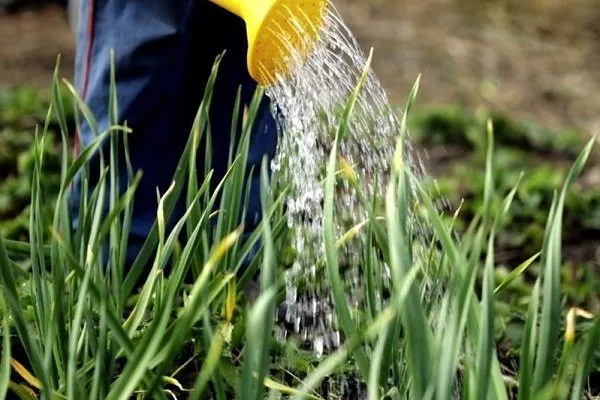
The plant requires moderate watering. Excess moisture can cause the delicate bulbs to rot.
The beds are watered as the top layer of soil dries out. Don't add too much water: pouring too much water under the roots can impair the onion's flavor.
It is recommended to use warm water for watering. The recommended frequency is 2-3 times a week.
During the active growth period, the beds need to be watered frequently and thoroughly. To ensure juicy and fresh foliage, the plant's leaves should be periodically misted with water.
Top dressing
In spring, after the snow melts, mineral fertilizers are added to the soil:
- potassium chloride;
- ammonium nitrate;
- superphosphate.
Proportions: 10 g of substance per 1 sq. m.
If there is a lack of nutrients, repeat the procedure after 2-3 weeks.
In the second year of growth, the crop needs to be fed with a complex mineral fertilizer, which consists of potassium, phosphorus and nitrogen substances (15 g, 40 g and 20 g, respectively).
After each cutting of green mass (approximately once every 3 weeks), it is recommended to feed the plants, alternating organic matter with complex mineral compositions.
Ash (1.5 cups of wood ash per 10 liters of water) and bird manure (mixed with water in a 1 to 1 ratio) are suitable as organic fertilizers.
Weeding and loosening
Weeding helps remove weeds, which draw nutrients from the soil and attract certain crop pests (such as onion flies). Weeding is performed as the grass grows.
Loosening the soil ensures adequate oxygen supply to the underground bulbs. This procedure is performed 2-3 times per season.
Garter
This procedure is necessary because the shoots of multi-tiered onions are unstable and prone to lodging due to the weight of the aerial bulbs. To prevent this, install stakes in the area and stretch twine between them, ensuring that the twine is above the center of the shoots. Tie the upper tiers of the plant into bundles and secure them.
Pest and disease control
The plant is susceptible to diseases such as downy mildew and peronospora. To prevent these diseases, spray the plant with a weak solution of Bordeaux mixture. Repeat the treatment after 7 days. A solution of washing soda can also be used as a treatment, dissolving a tablespoon of the solution in a liter of water.
The key to preventing insects and other pests on multi-tiered onions is regularly removing dry or rotting leaves. The greatest threats to this crop are the onion fly and the onion weevil.
Harvesting and storage
The leaf harvest begins early: the first leaves can be cut as early as April, when they reach 25 cm in length. They should be cut 5-8 cm above the neck of the underground bulb.
The bulbs that have formed in the tiers are harvested between late July and mid-August. By this time, they have acquired a purple hue with brown flecks. To harvest them, carefully cut the stem with the bulbs 5 cm from the ground with a sharp knife.
Some of the resulting harvest can be used for culinary purposes, while the rest can be stored and then replanted in containers over the winter. The bulbs can also be planted in the soil in the spring to produce young, succulent greens.
Gardeners recommend storing such onions in pits or cellars. They can also be stored in attics, unheated rooms, or in a layer of sand at temperatures no lower than -2 degrees Celsius. The harvested onion can also be stored in the refrigerator or freezer, after drying and packaging it in paper bags. Unseparated onions retain their appearance and flavor much longer.
In warm rooms, the collected bulbs begin to sprout and eventually die.
Learn about the specifics of growing multi-tiered onions and their beneficial properties in the following video:
Multi-tiered onions have a unique appearance and produce a large amount of green above-ground material—these are the distinctive characteristics of this variety. To ensure a good harvest, the crop must be provided with the necessary planting and growing conditions.