
Red salad onions are a versatile variety widely used in cooking. While their tops resemble those of regular onions, the bulbs themselves have a distinctive appearance due to their reddish-purple coloring, which is unusual for this crop.
Who and when bred the red salad onion?
The Red Salad Onion was developed by Russian breeders. Its authors are M. M. Tsiunel, S. F. Gavrish, I. M. Lezenkova, and D. S. Gavrish. The variety was added to the State Register in 2013. It is recommended for cultivation in the Central Region of the Russian Federation.
Description of the plant and bulbs
The plant has a neat and compact rosette of leaves. The leaves are dark green, with a juicy and delicate texture. The bulbs are strongly elongated, medium-sized and dense, with elongated necks.
This variety is classified as a small-cluster variety. Each cluster contains no more than two bulbs weighing 50-65 g. The dry scales of the Red Salad Onion have a vibrant purple hue, while the juicy scales are purple-white. The bulb length reaches 10 cm.
Taste and application
Thanks to its pleasant, semi-sharp flavor, this variety is extremely popular with gardeners and cooks. Its sweet and piquant taste is virtually free of bitterness. The pods are also semi-sharp.
Red salad onions are rich in vitamins, especially A, B, C, and P, as well as microelements such as zinc, iron, magnesium, iodine, potassium, and others. Most importantly, they are rich in phytoncides, which kill or inhibit most pathogenic fungi and microorganisms.
Productivity and other characteristics
Red salad onions are an early-ripening variety with a 90% pre-harvest maturity rate. The time from germination to harvest is 100-110 days. This onion has an excellent yield—approximately 350 centners per hectare. The variety tolerates frost and drought well.
Pros and cons
Before planting red salad onions in your garden, it's worth familiarizing yourself with all of their advantages. It's equally important to be aware of any shortcomings, as they may be critical for you, requiring you to look for a different variety.
Advantages:
Flaws:
Subtleties of planting
This variety can be grown from seeds, sets, and seedlings. To obtain large bulbs this season, use sets—small bulbs grown from seed. Seedlings are more commonly used in regions with long springs and short summers.
Features of planting red onions:
- Plant in open, well-lit areas. The best soils for this variety are fertile, moist loams or sandy loams with neutral or slightly acidic conditions. Red onions do not tolerate high acidity, so wood ash or other acidifying agents are added to acidic soils.
- In temperate climates, seeds and sets are planted around the end of April. Planting occurs based on soil warming, which should reach 10 to 12°C. Seeds for seedlings are sown in March, and planting occurs in May.
- Regardless of the growing method, seeds are sown at a depth of 1-1.5 cm. The optimal planting pattern is 5 x 20 cm.
How to care?
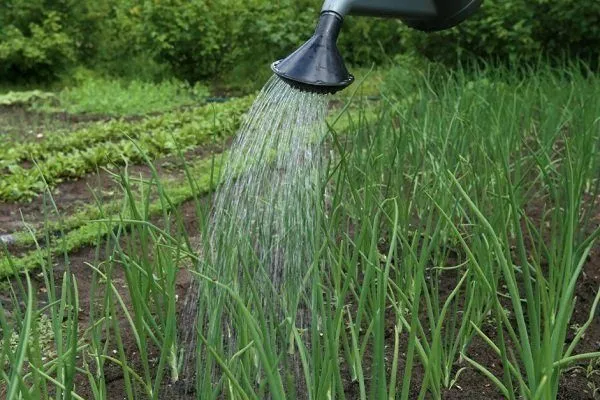
To get a lot of tasty and large red salad onions, you will need standard care - watering, fertilizing, loosening the soil.
Care features:
- Watering Red onions need regular harvesting; this affects their flavor, juiciness, and size. Moisture is crucial during periods of heat and drought.
Watering should be done in moderation, as excess and/or stagnant moisture will cause the bulbs to rot. In normal weather, the recommended frequency is once a week; in rainy weather, watering should be discontinued. - Fertilizers They are added when digging the soil and preparing the beds. Typically, this includes humus and some mineral fertilizers, such as superphosphate and potassium salt.
Two weeks after germination, diluted cow manure is added. Subsequently, mineral fertilizers are used, primarily potassium-phosphorus compounds, to minimize the amount of nitrates in the bulbs. - Loosening It's best to weed the beds after each watering. Weeds should be removed at the same time. If you don't weed them, you won't get large onions.
Diseases and pests
Red salad onions have fairly good immunity to most infections and pathogens, fungi, bacteria, and viruses. With proper agricultural practices, they are not susceptible to rot, fusarium, yellows, and other diseases. However, preventative treatments are recommended.
The greatest risks are associated with fungal infections. To completely eliminate their occurrence, the green mass is sprayed with copper sulfate. To do this, prepare a solution of 1 tablespoon of the solution per 10 liters of water.
Cleaning and storage
Red onions are harvested once they reach full ripeness. Harvesting times vary by region; in the central part of the country, onions are ready by the end of July, while in Siberia and the Urals, they're ready by August. Harvesting begins when the tops turn yellow and lie flat on the ground, the peel rustles and peels easily from the bulbs, and the necks dry out and become thinner.
The block is carried out in dry, sunny weather. The harvested onions are dried in the beds, or better yet, on spread-out blankets. If it rains, the onions are moved to a dry, ventilated room. Before storage, the onions are sorted, the tops and roots are trimmed, and then stored in boxes, cardboard boxes, or hung from the ceiling, tied in braids or folded into nylon tights.
Reviews
Red salad onions are rightfully popular among avid gardeners. Despite their recent introduction, this red variety has already become a favorite among our gardeners. In addition to its excellent flavor, they value its early maturity, high yield, and disease resistance.