
After harvesting onions, it's important to preserve them for as long as possible without losing quality. To achieve this, the onions need to be properly prepared. There are various ways to store them, which are discussed further in the article.
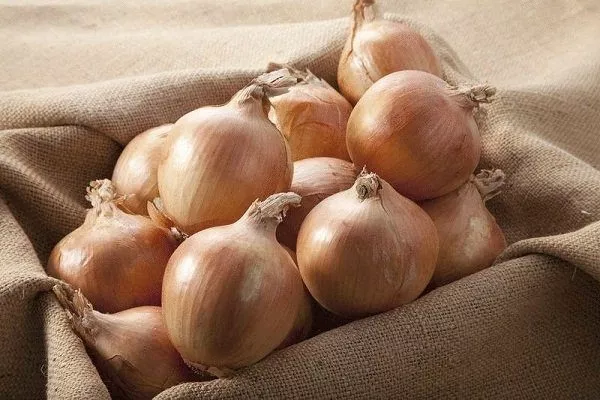
Preparation for long-term storage
A key condition for long-term storage of onions is harvesting them at the proper time—they should be ripe, but not left in the ground for too long. Unripe onions have a shorter shelf life and are more susceptible to disease, while overripe ones are prone to sprouting.
- ✓ Choose varieties with good shelf life, such as 'Sturon', 'Centurion', 'Red Baron'.
- ✓ Consider the ripening period: late-ripening varieties are stored longer.
- ✓ Pay attention to the thickness of the neck: the thinner it is, the better the onion will be stored.
Work should be planned for dry weather. The harvested crop requires some preparation:
- Cleaning onions from soilThere is no need to rub it too much; any unnecessary residue can be removed after drying.
- DryingThis stage should last two weeks. If the weather is sunny, it's recommended to spread the harvest directly on the beds—the process will go much faster. On cloudy or rainy days, the onions can be dried in any dry, well-ventilated area. The scales and roots should be completely dry.
During drying, the onions need to be turned periodically. This isn't necessary when using wire mesh drying racks. Another option is an electric oven. Set the temperature to the lowest setting to prevent the onions from drying out. It's best to dry them with the door open to allow excess moisture to evaporate faster. - Final cleansingAny remaining soil and cracked scales should be removed.
- TrimmingThe specifics of this stage depend on how the harvest will be stored. The roots must be trimmed completely in any case, without touching the base. The feathers are usually trimmed completely, leaving only a 5 cm tail. Longer ones should be braided for storage.
- CullingThis work should be coordinated with other preparatory steps. Only firm onions without mechanical damage or signs of disease or pest damage are suitable for storage. Onions that do not meet these requirements should be kept for consumption or discarded. When pruning, set aside onions with green necks—they will not store well.
- SortingThis stage is also usually combined with one of the previous ones. The harvest should be sorted by size into three groups.
Burning the roots can help reduce the risk of onion sprouting. They will be unsuitable for planting, so you should immediately set the planting material aside. Another option is to treat the cut ends with a lime paste. These onions should also not be used for planting.
- ✓ Use paraffin treatment on the root collar to block moisture access.
- ✓ Treat onions with a salt solution (1 tablespoon per 1 liter of water) before storing.
Storage conditions for onions
To extend the shelf life of harvested onions, certain conditions must be met. These include temperature and humidity in the room—both are interrelated.
There are 3 options for storing vegetables:
- Cold method At temperatures of -3 to 0 degrees Celsius, this is the best option. Under these conditions, the harvest is stored for the longest possible time.
- Warm method At a temperature of 18-22 degrees Celsius, air humidity should be 60-70%.
- Combined methodInitially, the harvest is stored at a temperature of 18-22 degrees Celsius, and when persistent cold weather sets in, it is cooled and the cold method is switched over. In the spring and during the thaw, the warm method is returned.
When storing onions cold, avoid leaving them in warm places for long periods. Use them in small quantities for eating.
When choosing the appropriate temperature, consider the onion variety. As the onion's spiciness increases, the recommended storage temperature decreases.
The storage area for onions should be dry and well-ventilated. Ventilation can be natural or forced. In the latter case, it is important to monitor its proper operation. There should be no heat sources nearby.
It's important to store onions in the right containers. They should be breathable. Boxes, crates, or baskets should be no more than 30 cm high. The same applies to other containers—the onion layer should also not exceed 30 cm. Smaller containers are recommended to minimize damage to the harvest if spoilage occurs.
When storing onions, it is also important to observe the following conditions:
- periodic inspection of raw materials with rejection of spoiled items - 2-3 such checks over the entire period are sufficient;
- avoid storing onions together with crops that require higher indoor humidity;
- When storing in boxes and other containers, do not close them tightly - this increases the humidity level and provokes rotting;
- avoiding strong and frequent temperature changes in the room.
Hot and early-ripening onions store best. Salad and semi-hot varieties have average shelf life.
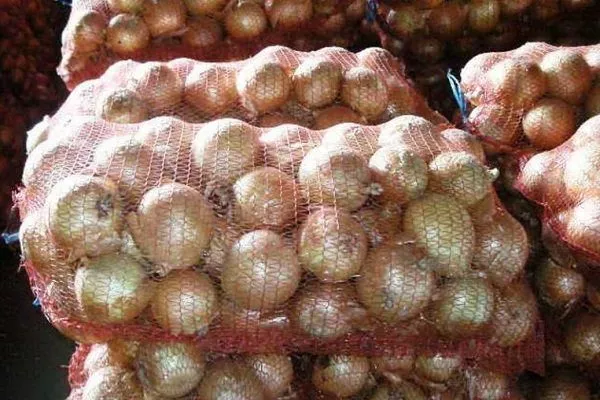
Methods for storing onions in basements and cellars
Storing onions in a basement or cellar offers the advantage of cooler temperatures and more space. You can store your harvest in the following ways:
- Racks, shelvesBefore laying out the onions, cover the surface. Paper, burlap, or straw can be used. Plastic is not recommended. If possible, arrange the onions in a single layer.
- Wooden boxes, paper boxesPerforation of such containers is mandatory. They should be placed on shelves or provided with stands. Onion storage containers should not be allowed to come into contact with the floor or walls of the room.
It's also important to remember the optimal thickness of the raw material layer—if it's too thick, the bulbs at the bottom will rot, leading to the bulbs rotting and spoiling the remaining bulbs in the container. - Linen bagsIt is optimal to store up to 5-10 kg of onions in one bag.
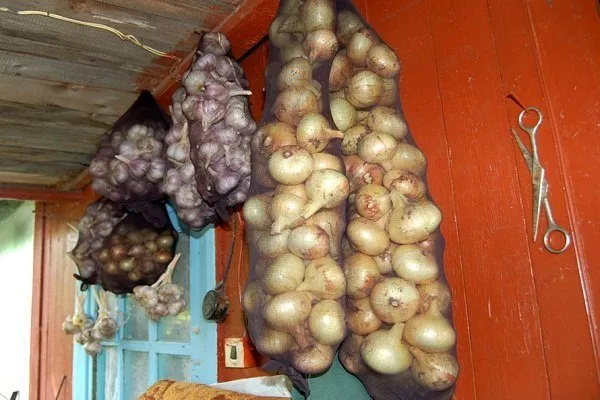
- Nylon stockingsAn effective grandmother's method. Don't overstuff stockings, otherwise they may rip during storage, and all the contents will end up on the floor. The onion-filled stockings could be damaged during the fall, and even ruined before they're discovered. Hang stockings filled with onions indoors so they don't come into contact with anything.
- Egg containersThis method is suitable for those with a lot of these containers and small bulbs. They should be divided into containers and placed on shelves. You can stack the containers on top of each other. Cardboard containers are best.
It's useful to use lime in a cellar or basement. You can apply it to the walls and floor of the room, or place it in containers and place it in corners or along the walls. Lime absorbs moisture well.
For better harvest preservation, using crushed chalk is effective. A 0.2 kg powder per 10 kg of onions is sufficient. Apply the powder evenly on all sides of each onion, but avoid making the layer too thick. The chalk will absorb excess moisture during storage, preventing a number of diseases.
Ash or wood shavings can also be used to absorb excess moisture. If the room is too dry, it's helpful to leave the husks behind when harvesting and sprinkle them over the remaining harvested material.
Methods for storing onions at home
Not everyone has a basement or cellar, so storing onions in an apartment is a pressing issue. It's also convenient for storing part of the harvest for food if the main storage area is located far from the home.
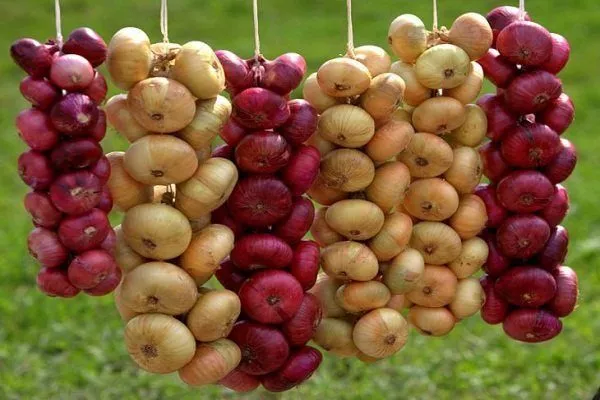
Braiding
One of the popular ways is braidingThis should be planned in advance, as you need to leave 12 cm tails. You need to follow the following algorithm:
- Sorting raw materials by sizeThis allows you to make the braids stronger and more even.
- Prepare a strong and sufficiently long rope – its length will correspond to the length of the braid. It's more convenient to tie one end immediately in the storage area.
- WeavingAttach 2-3 onions by their stems to the bottom end of the rope. You can make a loop for this purpose beforehand. Then, take two onions at a time, twist the stems together, place them on top of the already suspended onions, and twist them one or two more times. You can also take one onion at a time, wrapping its stem around the rope twice.
The finished braids can be hung in a closet, pantry, or kitchen. If carefully braided using equal-sized bulbs, they will perfectly complement your interior.
Container for storing onions
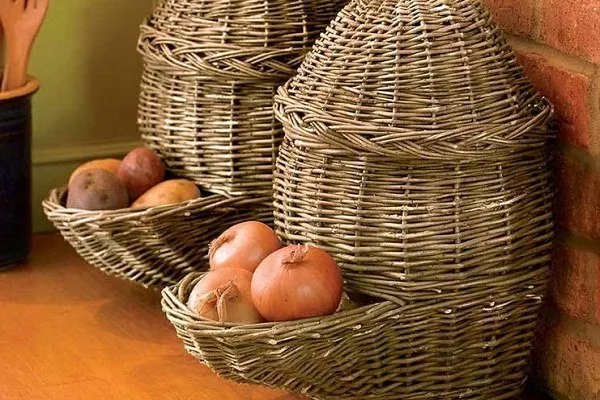
At home, onions can be stored in the following containers:
- wooden boxes;
- cardboard boxes with perforations;
- wicker baskets;
- fabric bags;
- nylon stockings;
- special vegetable nets made of polypropylene.
Storage on the balcony
In an apartment, onions can be stored on a balcony if it's closed. If the balcony is cold, the harvest can be stored there down to -6 degrees Celsius. However, nighttime temperatures should be taken into account.
If the balcony is warm, you can store onions there all winter. You can use suitable containers or hang them in stockings or braids. Keep in mind that temperature fluctuations are undesirable for onions, as they increase the risk of spoilage and sprouting.
Storage in the refrigerator and freezer
One of the best places to store onions in an apartment is the refrigerator. Onions can last up to a month there.
Freezing onions is one option for storing them at home. Peel, chop, and freeze the onions. It's best to portion them out into small containers or heavy-duty bags. You can also make various vegetable mixes.
Frozen onions can be stored at -18°C (-18°F) for up to six months. If the freezer temperature is around -8°C (-8°F), the shelf life is halved.
You can learn about freezing onions for the winter from the following video:
Other places to store onions
Onions placed in any chosen container can also be stored in a pantry, on a loft, or in a closet. Crates and boxes can be placed under a bed or closet if there is no radiator or other heat source nearby. Crushed chalk is an effective way to treat onions.
Onion preservation
Canning is also a popular way to preserve onions at home. Pickling is especially beneficial, as it imparts a distinctive flavor and can be added to salads and appetizers.
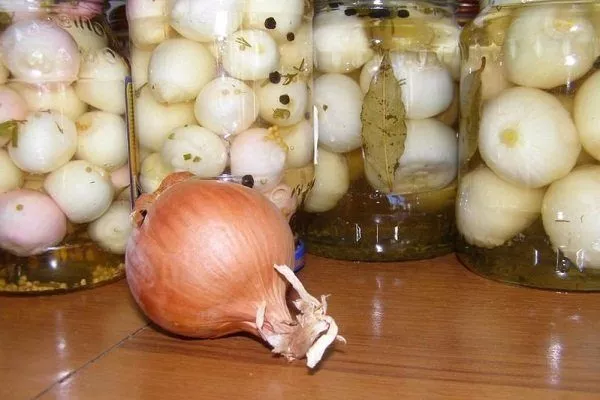
Onions can be preserved on their own or with other vegetables, such as tomatoes, peppers, and cucumbers. Red onions are great preserved in a balsamic vinegar—small onions don't even need to be chopped.
Drying onions
Drying is a good way to preserve the herbs. In this case, simply adding the dried herbs at the end of cooking will add both flavor and aroma to the dish.
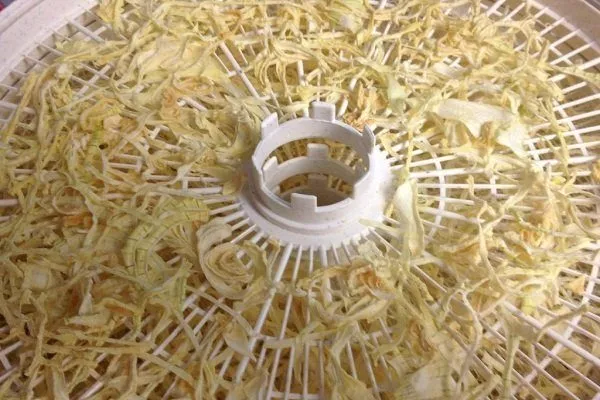
Dry onions cut into rings. Three hours at 60 degrees Celsius (140 degrees Fahrenheit) is sufficient. Store dried onions in a tightly sealed container. You can store them separately or mix them with other dried vegetables and herbs.
Possible causes of onion spoilage during storage and preventive measures
Onion spoilage during storage usually means rotting. There are various possible causes:
- disease - most often it is a fungal or bacterial infection, the signs of which appear precisely during storage;
- high humidity in the room;
- improper packaging – tightly closed containers, use of polyethylene;
- Excessive use of nitrogen-containing fertilizers brings the harvest time closer, but has a negative impact on the shelf life of the crop.
The following measures will help prevent crop spoilage during storage:
- processing of planting material in spring – it is optimal to use a solution of potassium permanganate;
- moderate use of fertilizers, correct potassium fertilization - they increase the shelf life of the crop;
- be careful when harvesting – infection often occurs due to mechanical damage;
- careful culling and removal of damaged specimens;
- complete drying of the crop;
- preparation of premises for storing the harvest – its complete drying, disinfection;
- ensuring good ventilation;
- maintaining the recommended temperature and humidity levels;
- use of breathable containers for storage;
- periodic inspection of the stored harvest with the rejection of spoiled specimens.
You can learn about the storage features of onions from the following video:
Following all the proper storage rules for onions will help them stay in good condition for as long as possible. This can be done in an apartment or even if you have a basement or cellar. Preserving the harvest is especially important if some of it is intended for planting next year.