
Hercules is a hybrid variety onions, which is recommended for cultivation in the central regions of the country. The Hercules onion has excellent characteristics and numerous advantages, which are fully realized when optimal conditions are created for the crop's growth and development.
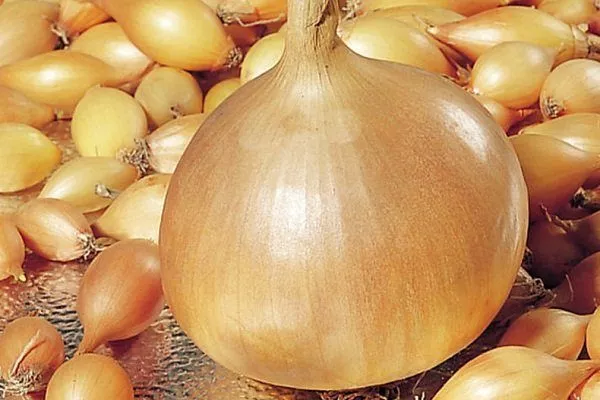
Bow Hercules
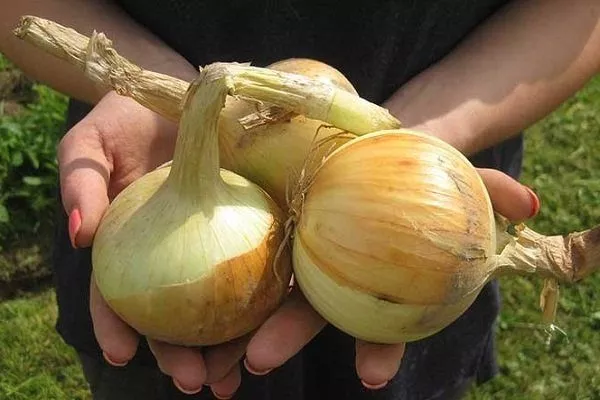
Hercules onions have a spicy-sweet taste.
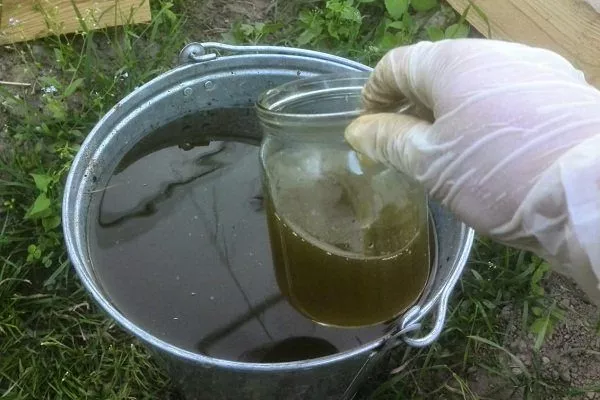
Hercules onions have a long shelf life.
Characteristics of the variety, advantages and disadvantages
Hercules was bred by the Dutch and included in the State Register in 2006. Characteristics of this onion variety:
- mid-early ripening – after emergence, the harvest is expected in an average of 75 days;
- feather height – up to 35 cm, dark green color;
- formation of a small number of leaves, which ensures large fruit sizes;
- average weight of bulbs – 140 g;
- golden-yellow dense skin;
- bulbs are elongated oval in shape;
- white juicy pulp;
- sweet and spicy taste, no bitterness, but with a piquant aftertaste.
Hercules is a biennial crop. When planted from seeds in the fall, you can obtain small onions that should be planted in the spring for a full harvest.
Hercules is a hybrid variety, and breeders have worked hard to develop its advantages:
- excellent taste;
- early maturity;
- high yield – up to 8 kg of onions can be obtained from 1 sq. m;
- formation of a powerful root system;
- resistance to arrow formation;
- long-term storage without loss of taste;
- unpretentiousness regarding growing conditions – grows successfully in arid regions, yield is high even with rare watering;
- resistance to many diseases;
- an excellent option for growing on an industrial scale.
Optimal conditions for growing
The realization of all the benefits of the Hercules onion variety depends on creating optimal conditions for the crop:
- Sunny and elevated areaThe crop doesn't like lowlands; if the entire garden is located like this, the beds need to be raised.
- Temperature conditionsHercules should be planted in open ground when the air temperature reaches 8-10 degrees Celsius and the threat of night frosts has passed.
- Crop rotation rulesOnions should not be returned to their original location for three years. They thrive after green manure, nightshades, cucumbers, and cabbage. Garlic and carrots are undesirable precursors but good neighbors, repelling pests.
- Neutral soil acidity is pH 7.
- ✓ Soil pH level should be strictly between 6.0-7.0 for optimal growth.
- ✓ The soil must have good drainage to avoid water stagnation.
Hercules prefers black soil and loamy soil. In the fall, when digging the soil, add the following fertilizer per square meter:
- urea – 1 tsp;
- humus – 4 kg;
- superphosphate – 1 tbsp. l.;
- peat – 5 kg.
If the soil is sandy, then different fertilizers are needed:
- clay soil – 2 buckets;
- urea – 1 tbsp;
- humus – 1 bucket;
- superphosphate – 1 tbsp. l.;
- peat – 1 bucket.
Clay soil is not suitable for Hercules. Fertilizing the soil in other cases increases its fertility.
Wood ash can also be added during autumn digging. 0.5 kg per square meter is sufficient. In this case, the following fertilizers should be used in the spring:
- potassium – 15 g;
- humus – 0.5 buckets;
- superphosphate – 35 g.
Immediately before planting, you will need to add urea to the soil at a rate of 15 g per square meter. Ammonium nitrate can be used instead, but at a rate of 12 g per square meter.
Landing
Hercules can be planted using seeds or sets. The method chosen determines when the harvest is achieved. Seeds are cheaper than sets, but they also take longer to produce results and require more work.
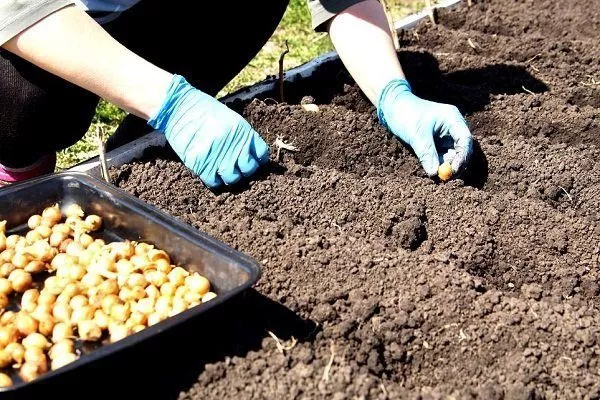
Seeds in open ground
Hercules must be planted with seeds at the right time:
- Winter planting is possible in any region except the Far North. Sowing should be done at temperatures up to 5°C (41°F). This should be done 2-3 weeks before the first frost, and the soil should be dry. Germination will begin in early spring.
- Early spring, when the soil warms to 3°C (3°F), can be chosen for sowing. Thanks to the meltwater, the crop will grow better and yield a good harvest, but its shelf life will be shorter—no more than 3 months.
- Sowing at a soil temperature of 10-12 degrees Celsius produces small and medium-sized onions. These are mostly for planting next year, but some can be used for edible purposes.
Regardless of the chosen timeframe, you need to act according to the following algorithm:
- Check the seed material for viabilityTo do this, soak the seeds in water. Any seeds that float to the surface will not germinate and should be discarded. It's recommended to leave a few seeds in water until germination occurs and assess the ratio of germinated to non-germinated seeds. If there are more non-germinated seeds, the quality of the seed is unsatisfactory and it's best not to use them.
- Warm up the seedsTo do this, you can place them next to a radiator or another warm place and leave them for 5 days. This will help reduce bolting.
- DisinfectionAt this stage, the seeds should be soaked in a potassium permanganate solution for 15 minutes. Then, they should be rinsed and dried.
- Growth stimulationThis step is optional. Epin is commonly used. This biostimulant should be added to water and the seeds soaked. It can also be used during planting.
- Prepare the bedsDigging is carried out in the fall; in the spring, only loosening, leveling, and application of necessary fertilizers are required.
- Make grooves, deepening by 1-1.5 cm. Leave 20 cm between rows.
- Sow the seeds. You should leave 1.5 cm between them.
Hercules can also be planted as seedlings. They take 50 days to grow, and sowing should take place in mid-February.
Onion sets
Onion sets are usually planted when the air temperature reaches 10 degrees Celsius and the soil temperature is 2 degrees cooler. They can be planted earlier, when the soil has thawed at least 5 cm. This allows for faster root development and reduces the risk of certain pests. There's no need to worry about frost—onion sets tolerate temperatures down to -4 degrees Celsius.
When planting Hercules onion sets, you need to follow the following algorithm:
- Culling of planting materialSelect only vigorous specimens. Mechanical damage and signs of disease are unacceptable. It is recommended to sort the onions by size. Bulbs 2-2.5 cm in diameter are considered optimal. Smaller specimens are best planted in early spring or before winter.
- Warming upPlace the seedlings in a warm place for 2-3 days. If possible, keep the temperature at 40 degrees Celsius (104 degrees Fahrenheit) – this warming reduces the risk of various diseases.
- Preventive treatmentTo increase disease resistance, dissolve 1 tablespoon of nitrophoska in 10 liters of water. Soak the seedlings in this solution for up to half an hour, then let them dry. Copper sulfate can also be used for treatment; a solution can also be prepared from it.
- Preparing the soil, forming furrows or holesLeave 20-25 cm between rows.
- Planting onion setsLeave 10 cm between plants in a row. The seedlings should be planted 3-5 cm deep, with 2 cm of soil above the collar.
- Watering After planting, watering is only required if the soil is dry. In spring, the crop has sufficient natural soil moisture.
You can plant Hercules onion sets in the fall if winters in your region aren't too harsh. In this case, the harvest can be collected as early as July. Planting should be done two weeks before the first frost. The onions shouldn't have time to sprout, otherwise they will die over the winter. When planting for the winter, mulch with dry grass or sawdust is necessary. A 10-cm layer is sufficient.
- ✓ The bulbs have increased resistance to cracking due to changes in humidity.
- ✓ The variety demonstrates a unique ability to recover from pest damage.
Caring for crops in open ground
A bountiful and select harvest can be achieved with proper plant care. This requires a comprehensive approach.
Watering
Hercules doesn't like excess moisture, so watering should be moderate but regular. It's recommended to water onions twice a week. During severe drought, it's best to water more frequently.
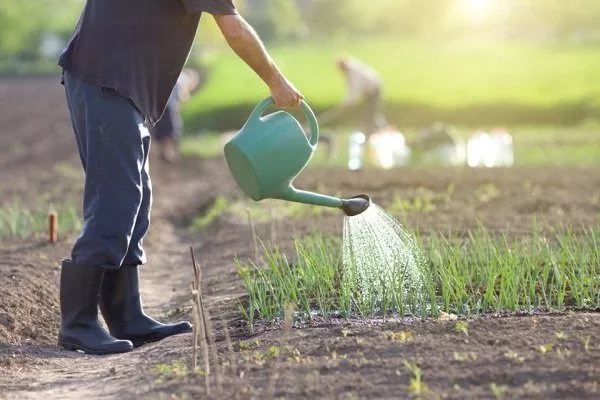
Irrigation is best for Hercules. Watering should be done early in the morning or in the evening, after the sun has set.
If precipitation falls regularly, then you need to focus on the condition of the soil and water the beds only when it dries out.
Watering is especially important during the first few weeks of active growth. Watering is stopped completely two weeks before harvest.
Thinning
This measure is usually required when planting onions from seeds or seedlings. Thinning should be done in two stages. The first thinning is done in the second week after planting. The distance between the seedlings should be reduced to 2.5 cm.
The second thinning is carried out a month after planting. This time, the distance between adjacent seedlings should be increased to 8-10 cm.
When thinning, only the strongest specimens should be left. They shouldn't be left lying around in the garden bed—all plant debris should be removed immediately.
Loosening and weeding
Loosening the soil is essential to ensure aeration. This promotes better crop growth. Loosening is done after watering or heavy rain.
Weeding is recommended along with loosening the soil. Weeds must be removed promptly, otherwise they will slow the growth and development of the onions. This will reduce the quantity and quality of the harvest, and the bulbs will be small.
Top dressing
Fertilizing is not a mandatory step in caring for Hercules, but without it, yields drop to 5-6 kg per square meter. It is recommended to fertilize the crop three times per season:
- 2 weeks after planting It is recommended to use organic fertilizer. Chicken manure is effective—add 0.2 kg of fertilizer per 10 liters of water. Additionally, you can use 20 g of urea.
- A week after planting It's best to use a complex fertilizer. For 10 liters of water, you need 20 g of ammonium nitrate, 15 g of potassium chloride, and 60 g of superphosphate.
- During the period of bulb ripening You should use the same fertilizers as for the second feeding.
Mulching
Mulching is used to reduce weed growth and prevent the soil from drying out. Compost is the best mulch for Hercules. The mulch should be renewed several times per season, and the layer should not exceed 7 cm.
Pest and disease control
Hercules has high resistance to various diseases, and disinfecting and warming the seedlings further reduces the risk. If signs of disease do appear, the affected plants should be removed and burned. The problem is usually caused by fungal infection, so fungicides should be used.
The onion fly is the crop's main pest. It can be controlled by dusting the plants with tobacco dust. Ash and black pepper are also effective. You can also prepare a solution from the dry mixture and spray it on the crop.
Harvesting and storage
The Hercules harvest occurs at the end of summer, when the onions turn yellow and fall over en masse. They shouldn't be left in the ground too long, otherwise their shelf life will be reduced.
The harvest should be done with a pitchfork. The bulbs should be cleaned of soil and dried completely in the sun or in a well-ventilated area.
Be sure to trim the roots and feathers, leaving 5 cm tails. You can store the harvest in nets, wooden boxes, cardboard boxes, nylon stockings, or bundles.
The optimal storage temperature is 15-20 degrees Celsius. The storage area should be dry, dark, and well-ventilated.
Properly grown Hercules onions will yield a bountiful harvest of large onions that will last until spring. Storage life depends largely on the timing of harvesting and proper preparation of suitable growing conditions.