
The list of potential onion diseases and pests is quite impressive. Susceptibility to them largely depends on the crop variety and the level of cultivation practices. Diseases and pests must be addressed promptly, beginning with preventative measures.
Onion diseases
Onion diseases can be caused by bacteria, viruses, and fungi. Each case has its own specific characteristics.
| Name | Type of disease | Pathogen | Symptoms |
|---|---|---|---|
| Aspergillosis | Fungal | Aspergillus | Discoloration of the bulb neck, wateriness, black powdery mass of spores |
| Bacteriosis | Bacterial | Bacteriaceae, Pseudomonadaceae, Myconacteriaceae | Softening of the bulbs, unpleasant odor, brown tissue between the scales |
| Smut | Fungal | Urocystis cepulae Frost | Gray stripes on feathers, black powdery masses, death of seedlings |
| Yellow dwarfism | Viral | Onion yellow dwarf virus | Yellow stripes on feathers, leaf deformation, growth inhibition |
| Downy mildew | Fungal | Oomycetes | Pale yellow spots, white coating, drying out of feathers |
| Mosaic | Viral | Allium virus I Smith | Light green speckles, stunted growth, sterile inflorescences |
| Penicillosis | Fungal | Penicillium | Brown spots, green mold, empty bulbs |
| Gray mold | Fungal | Botrytis cinerea | Gray rot on the neck, soft bulbs, cloudy pulp |
| Stemphilium | Fungal | Stemphylium allii Oud | Brownish-purple spots, pinkish-purple bloom, leaf breakage |
| Fusarium | Fungal | Fusarium | Pinkish bloom, poor root development, yellowing of feathers |
Aspergillosis
This disease is fungal. It is also known as black mold or black rot. It is caused by fungi of the genus Aspergillus.
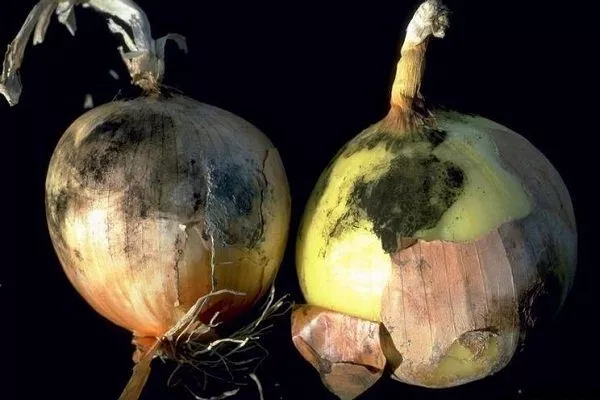
The disease is rarely detected during cultivation. The only sign is discoloration of the bulb neck—this is how the pathogen enters the fruit.
The main symptoms of aspergillosis are revealed during storage of the harvest:
- wateriness of the bulbs;
- black powdery mass of spores under the husk, between the juicy scales;
- complete drying of the bulbs is possible.
Aspergillosis often affects immature and poorly dried bulbs. High temperatures in the storage area and inadequate ventilation can also trigger the disease.
Affected specimens must be disposed of; they cannot be saved.
Preventive measures are as follows:
- burning of plant residues;
- Compliance with the harvesting deadlines - it must be fully ripe;
- complete drying of the crop;
- compliance with storage conditions: ventilation in the room, correct temperature and humidity levels.
- ✓ Optimum storage temperature for bulbs: 0-3°C to prevent the development of fungal diseases.
- ✓ Air humidity in the storage area should be maintained at 60-70% to minimize the risk of rotting.
Bacteriosis
This bacterial disease can be caused by Bacteriaceae, Pseudomonadaceae, and Myconacteriaceae. The affected plant dries out completely or partially and may die.
Bacteria are found in particles of infected plants. They can be carried by pests and animals, wind, irrigation water, and precipitation. The pathogen also survives in the soil. It can enter healthy plants through damaged roots, foliage, or even the slightest wound.
Signs of bacterial blight of onions are as follows:
- softening of affected bulbs;
- unpleasant odor;
- small flies;
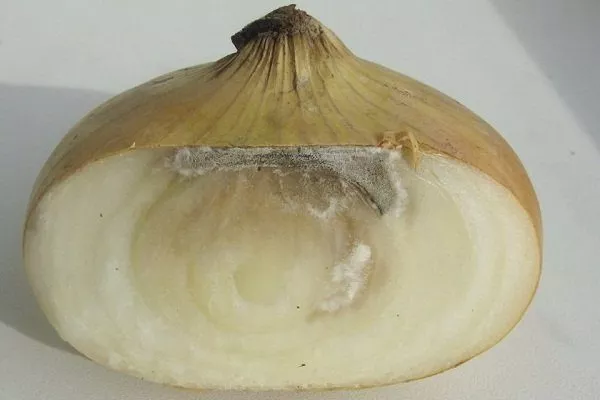
- The section shows affected tissues - they are located between healthy scales and have a brown color.
Bacterial rot most often affects onions during harvesting and storage. It can be caused by damaged fruit or insufficient drying.
Bulbs affected by bacterial blight should be discarded; they are not suitable for consumption. To reduce losses, the fruit should be regularly inspected and any damaged specimens discarded.
Prevention of bacteriosis consists of the following measures:
- burning of plant residues;
- soil disinfection;
- moderate watering of the crop, stopping it before harvesting;
- care when harvesting – damage to fruits should be minimized;
- complete drying of the harvested crop.
Smut
This fungal disease is caused by the bacterium Urocystis cepulae Frost. Chlamydospores are found in the soil and can be carried by dust onto seeds. Spores germinate at temperatures of 13-22 degrees Celsius, and crop infection can occur at temperatures of 10-25 degrees Celsius.
Seedlings are usually affected when planted from seeds. The disease manifests itself with the following symptoms:
- the appearance of narrow longitudinal stripes on the feathers with a gray color and swollen epidermis;
- drying of the stripes with rupture of the epidermis and the appearance of black powdery masses;
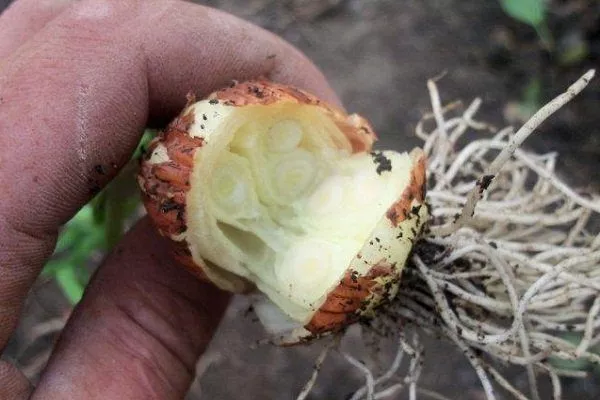
- The disease can also affect adult crops, affecting the outer fleshy scales.
Affected seedlings die, leading to crop loss. If bulbs do form but are infected, they contain black spores. The fruit skins eventually crack, and the spores enter the soil, surviving for up to 5-6 years.
Preventing smut involves using disease-resistant varieties. Crop rotation should also be practiced: return onions to their original location after at least three years. Avoid planting seeds in an infested area for six years.
Yellow dwarfism
The disease is viral. It is also known as viral streak. It is caused by the onion yellow dwarf virus. The virus resides in the bulbs and is spread by aphids. The incubation period is up to two weeks.
The disease is expressed by the following symptoms:
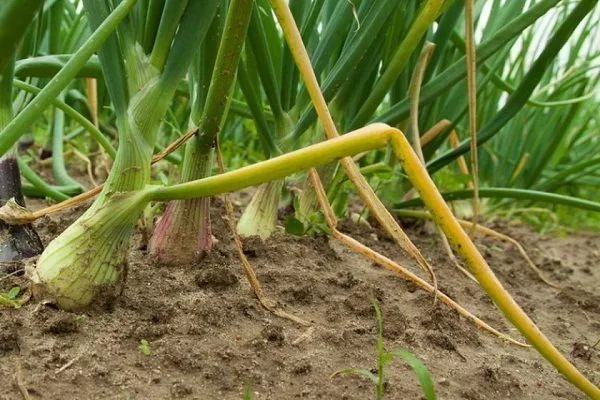
- yellow stripes on feathers;
- leaf deformation;
- curling and lodging of feathers, possibly their flattening;
- strong inhibition of the growth and development of culture.
Affected plants must be removed and burned promptly.
Prevention of the disease consists of the following measures:
- aphid control – insecticides such as Aktara should be used;
- use of varieties resistant to this disease;
- Planting crops with seeds, including seedlings or sets, does not contain the virus.
- ✓ The presence of a thick waxy coating on the leaves reduces the risk of infection with downy mildew.
- ✓ Deep root system reduces the likelihood of fusarium damage.
Downy mildew
This disease is also known as downy mildew. It is caused by oomycetes, a pseudofungi belonging to the family Peronosporaceae. They survive for a long time in fallen leaves and bulbs.
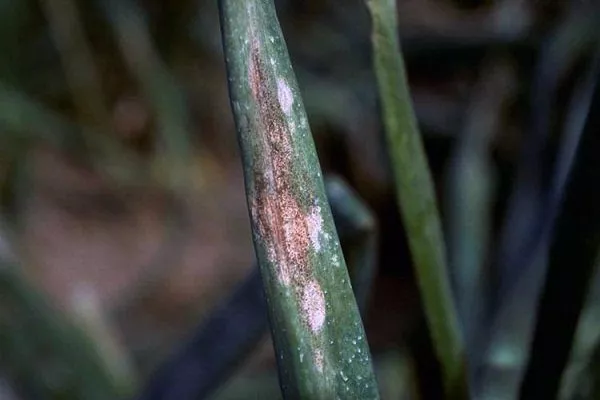
The signs of the disease are as follows:
- Fuzzy, shapeless, or angular spots, possibly with a faint border. These lesions can be pale yellow, yellow-brown, reddish-brown, or purple. They are slightly raised, gradually turning brown and drying out. The spots expand and can merge into a single, large spot that covers the entire leaf.
- Affected feathers become curved and dry out, and may become deeply cracked.
- The spots develop on one side, and a faint white powdery coating appears on the reverse side. This coating may also be gray or gray-purple in color.
- Downy mildew usually begins at the top of the crop, which is different from black spot, which has similar symptoms.
Downy mildew most often appears in the spring. It gradually affects all parts of the plant. High humidity and temperature fluctuations—low at night and fairly high during the day—facilitate the disease's development.
Treatment details depend on the onion's intended purpose. If grown for bulbs, remove affected plants and spray the remaining ones. Oxychom is effective. Dissolve 20 g of the product in a 10-liter container of water and spray twice a month.
When growing a crop for feathers, spraying with chemicals is unacceptable, so the following measures must be taken:
- stop fertilizing with organic matter;
- temporarily limit watering;
- apply potassium-phosphorus fertilizers;
- when harvesting, warm it up for 12 hours at 40 degrees;
- Treat the storage area for the harvest with bleach - 0.4 kg per 10 liters of water, treatment is carried out 2 months before.
Downy mildew prevention involves following crop rotation rules and carefully culling planting material. When planting onion sets, heat them at 40 degrees Celsius for 12 hours two weeks before planting.
Mosaic
The disease is viral, caused by the Allium virus I Smith. It is transmitted by the garlic mite.
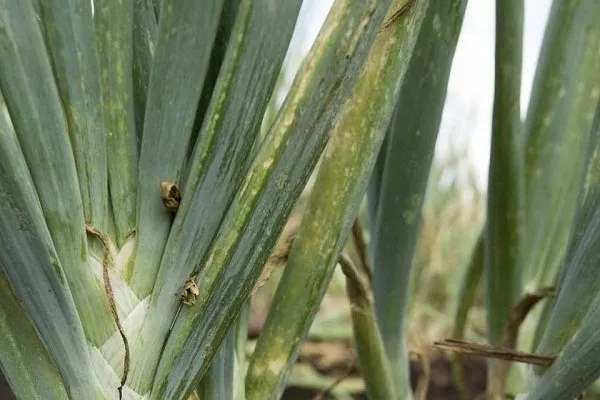
The signs of the disease are as follows:
- small elongated specks or wide stripes of light green or cream color;
- leaf growth retardation, feather lodging;
- bending of the arrows, appearance of longitudinal mosaic stripes;
- damage to inflorescences: looseness, sterility or small number of seeds.
Affected specimens should be disposed of. Other control methods focus on disease prevention:
- insecticide treatment for vector control;
- burning of plant residues;
- moderation of watering and fertilizing;
- compliance with crop rotation.
Penicillosis
This disease is also known as capitate rot or green mold. It is caused by fungi of the genus Penicillium.
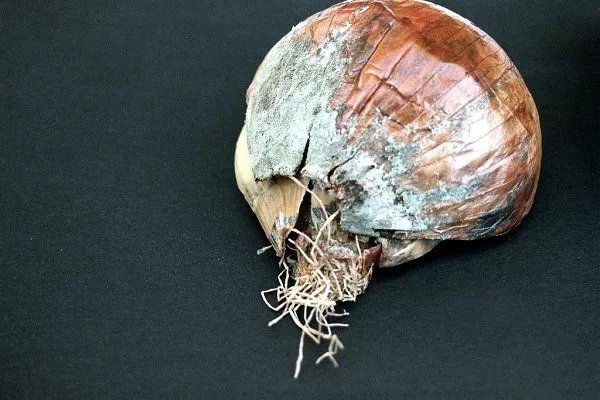
The signs of the disease are as follows:
- the appearance of brown watery spots on the bottom or outer scales;
- gradual softening of the affected tissues;
- the appearance of plaque on the affected tissues, first whitish, then green, moldy in color;
- the release of a huge number of spores when the scales break;
- The affected bulbs feel empty to the touch.
Green mold appears in large numbers when onions are stored for several months. The process is accelerated by high room temperatures and humidity. Freezing and mechanical damage to the fruit also contribute to the disease's development.
Affected specimens must be disposed of. Preventative measures include the following:
- thorough drying of the harvested crop before storing;
- compliance with storage conditions - at positive temperatures, air humidity should be 60-80%;
- soil disinfection;
- burning of plant residues.
Gray mold
This disease is caused by Botrytis cinerea. Spores and sclerotia of this mold can be found in soil and plant debris.
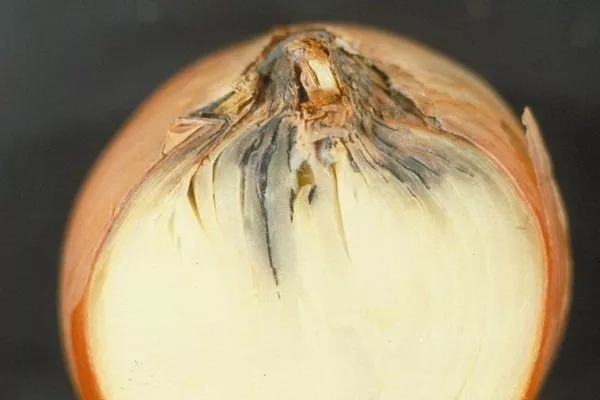
During cultivation, the pathogen attacks the scales of the bulb neck, which is why the disease is sometimes called neck rot. Infection is facilitated by constant humidity, rainy weather, and pests.
Gray mold often occurs during harvesting and manifests itself during storage. The disease's development is triggered by high temperatures and humidity.
The signs of sulfur rot are as follows:
- fruit spoilage begins from the base of the neck; grey rot is visible on the surface;
- if you press near the neck, this area will dent;
- Fruit damage is clearly visible in the cut: softness, turbidity, usually grey colour, the pulp looks like it has been boiled.
If the disease appears during harvest storage, the following measures must be taken the following year:
- disinfect the soil;
- burn all plant residues if this measure was not taken in the fall;
- when growing crops, treat them with fungicides such as Quadris, Switch, Bravo;
- artificially accelerate the ripening of the crop - limit nitrogen fertilizers, increasing potassium-phosphorus fertilizers;
- After harvesting, burn all plant residues.
It is recommended to select disease-resistant varieties of the crop. When planting seeds, pre-treat them.
Onions affected by gray mold should not be eaten. Any spoiled onions discovered during storage should be discarded.
Stemphilium
This fungal disease is caused by Stemphylium allii Oud. It is most often observed in plants already infected with downy mildew.
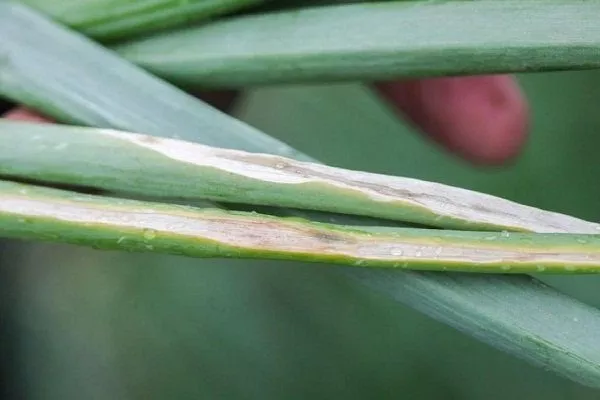
The signs of the disease are as follows:
- distinct brownish-purple spots;
- abundant plaque on spots, first pinkish-purple, then brown;
- breakage of leaves and shoots in affected areas;
- the formation of shriveled seeds, the process may even stop altogether;
- leaf dying.
Dry, warm weather favors the development of stemphylium. Control and prevention methods are similar to those for downy mildew.
Fusarium
The disease is caused by fungi of the genus Fusarium. It is also known as root rot or bottom rot.
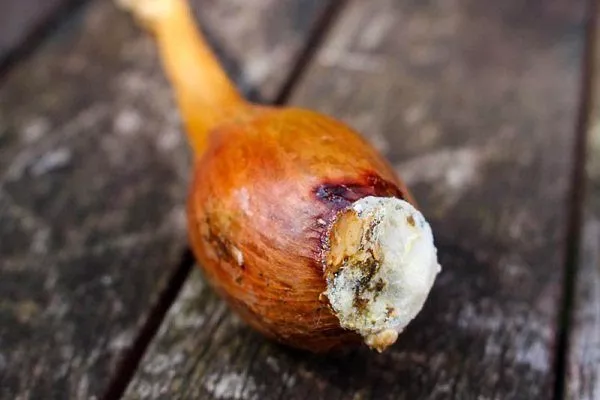
Signs of damage are as follows:
- stunted fruit growth;
- the appearance of a pinkish coating;
- poor development of the root system, brown color of the roots;
- yellowing of feathers, their gradual dying off - the process begins from the tips, but this sign is not obligatory.
Affected plants must be removed and burned immediately, otherwise the disease will spread to healthy specimens.
Be sure to treat the crop with a suitable fungicide. This could be Fundazol or Quadris.
Prevention of fusarium involves the following measures:
- preparation of planting material – treatment with fungicides;
- burning of plant residues;
- soil disinfection – solution of potassium permanganate, copper sulfate;
- application of potassium-phosphorus fertilizers – increases the crop’s resistance to disease;
- Compliance with crop rotation rules - onions should not be returned to their original location for at least 3 years.
Onion pests
In addition to potential onion diseases, it's important to be aware of the pests that can be dangerous. Some of these pests also affect other crops.
| Name | Pest type | Signs of defeat | Methods of control |
|---|---|---|---|
| Onion hoverfly | Insect | Stunted growth, yellowing feathers, rotting bulbs | Removing affected plants, watering with a saline solution |
| Onion fly | Insect | Withering feathers, rotting bulbs, white worms | Chemicals, tobacco dust, ammonia |
| Onion mite | Mite | Deformation of feathers, white coating, wrinkling of bulbs | Acaricide treatment, heat treatment |
| Tobacco thrips | Insect | Light spots, feather curvature, growth retardation | Insecticides, sticky traps, herbal infusions |
Onion hoverfly
The pest is also known as the lesser narcissus fly. It attacks only plants that have sustained mechanical damage or are infested with other pests. Adults reach an average of 7 mm in length and are bronze or metallic green in color.
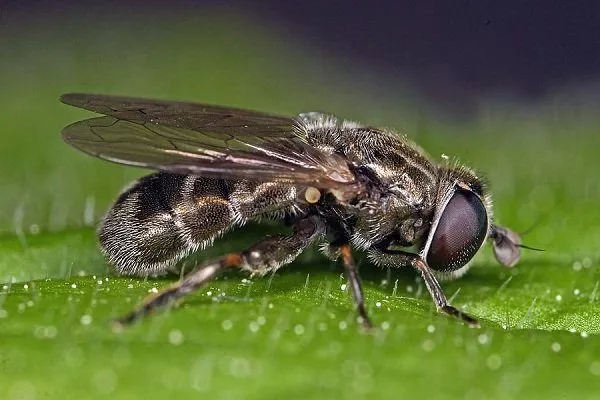
Signs of crop damage are as follows:
- growth retardation;
- yellowing and wilting of the tips of the feathers;
- softening of the bulbs, rotting, appearance of an unpleasant odor.
The insect's larvae cause damage to the crop. They emerge in June. The bulbs serve as the pest's wintering grounds.
In the past, onion hoverflies were controlled with chemicals, but now other methods are recommended:
- timely removal of affected plants;
- watering with a solution of table salt - 0.2 kg per 10 liters of water, water when the feather grows to 5 cm, then after 3 weeks.
Prevention involves crop rotation and deep digging of the soil in the fall.
Onion fly
This is one of the main problems affecting onions and other bulbous plants. The onion fly resembles the common onion fly, but is ashen in color. The insect's activity begins in mid-May. It lays eggs in the plant scales and soil. The hatched larvae penetrate the plant, which serves as their food source.
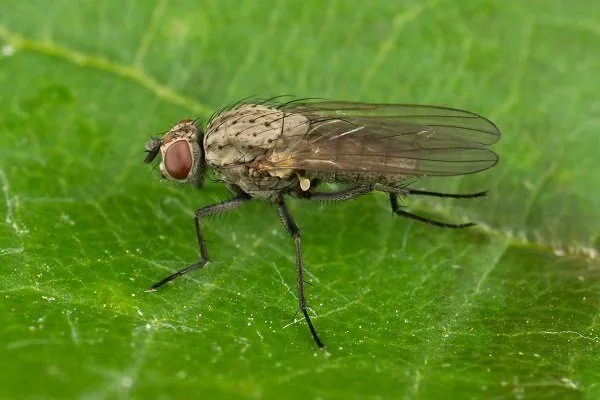
Signs of pest presence are as follows:
- withering and drying of feathers;
- slowing down of plant growth or its complete cessation;
- the appearance of an unpleasant specific odor;
- rotting of bulbs;
- white worms under the upper scales of the fruit.
There are different ways to get rid of onion flies:
- ChemicalsThey use Actara (Thiamethoxam), Imidacloprid, Diazinon, Dimethoate, and Ripcord. Follow the instructions: dissolve the required amount of the product in water and spray the crop.
- Tobacco dustIt can be used as a dusting agent, mixed with equal parts ash and black pepper or naphthalene. Another option is spraying. Dissolve 250 g of the solution in 10 liters of water, let it sit for two days, and then apply it to the plants—one liter of solution per square meter is sufficient.
- AmmoniaThis method is effective in the early stages, when the pest has been noticed but has only just begun laying eggs. Dissolve 3 tablespoons of the solution in 10 liters of water and spray the crop in the afternoon.
- KeroseneThis product is lethal to onion fly larvae. Simply apply 50 grams of kerosene to a bucket of water; spray the soil around the bulbs.
- Laundry soapDissolve half a block in a bucket of water. Use the resulting solution to treat not only the soil but also the greenery.
It's easier to prevent onion fly larvae than to fight them. Preventative measures include:
- adherence to crop rotation rules - do not plant onions after other plants of this family, do not return them to their previous planting location for at least 3 years;
- digging up the plot in autumn with a full bayonet of a shovel;
- alternating beds of onions and carrots - both crops have their own type of fly that cannot stand the smell of such a neighborhood;
- processing of planting material - 2 minutes of soaking in a solution of potassium permanganate is enough;
- regular loosening of the soil - flies do not like loose soil, so they do not lay eggs there;
- Preventive treatment of plantings with wood ash, tobacco dust, and laundry soap.
Onion mite
This pest is difficult to spot with the naked eye due to its whitish color and small size—about 1 mm. The insect appears at high temperatures and sufficient humidity.
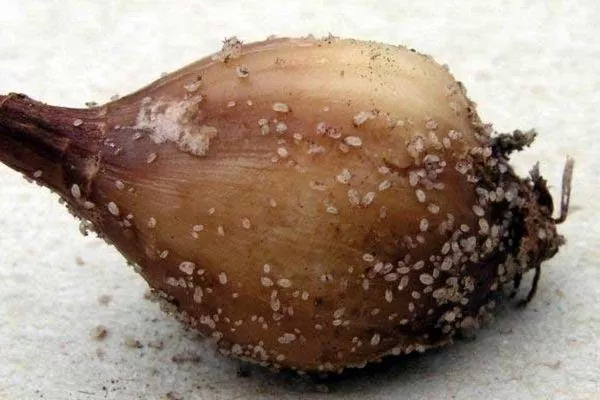
Crop damage can be identified by the following signs:
- deformation of feathers, appearance of white coating;
- dehydration of the bulb and its wrinkling;
- the appearance of yellow spots on the bulbs;
- looseness of fruits, the appearance of larvae on them, resembling dust;
- Mold may appear in the affected areas.
Onion mites can cause harm not only to crops but also to humans. These can include allergic reactions, asthma complications, and digestive disorders.
You can fight the pest in the following ways:
- treat with chemicals - you need to resort to acaricides and insectoacaricides;
- Get rid of affected plants regularly.
You can disinfect affected bulbs by heat treatment - immerse them in water heated to 45-50 degrees for 5 minutes.
Getting rid of onion mites is not easy, so it is important to follow preventative measures:
- processing of planting material – heating at 35-40 degrees for a week;
- culling of the harvest - all specimens with the slightest signs of damage are not suitable for storage;
- treatment with nettle infusion - brew the leaves in boiling water in a ratio of 1:5, leave for 5 days, then dilute in 10 parts water and pour the culture under the root;
- disinfection of the storage room for crops, organization of ventilation in it;
- pruning greens before storing.
Tobacco thrips
This insect is also known as the onion beetle. Besides onions, it is a threat to garlic, cucumbers, melons, and flowers. An adult beetle is approximately 0.8 cm long, with fringed wings and a narrow, elongated body, light yellow or dark brown in color. The larvae are wingless and whitish or greenish-yellow in color.
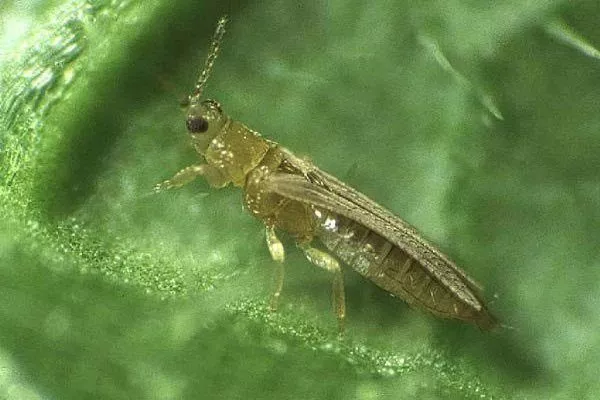
The primary pests are the larvae and females of the tobacco thrips, which feed on plant sap.
Signs of damage are as follows:
- angular spots, at first light, then brown;
- black dots of excrement at the bottom of the spots;
- curvature of the affected feather, yellowing of the tips;
- slowing down of crop growth.
When tobacco thrips infest the crop suffers, therefore it is necessary to fight this pest:
- insecticides for treatment: Aktara, Actellik, Fitoverm, Fufanon;
- sticky traps - apply special glue for insects to strips of yellow or blue cardboard and place them between rows;
- Spraying with an infusion of tobacco leaves - grind the dry raw material, add a little water, leave for 3 hours, after straining for another 36 hours, for spraying dilute in two parts water;
- celandine - put 100 g of dry grass or 400 g of fresh stems and flowers in a liter of water, leave for 3 days, use for spraying;
- Sulfur for fumigation of rooms where onions will be stored - 60 g of the substance is needed per 1 cubic meter.
Prevention of tobacco thrips involves the following measures:
- compliance with crop rotation rules;
- burning plant residues – the pest overwinters in them;
- digging up the area in the fall - it is better to dig with a full bayonet, as the pest burrows about 7 cm deep for the winter;
- removing weeds – food for insects in spring;
- Warming up the planting material – two days at a temperature of 40 degrees.
You can learn about another way to combat onion pests in the following video:
Proper cultivation of onions and timely prevention of diseases and pests can help avoid many problems. Ignoring them is crucial, as the quality and quantity of the harvest will suffer, its shelf life will be reduced, and losses during this period will increase significantly.