
Surprise is a mid-early, colored potato variety. It's a favorite among Russian gardeners for its high yield, attractive tubers, and excellent flavor. This potato offers not only nutritional value but also medicinal benefits.
Who developed the variety and when?
Surprise owes its origins to the A.G. Lorkh All-Russian Research Institute of Potato Farming and the Korenevo Agrocenter. It was developed by staff from these two institutions during their joint breeding efforts. Its authorship belongs to:
- Simakov E. A.;
- Zharovoy V. A;
- Semenov V. A.;
- Mityushkin A.V.;
- Salyukov S.S.;
- Zhuravlev A. A.;
- Ovechkin S. V.;
- Gaitova N. A.;
- Gaizatulina A. S.
The variety was added to the Russian State Register in 2021. This potato variety is intended for cultivation in home gardens and farms in the following regions of the country:
- North-West;
- Central;
- North Caucasian.
Description of the variety
Surprise possesses many excellent characteristics, making it popular among gardeners and agricultural companies cultivating it on an industrial scale. This variety is suitable for commercial cultivation due to its high yield, attractive tuber appearance, color, and shelf life.
Characteristics of the appearance of the bush and root crops
Plants of this variety belong to the intermediate type and are distinguished by the following features:
- semi-erect structure;
- medium height (their “height” is 55-65 cm);
- good branching;
- strong stems;
- dense foliage;
- medium-sized, dark green foliage.
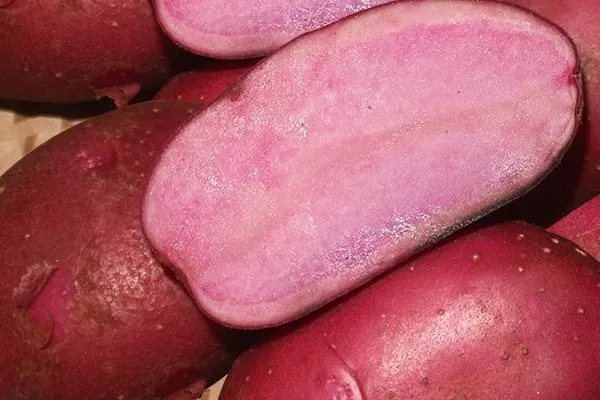
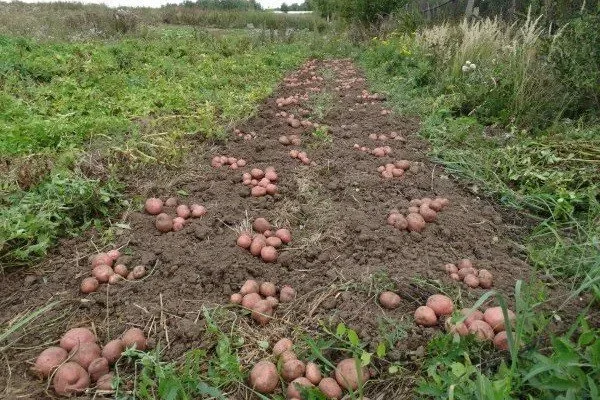
During flowering, numerous small buds of a pale reddish-purple appear on the potato plants of this variety. The corolla within them is faintly colored. Each Surprise plant produces up to 15 tubers. These tubers are large to medium in size, uniform in shape and color.
Tubers of this variety have the following characteristics:
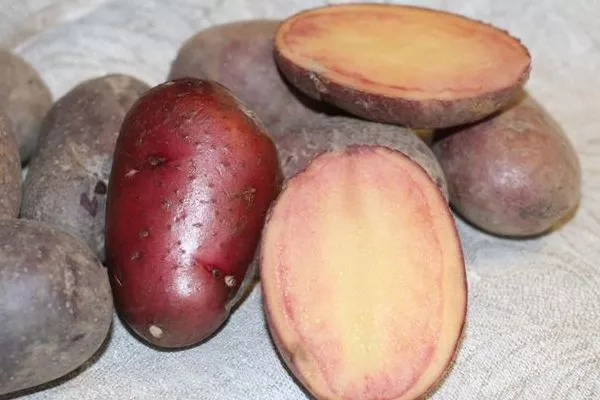
- elongated oval shape;
- weight - 100-126;
- smooth red skin;
- small eyes, set at medium depth;
- variegated flesh (its color varies from pink to red).
The color of the skin and flesh of Surprise tubers is influenced by soil composition. If the potato grows in light soil, it has a pink color. When grown in black soil, the flesh becomes light ruby, and the skin a deep red. Abundant watering also promotes vibrant color.
Purpose and taste of tubers
This variety of potato is harvested for table use. It belongs to culinary type A, meaning its tubers are not prone to overcooking. Their starch content is low (12%). Their flesh is firm, not mealy or watery, and is not prone to browning.
Housewives use Surprise Potatoes in cooking as follows:
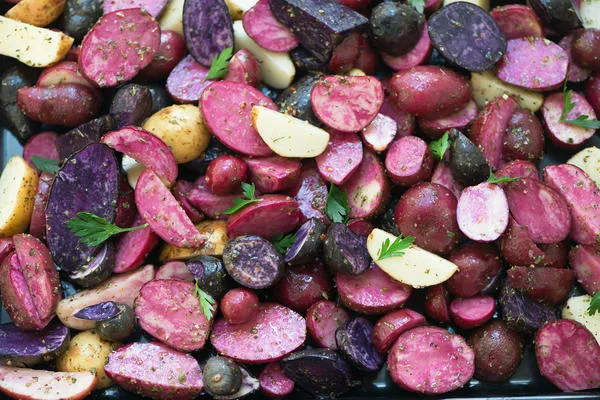
- boil;
- cooked in their skins;
- baked;
- added to salads and soups;
- fry;
- stewed to make vegetable stew.
The tubers of this variety have an excellent flavor, cooked in any way. When cooked, they are easily separated with a knife. The cut is always smooth.
Its consumption is recommended for people suffering from the following health problems:
- heart disease;
- vegetative-vascular dystonia;
- metabolic disorders.
Ripening and yield
This vegetable variety is characterized by mid-early ripening. The period from germination to tuber harvest is 115-125 days.
The yield figures for Surprise are as follows:
- from 13,200 kg to 30,000 kg per 1 hectare of potato planting (which is 1,100-8,200 more than standard varieties such as Nevsky and Volzhanin);
- 45,500 kg per 1 ha is the maximum figure obtained during state testing of the variety (it is 12,800 kg higher than that of Briz).
The yield of this vegetable variety has good marketability (78-89%) and is distinguished by increased shelf life (93%).
Landing features
Plant Surprise potatoes in May. Do this before the summer season begins. Wait until the garden soil warms up to 12°C (55°F) at a depth of 10-12 cm. Carefully select the site for your potato beds. It should meet the following requirements:
- be located on the south side of the garden;
- well-lit by the sun;
- protected from gusts of wind and drafts;
- stay away from outbuildings, houses, tall trees and other objects that create dense shade;
- distinguished by loose, fertile, non-acidic, well-drained soil.
- ✓ The site should be located on the south side for maximum sunlight.
- ✓ The soil should be loose, fertile, with good drainage and neutral acidity.
Prepare the area chosen for planting this vegetable variety in the fall:
- dig up;
- remove weeds and plant debris;
- enrich with fertilizers such as potassium sulfate, nitrophoska, urea or any complex mineral composition.
Be sure to germinate the Surprise tubers before planting. To do this, leave them in a warm room for one month. Wait until shoots appear, which should be a couple of centimeters long. Treat the sprouted tubers with a weak solution of potassium permanganate or a biofungicide.
Plant this potato on a dry and warm day, following this pattern:
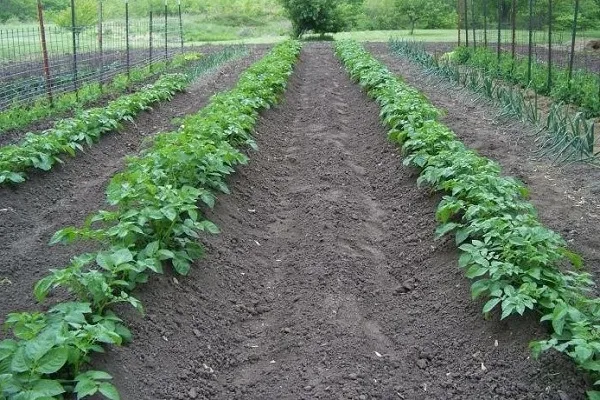
- the distance between planting holes is 30 cm;
- row spacing - 60 cm.
Care
Potato plants of this variety require little care. To ensure they grow well and bear fruit, simply follow standard vegetable growing practices, which include the following:
- WateringWater the bed only in the evening, when sunlight is at its lowest. Surprise requires three waterings per season. The first time is 10 days after the sprouts emerge. The second time is three weeks after the first. Water the beds again as needed. Water the plantings generously. The soil should be moistened to a depth of 40-50 cm.
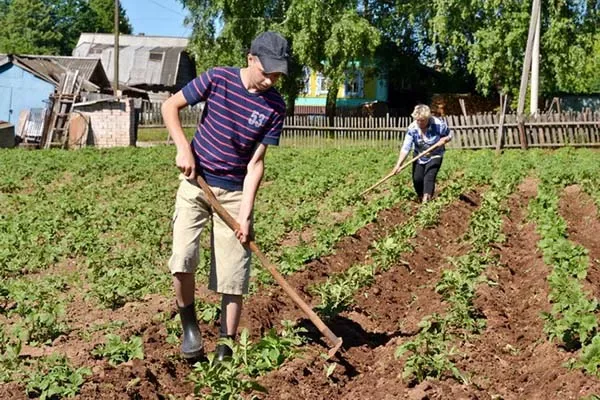
- Loosening the soilDo this after watering and rain to enrich the garden soil with oxygen. Perform the procedure carefully, being careful not to damage the potato plants.
- WeedingRemove weeds promptly. They inhibit the growth and development of vegetable crops. Pests hide in them.
- HillingWhen the plants reach a height of 10-15 cm, hill them up. Repeat the procedure after 2-3 weeks, hilling up to the lower leaves. This will promote better tuber formation.
- Periodic inspection of bushes to detect infections and parasitesIf signs of disease are detected, treat the potato planting with a biofungicide. For severe infestations, use Bordeaux mixture or Acrobat. If Colorado potato beetles are detected, remove the pest manually or apply Colorado.
- Fertilizing plantingsThis potato variety responds well to fertilizer and thrives in fertile soil. At the early stage of plant development, apply ammonium nitrate, urea, nitrophoska, or chicken manure infusion.
At the beginning of flowering, use Speedfol Bor (1 kg per hectare). During tuber formation, apply phosphorus and potassium compounds (e.g., superphosphate, potassium sulfate).
Possible diseases and how to combat them
Surprise has a strong immune system. It is resistant to the following infections:
- rhizoctonia;
- potato cancer;
- scab;
- to the Y virus.
However, bushes of this variety are susceptible to late blight of the foliage and tubers. The risk of infection increases under unfavorable weather conditions. Fungicides, particularly Fitosporin-M, help combat this problem.
Potato planting also suffers from the following parasites:
- NematodesThe variety is susceptible to it. The problem is difficult to diagnose. It affects the roots of the plant. Its symptoms include yellowing and subsequent wilting of the foliage, shoot deformation, and smaller flowers. To combat the nematode, use Karbofos, Lindane, Nemagon, and Fosfamide.
- Mole cricketsThis pest destroys all parts of the plant: it chews through stems and roots and damages tubers. If it is detected, treat the potato planting with Aktara, Prestige, or Shedevr.
Harvesting and storage
Dig up the Surprise potatoes after the tops have lodged and dried out. Do this in dry, sunny weather.
After harvesting the tubers, do the following:
- put them in the shade and lay them out there to dry for a couple of hours;
- Sort out the potatoes and discard any spoiled ones;
- place the harvest in suitable containers (boxes, nets, bags);
- Transfer them to a cool, dry, dark place for long-term storage.
The optimal conditions in a vegetable storage facility should be as follows:
- temperature - +4-5°C;
- humidity - 80%.
- ✓ The temperature in the storage area must be maintained at +4-5°C.
- ✓ Air humidity should be around 80% to prevent tubers from drying out.
- ✓ Good ventilation must be provided to prevent the development of fungal diseases.
Positive and negative qualities
Surprise has many positive qualities, earning it a place among the most popular vegetable varieties grown by gardeners. However, despite its many advantages, it does have a few drawbacks.
Reviews
Domestic gardeners have appreciated the Russian-bred variety Surprise. They love its uniquely colored tubers, their wonderful flavor, their nutritional value, and their medicinal properties.