
The Ryabinushka potato, which appeared in our millennium, is considered an elite variety because it meets the basic requirements of farmers and consumers. It is easy to grow, resistant to many adverse factors, does not darken when exposed to oxygen, and is versatile.
Description of the variety
Ryabinushka is a mid-early potato with high marketability (up to 96%) and shelf life (approximately 90%). It has many positive characteristics, but also some drawbacks. All these characteristics will help gardeners make the right choice about whether to cultivate this crop in their own fields.
Origin of the variety
Ryabinushka is the fruit of the labor of Russian breeders, created in 2003 as part of the Vsevolozhsk Breeding Station. Among those who contributed to its development are O. I. Zueva, E. V. Bryantseva, G. N. Slobodina, and V. E. Zuev.
Over the next four years, Ryabinushka successfully passed a series of official variety tests, which allowed it to receive a place in the State Register in 2007.
What do plants and tubers look like?
This variety is a tall shrub, reaching almost 100 cm in height. The crown is semi-spreading, as are the shoots, which are semi-erect. Other characteristic features:
- The shoots of this variety are quite thick – reaching up to 10 mm in diameter;
- the leaves are medium in size, as they do not exceed 10 cm in length, their color is dark green;
- the veins on the leaf blades are almost invisible, the edges have a slight waviness;
- the foliage has its own characteristics: in the lower part of the bush it is strong due to the large size of the leaves, and in the upper part it is weak, since the leaf blades are smaller;
- the inflorescences contain about 6 flowers with an unusual violet-blue hue;
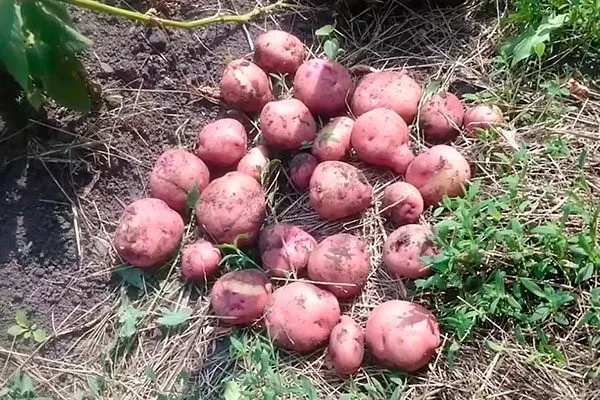
- the fruits are medium-sized – their weight varies from 90 to 135 g;
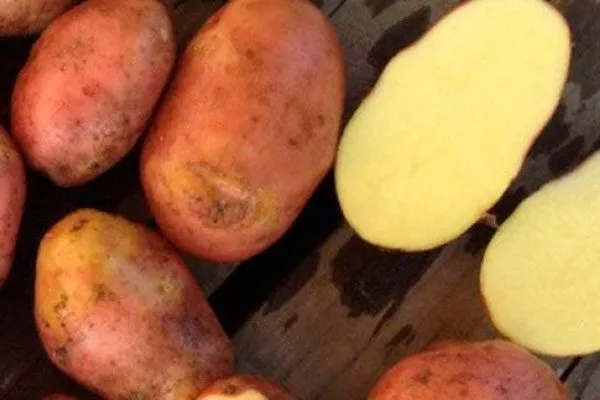
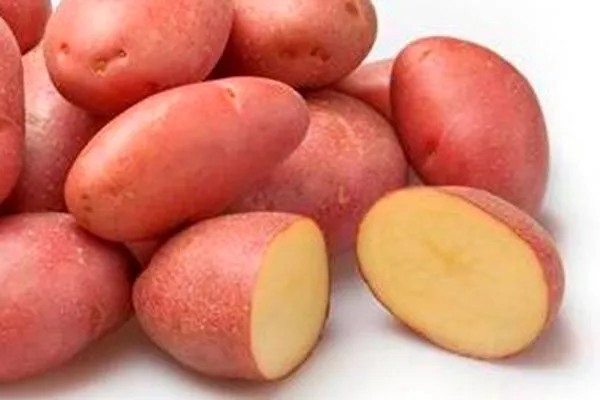
- the skin is of medium thickness with a smooth reddish surface;
- the pulp is creamy in color and has a pleasant texture;
- the shape is oval and regular, most often all potatoes are the same;
- the eyes are very small and located superficially;
- the root system is well developed.
Taste characteristics and purpose
Ryabinushka tubers have a starch content of 11.9-15%, making them particularly valuable. They contain high levels of anthocyanins, as evidenced by their bright red skin, and the color of the flesh indicates an abundance of beta-carotene.
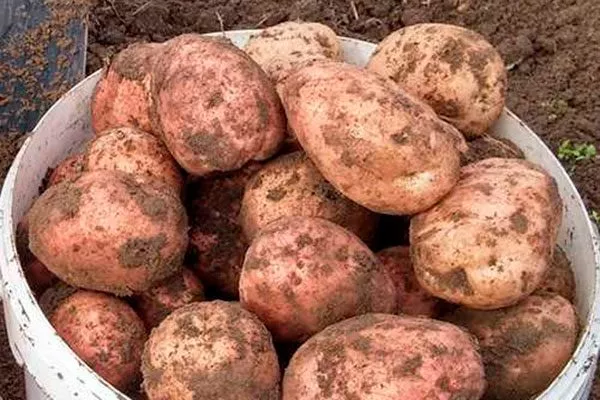
The culinary potential of this potato variety is vast: it's used in a variety of soups, salads, and main courses. When boiled, the potatoes retain their shape and emit a pleasant aroma, and their flavor is highly rated.
Chemical composition, trace elements and vitamins
The chemical composition of potatoes is influenced by a variety of factors, including soil quality, weather conditions, and growing methods. However, complex chemical analysis isn't necessary to obtain some information about potatoes. The appearance of the Ryabinushka potato allows one to draw certain conclusions:
- the red color of the skin indicates that the potato is rich in anthocyanins – bioflavonoids that help strengthen the vascular wall and have antioxidant properties;
- The creamy color of the pulp indicates a high level of beta-carotene.
Additionally, its chemical composition includes:
- water – 76.3%;
- dry matter – 23.7%;
- starch – 17.5%;
- sugar – 1%;
- fiber – 1%;
- proteins – 2%;
- ash – 1%;
- organic acids – 0.7%.
How many days to harvest?
Rowan potatoes reach maturity before they're ready for culinary use within 80 to 90 days. However, they can be harvested a couple of weeks earlier, before they're fully ripe. This allows them to be stored until the end of April.
Productivity
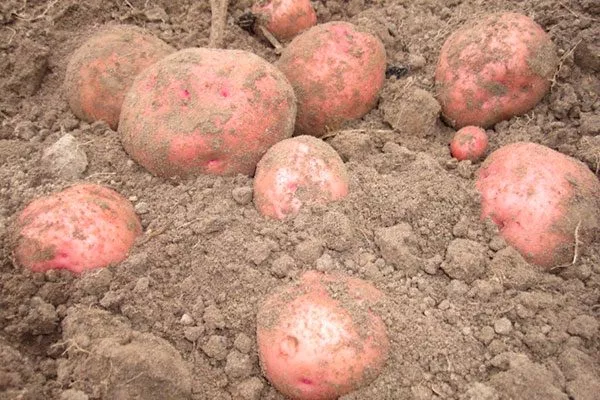
Ryabinushka's high yields are comparable to the best varieties: you can get up to 39-40 tons of potatoes from one hectare.
Disease/pest resistance
It boasts good resistance to pests and diseases, including potato canker and nematodes that can damage potatoes. The variety is moderately susceptible to late blight, common scab, black scab, and various viruses.
Which regions are suitable?
This variety is ideal for regions of Russia where summers are short and not particularly hot. Ryabinushka is ideal for the Northern, Northwestern, Central Black Earth, Volga-Vyatka, Volga, Far East, and Western Siberia regions.
Key advantages and disadvantages
This variety has a number of unique qualities that have contributed to its popularity among consumers. However, it also has certain drawbacks. Ryabinushka is ideal for both home and commercial cultivation thanks to:
Among the disadvantages are increased lighting requirements and the need for regular watering.
Features of planting operations
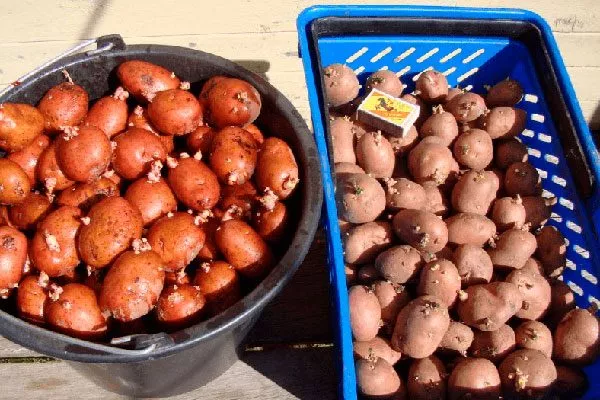
It's recommended to sprout potatoes approximately 25-30 days before planting, but first, select high-quality planting material. Medium-sized tubers with a moderate number of eyes are best.
- ✓ The tubers should be of medium size, with evenly distributed eyes.
- ✓ No signs of disease or damage on the surface of the tubers.
- ✓ The room temperature should be stable, without sudden changes.
- ✓ Lighting should be diffused to avoid overheating of the tubers.
How to prepare:
- To sprout, place the potatoes in a single layer in any natural container and leave them in a bright room at a temperature of about 20°C. The eyes usually enlarge within a week.
- After shoots have formed, move the tubers to cooler conditions with a temperature of 10-12°C until planting.
- Before work, treat the tubers in a solution of copper sulfate (20-25 g), potassium permanganate (1 g) per 8-10 liters of water for disinfection.
The Ryabinushka potato variety prefers fertile, light soils such as sandy loam. Organic and other fertilizers are applied in the fall during plowing or digging. Pay attention to crop rotation – good predecessors for this variety include grain crops, beans (peas and beans), and perennial green manures (alfalfa, lupine).
There are two ways to plant Rowanberry:
- square-nest method – with an interval between holes of 25-35 cm;
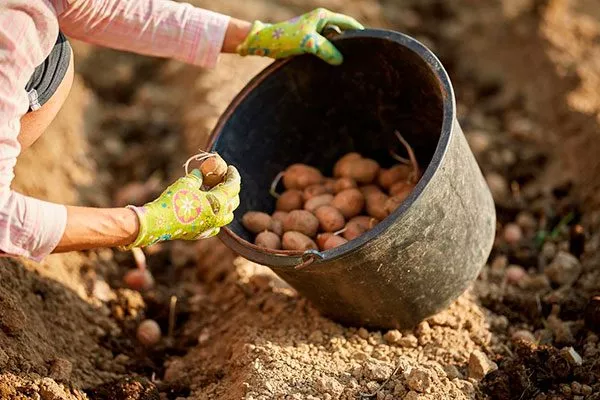
- into the ranks – with a distance between bushes of 25-35 cm and between rows of 55-75 cm
The seeding rate is 27-30 kg per 100 m², which is approximately equal to three buckets of seed potatoes. Dig holes to a depth of approximately 10-12 cm, place the potato, add 450-500 g of crushed charcoal if possible, then cover with soil and level.
Subtleties of care
Cultivation does not require special techniques and is carried out according to standard agricultural practices:
- Watering. During periods of heat or prolonged drought, when precipitation has gone for more than a week, the variety requires frequent watering. It's convenient to water the plants with a hose, directing the water between the rows. For smaller areas, a watering can can be used, with a water consumption of approximately 10-15 liters per square meter. Watering is best done once a week after sunset.
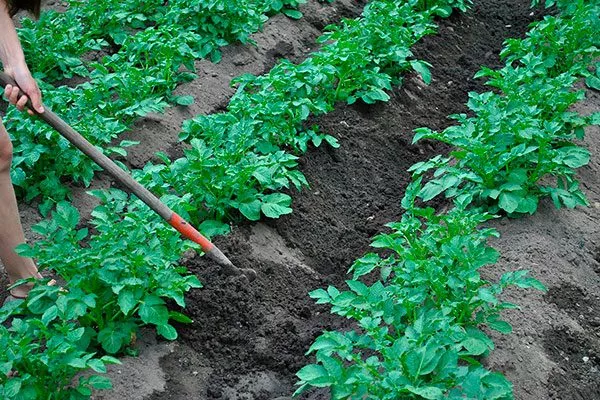
- Loosening. It is recommended to loosen the soil between the rows once a week, the morning of the next day after watering or after heavy rain.
- Weeding, hilling. Weed removal is often combined with loosening. During the first half of the growing season, this should be done 2-4 times per month, and once per month during the second half. Hilling should be done at least twice during the entire season:
- the first time at the end of spring, when the height of the shoots reaches 10-17 cm;
- the second time at the beginning of budding.
Fertilizing deserves special attention. Rowanberry responds well to mineral and organic compounds (all doses correspond to 10 liters of water):
- First feeding produced at the stage of sprout formation:
- Water, urea – 1 tbsp.
- Mullein – 500-600 ml, water, leave for 4-5 days.
- Chicken manure solution – 300 ml, water, leave for the same amount of time.
- Consumption: 500 ml per bush.
- Second application of fertilizers during budding:
- Potassium sulfate – 1 tbsp., wood ash – 200 g, water.
- Consumption: 500 ml per bush.
- Third recharge(when flowering is activated):
- Superphosphate – 2 tbsp., mullein mixture – 200 g, water.
- Consumption: 500 ml per bush.
How to combat diseases and pests?
The Colorado potato beetle is the potato's main enemy. In small areas, it can be removed manually, but if it infests significantly, insecticides can be used. For this purpose, spray with Decis, Actellic, Karbofos, and other insecticides.
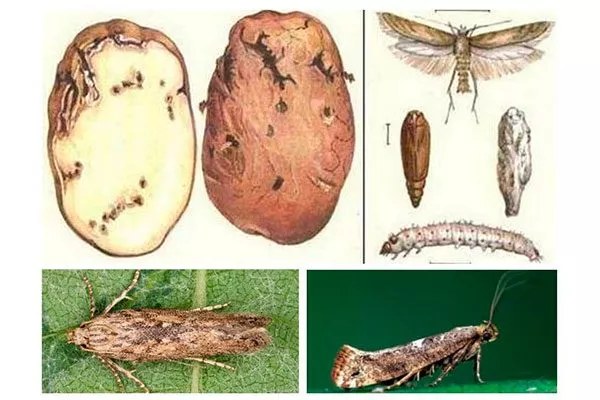
In case of fungal infections of potatoes, including scab, late blight and alternaria, treatment with fungicides (Quadris, Uniform, Shirlan or their analogues) is recommended.
Prevention:
- You can protect potatoes from the Colorado potato beetle by treating the corms with Tiran or Maxim before planting.
- To protect against diseases, including late blight, potatoes are treated with a solution based on copper sulfate before planting.
- Only healthy corms should be selected for planting.
- To repel pests, it is recommended to plant plants with a strong aroma, such as calendula, mint, thyme, and the like, in the free spaces between potato rows.
The main preventative method is careful adherence to crop rotation rules.
Harvesting and storage
Once a rich harvest has been achieved, harvesting is an important aspect – this must be done in accordance with certain rules, which significantly extends the storage period.
How and when to collect?
In the central part of the country, the traditional time for potato harvesting is early September, and a little earlier in the south. Important rules for a successful harvest:
- Tubers should be dug up in dry, sunny weather.
- The dug up potatoes should be spread out in one layer outside for two to three hours to dry.
- After this, the tubers are placed under a canopy or in a ventilated place for 10-14 days.
- The potatoes are then checked for damage, sorted, and stored long-term in a cellar or dry room. To improve storage, the tubers can be covered with dry wood ash.
Storage features and shelf life
To achieve maximum shelf life of the harvested crop, it is important to observe the following storage conditions:
- room temperature – from +3 to +4 degrees;
- air humidity – about 75-85%.
Potential difficulties when growing
Being a relatively new variety, Ryabinushka poses no problems for gardeners and farmers. However, to ensure the harvest meets the parameters stated by the cultivar, it is essential to provide high-quality and timely fertilizing.
Try to treat bushes with fungicides and insecticides in the spring to prevent diseases and pest infestations.
Reviews from vegetable growers
The Ryabinushka potato has proven itself to be an excellent choice – it produces abundant yields with uniform, marketable tubers, has a long shelf life, and easily withstands long transportation. It's easy to grow, but requires maximum fertility to achieve high yields. This elite variety is profitable for commercial cultivation.