
Colette is an extra-early table potato variety. This variety has become popular with domestic gardeners and farmers growing vegetables for its ability to produce multiple harvests per season. It is loved for its excellent flavor and marketable appearance, as well as its nutritional and medicinal value.
Colette's origins
Colette is a German cultivar developed in the late 1990s. It was developed by Kartoffelzucht Bohm and Europlant Pflanzenzucht GmbH. The variety was added to the Russian State Register in 2002.
Description of the variety
Colette's characteristics surpass those of many early varieties considered high-yielding. This potato is heat-tolerant, but requires ample watering and is disease-resistant. Its main advantage is its ability to produce two harvests per season.
Chemical composition, vitamins and microelements
Potatoes of this variety are rich in many substances beneficial for human health:
- vitamins;
- microelements;
- amino acids.
By consuming it in food, you can achieve the following healing effects:
- strengthening of bone tissue;
- normalization of the gastrointestinal tract;
- improving metabolism;
- prevention of the occurrence and development of malignant tumors due to the high content of folic acid in tubers;
- improving the condition of the heart and blood vessels thanks to the potassium contained in potato pulp, as well as vitamins C and B6;
- protection of cells from the effects of free radicals, which is provided by quercetin present in potatoes.
Description of the plant and tubers
Bushes of this variety have the following characteristics:
- semi-erect structure;
- Foliage: medium-sized, green, with slightly wavy edges;
- flowers: large or medium-sized, red-violet in color.
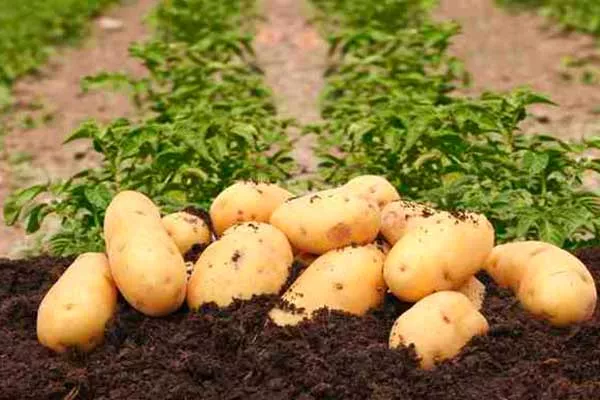
Each Colette plant produces 6 to 11 tubers. The tubers are all approximately the same size, all medium in size. It's extremely rare to find potatoes that are too large or too small in a single cluster.
The tubers of this variety have the following characteristics:
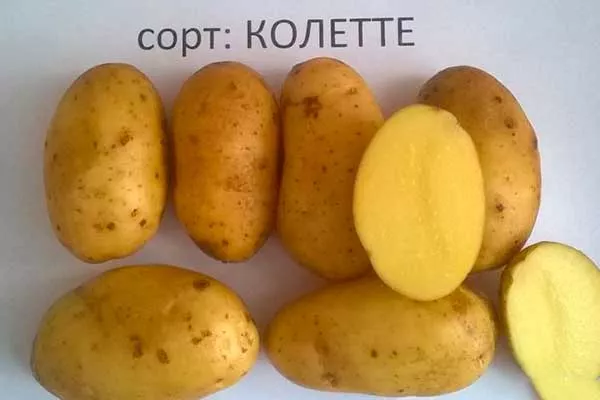
- round-oblong shape;
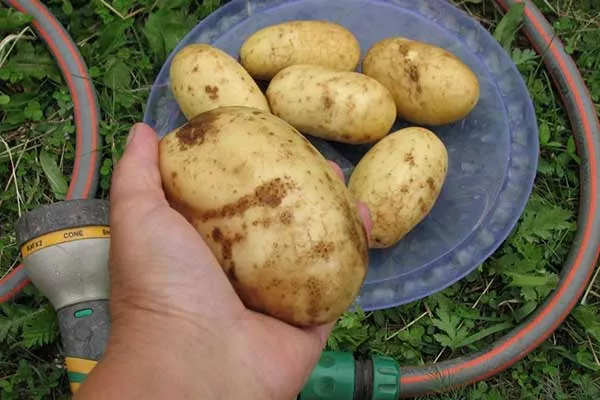
- weight - 70-125 g;
- smooth yellow skin with superficial eyes that are barely noticeable;
- light yellow flesh (it may also have a lighter cream color).
Taste characteristics and purpose
Colette is a table variety of vegetable crop. Its tubers have an excellent flavor. They have a tasting score of 4.9 out of 5. The energy value of the product is 77 kcal. This potato belongs to the culinary type AB and tends to cook poorly. The starch content of its pulp ranges from 12.2 to 15.2%.
Thanks to the slightly sweet taste and tender texture of the pulp of this vegetable, it makes very appetizing dishes such as:
- french fries;
- boiled;
- baked;
- fried;
- potato salad;
- puree.
Ripening and yield
This potato variety ripens in June and July. The tubers ripen within the following timeframe:
- 45 days - the first potatoes that are dug up for testing;
- 50 days - if the vegetable is grown in favorable climatic conditions and with enhanced agricultural technology;
- 55-65 days from germination to harvesting of tubers is the time required to obtain a harvest of this variety under normal conditions.
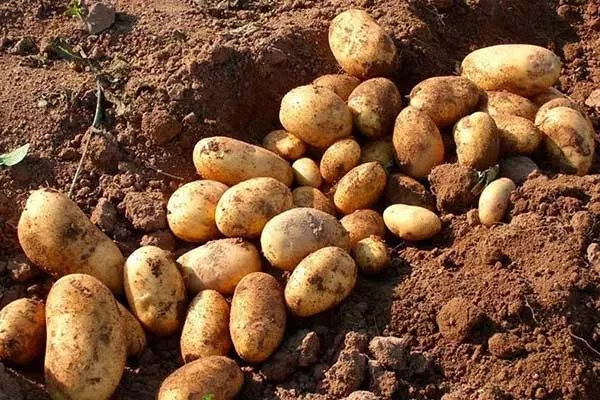
Colette bushes bear fruit uniformly. Their yield is high and stable. It varies depending on the timing of tuber harvest:
- Farmers harvest 11,300-15,300 kg/ha 45 days after germination, during the first digging (52,000/ha more than Bryansky Ranny, the standard variety);
- 15600-27600 kg/ha - the second digging, carried out after 55 days (3900 kg/ha more than the standard);
- from 16,600 to 21,700 kg per 1 ha of planting is the average yield of the variety (4,300 kg/ha more than Bryansk Early);
- 29,000 kg/ha is the maximum yield collected in the Rostov region.
The marketability of the vegetable yield of this variety ranges from 76% to 98%, and the shelf life is 92%.
Growing regions and planting times
The variety is included in the state register as a potato variety intended for cultivation in household plots and farms located in the following regions of the Russian Federation:
- Central;
- Volga-Vyatka;
- North Caucasian.
It is grown in European countries, as well as in Moldova and Ukraine. Even in areas with cold and damp summers, gardeners reap a good harvest of Colette.
Advantages and disadvantages of the variety
Domestic gardeners value this potato for its many advantages:
This variety of potato also has several disadvantages:
Features of planting and growing
Colette potatoes are demanding of soil conditions. The variety produces its maximum yield when grown in the following soils:
- light loamy or sandy loam;
- loose;
- fertile;
- with neutral acidity.
- ✓ The soil pH level should be strictly within 5.5-6.5 for optimal nutrient absorption.
- ✓ Organic matter content of at least 3% to ensure the necessary structure and moisture retention.
Plant the tubers in moist soil, warmed to +10°C. Do this within the following timeframes:
- mid-April - in the south;
- early May - in regions with colder climates.
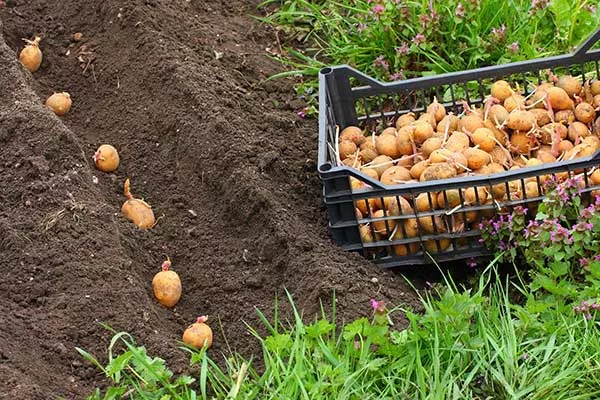
Prepare the area for planting potatoes in the fall:
- dig it up;
- clear away weeds;
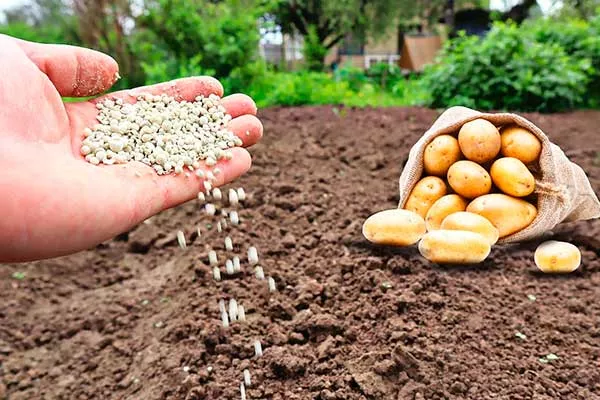
- fertilize with manure (consumption - 5-7 kg per 100 sq. m), superphosphate (1 kg per 100 sq. m), potassium composition (2 kg per 100 sq. m).
In the spring, you'll need to apply fertilizer again directly into the planting furrow or hole. Use wood ash or nitrogen-containing organic fertilizers for this purpose.
Prepare the seed material:
- select medium-sized tubers;
- discard damaged and spoiled specimens;
- Leave the potatoes in a bright room with a temperature of +15°C to germinate, laying them out on the floor with the eyes facing up, and moisten them from time to time.
After 14 days, sprouts will appear on the tubers. When they reach 2 cm in length, begin planting. Pre-treat the potatoes with Fitosporin-M.
When planting tubers in a garden bed, follow the following pattern:
- the distance between bushes is 30 cm;
- row spacing - 75 cm;
- planting depth - 10 cm.
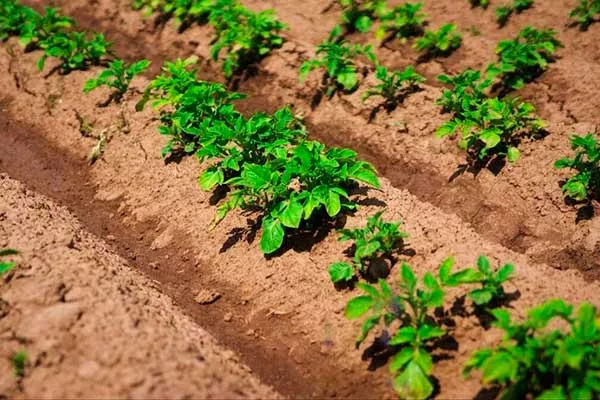
Care nuances
To get a bountiful harvest of Colette, care for your potato beds as follows:
- Water themThe variety loves moisture but does not tolerate overwatering. Water at least 3-4 times during the growing season.
Water the potatoes for the first time 10 days after the sprouts emerge. Water the second time 21 days after the first watering. Moisten the soil to a depth of 40-50 cm. Water the plants regularly every 7 days. Do this in the evening. - Loosen the soilThe measure saturates the soil with oxygen and rids the bed of weeds. Perform the first loosening when 2-3 leaves appear on the sprouts. Repeat the procedure after rain and watering. Loosen the soil without disturbing the roots. Remove weeds as you do so.
- Mulch the plantingUse sawdust, peat, or straw for this purpose. A layer of mulch will retain moisture in the soil and prevent weeds from growing.
- Hill up potato bushesThis procedure promotes root growth and the formation of more tubers, protects the tubers from pests, and warms them.
Hill up the bushes for the first time when they reach a height of 12 cm. Rake the soil under the plant and form a ridge. Repeat the process 14 days after the initial hilling. Repeat this process 2-3 times per season. - Inspect the bushes periodically for the presence of parasites on them, to identify the first signs of disease.
- Feed your potato plantsFertilize several times throughout the season. Apply the first fertilizer during budding. Use chicken manure diluted with water at a ratio of 1:20, mineral fertilizers, and wood ash (30-40 g per plant).
At the time of tuber formation, apply superphosphate in combination with potassium sulfide (20 g of each preparation per 1 sq. m).
- The first watering is 10 days after germination – 20 l/m².
- Second watering 21 days after the first – 25 l/m².
- Subsequent waterings every 7 days - 30 l/m², adjusted according to weather conditions.
Pest and disease control
Colette is a variety that exhibits resistance to golden cyst nematode and many potato diseases:
- cancer pathogen;
- viruses A and Y;
- common scab;
- black leg;
- curling of leaves.
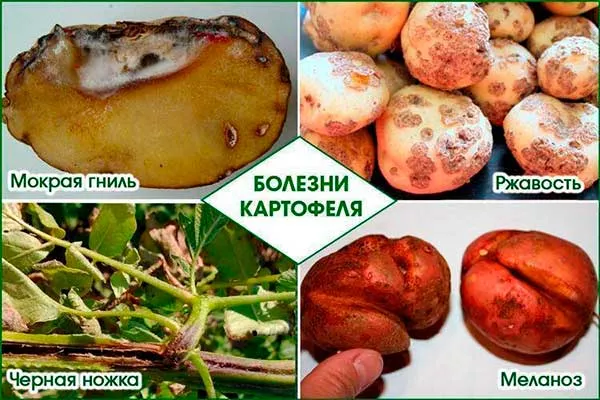
If agricultural practices are not followed and the weather is unfavorable, the bushes are affected by diseases and pests:
- PhytophthoraThis is a fungal infection that occurs in situations of overwatered soil and damp air. It is diagnosed by black and brown spots on the stems and foliage. The foliage of the affected plant turns black, curls, and dries out. The fungus then attacks the tubers, causing them to rot and become inedible.
- WirewormThis brown-yellow worm burrows holes into bush stems, chews through tubers, and damages crops. To control it, use Prestige KS and Tabu Trio.
As a preventative measure, when the first frost arrives, dig up the soil in your garden so that the parasite larvae die from the cold. - Mole cricketThis beetle chews stems and feeds on the flesh of tubers. Control it with Medvetox.
Harvesting and storage
Dig potatoes by hand. Mechanical harvesting is also possible. Begin harvesting 10-14 days after the tops have completely lodged and dried out. Do this in dry, sunny weather.
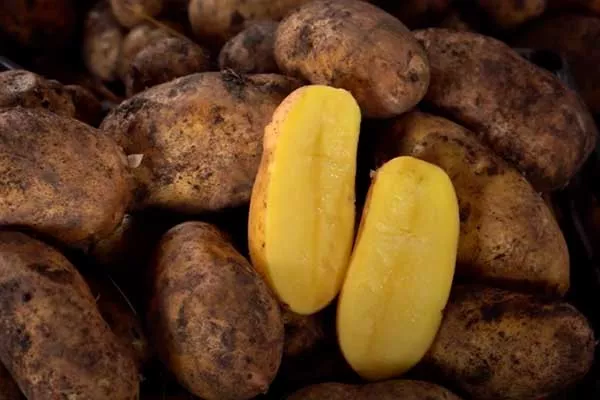
Colette tubers have thin skins. Dig them carefully to avoid damaging the skin. Otherwise, they will lose their marketable appearance and their shelf life will be affected.
Prepare the harvest for storage:
- place the tubers on a tray;
- leave them in a well-ventilated area to dry;
- sort through.
In mid-November, transfer the tubers to the cellar, providing them with the following conditions:
- temperature range - +3-5°С;
- humidity - 80%.
Storage features and shelf life of the variety
The variety has excellent shelf life (92%). To maximize shelf life, avoid storing Colette potatoes next to other vegetables (except beets). This will cause them to spoil quickly. Inspect the potatoes periodically throughout the winter, discarding any rotten or damaged tubers.
Reviews
Colette is popular among Russian gardeners due to its early maturity and the ability to produce two harvests per season. It is widely used in commercial cultivation due to its good shelf life and marketable appearance.