
The Kamensky potato deserves special attention due to its unique combination of qualities and characteristics. Not only does it boast high yields and excellent taste, but it also demonstrates resilience to adverse climatic conditions. Proper care and adherence to basic agricultural practices are essential.
History of appearance
It was developed by a group of breeders, including V.P. Koshkarov, E.M. Klyukina, and E.P. Shanina, at the Ural Agricultural Research Center. After successfully passing state variety trials in 2006, an application for approval was submitted. Since 2009, the variety has been included in the State Register of Russia.
Features of the Kamensky potato variety
In describing the Kamensky potato, the appearance of the bushes and tubers, their shape, size, and weight, are of particular interest. The main characteristics are presented below.
Bush
The bush is tall, with an intermediate growth pattern. Features of the plant:
- Stems may be erect or semi-erect, with noticeable pigmentation.
- The leaves are small, stiff, with wavy edges.
- The foliage is colored dark green.
- The inflorescences contain many large flowers.
- The corollas are large, red-violet in colour, with intense colouring, especially pronounced on the inside.
Tubers
It has a well-developed root system. Distinguishing characteristics:
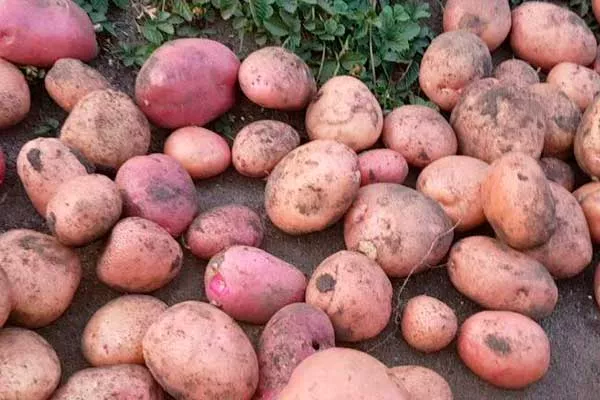
- Each bush can produce 15 to 25 tubers of approximately the same size.
- The average weight of the vegetable is from 90 to 110 g, but sometimes there are specimens reaching 130 and even 180 g.
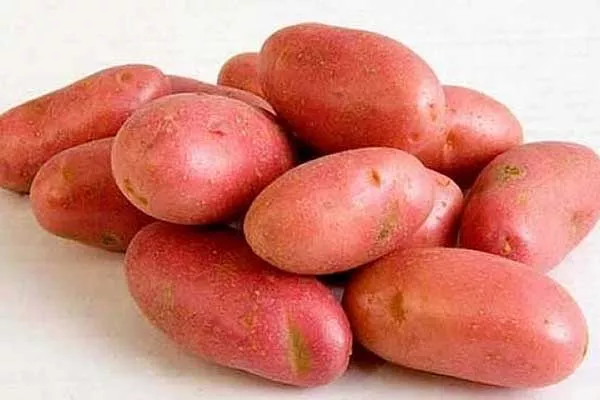
- The tubers have an elongated oval shape.
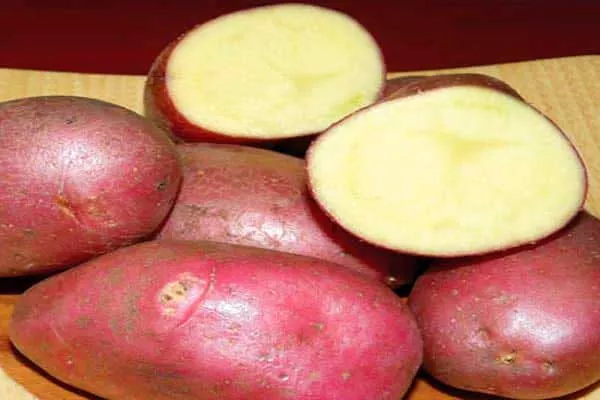
- The skin is quite strong, red in color, with a slightly mesh structure.
- The flesh is light yellow, and the eyes are small and located on the surface.
Taste qualities of Kamensky potatoes
One of the crop's key advantages is its excellent taste. In the tasting, the potato received a high score – 4.8 out of 5 possible points. The root vegetables are suitable for all types of cooking:
- frying;
- cooking (including mashed potatoes);
- baking;
- extinguishing.
The tuber flesh is moderately crumbly and tender, but not watery. Starch content ranges from 12.2% to 16.8% of the total mass.
Ripening time
This is an early-ripening variety. The harvest can be dug up 50-60 days after mass germination. If planted during the May holidays, the harvest can be collected as early as mid- to late-July. Due to its early ripening, two crop rotations per season can be planned in regions with warm autumns.
Potato yield Kamensky
This variety boasts high yields. 170-176 kg can be harvested from 100 square meters of land, which equates to up to 176 centners per hectare. The maximum recorded yield was 252 centners per hectare. To achieve such high yields, regular watering, fertilizing, and hilling are necessary.
Where is it grown?
Kamensky is distinguished by its good cold tolerance, making it suitable for cultivation in most Russian regions. This variety is primarily suited for the Ural and Volga-Vyatka regions. It is also successfully cultivated in the central part of Russia, the Volga region, and even as far as Siberia and the Far East.
Disease resistance
It has strong immunity to canker, but can be susceptible to the golden nematode. It can also be susceptible to common fungal infections, including late blight. Regular preventative treatments with fungicides are recommended. If necessary, insecticides or folk remedies can be used to control insects.
Advantages and disadvantages
Summer residents have already identified the main advantages and disadvantages of this crop. Positive qualities:
How to plant?
Begin planting seedlings when the soil warms up to 8-10°C at a depth of at least 10 cm. In the southern regions, this occurs in early May, in the central part of the country – closer to the 20th of the same month, and in the north – at the beginning of summer.
- ✓ The planting depth should be at least 10 cm to avoid the tubers freezing during unexpected frosts.
- ✓ The distance between holes should be 30-40 cm, and between rows - 60 cm, to provide sufficient space for the bushes to grow.
Select only healthy tubers for planting, free of growths, blemishes, cuts, and cracks. Medium-sized potatoes weighing between 60 and 80 g are recommended.
The planting process is usually standard:
- Level the surface.
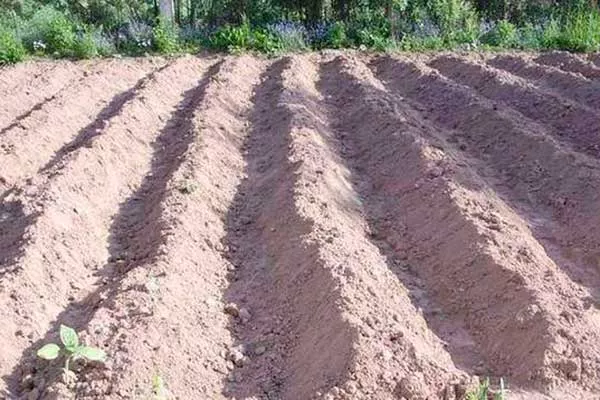
- Mark furrows at intervals of 60 cm.
- Dig holes up to 10 cm deep at a distance of 30-40 cm.
- Place the tubers and add some wood ash.
- Cover with soil.
- Water with settled water.
Care instructions
The Kamensky variety isn't susceptible to significant drought risks, but regular watering helps achieve maximum yield. Water the crop just three times per season:
- After the tops appear.
- Before flowering begins.
- Immediately after flowering.
Avoid watering after flowering. This is due to the activation of the late blight fungus during this period, when moisture can facilitate its spread.

Hilling can increase yields by 20-30% due to the formation of additional stolons. When hilling, loosen the soil and remove weeds that could negatively impact the crop.
When to harvest and how to store?
Harvest the tubers once the skins have hardened and the tops have dried. After digging, remove the soil from the tubers and sort them by size. Place the vegetables under a shelter or in a shed, where they should be spread out in a single layer to dry for several hours.
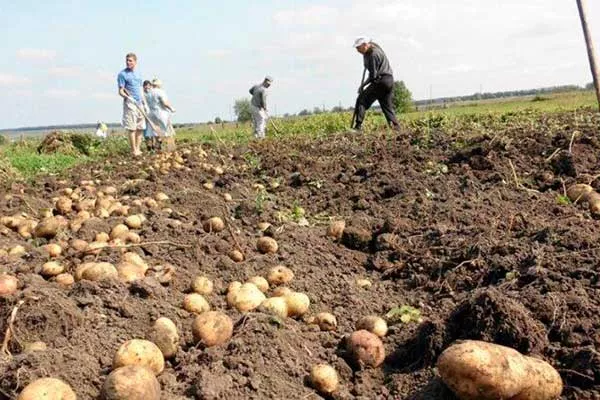
- After digging, the tubers must be cleared of soil and sorted by size.
- Place the vegetables under a canopy or in a shed to dry for several hours.
- Place the tubers in boxes or wicker baskets for storage.
Storing potatoes over winter requires a few considerations. Place the tubers in boxes or wicker baskets and store them in the cellar. Maintain the recommended temperature (1 to 3°C) and humidity (60%).
Reviews of Kamensky potatoes from gardeners
The Kamensky potato is an ideal choice for gardeners seeking a consistent, high-quality harvest. Its low maintenance, high yield, and excellent flavor make it ideal for both home-grown and commercial use. Timely care is essential.