
Most potato varieties developed by Belarusian breeders are well suited to the Russian climate, making them suitable for use in gardening practices in our country. One of the latest achievements in global potato breeding is the Palace variety. Its characteristics include rapid ripening, ease of cultivation, and resistance to various diseases.
Peculiarities of origin
The Palace potato variety was developed in Belarus by experts at the National Center for Potato and Vegetable Growing in 2017. After passing all the necessary tests, it was registered in the national Register of Varieties four years later. It is officially recognized as the variety most suitable for cultivation in the Grodno Region.
Description of the Palace potato
This variety stands out from others due to its bushes and tubers. Experienced gardeners will easily recognize it in the garden or in the vegetable storage area thanks to its unique characteristics.
Bush
The Palace potato produces medium-sized, intermediate-type bushes, reaching 40 to 50 cm in height. The shoots are strong and sparsely foliated, with moderate thickness.
At the beginning of growth, the stems grow vertically, but by the end of flowering, they bend to the side. Each bush is formed from three to four stems.
Other varietal characteristics of the plant:
- Leaves The leaves are quite large and richly green, with an open arrangement. Their blades are slightly wavy, and the veins are visible but not overly pronounced. The foliage is usually concentrated on the upper portion of the shoots.
- Flowers This variety is medium-sized, reaching approximately 1 cm in diameter. The buds form terminal inflorescences of four to five flowers. The corolla has a rich pinkish-lilac hue, and the apex is smooth. The anthocyanin hue inside the bud may be barely noticeable or absent entirely.
- Root system This variety is distinguished by its vigor and consists of numerous rhizomes and short and medium-sized stolons, ensuring effective bush development even in unfavorable climates. Each bush produces up to 8-10 fruits.
Tubers
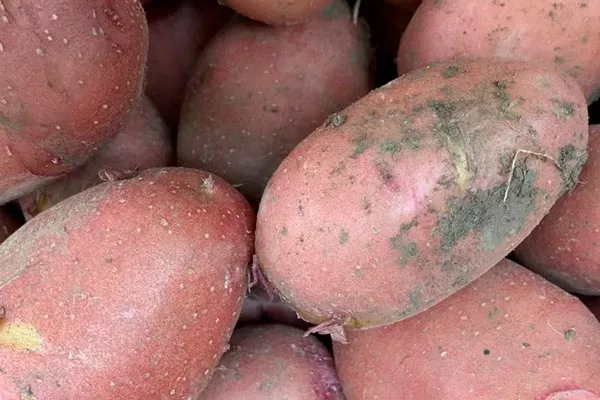
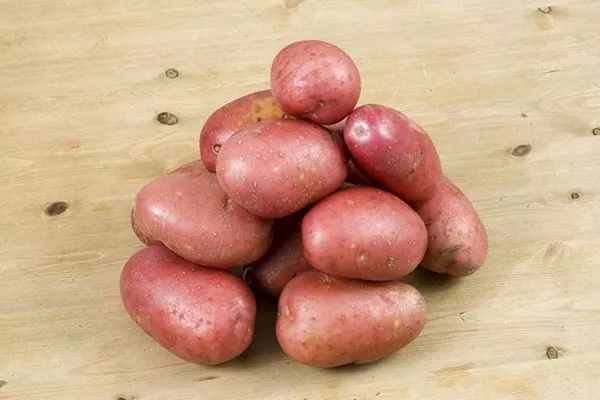
Palats tubers are characterized by their regular, round, and slightly elongated shape. Each root can weigh between 70 and 150 g. Other characteristics:
- The skin of the Palats potato is characterized by its small thickness and sufficient strength, as well as smoothness.
- Eyes on the surface of tubers are rare and are located at medium depth.
- The color of the tubers ranges between pink and pale red.
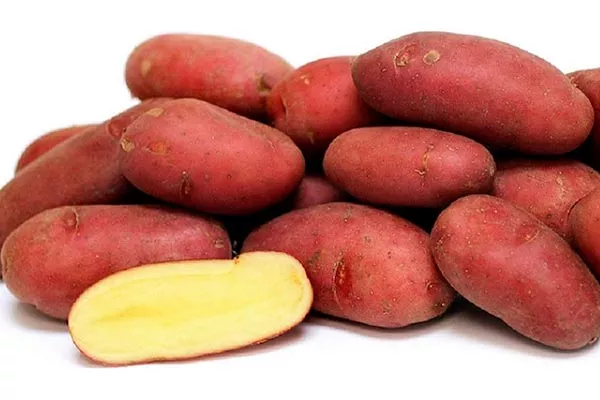
- The pulp has a dense structure and a yellowish-beige hue, which does not change upon contact with air.
- When cooked, the flesh of this variety softens slightly.
Characteristics of the Palace potato
This potato variety enjoys an impeccable reputation in Belarus, where its flavor is rated as high-quality or excellent. But this variety also boasts many other positive attributes.
Taste qualities of Palace potatoes
This variety is distinguished by its firm, non-watery flesh, which has no trace of flouriness, but instead possesses a subtle sweet and creamy flavor. This potato is ideal for a variety of culinary dishes. Professional tasters classify it as a Class AB potato, meaning that after cooking, the flesh retains its structure and does not fall apart when cut.
At home, Palats is ideal for steaming, frying, stir-frying, stuffing, and baking, as well as for entrees and all kinds of side dishes. The tubers are also suitable for freezing.
Ripening periods of the Palace potato
Palats is a potato variety distinguished by its early maturity. The crop reaches full maturity in just 50-70 days after the first shoots emerge. The youngest potatoes are ready to harvest at 45-50 days.
The ripening interval may vary depending on local climate conditions, seasonal weather changes and the level of care given to the crops.
Productivity
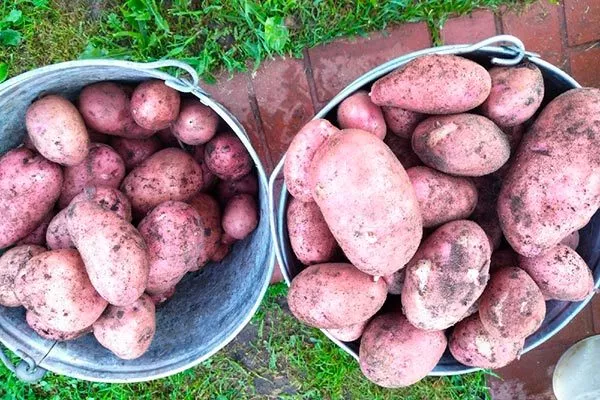
Palats yields reach 550-600 centners per hectare in commercial fields in Belarus. In individual plots, where each plant produces 8-10 tubers, a yield of up to 1.5-2 kg per bush can be expected, for a total yield of 250-400 kg per 100 square meters.
Cold resistance
The Palace variety is a heat-loving crop. Its shoots can tolerate short-term temperature drops to -2°C and quickly recover from damage caused by spring frosts. However, to preserve the tubers after digging, they should be stored at a temperature above +1°C.
Keeping quality
Palats is distinguished by its ability to retain its quality for a long time. If properly stored in a cellar, it retains its consumer properties until spring, with losses not exceeding 5%.
Growing regions
The Palace variety is not yet included in the official list of Russian breeding achievements, nor are there any officially recommended regions for its cultivation. However, given its varietal characteristics, it is safe to say that this variety is capable of successfully developing and producing a harvest in any region where agricultural production is possible.
Disease resistance
The variety is resistant to diseases and insects. Thanks to the efforts of breeders, it has innate protection against golden root nematode, bacterial canker, and many viral infections that can be fatal to the plant.
According to information provided by the manufacturer (which is confirmed by reviews from gardeners), the Palace variety demonstrates average resistance to fusarium, various forms of rust, alternaria, and late blight of tubers, but not leaves.
Pests generally don't bother the Palace potato, with the exception of the Colorado potato beetle. To prevent its spread in fields, preventative measures are necessary.
Landing rules
To speed up potato germination, the seeds are dried in special conditions before planting. This is done in two ways: dry and wet. In the first method, the potatoes are spread out in a single layer and left in the sun for 38-43 days. In the second method, which achieves results in 2-3 weeks, they are laid on a layer of damp sawdust or moss.
- ✓ The optimal soil temperature for planting should not be below +8°C.
- ✓ The planting depth of tubers should be adjusted depending on the soil type: on light soils - 10-12 cm, on heavy soils - 8-10 cm.
Planting time depends on the region:
- in the southern regions of Russia, planting begins in March;
- in the Central District – in May;
- In the north, it is better to wait until the end of May, when the ground warms up as much as possible.
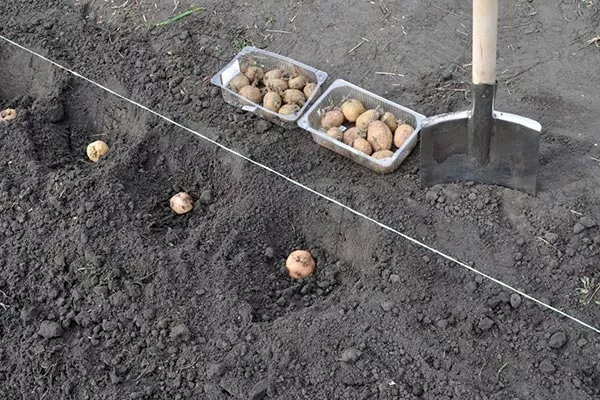
A popular method for planting potatoes is using a spade. This allows for space-saving use and maintains soil moisture. Features:
- In spring, the soil on the site is plowed and loosened.
- For planting, make shallow holes - 6-8 cm for small tubers and 10-15 cm for large ones.
- Before placing the tuber, it is recommended to add a little compost (literally a handful) into the hole.
- The Palace potato is planted in rows with an interval of 70-75 cm between them, and 35 cm is left between the tubers in a row.
But there are also alternative methods that Belarusian farmers use when cultivating this hybrid:
- Trench method. Ideal for planting potatoes in sandy soil mixtures. After draining the area in the fall, dig trenches 30-35 cm deep, spaced 90-95 cm apart. Lay a 15-17 cm layer of fresh hay in each trench, then add 5 cm of rotted manure and wood ash dust.
This mixture is thoroughly moistened and left for the entire winter to allow the components to bond tightly. In the spring, potato tubers are placed in the trenches. - Comb variant. This method is recommended for moist soils. In the spring, mounds 15-20 cm high are created, for which a walk-behind tractor is ideal. The distance between the ridges should be 70-80 cm. For planting potatoes, holes are made in the ridges, spaced 30-35 cm apart.
- Dutch method. Potatoes are planted in tall rows spaced 45-50 cm apart, with a gap of 80 cm between them. Compost, wood ash, and a small amount of superphosphate are added to each hole.
Care
To ensure a fertile harvest and grow high-quality tubers, it is extremely important to monitor the potatoes during their development.
Hilling
To ensure adequate air circulation for the root system and to remove weeds, agronomists perform two soil mulches. The first mulching is performed one month after planting, when the leaves of the young plants reach 7-9 cm above the soil surface.
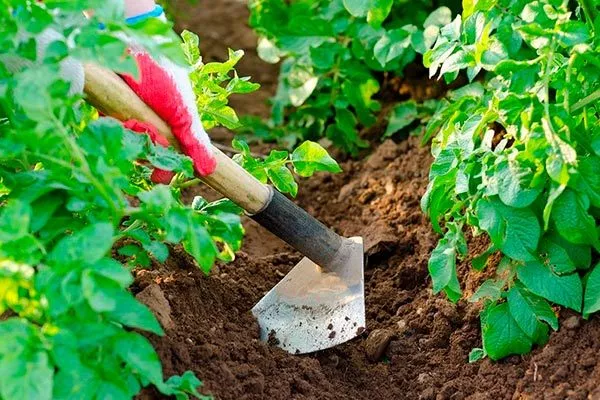
The second topsoiling is done two weeks after the previous one. By this time, the stem height should exceed 12-14 cm. This operation is performed after the soil has been saturated by rain or watering.
Water treatments
To ensure proper potato development, it's important to maintain optimal soil moisture. This will prevent fungal infections and pest attacks that can reduce yield. Certain guidelines have been developed for this purpose:
- The initial watering is done approximately one month after planting, when the first leaves appear, using settled water at a rate of 3-5 liters per bush. The water is directed directly to the roots.
- Until the plant blooms, water it no more than once a week. However, in particularly hot weather, more frequent watering may be necessary. Testing for watering is simple: insert a stick into the soil to a depth of 10-12 cm. If there isn't enough moisture, it's time to water.
- During the potato flowering period, it is recommended to increase the frequency to twice a week, using a sprinkler system in the morning or evening, applying 12-15 liters of water per plant. After this, protect the soil by covering it with sawdust or hay.
- When the period of withering of the tops begins, watering should be reduced to 2-3 liters of water every 10-15 days.
- Two weeks before harvesting, watering stops completely.
Weeding
In addition to removing unwanted plants, weeding also improves the structure of the soil mixture in the beds. Potatoes should be weeded for the first time approximately 20 days after planting, and a second time when the plants reach 35-40 cm in height.
Fertilizer
Charcoal or compost are often used to nourish the soil. Nitrogen promotes leaf and stem growth, while mineral components ensure early crop formation. These include Double Superphosphate, urea, potassium, and saltpeter.
Recommendations:
- To achieve the best productivity results, it is recommended to combine organic and mineral fertilizers at planting time.
- If you notice that young plants are looking weak and fragile, you should feed them as follows: add 1 tablespoon of urea to 1 liter of liquid compost. This dosage is calculated for 1 square meter of plantings.
- Fertilize a second time 15-18 days after the first time, adding potassium sulfate granules (1 tbsp.) and wood dust (about 300 g) directly under the roots per 1 sq. m.
Harvesting and storage
Harvesting of the Palace potato variety occurs in August and September. A week before harvesting, the potato tops are cut off, which facilitates the transfer of nutrients to the tubers. Harvesting takes place under favorable weather conditions: dry and warm.
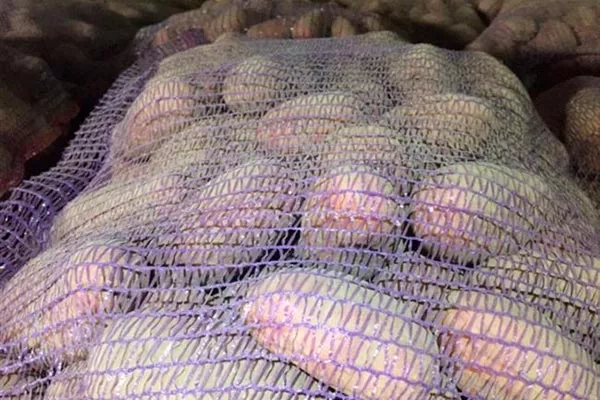
Further actions and rules for preserving the harvest:
- Before long-term storage, potatoes are left in a cool, well-lit room for two weeks to allow the microcracks from the shovel to heal and the potatoes to ripen.
- The new harvest is immediately harvested for planting. Undamaged tubers, preferably small in size, are selected and placed under a canopy or a tree canopy in partial shade. This period lasts for 20 days. During this period, the tubers accumulate solanine, a toxic compound that makes them inedible to pests and increases germination.
- Potatoes intended for human consumption should not be stored in the light, otherwise they will turn green and become poisonous due to the solanine they contain.
Therefore, for two weeks, the edible potatoes are transferred to a dark, cool place for storage, while the seed tubers continue to be kept in the light until the greening process is complete, which takes about a month.
Diseases and pests: features of control and prevention
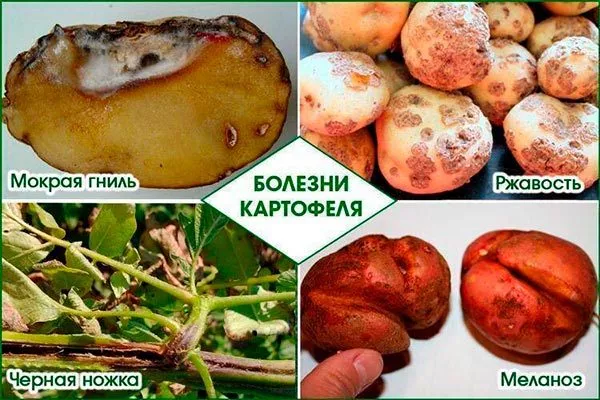
The Palace potato variety is resistant to diseases such as potato cancer and rhizoctonia, but it is particularly susceptible to late blight. This disease damages the stems and root system and, if left untreated, can lead to significant yield losses. To combat this problem, the following measures are recommended:
- organize crop rotation correctly;
- loosen the soil and reduce the amount of watering at the first signs of disease;
- apply mineral fertilizers;
- treat seeds with growth stimulants;
- use the following medications: Quadris, Maxim and Celeste TOP.
The Colorado potato beetle is the potato's main enemy, which quickly adapts to insecticides, making control difficult. The beetle possesses toxic substances that protect it from attack, causing birds and other animals to avoid it.
- Hand-collect beetles and larvae early in the morning when they are less active.
- Use biological products such as Bitoxibacillin according to the instructions before flowering begins.
- Alternate chemical treatments to prevent beetles from becoming accustomed to insecticides.
The use of chemicals simplifies potato farming processes, but requires regular application. For treating potato leaves, it is recommended to use:
- 5% emulsion concentrate Foxim;
- 20% emulsion solution Sumicidin.
Apply them at least twice per season, but finish treatment 20 days before harvest. In small garden plots, gardeners can collect beetles and their larvae by hand, but this method is only effective for small areas.
Positive and negative qualities
The variety is quite transportable and retains its quality for a long time. Under favorable conditions, more than 95% of tubers retain their marketable appearance and nutritional properties.
There are other benefits:
Reviews
The Palace potato, originally from Belarus, is a versatile, early-ripening variety that was recently introduced to the Russian agricultural market. Its popularity is growing due to its productivity and adaptability to a variety of climates and soil types.