
The Cornet potato is a table potato variety with a general purpose. It was developed quite recently—it was developed in 2020, the application for approval was submitted in late 2021, and it was added to the State Register of Russia in 2024. The breeding work was carried out by specialists from the A.G. Lorkh Federal Research Center.
Features of the Cornet potato
The Cornet potato is versatile. Its tubers are used not only in home-cooked dishes but also for processing to produce high-quality starch. Therefore, this variety is also grown industrially. This potato has the following characteristics:
- regions and climate – zoned to a greater extent for the central part of the country, but cultivation is permitted in any climatic conditions (from south to north);
- ripeness – mid-early, since the harvest can be collected 80 days after emergence in the south and 90 days in cool zones;
- fertility – quite high:
- commercial – from 170 to 480 centners per 1 hectare;
- maximum – 60-65 tons per 1 ha.
- disease resistance – depends on the type:
- high resistance to potato cancer, late blight, alternaria;
- average - to rhizoctonia and common scab.
- drought tolerance – at an average level;
- shelf life – estimated at 90-92%;
- marketable condition – from 91 to 94%.
Description of the plant and tubers
The shrub is considered medium-sized and belongs to the intermediate type. The variety has the following characteristic features:
- shoots – half erect, strong;
- leaf blades – medium size, dark green, slightly faded in color;
- flower corollas – red-violet, but pale, medium size;
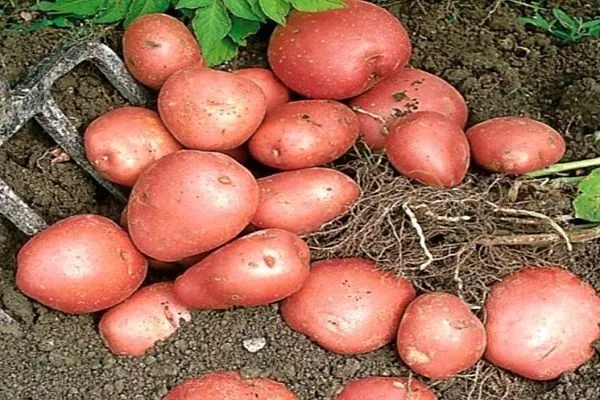
- weight of root crops – 100-140 g, but there are specimens up to 200 g;
- tuber shape – oval-elongated;
- skin – smooth and red;
- eyes – very small;
- pulp – light cream color, medium density;
- the number of potatoes under one bush is 15-18 pcs.
Taste characteristics and purpose
Cornet potatoes are distinguished by their high starch content, ranging from 17 to 22%. This quality makes them ideal for mashed potatoes and roasts, as the starch provides excellent texture.
One of the key advantages of this variety is that the flesh does not darken after cooking, which makes it particularly attractive for the restaurant business.
Pros and cons of the variety
To choose a specific potato variety, it's important to first understand all its positive and negative qualities. Key advantages:
The only drawback of the culture is its demanding nature regarding the soil composition.
Landing features
Before planting potatoes, it's important to carefully familiarize yourself with their characteristics and inspect each tuber thoroughly. Avoid using spoiled, small, or damaged potatoes—large, healthy tubers are essential.
- ✓ The optimal soil pH should be in the range of 5.5-6.5 for maximum yield.
- ✓ The soil must be well-drained to avoid water stagnation and rotting of the tubers.
Subtleties of planting the Cornet variety:
- Preparation of planting material. Many experts recommend pre-treating each potato with a growth stimulant before planting. Epin can be used for this purpose. To germinate, lightly moisten the potatoes with water and place them in a dark, warm place. Once the sprouts reach 1.5-2 cm in length, the tubers can be planted in the soil.
- Deadlines. Planting is done in the spring – at the end of April or the first of May, when the soil temperature stabilizes at approximately 12-14 degrees.
- Site preparation. Soil preparation begins in the fall, enriching it with organic fertilizers such as cow manure or fresh bird droppings. In the spring, the soil is dug again and fertilized with organic matter. Phosphates and potassium solutions are also added, which promotes soil looseness and ensures oxygen access to the roots.
It is important to keep in mind that soil where tomatoes or sunflowers were previously grown is not suitable for Cornet potatoes. - Planting diagram. For planting potatoes, it's recommended to dig holes about 10-11 cm deep. Leave a distance of about 30-35 cm between them to prevent the plants from shading each other and interfering with growth, which can reduce yield. The distance between beds should be at least 60-65 cm.
Some experts advise leaving 80-85 cm between rows and 40-45 cm between bushes to increase yield. - Landing. Wood ash is added to each hole to disinfect the soil, after which the tuber is placed and covered with soil.
Care
Many people mistakenly believe that growing potatoes is simple. However, each variety requires careful and knowledgeable care, as growing conditions directly affect the quality and yield of the harvest. Please note the following care instructions for the Cornet variety:
- The bushes require regular watering, especially during bud formation and the beginning of flowering. Despite Cornet's drought tolerance, it's best not to overdo it. It's recommended to water the plants in the morning or evening, when the sun is less intense. Under normal conditions, 2-4 waterings per week are sufficient.
- Young plants require nitrogen-containing fertilizers. Organic fertilizers are best. During flowering, potassium and phosphorus should be added, and after flowering, the plants should be sprayed with a superphosphate solution.
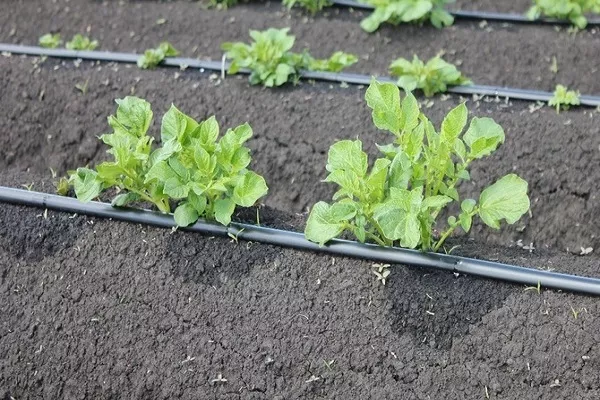
- Two weeks after germination, loosening the soil is necessary. This will help remove weeds that compete for moisture and air, and prevent crusting on the soil that hinders plant development. Loosening improves oxygen access to the tubers and promotes faster soil warming.
- ✓ Watering should be moderate to avoid over-watering and the development of fungal diseases.
- ✓ Use water at a temperature of at least 15°C to avoid stressing the plants.
Possible diseases and how to combat them
Despite the Kornet variety's resistance to cancer and nematodes, it is still susceptible to problems in the event of a violation of agricultural requirements or unstable weather.
What to do:
- Potato cancer. This disease causes tubers to become infected and subsequently rot. The leaves of the plant are unaffected. Infected tubers should not be eaten. However, the soil should be treated with Nitrofen to prevent the spread of the disease.
- Nematode. If nematode infestation occurs, the bushes will wilt. When signs of the disease appear, the affected plants should be dug up and burned, and the soil treated with Bazudin. It is also recommended to enrich the soil with liquid manure.
Additionally, it is necessary to protect bushes from fungal diseases using preventative measures:
- Crop rotation: avoid planting after tomatoes, potatoes, eggplants, and peppers.
- Maintain cleanliness in the area: remove overgrown tops and weeds.
- Maintaining the distance between plants when planting.
- Treatment of tubers and soil with fungicides before planting.
- Carrying out preventive treatments with solutions of fungicides containing copper.
- Manual collection of Colorado potato beetles before harvesting and the use of pest control products, such as Tabu, Regent, Confidor.
Harvesting and storage
Potatoes are harvested when the tops begin to wilt, dug up, and air-dried for a day. It's important to remove any rotten or damaged tubers. Store in a cool place with a temperature of around 4-5 degrees Celsius. It's recommended to store potatoes in wooden crates for better ventilation and to prevent rotting. Sawdust can be used to absorb excess moisture.
Reviews
Despite its youth, the Kornet potato is quickly gaining popularity. Planting material is already available in various cities across Russia. It is actively cultivated in both private plots and small and large agricultural complexes. The variety boasts excellent characteristics, which is why it is so highly valued.