
The Kingsman potato was introduced to the world quite recently, but has already gained popularity among farmers and private gardeners. It is characterized by its table quality, abundant fruiting, good transportability and shelf life, and resistance to major potato diseases and pests. Its maximum starch content is 14.5%.
History of origin
The Kingsman is a culinary potato variety developed by Douglas Harley of Cygnet Potato Breeders LTD. The new potato was officially approved for cultivation in 2020.
Features of Kingsman potatoes
The variety in question has good marketability: approximately 80-83% of the roots are suitable for subsequent mass sale or consumption in the spring. This suggests that the majority of the harvest can be successfully marketed.
In addition, this variety is characterized by its transportability, which attracts farmers for commercial cultivation and delivery over long distances.
Other parameters:
- Commercial yields range from 180 to 410 centners per hectare, which is 53-60 centners higher than the standard Ladozhsky and Bronnitsky varieties.
- Maximum fertility reaches 458 centners per hectare, exceeding the standard of the Petersburg variety from the Smolensk region by 104 centners.
- The taste of the potatoes is rated as good.
- The shelf life of the product is 95%.
- The variety is resistant to cancer and golden potato cyst nematode.
- According to the developer, it has average resistance to wrinkle and stripe mosaic, as well as leaf curl.
- The period from germination to harvest is from 100 to 110 days.
Description of the plant and tubers
Kingsman is a medium-sized, stem-type plant with semi-erect, sometimes spreading, stems. The bush has large, intermediate-sized leaves with a classic green or slightly lighter color.
Other external characteristics of the variety:
- flowers – medium in size;
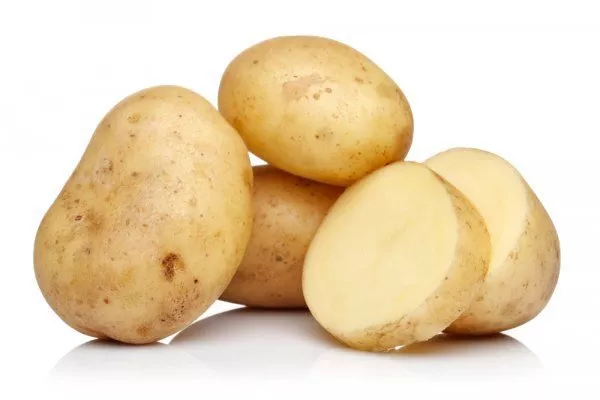
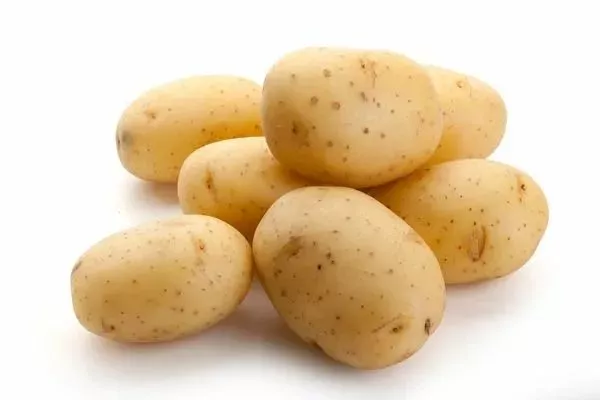
- shape of root crops – round-oval;
- skin color – light yellow, closer to white;
- surface texture – completely smooth;
- eyes – located superficially, small;
- weight of one tuber – 110-115 g.
Purpose and taste of tubers
This potato variety is classified as a table potato and has excellent marketability, making it popular among producers and consumers. It has excellent flavor, and its flesh does not darken after cooking. Furthermore, the tubers have small or very small eyes, making them easier to process.
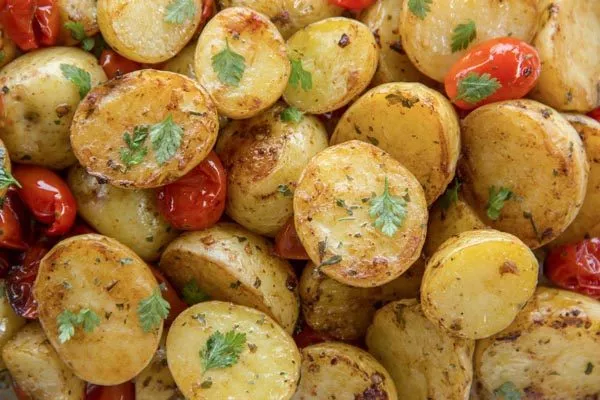
The tubers are ideal for boiling, maintaining their shape without overcooking or deforming, whether peeled or boiled in their skins. They also fry well. If needed, cut potatoes can be frozen in cubes, either individually or combined with other vegetables, for quick, complete meals.
How to grow Kingsman potatoes?
Kingsman isn't particularly demanding in terms of planting and subsequent care, but it's important to pay attention to certain varietal characteristics. This will ensure maximum yields and large root vegetables.
Planting methods
Gardeners choose their potato planting method based on the soil's topography and type. Each method requires specific spring preparatory work and fertilizer application rates. Here's how to plant Kingsman:
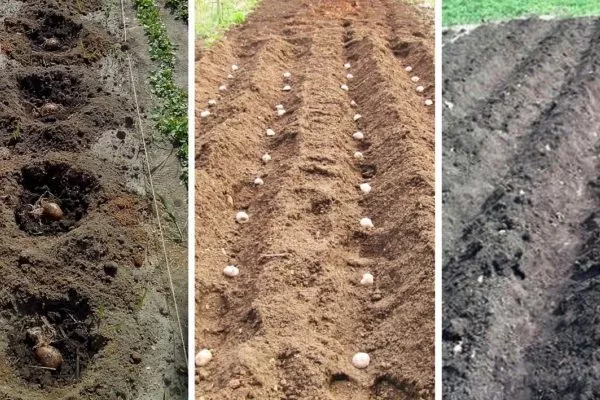
- Under the shovel. The most common method, ideal for level areas, is to loosen the soil lightly in the spring to conserve moisture using a cultivator or pitchfork, then level it with a rake. Planting takes place in early May.
The tubers are planted 30-35 cm apart at a depth of 6-8 cm, with the sprouts facing upward. Two handfuls of organic matter and 1 tablespoon of crushed charcoal are added to each hole, then covered with soil from the following holes. Rows are spaced 75-85 cm apart. After emergence, the plants are hilled and fertilized with organic mixtures. - In the trenches. Method for sandy soils: In the fall, apply fertilizer, dig trenches 30-40 cm deep, spaced 80-100 cm apart, and place a 12-17 cm layer of damp hay or straw on the bottom, followed by 5-8 cm of fresh manure and a small amount of wood ash.
In spring, when the materials have rotted and compacted, tubers are planted in the trenches two weeks earlier than usual, covered with agrofibre (polyethylene is not recommended). The bushes are hilled three times before flowering, raking the soil up to the stems. If the trenches are prepared in the spring, use already rotted manure. - In the combs. The ridge method is used on heavy, waterlogged soils. In the spring, ridges 15-25 cm high are formed in the field, and tubers are planted on the tops every 30-35 cm. Care is the same as with the first method, but watering is more frequent due to the rapid drying of the soil in the beds, which are also mulched to conserve moisture.
- Dutch method. It involves planting tubers in high beds 40-45 cm apart, with row spacing of 70-80 cm. In addition to compost and wood ash, about 15-20 g of superphosphate and potassium sulfate are added to the planting holes.
- In the straw. Growing potatoes in straw is a traditional method, dating back over 100 years. In the fall, the selected plot is covered with a thick layer of hay or straw. In the spring, the tubers are planted directly into the rotted grass, arranged in rows at standard spacing. After planting, the site is covered again with a layer of hay or straw.
Using this method eliminates the need for additional fertilizing and weeding. Harvesting becomes significantly easier, as the potatoes can be removed by hand without risk of damage, while maintaining the cleanliness of the tubers.
The subtleties of planting work
Growing Kingsman potatoes is relatively easy thanks to their high resilience. The key to successful development of this variety is choosing a suitable planting site. The site should be open, well-lit, and protected from the wind. Ideally, the tubers should be planted in rows running north to south.
Other nuances:
- The soil in the area should be fertile and loose. It is recommended to add 4-6 kg of rotted manure or compost per square meter. Organic fertilizers can be added directly to the planting holes, after mixing them with the soil.
- Potatoes are planted in the first month of spring, deepening them to a depth of 10-13 cm, with a distance of 30-45 cm between bushes.
- Good predecessors for potatoes are cucumbers, cabbage, lettuce, spinach, carrots, beets, corn and parsley.
Further care
Caring for Kingsman includes regular watering and application of mineral fertilizers to maintain plant health:
- Potatoes should be watered moderately - it is important to control the soil moisture level, avoiding over-watering.
- To reduce the amount of moisture evaporation and control weeds, mulching with a layer of non-acidic peat, straw or humus is used.
- Before harvesting, a test digging is carried out to assess the degree of maturity of the potatoes.
- After harvesting, the tubers are kept outside (if the weather is favorable) to dry and sort before being stored.
- Particular attention is paid to fertilizing. Slurry and fermented grass are used for this purpose, applied four times during the growing season.
Reviews
The Kingsman potato is a new record-breaker among white potato varieties. It is characterized by excellent yields, relatively good resistance to pathogens and pests, and impeccable shelf life and transportability. It is easy to grow and versatile in use.