
Growing potatoes is one of the most labor-intensive processes in agriculture. To make this task easier, farmers invented the potato planter. Thanks to its significant labor savings, this device has found wide application in both small farms and large-scale plantings.
Operating principle
A potato planter (PP) is a specialized piece of equipment consisting of a potato loading compartment, a conveyor mechanism, a plow, a hiller, and wheels. The PP allows you to set the depth and spacing of the potatoes, ensuring optimal planting for germination. However, this device can only be used on pre-prepared soil.
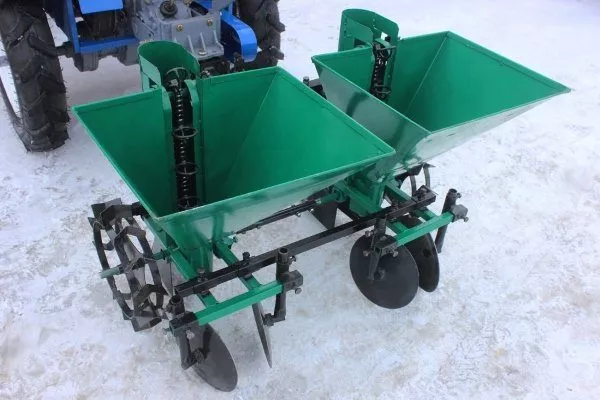
How do most potato planters work? The planter, powered by a self-propelled tractor, moves on wheels with a special lug design that transmits power to the seed feed system.
The plow tills the soil to the desired depth. Then, the tubers from the compartment are transported into the soil, and disc cultivators fill the furrow. The result is a level bed with a uniform planting density and uniform row spacing.
Let's take a closer look at a detailed diagram of a tractor-mounted potato planter with the function of simultaneously applying fertilizers into furrows and backfilling planted potatoes:
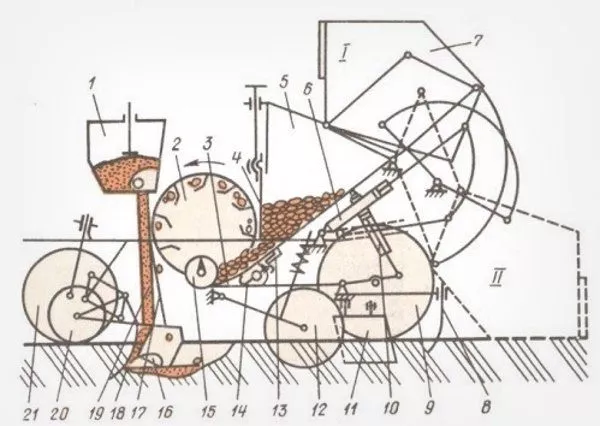
I, II – working and loading position; 1 – device for sowing fertilizers; 2 – scooping apparatus; 3 – feeder bucket; 4 – gate; 5 – main compartment; 6 – loading compartment hydraulic cylinder; 7 – loading compartment; 8 – loosener of tractor track marks; 9 – running wheel; 10 – hydraulic lifting cylinder; 11 – stabilizer; 12 – element for filling furrows; 13 – shaker flap; 14 – agitator; 15 – auger; 16 – coulter mouldboards; 17 – tuber deflector; 18 – coulter; 19 – fertilizer wire; 20 – copying device of planting part; 21 – support wheel.
The design of the planter is based on a frame on which the main compartment 5 is mounted with a bottom slope towards the feeder buckets 3. It is equipped with flaps 13 and stirrers 14. On the front wall of the compartment there are 3 windows, which are closed by valves 4.
Mounted in front of the main bin are six scooping units 2 with augers 15 and three fertilizer seeding units. At the rear, the loading bin 7 is hinged to the bin. Its grated bottom allows impurities to be sifted out during loading (position II). Once filled, the compartment is raised using two hydraulic cylinders 6 (position I), and the tubers flow by gravity into the main bin 5.
The potato planter frame rests on four wheels: two metal support wheels (21) in the front and two pneumatic running wheels (9) in the rear. The wheels are individually suspended by hydraulic cylinders (10). The front section of the KS is lifted by the tractor's attachment, while the rear section is lifted by the hydraulic cylinders (10) of the wheels (9).
The scoops 2 are driven by the tractor's power take-off shaft via the drive shaft, bevel gear, coupling shaft, control drive, and chain drives. Fertilizer seeding units 1, augers 15, stirrers 14, and the roller pushers of the shaking shutters 13 are driven by chain drives from the scoop shaft. They rotate clockwise (when viewed from the left). Potatoes from the hopper are fed by shutters 13 and stirrers into feeder buckets 3, from where they are transported by augers 15 to the scooping apparatus.
When the spoon approaches the coulter, the clamping lever, striking the guide bar, retracts the clamp, and the potatoes fall into coulter 18. At the same time, fertilizer flows through the fertilizer line 19 to the front of the coulter and into the furrow. Mouldboards 16 cover the fertilizer with soil, on top of which the potatoes fall. Discs 12 fill the furrow. Stabilizer 11 keeps the planter stable on sloping surfaces.
Potato planters are fairly simple in design and require no specialized maintenance or additional planting steps. Simply connect them to a walk-behind tractor or tractor, place the potatoes in the compartment, and the machine will do the labor-intensive work for you.
Types of potato planters
The main difference between potato planter models is the type of planting material supply:
- Finger method. When planting, potatoes are intercepted by metal finger-shaped rods, which feed the tubers into the soil.
- Flat belt feed. The tubers fall into the soil thanks to horizontally positioned belts.
- Shaped belts. A very gentle system. Even sprouted potatoes are not damaged when served. Similar to the previous one, only the belt is shaped differently and has grooves.
- Spoon-shaped. The seed moves along a structure made of spoon-shaped elements attached to a belt.
- Multi-belt feed. Two rows are planted at once. This setup ensures that the tubers are planted in a straight line.
- Impaling planting units. Often used when planting cut potatoes.
| Method of submission | Damage resistance | Landing speed | Cost of implementation |
|---|---|---|---|
| Finger method | Average | High | Low |
| Flat belt feed | High | Average | Average |
| Shaped belts | Very high | Low | High |
| Spoon-shaped | High | High | Average |
| Multi-belt feed | Average | Very high | High |
| Impaling planting units | Low | Average | Low |
The most popular potato planters are those with a spoon feeder. There are several varieties. One of the most effective is the combination type, which allows not only to plant potatoes but also to form a ridge and apply insecticides to the soil. This feature is usually not included in the basic package, but it can always be added as an option.
Planters of this type have many advantages:
- automatic ridge formation;
- The hydraulic drive ensures convenient operation of the device;
- wide row spacing prevents sheets from closing together;
- Thanks to the floating design of the anchor, the tubers fall out of the spoons in a timely manner;
- the planting mechanism is located at a small height above the ground, due to which planting is quite precise and the tubers are not damaged when falling;
- Spoon feeding allows you to avoid several tubers getting into one hole and missing plantings.
- ✓ Compatibility with existing equipment
- ✓ Soil type and its readiness
- ✓ Volume of work and planting area
- ✓ Purchase budget
- ✓ Availability of additional functions
When choosing a planter, plan ahead for your potato growing method. The European method requires row spacing of 75 cm, while the American method requires spacing between rows of 86 and 102 cm. This is important because the greater the spacing between rows, the denser the potato planting, which necessitates creating a large ridge to ensure proper potato development.
Potato planters can also be divided into two more groups:
- Semi-automatic. The tubers are fed by the device operator.
- Auto. The seed is automatically directed from the hopper to the conveyor.
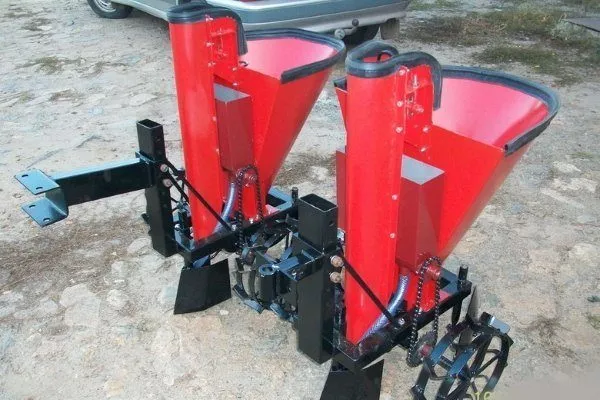
French potato planters
A separate type is the French planter, which is designed for planting sprouted potatoes.
The planting process is carried out using a conveyor belt, which delivers the tubers to the planting bin. From there, the potatoes are fed along the next belt into a working chute, where they are arranged in a line using belts and a special cylindrical brush.
The tubers then roll onto a fork-shaped plate, which, under the weight of the planting material, lowers and feeds it directly onto the planting drum. This design allows for very gentle planting of sprouted tubers.
Technical characteristics of potato planters
Among the main parameters characterizing the devices under consideration, the following can be highlighted:
1Planting depth
The ability to regulate this parameter directly impacts the speed of seedling emergence. At a depth of 100–150 mm, tubers receive the necessary amount of heat, oxygen, and moisture for optimal fruit development. In heavy soils (loams), this parameter should be reduced to 70–100 mm, and in mountainous areas, to 40–60 mm.
2Speed of movement
This directly impacts productivity. The higher the planter's operating speed, the larger the area planted per unit of time. Among the potato planters available on the Russian market, you can find a device with operating speeds ranging from 4 to 11 km/h.
3Row spacing is the distance between planting rows.
Although most agricultural producers use the 70-75 cm spacing for potato planting, many farmers have recently adopted a 90 cm spacing. They argue that this option results in higher yields due to the increased leaf surface area available for assimilation.
Better ventilation also reduces the risk of late blight. If you plan to experiment with different planting options, consider purchasing a planter that allows you to adjust the working width to your desired settings.
In summer cottages, to save space, a distance of 60-65 cm between rows is often used.
4Weight
This parameter should be taken into account depending on the type of soil in which the planting will take place. If the soil is sticky, it's better to choose lighter designs. In hard soil, use heavy planters, as insufficient weight makes it difficult to achieve the required planting depth, and a lightweight mechanism may even bounce, necessitating the use of additional weight.
If you have a small planting area, keep in mind that heavier KSs are less maneuverable. Fuel consumption is also a significant factor, which affects the weight of the planter—heavier options will consume more fuel.
5Hopper capacity
It directly depends on the planting area and the ease of refilling. If the plot has good access and it's convenient to fill the tubers, you shouldn't go for a larger hopper. While this will reduce the time spent refilling, it will impact the weight and, therefore, the maneuverability of the machine. These recommendations also apply when choosing a planter for a small garden plot (hopper capacities for walk-behind tractor planters range from 20-50 kg).
6Price
When choosing a potato planter, don't be fooled into thinking that a more expensive option will be of equal quality. For example, foreign-made equivalents, including customs duties, will cost more than domestically produced ones, given the same specifications. However, some manufacturers sacrifice quality in order to reduce price (using lower-quality materials, reducing metal thickness, etc.).
The cost of potato planters also depends on the number of built-in additional features. These range from budget-friendly, simplified options to expensive models with built-in dispensers for fertilizers and other vitamin and mineral supplements.
7Planting frequency is the distance between tubers along the length of the row
This value depends on many factors:
- potato variety – early varieties (25-30 cm) denser than later ones;
- size of tubers - small ones are planted more densely;
- Soil fertility – good soil allows for denser planting.
In summer cottages, in order to save space, the planting frequency is reduced to 18-25 cm.
Review of potato planter models
There are quite a few manufacturers and models of KS available. Let's look at those that are in the greatest demand due to their excellent price-quality ratio.
Planters for walk-behind tractors
KS-1A. This unit weighs 33 kg, has a bucket capacity of 34 liters, and a wheel spacing of 0.6 m. It is planted at a rate of 5 tubers per 1 m. It is manufactured in Russia. It automatically forms a ridge. It is transported from the hopper to the ground automatically, one at a time.
KS-1. It can be used with medium- and heavy-duty walk-behind tractors. It weighs 25 kg and is 70 cm wide. Row spacing is 0.6-0.7 m. The planting rate is 5-6 tubers per square meter. It processes an average of 0.2 hectares per hour.
KSM-1. Weight: 44 kg, bowl size: 41 l. Allows planting potatoes at a distance of 0.25-0.3 m. Row width: 0.4-0.6 m. Productivity: up to 0.25 ha/hour.
Neva. Designed specifically for use with the NEVA walk-behind tractor. Despite its minimal weight (25 kg), this model, like most heavier models, can process up to 0.2 hectares per hour. Row spacing is 0.6-0.7 m.
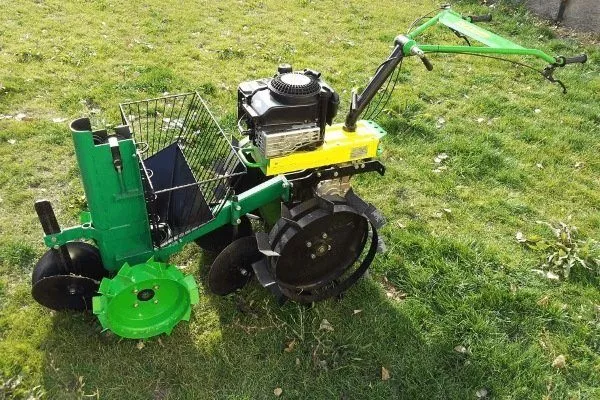
When purchasing a potato planter, make sure that the selected model is compatible with your type of walk-behind tractor.
Models for small tractors
L-201 suspended. Used for planting unsprouted seed. Compatible with tractors of subclasses 0.5-1.3. Row spacing is 50-70 cm. Productivity is 1.16 ha/hour. Tuber filling is not provided. Weight: 380 kg. Planting distance: 18-37.5 cm.
L-202. Suitable for planting unsprouted tubers. Compatible with tractors of various subclasses. Row spacing is 70 cm, and the hopper has a capacity of 600 kg. Productivity is up to 2.4 hectares per hour. Planting spacing is 20.5-40.5 cm. Weight: 760 kg.
L-207. Four-row potato planter. Allows planting of unsprouted potatoes in four rows simultaneously. Row spacing is 0.7, 0.75, or 1 m. Compatible with MTZ 80 and MTZ 100 tractors. Equipped with a fertilizer spreader. Productivity is up to 3.24 ha/hour. Allows for loading the hopper directly from a truck in the field. Planting density is 30-70 plants/ha, fertilizer consumption is up to 400 kg/ha. Hopper capacity is 1,200 kg. Weight is 1,900 kg.
KS SN-4B. Allows simultaneous application of coarse fertilizers while planting unsprouted potatoes. Row spacing is 0.6-0.7 m. Planting distance is 20-40 cm. Automatically backfills the fertilizer furrow. Can process up to 1.3 hectares per hour. Weight: 1,100 kg.
Operating Rules
To ensure your potato planter serves you for a long time, you should make it a habit to follow a few basic rules:
- After finishing the workday, clear the hopper, feeder buckets, coulters, and other components of soil. Check and, if necessary, adjust the tension of the chain drives and mounting bolts.
- Lubricate the lower link pivots every 32 hours of operation.
- During the off-season, store the potato planter indoors or under cover. Loosen the springs, rods, and chains.
- Inspect the planter every two months.
Making a potato planter yourself
It is important to know that a self-assembled unit must perform three main functions:
- even formation of a furrow of a given depth (furrow cutter);
- uniform supply of potatoes (tuber pipeline);
- backfilling the planted material with soil (backfill disks).
One of the most complex parts of a root system is the tuber conveyor, and not every DIYer can build a properly functioning mechanism. To avoid these difficulties, many farmers hire an assistant to manually feed the planting material into a furrow made with a simplified planter.
Here are some drawings of a fully functional potato planter that can be attached to a walk-behind tractor or tractor:
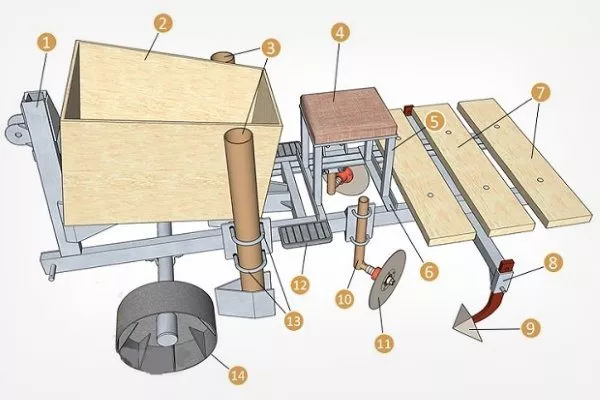
1 - supporting frame; 2 - potato hopper; 3 - planter; 4 - seat; 5 - seat rest; 6 - support; 7 - luggage rack flooring; 8 - holder for a pair of rippers; 10, 11 - stand with a closing disc; 12 - foot rest; 13 - planter mount; 14 - support guide wheel.
Potato planter diagram with dimensions:
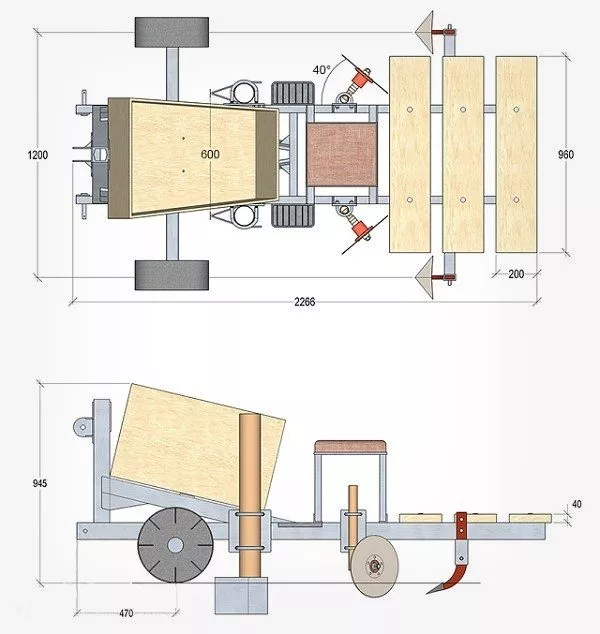
In this design, the ripper is a cultivator tine assembled with a stand. The seat post is made from a 42 x 42 x 3 mm pipe, the seat post supports from a 50 mm angle, and the footrests from a 6 mm thick flat sheet. These parts are constructed separately and then welded together using a leveling system based on the individual's measurements.
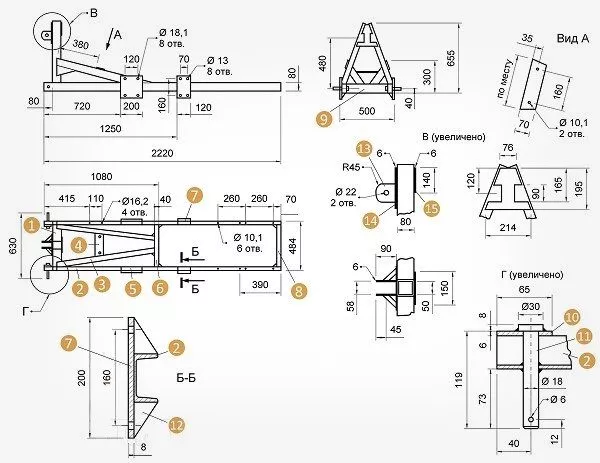
Materials needed to make the frame:
| No. on the drawing above | Element name | Material | Quantity |
| 1 | arch | channel No. 8 | 1 pc. |
| 2 | spar | channel No. 8 | 2 pcs. |
| 3 | diagonal | strip 80 x 14 mm | 2 pcs. |
| 4 | bunker mounting bracket | strip 70 x 8 mm | 1 pc. |
| 5 | tuber pipeline support | 8 mm sheet | 2 pcs. |
| 6, 8, 9 | crossbars | channel No. 8 | 3 pcs. |
| 7 | support of the closing disk stand | 8 mm sheet | 2 pcs. |
| 10 | jumper | 6 mm sheet | 2 pcs. |
| 11 | tractor hitch lower link mounting pin | rod with a diameter of 18 mm | 2 pcs. |
| 12 | kerchief | 4 mm sheet | 30 pcs. |
| 13 | fork for mounting to the central link of the tractor hitch | 6 mm sheet | 1 pc. |
| 14, 15 | overlays | 6 mm sheet | 2 pcs. |
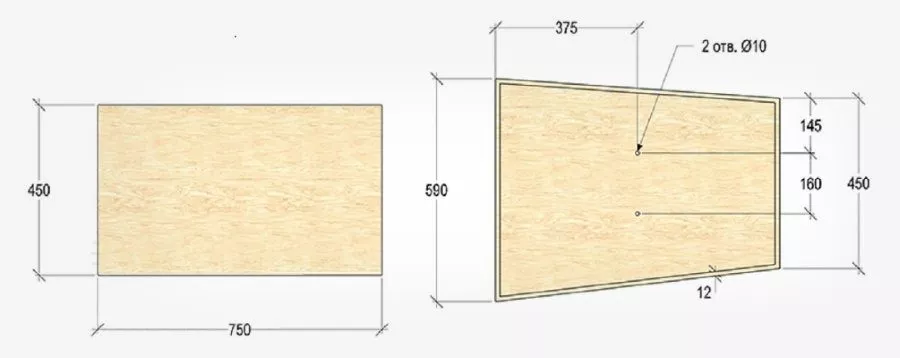
The potato hopper is made of steel or plywood sheets. Furrow-closing discs are mounted to a support, and the pressure angle and depth of penetration are adjusted using stirrups and bushings (see drawing).
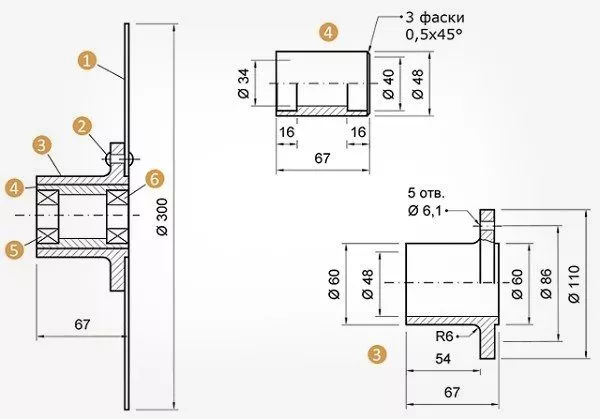
Sealing discs: 1 – disc; 2 – rivet (diameter 6 mm – 5 pcs.); 3 – hub; 4 – bearing housing; 5, 6 – bearing.
The furrow cutter's working depth is adjusted on the frame and secured with ladders. The seed is fed into the planter using a lift or manually.
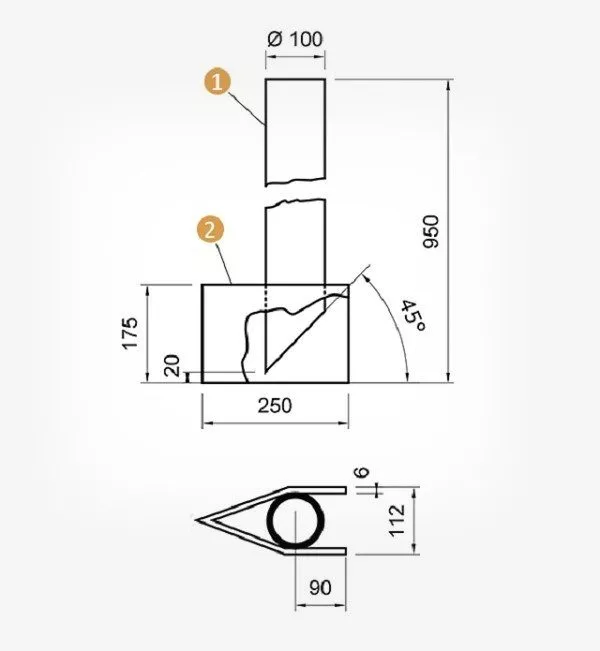
Planter with furrow cutter: 1 – tuber pipeline (100 mm pipe); 2 – furrow cutter (6 mm sheet).
The following drawing shows the bushing that adjusts the position of the closing disc:
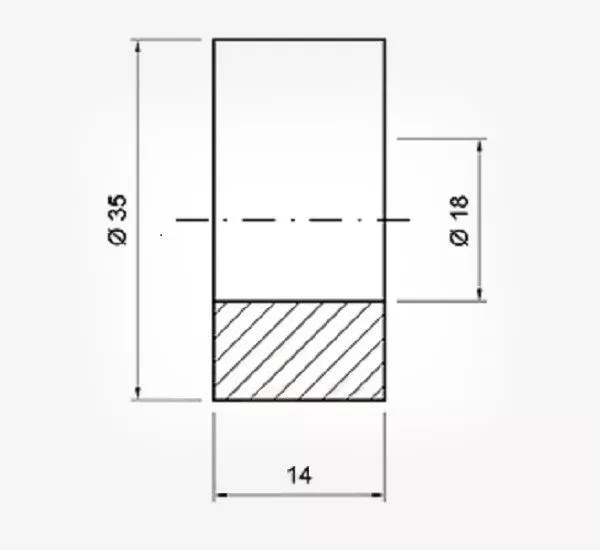
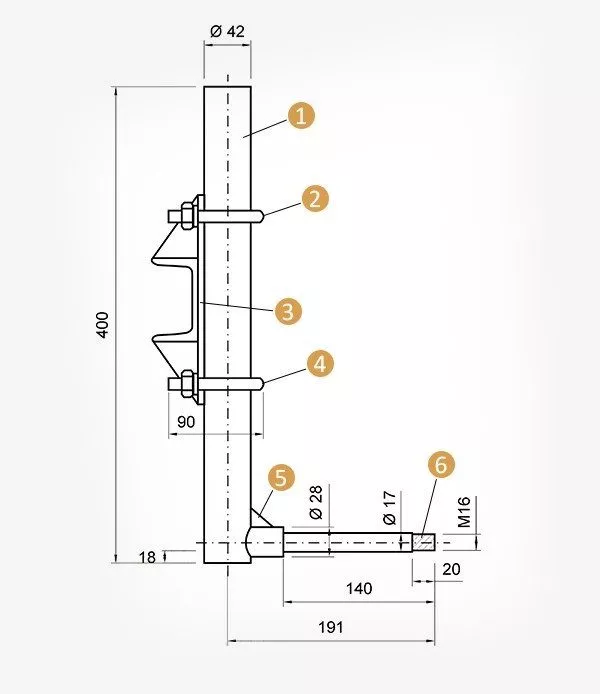
Post of the sealing disk: 1 – post base (42 mm pipe); 2, 4 – M12 step ladders; 3 – post support; 5 – gusset made of 20*20 mm sheet; 6 – console (rod with a diameter of 28 mm).
For mulching, rippers (cultivator attachments installed at the bottom of the frame) are used, the depth of which is regulated by the vertical movement of the racks.
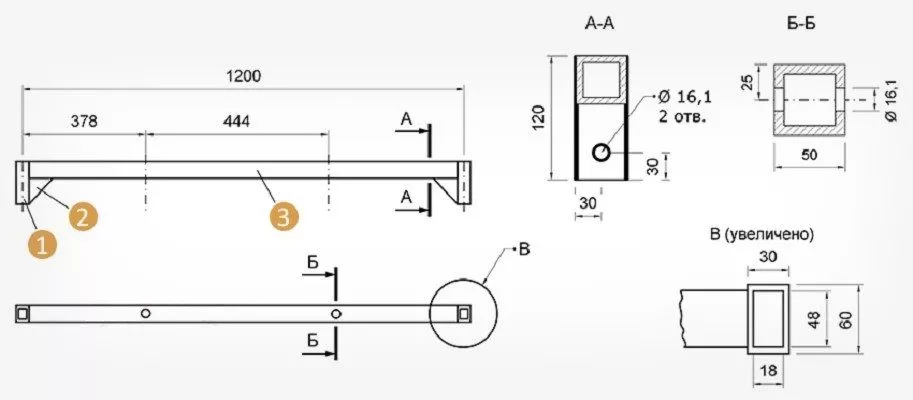
Ripper holder: 1 – collar; 2 – gusset (4 sheets of 6 mm); 3 – rod made of 50*50 angle (square weld).
The axle that attaches to the frame is quite difficult to manufacture. It's best to order one from a specialized workshop, or, if possible, adapt an existing one:
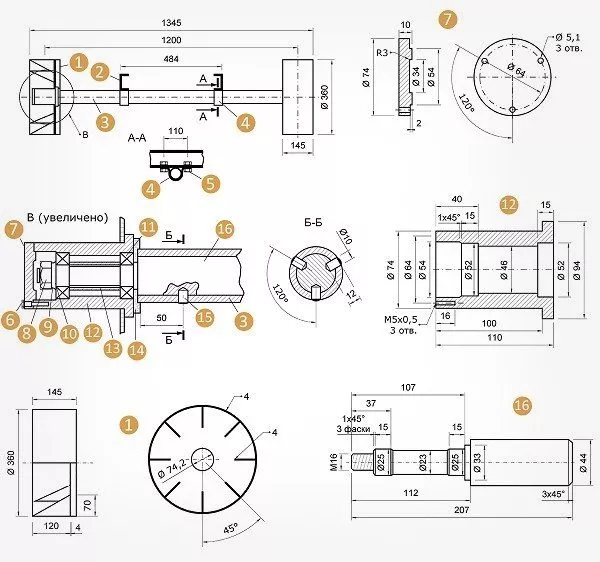
What you will need to make a wheel axle:
| No. in the picture above | Element name | Material | Quantity |
| 1 | support wheel | 4 mm sheet | 2 pcs. |
| 2 | frame side member |
| |
| 3 | axis | pipe with a diameter of 60×8 mm, length of 1,067 mm | 1 pc. |
| 4 | clamp | 8 mm sheet | 2 pcs. |
| 5 | bolt | M16 | 4 pcs. |
| 6 | screw | M5x0.5 | 6 pcs. |
| 7 | hub cap | 2 pcs. | |
| 8 | screw | M16 | 2 pcs. |
| 9 | split washer | 2 pcs. | |
| 10 | thrust washer | 2 pcs. | |
| 11 | bearing | 205 | 4 pcs. |
| 12 | hub | 2 pcs. | |
| 13 | spacer sleeve | pipe 55 mm long | 2 pcs. |
| 14 | pad | felt | 2 pcs. |
| 15 | pin | 6 pcs. | |
| 16 | thorn | 2 pcs. |
If you own a mini-farm or a large plot of land and grow potatoes, purchasing a potato planter will significantly reduce your labor costs. After some time, you'll definitely see the value of purchasing a potato planter.