
The Azart potato is a mid-early table variety that adapts to any soil and climate. But its most important advantage, according to farmers and gardeners, is its increased resistance to late blight, the potato's main enemy. It can be grown both indoors and on a large scale, as the variety's marketability is at least 90%.

History of origin
The team at the A. G. Lorkh All-Russian Research Institute of Potato Farming focused on developing high-quality potato varieties using advanced molecular genetic technologies. Their research efforts resulted in the development of the Azart potato variety, a product of selective breeding.
The experimental work was carried out in the laboratory conditions of the institute, which is located in the village of Korenevo, Lyubertsy District, Moscow Region. The exact year of selection is still unknown.
Description of the plant and tubers
Azarta is characterized by upright shoots and a tall or medium-tall crown, yet the bush appears quite compact (due to its lack of spreading). Other characteristic qualities:
- leaves - smaller than other varieties, which is a special varietal characteristic;
- inflorescences – spreading type with snow-white flowers;
- root crop parameters – oval-elongated shape, weighing about 90-100 g;
- the peel and its surface – smooth, light yellow, equipped with a slight mesh and rare dots;
- pulp – creamy shade.
7-10 potatoes are formed under one bush.

Taste characteristics and purpose
This potato variety boasts a refined flavor, making it ideal for creating a variety of culinary masterpieces. Its flesh does not darken during cooking, ensuring an attractive presentation.
Potatoes are a valuable source of nutrition. A 300-gram serving contains a full complement of carbohydrates, phosphorus, and potassium. Potato flesh contains important health nutrients:
- zinc;
- iron;
- iodine;
- manganese;
- sodium;
- calcium.
Potatoes are rich in vitamin C, all the amino acids found in edible plants, starch and fiber (starch – from 14 to 18%).
When it ripens, what kind of harvest does it produce?
The Azart potato is a mid-early variety, with 80 to 95 days between the first green leaves appearing and harvest time. The average yield ranges from 50 to 55 tons per hectare.
Landing
Potatoes prefer medium-dense soil containing loam, peat, and sand. It's important to strictly follow crop rotation rules, avoiding growing potatoes in areas where nightshade crops, such as peppers, tomatoes, and eggplants, were grown the previous season. Ideal predecessor crops for potatoes include pumpkin, cabbage, corn, and beets.
Ideal conditions for successful potato growth include the following:
- comfortable temperature from +15 to +22 degrees;
- sufficient amount of light;
- light soil with a neutral pH content;
- moderate watering, avoiding excessive moisture.
Passion can be planted using different techniques, the choice of which depends on the conditions.
Comb method
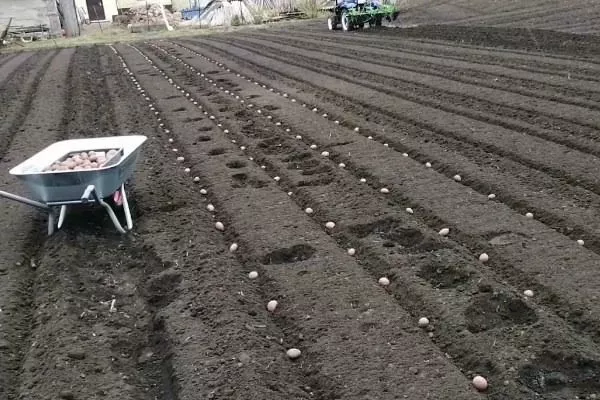
This approach is used when groundwater is close to the surface, for example, in marshy or waterlogged areas. Ridges are created using specialized equipment; their optimal height is 15-25 cm. The spacing between the ridges should be approximately 65-75 cm.
Landing in trenches
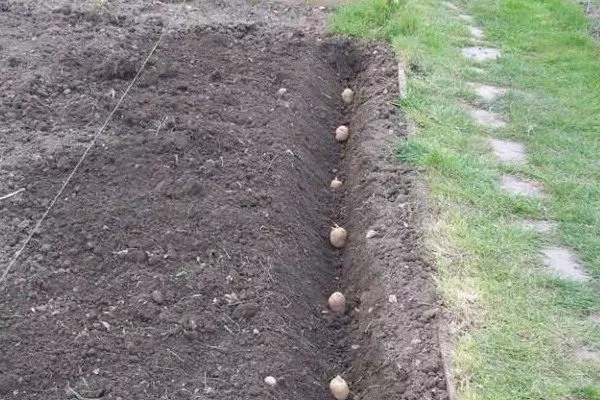
This method is suitable for planting on sandy soils, where the soil is extremely loose and light. Hole preparation begins in the fall, with compost and hay/straw added for fertilizer, as well as wood ash (preferably from deciduous trees).
Smooth landing
This method is especially suitable for plots located on slopes. Here, the soil is always warmed by the sun, loose, and slightly moist. Potatoes are planted at a depth corresponding to the width of a spade. The planting process usually involves two gardeners, who use rope to draw lines and dig holes 10-12 cm deep, filling them with soil from the next row.

Under the straw
This traditional method offers many advantages, including high yields, minimal susceptibility to pests and diseases, and the ability to produce a high-quality harvest without sorting. The straw prevents weeds from growing, significantly simplifying harvesting and maintenance.
The procedure is simple:
- For planting, a layer of straw 18-25 cm thick is spread on the ground.
- The tubers are placed in this layer.
As the potatoes grow and the straw settles, it is necessary to add a new layer of straw several times, on average 3-4 times per season.

Preparation of seed material
To ensure potatoes are fully prepared for planting, they are germinated for two weeks. The tubers are placed in a bright location to improve germination. Potatoes are ready for planting when their skin and flesh turn green, which can be confirmed by cutting into them.
This process stimulates the accumulation of solanine, which is harmful to nematodes. To disinfect against parasites, use Aktara or Fundazol according to the instructions.
Planting in open ground
First, the soil is tilled with a walk-behind tractor or pitchfork, then enriched with organic fertilizers such as compost/humus or diammophoska (5-7 kg or 20 g per square meter, respectively). When digging the planting holes, a handful of wood ash is placed on top.
The depth of planting holes can vary from 6 to 15 cm, depending on the soil type: in sandy areas, the holes are dug deeper, in clayey areas - more shallowly.
Growing and care
The Azart potato variety is grown using traditional methods. Plant care includes the following steps:
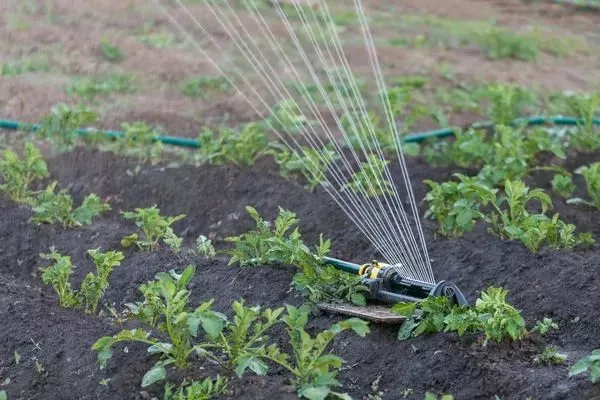
- Potatoes require at least three soil irrigations during the growing season. During dry periods, 40-50 liters of water should be added per square meter of soil. The greatest amount of water is needed during the end of flowering and tuber formation.
- Loosening of the soil should be done the next day after irrigation.
- The first hilling of the bushes is carried out when the stems reach 18-12 cm in height. The second hilling is carried out a month later. The final hilling is carried out after 28-30 days, forming a mound 20-25 cm high.
Potatoes respond well to the application of organic and mineral fertilizers:
- Before the first stage of hilling, it is recommended to add urea in the amount of 20-25 g per 10 liters of water, while the norm for one plant is 500 ml.
- Before flowering, it is advisable to use potassium sulfate at a dose of 1 tbsp per 10 liters of water.
- At the end of the budding period, it is recommended to use an ash solution, adding 3-4 tablespoons to 9-10 liters of water.
Diseases and pests
Azart has a high resistance to various diseases. However, when the soil is infested with nematodes, potato corms can be easily damaged. Actofit or Fitoverm are used against nematodes.
To protect potatoes from late blight, use a garlic infusion or a 1% Bordeaux mixture. Treatments are carried out every 9-12 days. To combat the Colorado potato beetle, use chemicals such as Prestige and Regent.

Advantages and disadvantages
Azart is deservedly popular because the variety has many positive qualities:
There is one drawback: an increased risk of infection by nematodes.
Reviews from gardeners
The Azart potato is considered an elite variety, characterized by high yields and resistance to adverse factors. It is intended for cultivation in large-scale agricultural enterprises and private gardens. Thanks to its compact size, it takes up little space.