
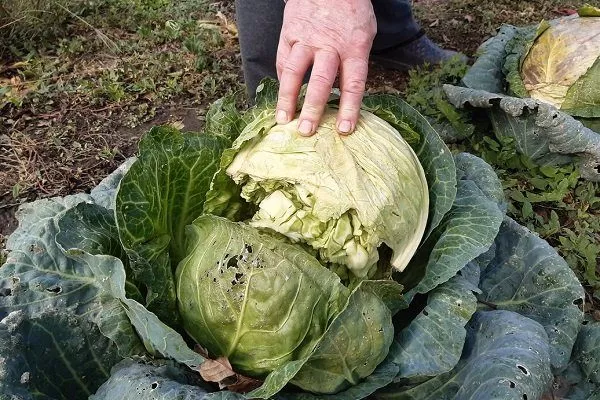
Cabbage cracks for a specific reason. Most often, it's due to violations of agricultural practices. However, there are factors that negatively affect the vegetable regardless of the gardener's actions. To prevent this, farmers need to master methods for protecting cabbage from cracking.
The main reasons for cracks in cabbage
There aren't many causes of cabbage fruit cracking, but they can be pathological (disease), natural (rain, drought, etc.), or agricultural (human-induced). Each case has its own underlying causes.
Untimely watering
To ensure healthy and strong cabbage growth, it's essential to strictly adhere to the watering guidelines for a specific variety. Inconsistency always leads to disastrous results. Moreover, cabbage cracks due to both insufficient and excessive moisture.
A sudden change in weather plays a significant role, especially if there was an initial drought followed by sudden, prolonged rains. What happens in this case:
- the plant's defenses cause it to begin to intensively absorb the maximum amount of water (as if afraid that it will be left without moisture again - this is especially relevant in case of untimely watering);
- As a result, the inner leaves swell and this pressure causes the outer and middle leaves to crack.
The same thing happens if a gardener has not watered a crop for a long time and then immediately adds too much water.
Temperature changes
Cabbage is a vegetable that begins to grow excessively rapidly when temperatures rise, even if the scapes are already fully formed. This most often occurs in the fall—rapid growth causes the scape to split, making room for new leaves.
The same thing happens when it's hot outside (above the temperature needed for the vegetable), and then the temperature suddenly drops by several degrees. This is because cabbage has difficulty growing during hot weather, so its development is slowed down; when the temperature drops, it picks up speed.
Violation of harvest deadlines
Even after reaching technical maturity, the vegetable continues to develop, which eventually leads to cracking. Therefore, it is crucial to harvest within the specified timeframe, based on the variety.
Lots of moisture
Another factor that contributes to cabbage cracking is high humidity. At the beginning of the growing season, the vegetable requires a lot of moisture, as it helps the leaves grow, but once the heads have formed, the watering amount is reduced by 3-4 times.
If watering is done correctly, but there are prolonged rains outside, the cabbage can't escape the increased humidity, so it grows rapidly. Many people think this is a good thing, but it's important to remember that the lower young leaves grow much faster than the upper ones, causing the cabbage to split.
Diseases
Cabbage also cracks due to certain diseases, such as fusarium wilt, vascular bacteriosis, and clubroot. These are bacterial diseases that can be recognized by another symptom: wilting leaves.
- ✓ Fusarium wilt: yellowing of leaves on one side of the plant.
- ✓ Vascular bacteriosis: black veins on the cut of the leaf petiole.
- ✓ Clubroot: swellings and growths on the roots, visible only when the plant is dug up.
To prevent this, perform a preventative treatment: add 1/4 tbsp of Fitosporin-M to 500 ml of water. Soak the seeds in the resulting solution before sowing.
Varietal characteristics
There are many varieties of cabbage, but not all are susceptible to cracking. Some species are particularly sensitive to external factors (watering, drought, moisture, temperature changes). These are primarily varieties intended for pickling.
How to protect cabbage from cracking?
Every gardener can take certain measures to prevent cracking, even if natural factors are considered the cause.
Caring for cabbage heads
The main care measures for cabbage heads include timely watering and fertilizing. However, there are other important nuances without which it's impossible to ensure complete protection:
- Temperature control. During drought and intense sun, cover the cabbage with a tarp. Special netting is used for this purpose. Burlap is an alternative, as it provides shade and allows air to pass through.
- Diseases. Even if you have treated the plants and they still become diseased, immediately cut off the affected head to prevent the infection from spreading further.
- Weeds. Remove it promptly, especially during rainy weather, as tall weeds do not allow air to pass through and the cabbage does not dry out.
- Long rains. If there is prolonged rain outside, be sure to cover the beds with double plastic film.
Watering
Early cabbage varieties should be watered generously in June, mid-season varieties in July, and late varieties in August. Be sure to keep this rule in mind. Other considerations:
- at the beginning of the growing season, pour at least 7-8 liters of water under each bush every day;
- After the head has formed, moisten it once every 3 days;
- If it rains during these days, do not water, postpone the time for another 2 days;
- use the drip irrigation method - it evenly distributes moisture throughout all the beds;
- 20-25 days before harvesting, stop watering completely;
- If the weather is too hot, watering becomes more frequent (approximately 2 times).
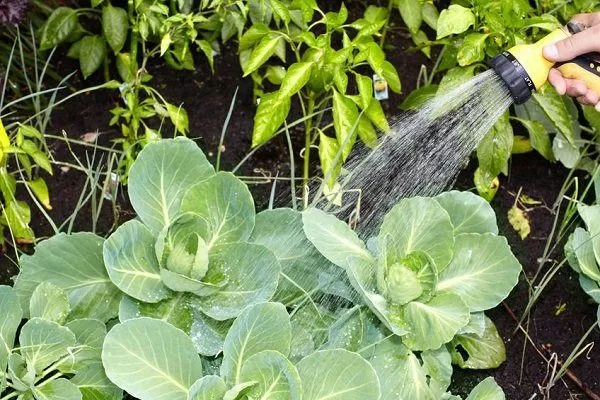
To know for sure whether a plant needs watering, conduct a test:
- Dig a hole 10 cm deep.
- Take soil from there.
- Squeeze it into a fist.
- Unclench your hand.
Top dressing
Fertilization – is an essential part of agricultural practices, as a deficiency of one or another element causes cabbage to crack. Be careful not to overfeed. To do this, use a universal fertilizing schedule for cabbage:
- First time. This is done 9-10 days after transplanting the seedlings. For 3 liters of water, you will need 12 g of superphosphate, 7 g of ammonium nitrate, and 3 g of potassium chloride.
- Second time. Fertilizer is applied after 14 days. Simply dilute 7-9 g of ammonium nitrate in 3 liters of water.
- Third time. Three days before transplanting into the garden, add 30 g of superphosphate, 12 g of saltpeter, and 8 g of potassium chloride per 4 liters of water.
- The fourth time. 16-17 days after transplanting the seedlings into open ground, add 1 liter of mullein per 20 liters of water (pour 0.5 liters under the bush).
- Fifth time. Approximately 3 weeks after the previous feeding. Add 400 g of wood ash to 2 liters of water.
Moisture drainage and mulching
During prolonged rains, it's important to install a drainage system to prevent excessive moisture from reaching the plant. To do this, dig trenches at a sloping angle from each bush to a drainage point.
This problem can be solved in advance – during the formation of the garden bed. Option 2:
- make a high bed;
- form a site with an inclined plane.
If the summer is dry, it's advisable to use mulching—applying mulch (grass, straw, peat, compost, etc.) under each bush after watering. This will prevent moisture from evaporating and the roots from drying out.
The most crack-resistant varieties
| Name | Ripening period (days) | Cabbage head weight (kg) | Peculiarities |
|---|---|---|---|
| Amager | 120-145 | 3.5-4.5 | A dense head of green leaves, sometimes with a bluish tint |
| Present | 125 | 4 | Flattened shape, leaves with a waxy coating |
| Snow White | 160 | 3-4 | Used for baby food |
| Kolobok F1 | 150 | 5-5.5 | Increased juiciness |
If you're worried about preventing cabbage from cracking, choose varieties that are as resistant as possible. The following are considered the most popular in Russia:
- Amager. This late-season cabbage matures in 120-145 days. A single head weighs 3.5-4.5 kg. It is a dense head with green leaves. Some specimens have a bluish tint.

- Present. This mid-late variety matures in an average of 125 days. The head weighs a maximum of 4 kg, is flattened, and the foliage has a waxy, light-green coating.
- Snow White. A very late variety, it takes about 160 days to reach technical maturity. Weighs 3-4 kg. A special feature: it is used for making baby food.
- Kolobok F1. This is also a late hybrid – the harvest takes 150 days. The heads are massive, weighing up to 5-5.5 kg. A distinctive feature is their increased juiciness.
What to do if the heads of cabbage have cracked – ways to preserve them
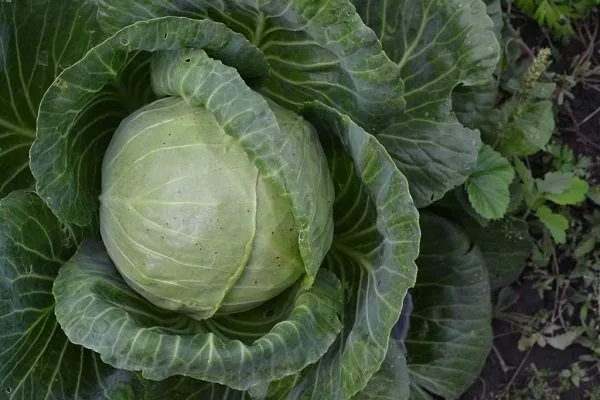
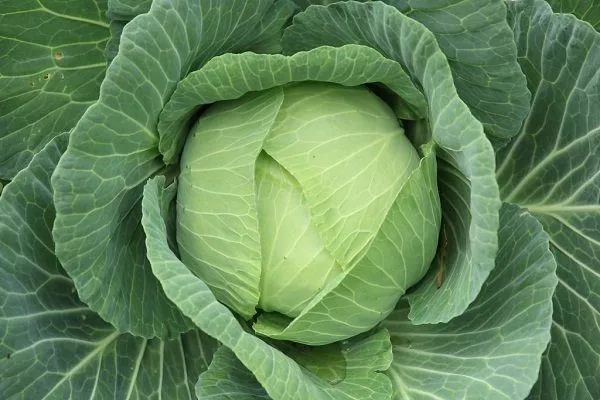
If the heads of cabbage have already cracked, it's essential to save the harvest immediately, as such specimens cannot be stored for long. This is because the leaves dry out, allowing pathogens to penetrate, causing the fruit to rot. But there are options for what to do with cracked cabbage.
Scrolling around the axis
This method is used when the cabbage has just begun to crack, stopping the process completely. What to do:
- Grasp the piece with your hands so that you get not only the head of cabbage, but also the shoot leading to the root.
- Lift the cabbage slightly and slowly rotate it around its axis.
We dry, ferment, and preserve
The best way to use cracked cabbage is to store it after primary processing. The following methods are used for this:
- Conservation. Cabbage can be used in a variety of recipes – salads, appetizers, borscht dressings, etc. Its shelf life is about 2 years, so choose a suitable recipe and preserve it.
- Pickling, pickling. If you don't have a lot of cabbage, you can pickle it and ferment it. This can be done in glass jars, barrels, pots, or plastic containers. However, this product can be stored in the refrigerator for a maximum of three weeks.
- Drying. Dried and pre-cut cabbage leaves are used in stews, cabbage soup, and borscht. Drying is done in an oven or dehydrator. They are typically stored in paper bags, glass jars with lids, or cloth bags.
Shelf life is about 1 year. - Freezing. Can be stored for up to 1 year, but without defrosting. Frozen cabbage can be used in a variety of dishes – if cut into strips, for borscht and stews; if whole, for stuffed cabbage rolls, etc.
The main condition is to pack the cabbage in a dry state; it is better to use vacuum bags.
If your cabbage has been cracking in your garden for years, consider whether you're following proper agricultural practices. If this is the first time this has happened in many years of growing the crop, look for a natural cause. In any case, it's better to take measures to protect the vegetable in advance than to worry about what to do with it later.