
The Fiesta broccoli variety is a hybrid, hence the F1 designation. Due to its hybrid nature, this variety is considered easy to grow, can be grown both outdoors and in greenhouses, and is cultivated in almost all regions of Russia. This plant is both nutritious and beneficial, thanks to its rich chemical composition. We'll tell you how to grow Fiesta broccoli yourself.
The history of the Fiesta broccoli variety
Broccoli originated several centuries ago, but the Fiesta hybrid was developed relatively recently—it was only in 1999 that the variety was included in the Russian state register as a cabbage with unlimited cultivation area. Broccoli is considered to have originated in the Eastern Mediterranean, from where it migrated to Europe, America, and the CIS countries.
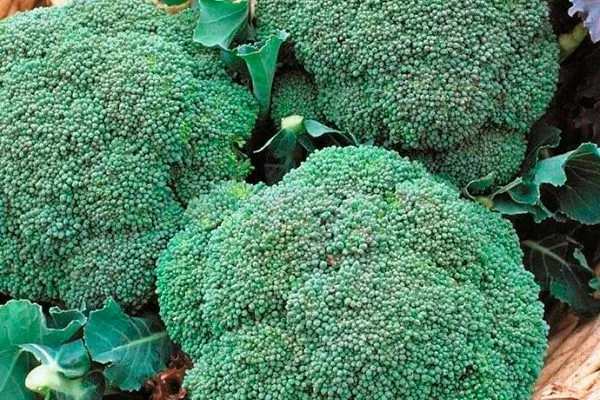
The Fiesta broccoli was bred in Holland at the Bejo Zaden BV nursery. Various varieties were used in various combinations, so the hybrid "absorbed" the best traits of all its parents.
Chemical composition
Fiesta broccoli is considered a low-calorie product—only 32 kcal per 100 g. But most importantly, this hybrid can provide 99% of the body's daily ascorbic acid needs. Fiesta contains a number of vitamins—B9, B6, B5, B2, B1, TE, NE, PP, Phe, A, C, E, K—as well as betaine, beta-carotene, and alpha-carotene.
Microelements found include chromium, iodine, boron, iron, nickel, copper, selenium, zinc, and manganese. Broccoli is also rich in potassium, calcium, sulfur, sodium, silicon, phosphorus, and magnesium.
Other indicators:
- water – almost 90g;
- carbohydrates – about 6.5g;
- proteins – almost 3g;
- fats – only 0.4g;
- fiber – just over 2.5g.
It goes without saying that this cabbage variety contains essential and replaceable acids and other substances, as it contains enough of them to ensure normal health.
Features of application
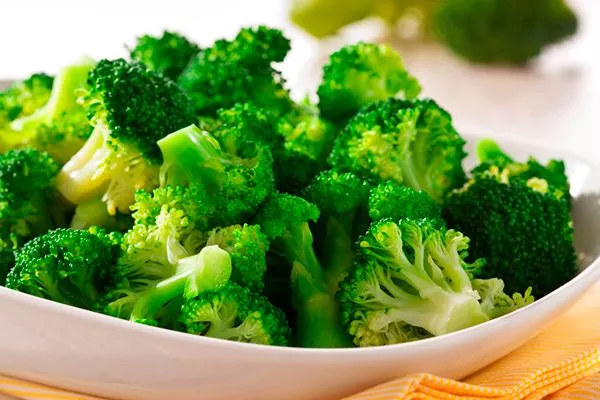
Doctors recommend fiesta as a dietary product, but at home, cabbage is suitable for all types of cooking. It can be fried, boiled, or stewed. It is used in casseroles, stews, sauces, first and second courses.
Ripening period and yield
Fiesta broccoli is a mid-early variety with a growing season of 80-90 days from planting the seedlings in open ground. Yields are considered average, with 2.5-3.5 kg per square meter (0.7-0.8 lb) possible with average care. However, with strict adherence to all agricultural practices, including careful watering and fertilizing, yields of up to 4-5 kg per square meter (0.8-0.9 lb) can be achieved.
Characteristics, description of appearance, taste
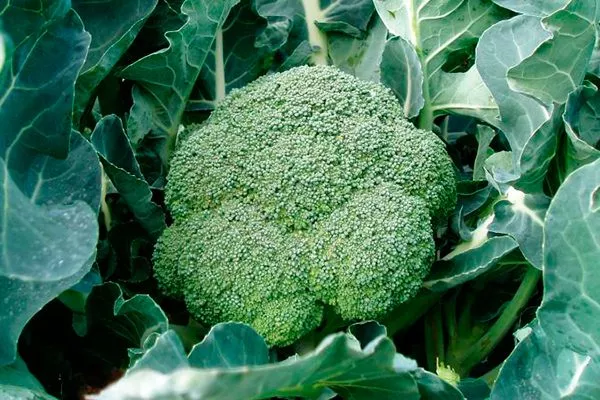
The Fiesta F1 hybrid broccoli is an annual asparagus-like plant belonging to the Brassicaceae family. Each plant reaches 80-95 cm in height, with a rosette of long, upright leaves.
Other characteristics of the variety:
- Leaves. The shape is elongated and wavy, with a vesicular structure. A characteristic curved contour runs along its entire length. The surface has a waxy, bluish coating. The direction is vertical.
- Heads/stalks. The heads are very dense in structure (resembling cauliflower) and round in shape, although flattened specimens are also common. Head formation begins when at least 16 leaves have formed. The head is large – 15 cm in diameter, weighing approximately 500 g.
However, if you strictly follow all agricultural practices, you can get cabbage weighing up to 1.5-2.0 kg. The heads have a bumpy surface and are a rich green color with a turquoise-blue tint. The stalk is of average size. - Escapes. The broccoli stalks are arranged in clusters. They are small but extremely juicy, growing from the stalk. There are 500-2,000 of them. Side shoots are completely absent, which distinguishes Fiesta from other broccoli varieties.
- Root system. It consists of a central rod with a very strong base, from which numerous root shoots extend.
- Taste. Quite pleasant and distinct. Nutty notes are present.
Which regions is it suitable for?
Fiesta broccoli is primarily grown in central Russia, the southern, and northern regions, making it ideal for growing throughout Russia. However, the optimal temperature range is 18-25°C. Excessive heat causes the broccoli to become loose.
The main advantages and disadvantages of a hybrid
The Fiesta F1 broccoli cabbage has many positive aspects, among which the following stand out:
What is the difference from other varieties and hybrids?
Fiesta has some unique differences from other varieties of broccoli. These include:
- cold resistance;
- absence of lateral shoots;
- cultivation in all regions without restrictions;
- nutty flavor;
- planting productivity even with sudden temperature changes.
Landing features
Planting is crucial when growing Fiesta broccoli, as it requires proper soil preparation, proper digging of the planting hole, and, most importantly, planting the seedlings deep enough. There are two types of planting: seedlings and direct seedlings.
- ✓ The soil pH level should be strictly within 6.0-7.0 for optimal nutrient absorption.
- ✓ The soil must contain at least 4% organic matter to ensure the necessary structure and moisture retention.
Soil requirements
Fiesta broccoli requires fertile, light, and well-drained soil. Black soil, loam, sandy loam, and medium clay soil are best. The soil pH should be neutral or slightly acidic. Broccoli thrives best in areas previously planted with grains, legumes, cucumbers, tomatoes, and perennial herbs.
Preparing for landing
The site should be prepared in advance – preferably in the fall. But if this is not possible, then at least 2-4 weeks before planting. To do this, simply dig the soil and add manure or compost. If the soil is highly acidic, add lime or dolomite flour.
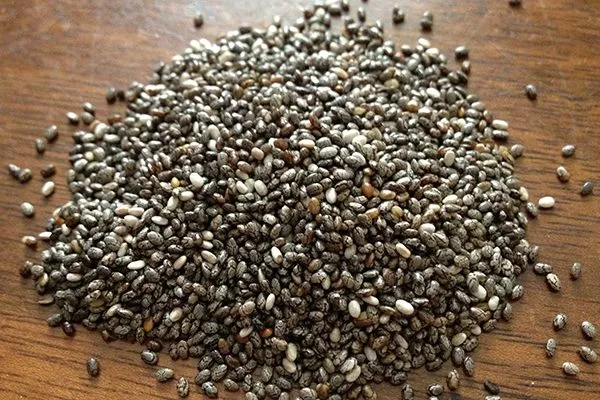
Regardless of the method of planting in open ground, you need to prepare the seeds. Here's how:
- Sort out the planting material – remove all hollow, damaged, over-dried or rotten elements.
- Disinfect the seeds by soaking them in a light pink solution of potassium permanganate for 15 minutes.
- Soak in water for 2 days.
- Treat with a growth stimulator according to the instructions.
- Place on a damp piece of gauze and allow the seeds to germinate.
How to plant without seedlings?
Seeds should be planted outdoors when the air temperature stabilizes at 14-16 degrees Celsius. This method is suitable for mid-latitudes and the south.
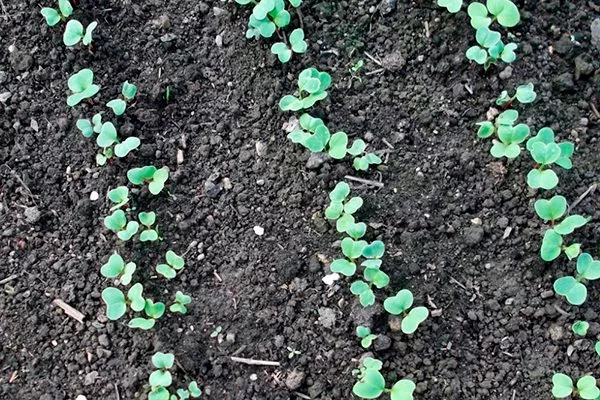
Sowing rules:
- Level the surface of the beds.
- Form furrows. The distance between rows should be at least 50 cm, and between bushes – 30 cm.
- Spread wood ash and humus in a thin layer over the grooves.
- Moisten slightly.
- Plant the seeds to a depth of about 2 cm.
- Cover with substrate.
- Water it.
- Cover the plantings with plastic film. Black is preferable.
Open the cover daily for 15-30 minutes to allow air to pass through, and water occasionally. When sprouts appear, remove the cover completely. Thin out the plants when the first three leaves emerge.
Timing, scheme and rules for planting seedlings
This method is used in harsh climates. Seeds are sown in April and May, depending on the region. After preparing the seeds, follow these steps:
- Prepare containers and disinfect them. Peat pots or honeycomb trays can be used.
- Fill them with substrate. You can buy it at the store or make your own. To do this, mix 3 parts garden soil with 1 part sand. You can add 0.5 parts peat if the soil is slightly acidic (peat acidifies).
- Place the planting material to a depth of 0.5-1 cm.
- Spray with a spray bottle.
- Cover with glass or clear plastic wrap.
- Place the container in a warm place.
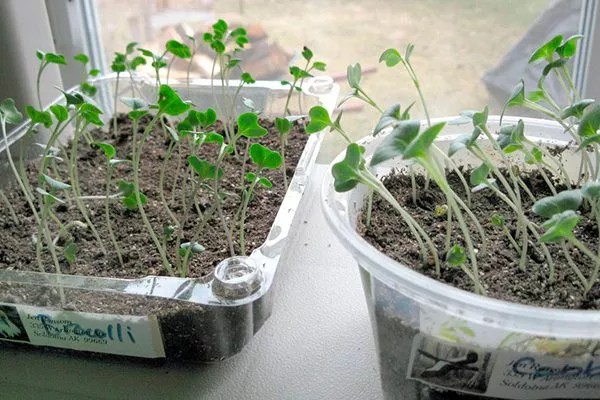
Continue caring for them as usual, including watering and ventilation. When the first three leaves form, transplant the seedlings into individual pots, and when they reach 6-8 leaves, transplant them into open ground or a greenhouse.
Some rules:
- the room temperature during sowing is +18-20 degrees, when the first shoots appear - from +10 to +15 degrees, when 3 leaves are formed - again +20 degrees;
- The easiest way to seal the seeds is with tweezers;
- It is better to immediately maintain a distance of 5 cm between planting material than to thin it out later;
- You can add humus or compost to the substrate, which will speed up germination;
- Place pebbles or expanded clay at the bottom of the containers for drainage – this will prevent water from stagnating;
- Be sure to make holes in the bottom of the containers to drain the liquid and place a tray.
Features of cultivation
The key to growing Fiesta broccoli is monitoring soil moisture levels. Insufficient water will significantly alter the plant's flavor—it will be loose, bitter, and unpleasant.
Care nuances
To retain moisture for a long time, mulch. Use straw, manure, sawdust, or freshly cut grass (preferably nettle, deadnettle, and similar plants rich in nutrients). Also, pay attention to the following maintenance procedures:
- Loosening. Carry out the first treatment 7 days after planting the seedlings and 3 weeks after sowing the seeds. Then, loosen the soil after each watering.
- Weeding. It is carried out once a week or as the weeds grow.
- Watering. Opt for the drip method. Moisten the soil as needed to prevent a dry crust from forming. Therefore, water approximately two to three times a week.
- Top dressing. Two weeks after transplanting, apply nitrogen and phosphorus. If you planted seeds, fertilize the plants 25-28 days after the first shoots appear. Fertilize a second time when small heads form. This requires a solution of ammonium nitrate (20 g), potassium nitrate (40 g), and water (10 l).
You can add wood ash. Apply the third time when the cabbage heads have filled out. Dissolve 50 g of superphosphate in 10 liters of water. Water after each feeding.
- 14 days after planting the seedlings, apply 10 g of ammonium nitrate per 1 m².
- During the period of head formation, add 20 g of superphosphate and 15 g of potassium salt per 1 m².
- Two weeks before harvesting, apply foliar feeding with a solution of boric acid (2 g per 10 l of water).
Pest and disease control
Fiesta, being a hybrid plant, is extremely rarely susceptible to disease. Therefore, preventative treatments with fungicides and insecticides are sufficient. Common pests include aphids, slugs, cutworms, and cockchafers. To combat them, use the following:
- aphid – a solution of the drug Oxyhoma or a soap solution;
- slugs – you need Silk or dusting with wood ash;
- cockchafer – potassium permanganate solution;
- cabbage moth – drug Lepidocid.
Harvesting and storage
Harvesting begins in August and ends in late September. It's important to monitor the broccoli's color change—you need to harvest the heads while they're still dark green. If the color changes, the vegetable is overripe, which means it's not suitable for storage or consumption.
How and when to collect?
The harvest should begin when the heads are fully ripe. They should be cut off with a sharp knife, stems included. The best time to harvest is morning or evening.
Storage Features
Fiesta broccoli has excellent shelf life, but proper storage is essential. Consider these tips:
- can be stored in a room for about 5 days;
- approximately 20 days in the refrigerator at a temperature of +6 degrees;
- 60 days – in a cellar or basement at a temperature of 0 to -1 degrees;
- approximately 8 months in the freezer (temperature -15-18 degrees).
When storing in a cellar, it's important to place the breathable container on a pallet and line the bottom with a damp cloth. Cover the container with plastic wrap.
What difficulties might arise when growing?
The main difficulty is following proper soil moisture management practices. If cabbage isn't watered in time, it will dry out.
Gardeners' reviews of Fiesta broccoli
Fiesta broccoli is a versatile hybrid that can be grown from seed or transplanted. It has a pleasant nutty flavor, excellent shelf life, and excellent transportability, making it popular among farmers not only for personal consumption but also for commercial use.