
Slava cabbage is a white cabbage variety that forms the basis of many Russian dishes. Its popularity is understandable – Slava is easy to grow, productive, and delicious. Let's learn how to plant and grow this famous cabbage.
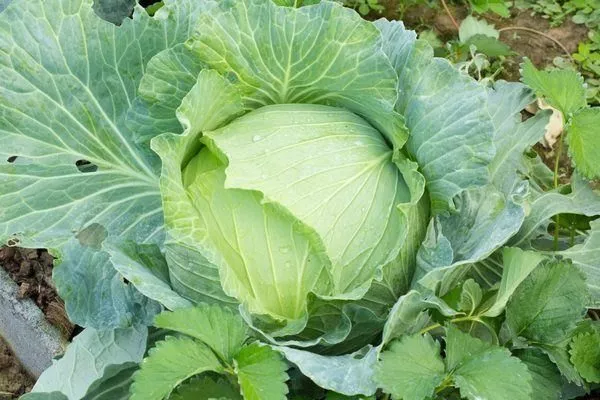
Cabbage Slava and its varieties
Cabbage is one of the most undemanding vegetables. Therefore, many of its older varieties continue to compete with newfangled hybrids. Among the varieties that have successfully stood the test of time is "Slava." It was developed in 1940 at the All-Russian Research Institute of Vegetable Crops Selection and Seed Production.
"Slava" is used in private and commercial vegetable growing. It is considered the best variety for pickling and fermenting. This cabbage comes in two varieties: 1305 and Gribovskaya 231.
| Name | Ripening period | Yield (t/ha) | Disease resistance |
|---|---|---|---|
| Glory 1305 | 100-130 days | 55-95 | Resistant to slime bacteriosis |
| Slava Gribovskaya 231 | 100-110 days | 65-90 | Resistant to fusarium and vascular bacteriosis |
Glory 1305
The "Slava 1305" variety is mid-season. The heads reach technical maturity 100-130 days after germination. It ripens evenly. 55-95 tons are harvested per hectare. It is recommended for fresh and pickled consumption. Harvest is in October. The heads have a shelf life of approximately three months. The variety is resistant to bacterial slime.
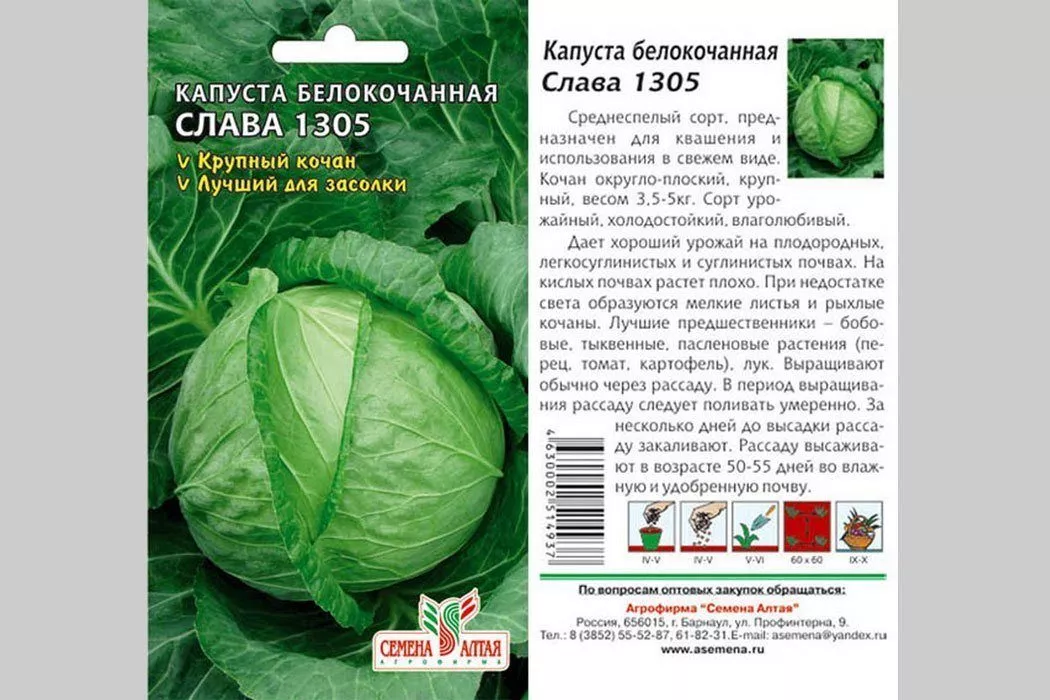
The rosette of leaves is raised. The leaves are rounded, slightly wrinkled, and wavy at the edges. The leaf color is grayish-green. The heads are dense, small to medium, round or flat-round, juicy and crisp. Weight: 2.5-3.5 kg. The cross-section of the head is yellow-white.
Slava Gribovskaya 231
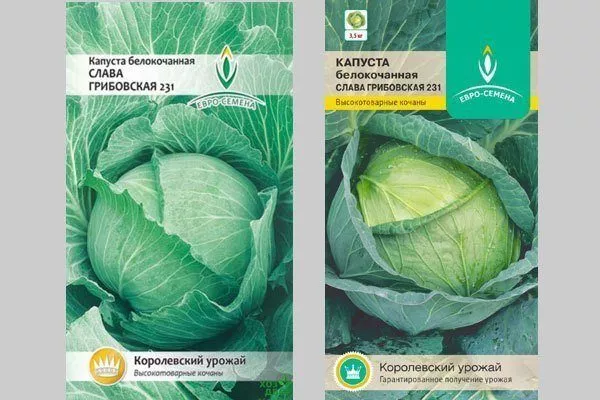
'Slava Gribovskaya 231,' like 'Slava 1305,' is a mid-season variety, but ripens two weeks earlier. Its heads reach maturity 100-110 days after germination. Yields are 65-90 tons per hectare. This variety is noted for its undemanding soil conditions. 'Gribovskaya' heads are denser than those of '1305' and store better over winter.
The rosette is medium-sized and compact. The leaves are green and dark green. The heads are small, rounded and flat, greenish-white, and resistant to cracking. Highly resistant to fusarium and vascular bacteriosis, and susceptible to clubroot.
Appearance of the Slava variety
Cabbage "Slava" has the classic appearance of an ideal white cabbage:
- Socket. Raised, medium sized.
- Leaves. Medium-sized, light green, with a slight waxy coating. The leaf surface is finely wrinkled.
- Head of cabbage. Dense, rounded, slightly flattened.
Characteristics
Main characteristics of the variety:
- Diameter – about 25 cm.
- Commercial yield: 57-93 t/ha.
- Weight: 2.5-4.5 kg. Maximum weight: 6-7 kg.
- Shelf life: 4 months.
The variety is resistant to diseases and pests. It tolerates low moisture levels well and is easy to cultivate.
Advantages and disadvantages
Advantages of the variety:
- Cold resistance.
- Excellent taste characteristics.
- Attractive presentation.
- Good transportability.
- Resistance to temperature changes.
- Versatility – the heads can be used for a variety of purposes.
- Does not crack.
- Maintains yield in dry regions.
Flaws:
- Insufficient resistance to cabbage clubroot.
- Lack of light and nutrients makes the heads of cabbage loose.
- After long-term storage, the commercial and taste qualities decrease.
Seedling method
Most gardeners grow cabbage using seedlings—this allows for a quicker harvest and simplifies the growing process from seedling to leaf emergence. Most importantly, this method is more reliable. Seedlings are equally popular in regions with different climates.
Advantages of the seedling method:
- A minimum of seeds is used.
- The harvest ripens earlier than when seeds are sown in the ground.
- There is no need to thin out the seedlings – this process is painstaking and time-consuming, and a significant portion of the seeds is wasted.
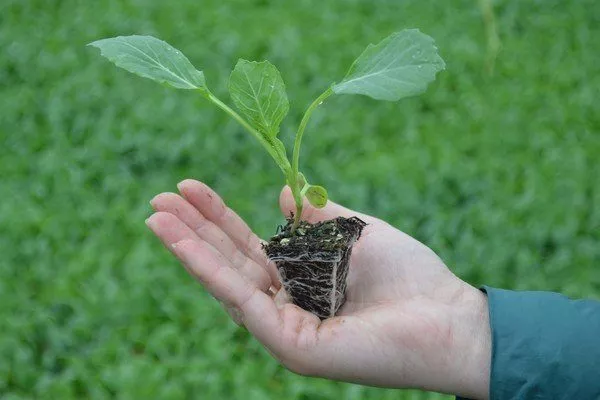
Seed preparation
To ensure germination and then healthy, strong seedlings, the seeds are sorted and prepared for planting. All small seeds are discarded, as they will not produce good heads.
The procedure for preparing cabbage seeds:
- Disinfection. Soak in water heated to 50°C. After 20 minutes, remove the seeds from the hot water and place them in cold water for a couple of minutes.
- Growth stimulation. The seeds are immersed in a nutrient solution prepared from potassium humate (1 g) and water (1 l). After 12 hours, the seeds are rinsed under running water and dried.
- Hardening. Place the seeds on the bottom (vegetable) shelf of the refrigerator for 24 hours at a temperature of about 2°C.
Sowing dates
Seeds for seedlings are sown in early April. The sowing date is adjusted for each region, taking into account the local climate. For example, in southern Russia, seeds can be sown earlier, around March 25th. Seedlings are planted a month after sowing, when the plants have 4-5 leaves.
Growing seedlings at home
Cabbage grows best without transplanting, so it's best to plant the seeds directly in individual pots. Peat pellets are the best option, as they eliminate the need for potting soil or transplanting.
If the seedlings are ready for planting but the weather isn't right, thinning them out can help—it slows growth. The seedlings don't stretch out, but become firmer and more squat.
If seedlings are grown in disposable cups or containers, they will need to be filled with potting soil. Garden soil is not recommended, as it lacks the nutrients needed for strong seedlings to grow, and it may also contain pathogens.
To fill seedling containers, you can purchase a special substrate, or you can prepare your own potting mix. Take equal parts of:
- turf soil;
- rotted humus.
To make the soil looser, coarse sand is added. To prevent blackleg, wood ash is added to the mixture.
The resulting soil mixture needs to be disinfected. Any method will do:
- prepare a weak solution of potassium permanganate and water the soil with it;
- Place the soil mixture in the oven and keep it there at a high temperature.
The disinfected soil is scattered into containers - into separate glasses, special boxes for seedlings, and peat pots.
Watch the video to learn how to grow strong cabbage seedlings:
Sowing occurs at a temperature of 12-18°C. One plant will require an area of 25 square centimeters. The procedure for growing cabbage seedlings:
- Preparing for sowing. Before sowing, moisten the soil in the containers. Make furrows in the boxes or holes in the cups. In the first case, the seedlings will need to be pricked out; in the second, you can do without.
- Sowing. Sow seeds in rows at intervals of approximately 2 cm. Leave 4 cm between adjacent furrows. Lightly cover the seeds with soil. Plant 2-3 seeds in individual cups.
Place the seed containers close to the light. To maintain optimal germination conditions, cover the containers with transparent film. To prevent condensation from forming under the cover, which increases humidity, the plants should be regularly ventilated.
Growing seedlings in a greenhouse
If gardeners have greenhouses, they grow seedlings in them—this frees up windows from boxes of seedlings, and most importantly, a greenhouse can grow many more seedlings—enough for yourself, your neighbors, and even some left over for sale.
Growing features:
- Sowing seeds in a greenhouse is done at the same time as when growing on windowsills.
- The soil in the greenhouse is prepared in the fall. Plant debris is removed from the soil, as it can be a source of disease for the seedlings. Three buckets of rotted manure are added per square meter, along with mineral fertilizers to provide the seedlings with phosphorus, magnesium, potassium, and nitrogen.
- The greenhouse maintains a constant temperature and humidity, allowing seedlings to grow in the most comfortable conditions possible. Excessive humidity leads to plant deformation and promotes the development of fungal diseases.
Caring for seedlings
Seeds sown for seedlings begin to sprout within a few days—3 to 7. For proper development, seedlings require specific care:
- Temperature. To prevent the seedlings from stretching beyond their intended length, they are kept at moderate temperatures, around 16°C during the day and 8-10°C at night. The seedlings are kept in this mode for 7-8 days.
- Picking. This procedure is necessary when growing seedlings in boxes—they will need to be transplanted. The seedlings are pricked out 10-14 days after emergence. Some gardeners pinch the root tips during transplanting, while others advise against this. After transplanting, the seedlings are initially kept at a temperature of 18°C (64°F), then lowered to 13-14°C (55-55°F). At night, the temperature can drop to 10-12°C (50-55°F).
- Thinning. If seedlings are grown in individual cups, they need thinning rather than picking – this is done after 2-3 leaves have formed. The strongest plant is left, while the others are pinched at the root.
- Lighting. When there's insufficient light, seedlings stretch, their stems becoming thin and fragile. Such seedlings are less viable. To extend daylight hours, artificial lighting is used—fluorescent lamps are installed. These are turned on for 12 hours a day.
- Soil moisture. Until the sprouts appear, the substrate is moistened with a spray bottle. Once the seedlings emerge, water between the furrows. If the plants are in trays, water should not fall on them. Seedlings in separate cups are also watered as carefully as possible. Water frequently enough to maintain moderate soil moisture. If the temperature is moderate, water approximately every 5-6 days.
- Top dressing. The first feeding is done at 10 days of age. It is recommended to feed the seedlings with organic matter or a fertilizer solution. The following composition and dosage are recommended for 10 liters of water: ammonium nitrate (20 g), superphosphate (20 g), and potassium chloride (5-10 g). Another feeding is done after 10 days, and the next one in 2-3 weeks.
For seedlings, both overdrying and overwatering are equally detrimental.
Learn how to care for Slava 1305 mid-season cabbage seedlings from this video:
Planting seedlings in the ground
Hardening off the seedlings begins 10-15 days before planting them in the ground. They need to be prepared for a possible drop in temperature. Hardening off begins by bringing the seedlings outside during the day. Ideally, the first step should be on a sunny day. The duration of these "walks" should be gradually increased.
Once the plants have 5-6 true leaves and reach a height of 15 cm, they can be planted in their permanent location. In temperate regions, planting occurs in mid-May or early July.
Features of planting seedlings:
- The Slava variety is cold-resistant, so seedlings are planted at 8-10°C.
- To ensure large heads of cabbage, the plant must have sufficient space to grow. Seedlings are planted at intervals of 50-60 cm, with 60 cm between rows.
- In cool spring regions, seedlings are covered with film, which is removed when the weather permits.
- Soil preparation for planting is similar to that in greenhouses. Here's the procedure for preparing open ground:
- The beds are marked out using stakes and twine. According to the planting plan, holes are dug – their size should be large enough to accommodate the plants' root systems.
- Fertilizers are added to each hole: urea (1 teaspoon) and superphosphate (2 teaspoons). The fertilizers are mixed with the soil.
- Water is poured into the holes until a creamy mass is obtained.
- The seedlings are planted in the resulting mixture. They are carefully compacted and covered with soil. From then on, the seedlings are watered every 2-3 days.
Growing without seedlings
Growing cabbage without seedlings involves sowing seeds in open ground. This method is popular in southern Russia. Seeds are sown from April 15th to May, provided the minimum temperature is 4-6°C. The optimal temperature for sowing is 10°C. If there is a risk of frost, cover the crops with plastic.
- ✓ Soil pH should be between 6.0-7.5 for optimal growth.
- ✓ The soil should be rich in organic matter, with compost or well-rotted manure added before planting.
Site requirements:
- Illumination. There shouldn't be even the slightest shade. To produce a full harvest, cabbage must be well-lit throughout the day.
- Soil. Neutral pH is desirable. Otherwise, the cabbage will become diseased and produce poor fruit. The soil should be nutritious, well-prepared, and loose. Hard, low-oxygen soil will prevent large heads of cabbage from developing.
- Predecessors. Cabbage grows well after potatoes, legumes, cucumbers, lawn grass, and dahlias. Undesirable predecessors include radishes, beets, and tomatoes. Beans and carrots are not recommended for planting near cabbage.
Don't plant cabbage in the same plot two years in a row. Cabbage can be replanted no sooner than after three years.
Step-by-step planting process
Step-by-step instructions for planting seeds in open ground:
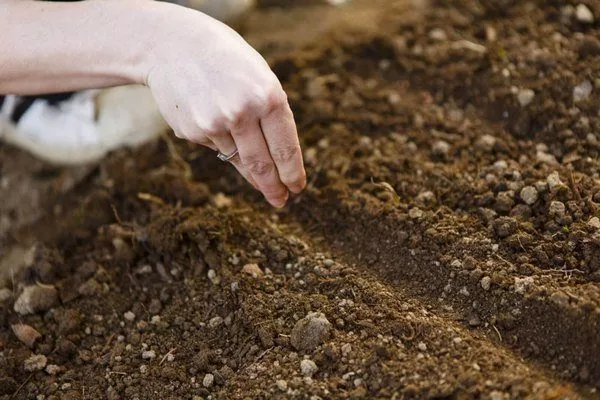
- Level the soil with a rake, breaking up any clods of earth.
- Mark out the beds by stringing a rope tied to pegs.
- Using a hoe, make furrows 2 cm deep.
- Water the grooves with warm water.
- Sow seeds at regular intervals. The seeding density depends on whether you're planting dry or sprouted seeds. If the seeds are sprouted, plant them 50-60 cm apart. Sow dry seeds more densely—thin out any excess seedlings later.
- Sprinkle the seeds with dry soil and compact them lightly with your palm.
Further care
Regardless of whether cabbage is planted from seeds or seedlings, its yield depends on the quality of care throughout the growing season. It's important to maintain loose soil and keep it regularly moist.
Frost protection
In northern regions and Siberia, frosts are still possible even in early summer. If young cabbage is exposed to low temperatures, the harvest will be lost. To prevent losses, cover the planted seedlings with plastic film—the film should be raised above the ground to allow the plants to grow freely.
If it is known in advance that a drop in temperature is expected, preventative watering is carried out - moist soil releases heat more slowly, saving young seedlings from the cold.
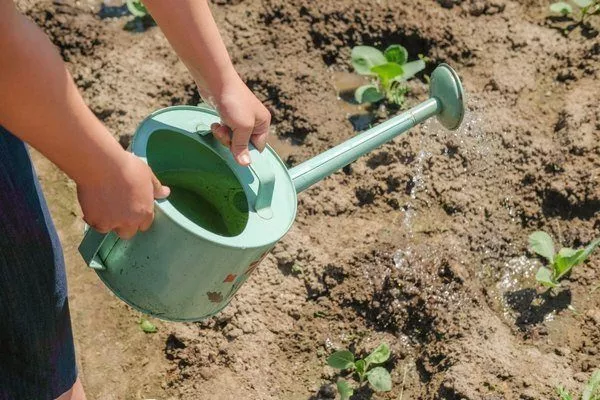
Watering
Watering cabbage can be done in different ways:
- Watering cans.
- Hoses, including sprinkler irrigation, using spray nozzles. This method of watering is useful in hot weather.
- On large plantations, drip irrigation is the optimal irrigation method. Water is supplied through pipes laid along the rows. The water is supplied automatically, making cabbage care much easier.
Features of watering cabbage "Slava":
- Cabbage is watered up to eight times per season. The frequency of watering depends on the amount of rainfall. Infrequent but abundant watering promotes the formation of firm, juicy heads of cabbage. Watering cabbage too frequently can cause the maturing heads to crack.
- Watering rate: 20 liters per 1 sq. m.
- Three weeks before harvesting, stop watering the cabbage.
If the inner part of the cabbage heads begins to ripen rapidly, the outer leaves may crack. In this case, gently turn the plant—this will break off some of the roots, slow down the absorption of water and nutrients, and stop excessive growth of the cabbage heads.
To prevent the soil from drying out, after watering mulchWhen the leaves are strong enough, the plants are hilled to stimulate root development. Hilling allows the plant to receive more moisture and nutrients, which are essential for the development and growth of the heads.
Top dressing
After planting, seedlings are typically fertilized three times. These are necessary to ensure the plants form firm, juicy, and tasty heads.
- 2 weeks after planting: apply a solution of mullein (1:10) or complex mineral fertilizer.
- During the formation of heads: add wood ash to the fertilizer (50 g per 10 l of water).
- 3-4 weeks after the second feeding: repeat the application of ash with mullein.
Periods and composition of cabbage feeding:
| Period of contribution | Composition of fertilizers |
| 2 weeks after planting the seedlings | Fermented mullein solution (one bucket per 5-6 plants) |
| During the formation of heads of cabbage | Wood ash is added to the mullein (50 g per 10 l) |
| At intervals of 3-4 weeks after the second feeding | Similar to the second feeding |
Many gardeners don't limit themselves to industrial fertilizers; to improve soil fertility, they also water it with herbal infusions. One popular recipe:
- A third of the barrel is filled with herbs—nettle, chamomile, dandelion, burdock. The herbs are pre-chopped. Water is poured into the barrel and the lid is closed. Fermentation begins in the barrel.
- After a week, strain the fermented liquid and dilute it with water (1:10). Water the cabbage with the resulting solution.
Iodine is considered a good fertilizer for cabbage. This element is beneficial for iodine-deficient soils, such as podzolic and peat soils. Iodine also prevents late blight, gray mold, and powdery mildew in all types of soil.
Diseases and pests
The Slava variety is fairly resistant to most common cabbage diseases. However, to avoid crop losses, gardeners should take preventative measures, and if threats arise, take action. control of cabbage diseases and pests:
| Diseases/pests | Symptoms of damage | How to fight? |
| Peronosporosis | Yellow spots appear on the leaves, and a whitish coating appears on the underside. | Spray with fungicides, for example, Ridomil Gold. |
| Clubroot | Characteristic growths appear on the roots | During digging, slaked lime is added to the soil – 250 g per 1 sq. m. |
| Fusarium | The leaves turn yellow and dry out | Affected leaves are torn off and destroyed, and the soil is treated with fungicides - benzimidazoles. |
| Blackleg | The lower part of the stem becomes thinner and turns black. | Before sowing or planting seedlings, the soil is disinfected with a weak solution of potassium permanganate, and affected plants are destroyed. |
| Diamondback moth | Moth larvae-eaten passages appear on the heads of cabbage | Weeds are removed in a timely manner; in case of severe attacks, spray with Entobacterin. |
| Cabbage aphid | Leaves affected by aphids become discolored and deformed. | Dill and parsley are planted between the rows – ladybugs fly to them and actively destroy aphids. |
Diseases can be triggered by excessive planting, dense plantings, and excessive fertilizing. To prevent diseases, cabbage is dusted with ash during the seedling stage and treated with Bordeaux mixture before planting outdoors. If cabbage is affected by a disease, the affected leaves are picked off and destroyed.
Harvesting and storage
The heads of cabbage are harvested in early August. They are cut with a sharp knife and placed in the shade to dry. After sorting, heads with minor damage are selected and processed, such as salting, fermenting, and pickling. The rest are stored. The cabbage is stored at a temperature of around 0°C, with an optimal humidity of 90%.
Healthy, medium-sized heads of cabbage are stored in different ways:
- place them on shelves or mesh containers, after wrapping them in paper;
- They are placed in vegetable nets and hung with twine from the beams.
The cabbage is placed in boxes and hung from the ceiling, with the stalks facing upwards.
Regardless of storage method, cabbage should be sorted periodically. Remove any damaged or rotten leaves to prevent spoilage and extend the shelf life of the heads.
Reviews of Slava cabbage
The "Slava" cabbage is a unique variety that has remained popular for nearly 80 years. This success is due to its remarkable agronomic and flavor characteristics, its pickling qualities, and its ease of cultivation.
I bought a set of cabbage seeds. Among them is Slava1305. I've never grown this variety before. I read the article with interest. Thank you.