
Cabbage is considered an easy-to-grow plant, ideal for growing in any climate. However, even it can stop growing at any stage of its development. This can happen for various reasons. Any of them can be eliminated to restore the cabbage's health and ensure a good harvest.
Reasons for poor seedling growth
The list of factors that can stunt cabbage growth during the seedling stage or completely destroy young plants is extensive. These include:
- poor quality seed material;
- failure to carry out disinfection measures immediately before sowing;
- highly acidic soil;
- neglecting soil disinfection before planting seeds;
- violation of the terms of planting seeds;
- the air temperature in the room with seedlings is above/below the norm (optimal is: within + 20°C before germination, when seedlings appear + 15°C during the day and + 8… + 10°C at night);
- dense planting (recommended distance between seedlings is 2 x 2 cm);
- short daylight hours (cabbage requires 14–15 hours a day without direct sunlight);
- violation of soil moisture rules;
- no additional nutrition (additional feeding is applied 2-3 times from the moment of picking until transfer to open ground).
- ✓ The optimal air humidity for cabbage seedlings should be 60-70%.
- ✓ To prevent seedlings from stretching, it is recommended to use phytolamps with a spectrum close to the sun, at a distance of 20-30 cm from the plants.
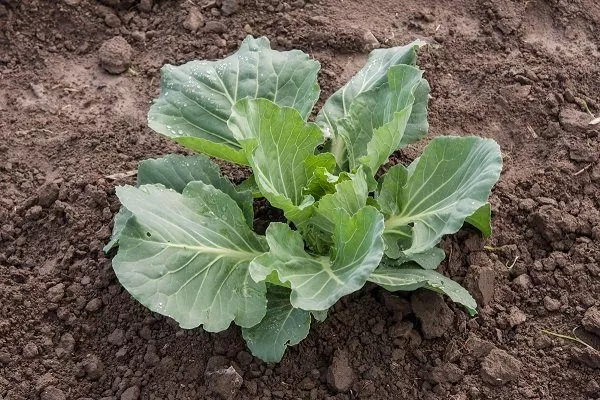
Often, inexperienced gardeners experience poor planting or even die immediately after transplanting their seedlings outdoors, even if they followed all the proper indoor growing practices. This often happens when they neglect hardening off the plants.
It is difficult for plants to immediately switch from the warm and comfortable growing conditions on a windowsill to the “harsh” outdoor climate.
Why does cabbage grow poorly in open ground?
In open beds, established young plants can also experience stunted growth. There are several reasons for this:
- there is a lack or excess of nutrients in the soil;
- watering is done incorrectly;
- growing conditions are not met - density, illumination, incompatibility with neighboring crops;
- exposure to pests or diseases.
By carefully examining the crop's growing conditions, it's easy to identify the factor affecting plant growth. The problem can then be addressed by taking specific measures.
Poor site selection
Cabbage thrives in intense sunlight. Therefore, it's recommended to plant it in an open area where the light won't be obstructed by fences, walls, spreading bushes, trees, or other tall plants.
If there's insufficient light, cabbage will initially grow from the roots, but at the third leaf stage, it will suddenly stop growing and begin to dry out. Saving the plant is likely impossible.
If the problem becomes noticeable at the initial stage of deformation (stem stretching away from the root, yellowing of the sprout), try using Zircon or Epin-Extra according to the instructions. However, there is no guarantee of any harvest. The plant will still not receive enough light.
Another option is to move the seedlings to an open, well-lit space:
- Lightly moisten the soil in the root zone of the young sprout.
- Step back from the stem about 5 cm and dig deep into the plant.
- Carefully remove the seedling along with the root ball.
- Place the seedling in the new hole up to the cotyledon leaves, but not burying them. Lightly compact the soil.
- Water with plain water or a solution of any growth stimulator according to the instructions.
- Cover with a plastic container (if the height and spread of the seedling allows) or a large burdock leaf. In other words, cover the seedlings as you did when initially planting them.
Bad soil
Cabbage is a biennial cruciferous plant, and plants of this species do not tolerate highly acidic soils. Even good fertilizer will not ensure the crop's growth in such conditions.
The optimal soil pH for cabbage is 5–6. If conditions are unfavorable, the plant will form several large leaves without a head of cabbage or even die.
There are several ways to determine soil acidity yourself:
- Check what crops grow in the chosen area. Plantain, sorrel, mint, and buttercup indicate acidic soil.
- Take a small amount of soil and add a drop of vinegar to it. The acidic environment will prevent the reaction, and no bubbles will appear in the soil.
Soil deoxidation is usually done in advance. In the spring, lime, dolomite flour, or crushed chalk are added before plowing at a rate of 500 g per square meter. Crushed eggshells also have a beneficial effect, enriching the soil with iron, calcium, phosphorus, and manganese.
Incorrect planting technique
Even minor damage to the tender roots of a cabbage seedling can lead to its death. The plant will be unable to obtain moisture and nutrients from the soil. The same thing will happen if the roots curl upward and become kinked during planting.
The transplant should be carried out in the following manner:
- Thoroughly water the soil in the seedling container with water at room temperature.
- Carefully remove the seedlings from the soil without damaging the root ball.
- Water the planting holes thoroughly. This will help prevent root breakage.
- Carefully place the seedling upright and cover it with soil, holding it slightly in the air. The plant shouldn't be buried below its growing point.
The video explains how to properly plant cabbage seedlings in the ground:
Planting density
Spacing cabbage seedlings too close together will create unhealthy competition for nutrients in the soil for the roots and sunlight for the leaves. Avoid planting seedlings in a small area with the "as many as possible" principle.
The optimal planting ratio for cabbage is 45–50 cm between seedlings and 70 cm between rows. The spacing can vary depending on the cabbage variety and ripening time. However, the space must be optimal to ensure each seedling receives sufficient resources.
Incorrect watering
The soil moisture regime is established while the seedlings are still growing. It is recommended to water only when the soil dries out, using small amounts of water to ensure the soil is saturated but not stagnant.
Follow the rules:
- Water the cabbage in the evening, otherwise the sun will simply evaporate the moisture from the soil surface.
- In normal weather, water once every 4–5 days; in hot weather, water every 1–2 days.
- To prevent the soil under the bushes from hardening and forming a dense crust, loosen it the day after watering.
Undernutrition or overnutrition
A lack of nutrients not only slows cabbage growth but also prevents heads from forming. Early varieties require fertilizing once or twice, while mid-season and late varieties require 3-4 times. The last application of nitrogen-containing fertilizers is one month before harvest.
The main substances that influence the growth and development of cabbage are:
- potassium;
- phosphorus;
- calcium;
- nitrogen.
However, both insufficient and excessive amounts of fertilizer are equally harmful. The table below contains information on the symptoms of various mineral exposures on cabbage.
| Name of the substance | Signs of deficiency | Signs of excess |
| Potassium | The edges of the leaves become covered with small dry spots and curl downward. The plant's color turns bluish-green. | The growth of the shoots stops, they turn light green, and the leaf blades become spotted. The leaves often begin to wilt and fall off. |
| Phosphorus | The veins on the underside of the leaf turn reddish-purple. The outer surface of the leaf becomes covered with light purple spots. Dying begins. | A rare phenomenon. It causes the leaves to turn pale, the plant to age rapidly, and interveinal chlorosis to appear. |
| Calcium | It appears within the growing cone. The problem only becomes noticeable when the head is cut.
External (rare) signs: leaf edges turn brown or black. They eventually die off. | Signs of chlorosis |
| Nitrogen | The plant turns pale green or yellowish and growth stops. | The color is dark green, the shoots grow too quickly, which causes the plant to weaken significantly. |
After the seedlings have taken root in the soil, it is recommended to feed them with Kemira Combi according to the instructions on the package.
Diseases
Exposure to pathogenic microorganisms that cause diseases not only stunts cabbage growth but also leads to its death. The most common cabbage diseases are:
- keel;
- downy mildew;
- Alternaria;
- mucous and vascular bacteriosis.
- ✓ Clubroot: In addition to growths on the roots, the plant may show signs of wilting in hot weather, even with adequate watering.
- ✓ Downy mildew: in addition to spots and plaque, leaves may curl and fall off prematurely.
Plants can be saved if symptoms are detected early. The table below shows how to do this.
| Name of the disease | Symptoms | Treatment methods |
| Kila | A fungal disease that manifests itself as growths of varying sizes on the roots. Root hairs become fewer, leading to insufficient water supply to the plant. | Affected seedlings are immediately removed by the roots and destroyed. The remaining plants are treated with sulfur-containing fungicides. |
| Downy mildew (peronosporosis) | A fungal disease, the upper side of the leaves becomes covered with irregularly shaped yellowish spots, while the undersides become covered with a faint gray-white coating. | When the first symptoms are detected, plants are treated with preparations containing copper according to the instructions. |
| Alternaria (black spot) | Leaves become covered with small black spots. As the disease progresses, these spots enlarge and fuse together. Eventually, black fungal spores appear on them. | At an early stage, affected plants are treated with 1% Bordeaux mixture (100 g of copper sulfate and lime per 10 liters of water) or a suspension of 0.5% cuprosan (50 g of 80% powder per 10 liters of water). |
| Mucous and vascular bacteriosis | The disease manifests itself in the plant's vascular vessels, which turn black. This is especially noticeable at the edges of the leaves, which turn yellow toward the center, become translucent, and dry out. | Affected specimens are removed with roots and destroyed. |
Pests
Not only insects, but also their larvae attack cabbage. Damaged areas are vulnerable to pathogenic bacteria and infections. Cabbage is most often attacked by:
- cruciferous bugs and fleas;
- cabbage flies;
- aphid;
- whitefly;
- white butterfly larvae (cabbage whites), cutworms, cabbage moths.
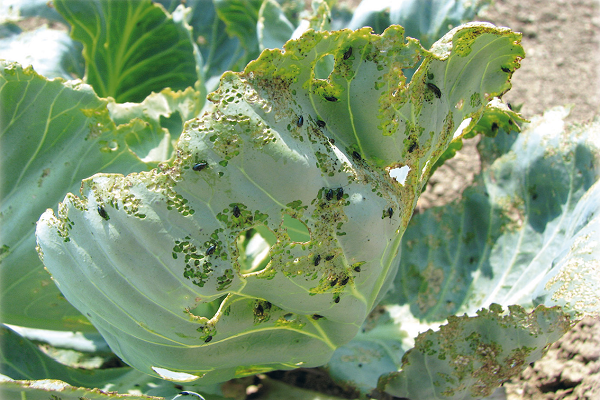
Since cabbage is often eaten raw, insecticide treatment is not recommended. At the very least, it should be applied one last time, 1.5 months before harvest.
Folk remedies can help repel pests. Cabbage pests are wary of strong, spicy odors. It's recommended to plant the following around the beds:
- calendula;
- sage;
- marigolds (low-growing varieties with small variegated flowers);
- dill;
- basil.
There are several effective home remedies:
- To combat caterpillars and aphids, spray your plants with an infusion of tomato tops. Finely chop the tops, add 5 liters of water, and simmer for 3 hours. Strain, dissolve 0.5 bar of tar soap in the liquid, and dilute with boiling water.
- Pour boiling water over a large amount of onion peels and let it steep for 24 hours. Dilute a little dishwashing liquid or soap shavings in the solution. Spray the cabbage with the mixture on all sides. Most insects will stay away from the plants, while the rest will stick to the leaves and die.
- For prevention, use a mixture of ash and tobacco dust in any proportions. Sprinkle it over the entire space between bushes and on the leaves.
Other reasons
Cabbage isn't a heat-loving crop. The optimal temperature for growing it is up to 25°C. At higher temperatures, the plant, even if already well-developed, begins to dry out and turn yellow. This is caused by dehydration. During these periods, cabbage requires regular soil moisture.
On the other hand, overly wet soil will cause root rot, causing the plant to stunt and eventually die. Water the plantings only when the soil is dry. Stop watering during wet, rainy weather.
The cabbage rosette is starting to rot or dry out due to unfavorable weather conditions. In this case, water the plants using one of the following mixtures:
- for 10 liters of water - 1 tbsp. of "Kristalin" and 2.5 g each of boron and magnesium;
- For 10 liters of water - 3 drops of iodine, 2 tablespoons of superphosphate and magnesium sulfate.
Late frosts and sudden cold snaps will also stunt cabbage growth. This occurs due to metabolic disruption in frozen roots and leaf blades.
Helpful tips
Preventative measures are important when growing cabbage. They will help avoid problems with growth and development.
Prepare the soil mixture for seedlings in advance, starting in the fall. If you can't find it in specialty stores, use this recipe:
- 1 part humus;
- 1 part turf soil;
- ash in a ratio of 10 tbsp. per 10 kg of mixture.
Prepare the soil in the garden bed in advance: dig it up, enrich with fertilizers, deacidify if necessary. Remove any debris from last year's plants from the surface; they may harbor harmful microorganisms and insect larvae. Try to remove the rhizomes of weeds.
Follow crop rotation rules. Rotate the cabbage bed each year. Plant the crop where the following grew last season:
- onion;
- tomatoes;
- potato;
- cucumbers.
Regularly inspect the condition of plants and the soil beneath them. Take appropriate action at the first sign of pest or disease infestation.
Incorrect variety selection can also cause poor cabbage growth. Look for hybrids adapted to your growing area. Follow the planting schedule.
Cabbage stunting is a common problem, but in most cases, it can be resolved quickly. Adhering to proper agricultural practices, constantly monitoring the crop's growth throughout the growing season, and providing timely plant support will help ensure a good harvest.