
To get a high-quality cabbage harvest, it's essential to care for it properly. Watering is also crucial, as both too little and too much moisture negatively impact the plant's growth and development. Furthermore, improper watering of seedlings can lead to various fungal and viral diseases. Let's look at how to water cabbage properly.
Water requirements for irrigation
Cabbage is a moisture-loving vegetable that requires regular and abundant watering with high-quality water. It must have the following characteristics:
- WarmAlthough cabbage is a cold-hardy vegetable, it should be watered with room-temperature water (18–23°C). Water temperatures below 12°C should never be used for irrigating cabbage, as this inhibits root development. This, in turn, leads to poor rooting, slow growth, and poor head formation. Criteria for selecting water for irrigation
- ✓ Use water that has been standing for at least 48 hours to allow chlorine and other volatile compounds to evaporate.
- ✓ Check the pH of the water, the optimal range for cabbage is 6.0-7.5.
Cold water promotes the development of fungal, rot, and bacterial diseases. Combined with low air temperatures, it can lead to the death of seedlings, especially in open ground.
- DefendedIf tap, well, or borehole water is used for irrigation, it should be left to stand for several days in buckets or barrels in a sunny area. Painting the containers black will allow the water to heat up faster. However, this is only true for temperate climates. In southern regions, water in such containers will quickly overheat. Using such containers for watering cabbage is not recommended, as it will also negatively impact the plant's growth.
- ✓ Water cabbage early in the morning or late in the evening for maximum water absorption.
- ✓ Ensure the soil is soaked to a depth of at least 30 cm for mature plants.
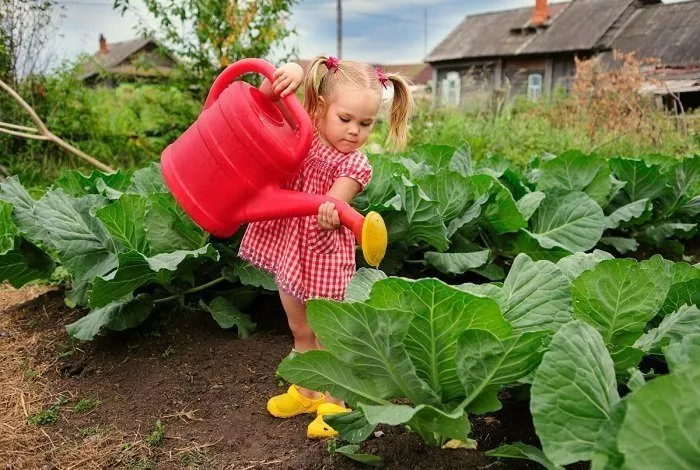
Frequency and intensity of watering
With the right watering frequency, cabbage heads won't crack, and the vegetable's flavor will improve. Let's take a closer look at the factors that should be considered when calculating the optimal irrigation frequency and intensity.
Development period
Watering of cabbage should be adjusted depending on the period of its development:
- After planting seedlings in open groundSeedlings should be planted in moist soil with a moisture content of 80%. To achieve this, the soil should be pre-moistened at a rate of 10-15 liters of water per square meter. In open ground, seedlings should be watered for the first time one day after planting. The optimal irrigation rate for seedlings is approximately 2-3 liters per plant or 8 liters per square meter. Water the cabbage once every three days for 2-3 weeks.
- After strengthening the plantEstablished plants need to be watered more sparingly – about twice a week at a rate of 12 liters of water per 1 square meter. In dry, hot climates, large-fruited cabbage varieties should be watered at a rate of 7-8 liters per plant.
- At the stage of tying forksDuring this period, cabbage actively grows leaves and heads form, so it requires abundant watering – approximately 10 liters of water per plant (20-30 liters per 1 sq. m, and during drought – up to 40-50 liters).
Two to three weeks before harvest, cabbage no longer requires moisture, so watering should be stopped. For late-ripening varieties, this should be done a month before harvesting, otherwise the heads will crack, significantly affecting their shelf life.
Regardless of the development stage, the plant must receive a steady supply of moisture, otherwise it will inevitably affect the vegetable. For example, if cabbage experiences a lack of water during the head formation stage, its inner leaves will grow vigorously, while the outer leaves will split. This, in turn, will lead to cracks.
Ripening period
When watering cabbage, you also need to consider what variety it belongs to:
- EarlyThese varieties require more watering than others, especially in June. Water consumption should be up to 20-25 liters per square meter. Soil moisture should be maintained at a level of at least 80-90%. Watering should be done two days after planting and every 8-10 days thereafter.
- Mid-season, lateThese cabbage varieties require ample watering when the heads of cabbage are fully ripening. This stage occurs in August, so it's during this period that watering should be generous, ensuring soil moisture doesn't drop below 75-80%. The watering frequency is as follows:
- once – on the day of planting;
- the 2nd time – a week after the first;
- 3-5 times – at the stage of rosette formation;
- 6-8 times – at the stage of head formation;
- 9 and 10 times – upon reaching technical maturity of the heads of cabbage.
After watering, the moist soil should be hilled. The optimal frequency of this agricultural technique varies depending on the cabbage variety: early cabbage should be hilled 1-2 times per season, while late cabbage should be hilled 2-3 times.
Soil type
| Name | Soil type | Watering frequency | Soaking depth (cm) |
|---|---|---|---|
| Light loamy soils | Lungs | Frequent | 30 |
| Heavy loams | Heavy | Moderate | 20 |
| Sandy and sandy loam soils | Sandy | Very common | 40 |
If you've followed all the watering guidelines, but your cabbage still starts to crack, you might need to take a closer look at the soil it's growing in. You can determine the soil type experimentally by rolling it into a ball and then pressing it down:
- If the soil can be easily rolled into a ball that crumbles when pressed, the garden likely has light, loamy soil. This means the cabbage requires more frequent watering.
- If the rolled ball forms a flat cake when pressed and doesn't crumble, the area likely has heavy loam soil. This type of soil absorbs water poorly and retains it for a long time, so watering should be done with caution. Loosening the soil after watering or rainfall is essential to improve aeration.
- If it's impossible to form a ball of soil, the cabbage is growing in sandy or sandy loam soils. These soils absorb any liquid quickly and lose it just as quickly. Therefore, watering frequency should be increased to prevent a dry crust from forming on the bed.
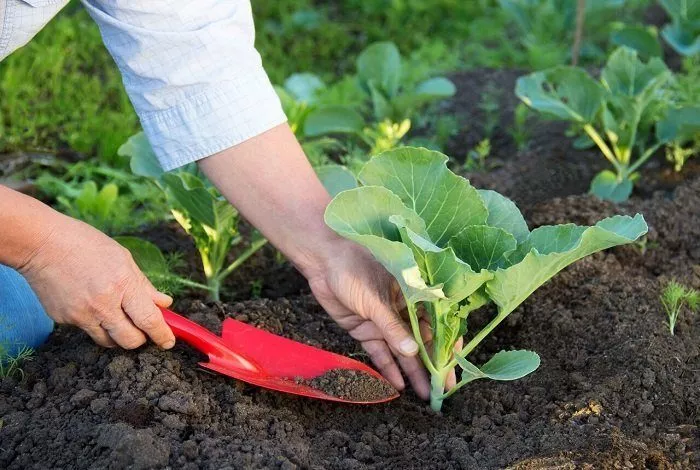
Cabbage grown on light soils often requires 5-6 waterings per season, while on heavy and dense soils – no more than 3-4 waterings per season.
Climate conditions
In humid climates where rainfall is common, watering frequency will be lower than in hot, arid regions. In southern regions, not only the frequency of watering but also the water consumption per plant should be increased, as moisture will evaporate much faster.
In arid climates, the optimal watering rate for large cabbage varieties is 7-8 liters per plant, or up to 50 liters per square meter. Of course, overwatering should never be allowed. This will cause the cabbage heads to become too loose, lose their transportability, and shorten their shelf life.
If a prolonged drought is followed by a long period of heavy rain, the cabbage roots should be trimmed. This will prevent the heads from becoming oversaturated with moisture, preventing them from cracking.
Watering methods
Gardeners most often use three irrigation methods in their plots: drip irrigation, sprinkler irrigation, and furrow irrigation. Each deserves special attention.
Drip
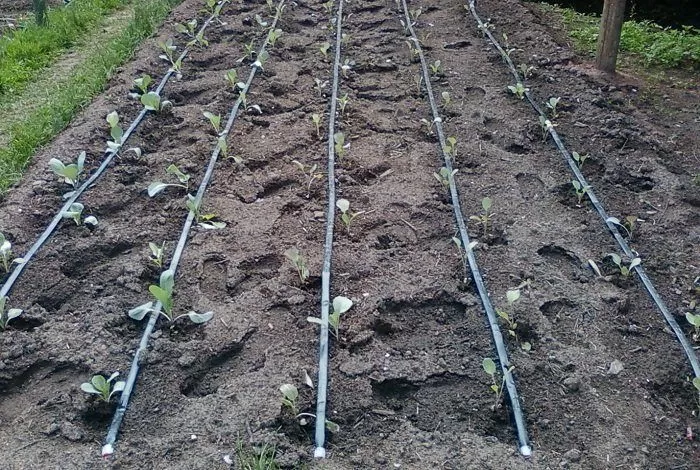
It's considered the most economical and effective method. It uses frequent, but small amounts of water, keeping the soil constantly moist. Drip irrigation involves running a 1.6 cm diameter irrigation pipe through the garden bed after planting the vegetable crop, so it requires additional investment. When using this irrigation method, consider the following parameters:
- the optimal distance between water outlets is 30 cm;
- the depth of soil wetting before the formation of heads of cabbage is 25-30 cm, and during the period of their formation – 35-40 cm;
- the duration of watering before the formation of heads of cabbage is 3 hours, and during the period of their formation – 2-2.5 hours;
- the frequency of watering in forest-steppe regions is 5-6 times (in wet weather) or 6-7 times (in dry weather), and in steppe regions – 8-11 times (4-6 times before the formation of heads of cabbage and 4-5 after);
- intervals between waterings – 8-10 days.
The watering schedule needs to be adjusted depending on soil composition and weather conditions.
Gardeners note the uneven watering as a drawback of this method. With weak water pressure, only the first few plants will be watered, as the water simply won't reach the last rows of plants. Increasing the water pressure increases the risk of overwatering the first few plants. To compensate for these drawbacks, it's recommended to water the area in batches when installing a drip system.
Some DIYers create their own drip irrigation systems for cabbage, using opaque plastic pipes (laid at a slight slope of 5 cm per meter), drippers, and couplings. Other gardeners prefer to plant plastic bottles with holes punched in the lids between rows of plants. They fill the containers with water as needed.
Sprinkling
In private farms, this method is achieved using watering cans or hoses with a nozzle that sprays water over the beds, while on an industrial scale, specialized systems are used. The advantage of sprinkler irrigation is that it moistens both the soil and the air above ground, preventing pests that are intolerant of high humidity from appearing on the crops.
This method also allows you to simultaneously feed your plants with essential nutrients while watering. The required amount of fertilizer is added directly to the water intended for irrigation.
The disadvantages of this method include the need for more frequent loosening of the soil after watering to avoid the formation of a hard crust.
Along the furrows
This method involves making shallow furrows along vegetable plantings, adding water, and then mulching them. This method ensures that the plant roots are evenly saturated with moisture, ensuring each plant receives sufficient water.
It's important to note that this method is only suitable for established plants that are well-rooted. Young seedlings should not be watered in furrows, as they require watering at the roots. Furthermore, this irrigation method is not suitable for sandy loam or sandy soils.
Using fertilizers when watering
Cabbage depletes the soil very quickly, as its rapid growth and head formation require a lot of nutrients and microelements. To maintain the plant's vigor, improve its flavor, and boost its immunity, various mineral and organic fertilizers are added to the water. These can be purchased at specialized stores and markets, or "folk remedies" such as manure, chicken manure, eggshells, boric acid, and onion peels can be used.
During the season, at least 3 fertilizing sessions are carried out in open ground:
- 14 days after transplanting the seedlings into open groundSeedlings are fed with mullein (500 ml per 10 liters of water) or chicken manure, diluted with water at a ratio of 1:15. The solution is injected under the plant roots to avoid contact with the leaves. This infusion can scorch the delicate leaf tissue and leave a burn.
- 14-21 days after the first feedingDuring the period of active rosette growth, cabbage is watered with mineral fertilizers such as superphosphate, ammonium nitrate, or potassium salt. For this, 15-20 g of the substance is diluted in 10 liters of water. Nettle is also rich in nitrogen, phosphorus, and potassium. Fresh stems and leaves of the plant are poured with water and left to infuse until they ferment. The resulting infusion is poured under the cabbage roots.
- 14 days after the second feedingThe third time, cabbage is fed if it's lagging in growth. To do this, take potassium sulfate and superphosphate in a 1:2 ratio, dissolve them in 10 liters of water, and water the planting. An alternative is to use wood ash at a rate of 30 g per plant.
If the cabbage is intended for long-term storage, then the fertilizer should include more potassium than nitrogen and phosphorus.
The nuances of watering different varieties of cabbage
All of the above watering recommendations are primarily suitable for white cabbage, which is what most gardeners grow in their plots. If you grow other types of cabbage, you'll need to consider some adjustments when watering them:
- Red cabbageIt is considered a drought-resistant species due to its well-developed root system. However, it also requires intensive watering during the period of head formation. It is fertilized twice during the growing season: at the stage of maximum leaf growth and at the beginning of head formation. During the first feeding, the cabbage is watered with a solution of 10 g of ammonium nitrate, 12.5 g of phosphorus, and 5 g of potassium chloride per 10 liters of water. The second time, 13 g of ammonium nitrate and 10 g of potassium chloride are dissolved in 10 liters of water.
- Broccoli. At growing broccoli It's important to remember that the plant's roots are very close to the soil surface, so it needs to be watered frequently—once every other day. When watering, the water should penetrate to a depth of 40 cm. In hot weather, water up to twice a day. After watering, loosen the soil to allow air to reach the roots and prevent the soil from becoming crusty. During drought, broccoli responds well to foliar spraying. This should only be done in the evening, when sunlight is less intense, to avoid sunburn.
- Cauliflower. All varieties of cauliflower Cauliflower grows in consistently moist soil. It shouldn't dry out, otherwise the heads won't form. Feed cauliflower for the first time 14 days after planting the seedlings in open ground, using slurry (1:10) or bird droppings (1:15) and 1 tbsp. of complete fertilizer. Water the plants at a rate of 0.5 liters per 1 square meter. The first feeding can also be done with a urea solution if the leaves are pale. The second watering with fertilizer is carried out 7 days after the first. Scatter 1 cup of wood ash per 1 square meter of area, lightly hilling the cabbage. The third feeding is done only when the head is the size of a walnut, using 2 g of urea, 50 g of superphosphate, and 20 g of potassium chloride per 10 liters of water.
- KohlrabiThis cabbage requires regular, but moderate, watering. Low soil moisture causes its stems to crack. During the first weeks after transplanting, kohlrabi should be watered once every 2-3 days, then reduced to once a week. Overwatering is dangerous, as it leads to root rot and fungal infections.
- Brussels sprouts. 10 days after Brussels sprouts planting In open ground, it is watered with nitrogen fertilizers. However, it is important not to overfeed it, as high nitrogen concentrations will kill the plant. A second mineral fertilizer is applied in July-August, using potassium-phosphorus fertilizers. Brussels sprouts do not need to be hilled, as the heads begin to form on the lowest leaves.
- Savoy cabbagePeople who Savoy cabbage is grown This is known to be the most frost- and drought-resistant variety, but it also thrives on moisture. Soil moisture should be maintained at 75% and air humidity at 85%. On hot days, the plants should be sprayed with warm, settled water. Fertilize twice per season. After planting, fertilize the seedlings with a solution of 20 g ammonium nitrate, 20 g potassium nitrate, and 50 g superphosphate per 10 liters of water. During the formation of the heads, water the cabbage with a solution of mineral fertilizers: 20 g ammonium nitrate, 30 g potassium nitrate, and 75 g superphosphate per 10 liters of water.
- Chinese cabbage. At growing Chinese cabbage It's important to understand that it requires moderate watering, and prefers a warm shower. When the rosette of leaves and head are forming, the air humidity should be between 70-80% on a sunny day and 60-70% on a cloudy day. At night, the humidity should be 80%. This cabbage variety doesn't require fertilizer because it tends to accumulate nitrates. Most of these harmful substances are found in the stems and petioles.
Peculiarities of watering seedlings
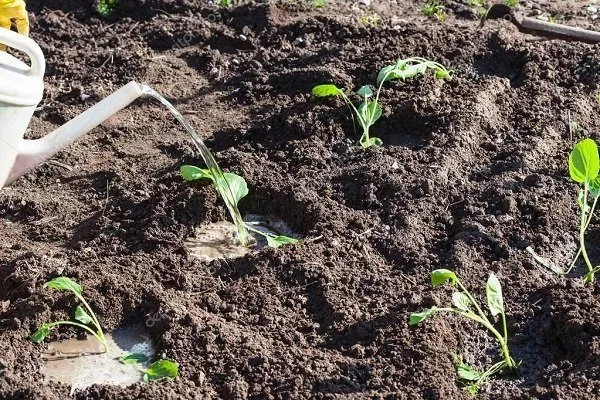
Cabbage requires plenty of water not only during the growth and head formation stages, but also during the more tender stages. When growing seedlings, keep in mind that cabbage prefers well-moistened soil, not waterlogged soil. The following guidelines should also be considered:
- The seeds are planted in well-moistened soil, and the first watering is done only after the seedlings emerge. Fertilize the plant one week after sowing, but first, water the soil thoroughly to prevent root burn.
- The first feeding is done at the second true leaf stage. The seedlings are watered with mineral fertilizers. For this, take 20 g each of ammonium nitrate and superphosphate, and 15 g of potassium salt, dissolved in 10 liters of water.
- The second feeding is done 12-15 days after the first. The soil is fertilized with slurry diluted with water at a ratio of 1 to 8, with the addition of 20 g of superphosphate.
- For the third feeding, dilute mullein (1:10) or bird droppings (1:15) in water and add 20 g of superphosphate and the same amount of potassium salt per 10 liters of water. Water the seedlings with this solution 5 days before planting them outdoors.
General recommendations
There are some general recommendations that should be followed when organizing cabbage watering:
- When watering the plant, do not use a hose with high water pressure, as this will wash away the soil and expose the plant roots.
- Avoid overwatering, as excess moisture can lead to root rot and loose heads of cabbage. Furthermore, overwatering can cause the heads to crack.
If a plant is in waterlogged soil for more than 8 hours, irreversible rotting of the root system begins.
- When watering the crop, be guided by weather conditions. If there's been rainfall, wait to water, and if there's a severe drought, water the cabbage several times a day, ensuring the water penetrates deep into the soil and reaches the root system, rather than just drenching the surface.
- After watering, loosen the soil to prevent a crust from forming on the surface. At the same time, remove all weeds.
- Some vegetable growers, noticing that their cabbage leaves are starting to wilt, immediately rush to the watering can and start overwatering. This is a big mistake. Wilted leaves can signal both a lack of water and an excess. To avoid making a mistake, be sure to check the soil before watering.
- When watering, ensure the soil is thoroughly soaked. While the plant is developing foliage, soaking the soil to a depth of 30 cm is sufficient. Once the shoots begin to form, water more thoroughly, to a depth of 40 cm.
- To obtain a head of cabbage weighing 2 kg over the entire period of growth and development, it is necessary to pour up to 200 liters of water under the bush.
- After watering, hill up the cabbage until the leaf rosettes close. Perform this procedure only after watering. This will encourage the formation of numerous lateral rhizomes, which will benefit the overall growth of the plant.
- The soil should be mulched with grass, hay, or non-woven black fabric. This will slow down water evaporation, allowing you to reduce the frequency of watering. Furthermore, a layer of mulch will stabilize the soil temperature and prevent the formation of a hard crust and the growth of weeds.
You can learn about how often to water cabbage, as well as the nuances and secrets of this process, from the video:
Watering cabbage is a crucial agricultural practice that will ensure a bountiful harvest of firm, strong heads. It should be generous and regular, but not excessive. It's important to remember that insufficient moisture causes the plant to dry out quickly, while overwatering can lead to blackleg and various fungal diseases.