
The cabbage white butterfly is a member of the white family that can cause irreparable damage to cruciferous crops. Only the cabbage white caterpillars are dangerous, as they chew through the leaves, resulting in crop failure. Learn about effective pest control and prevention methods in this article.
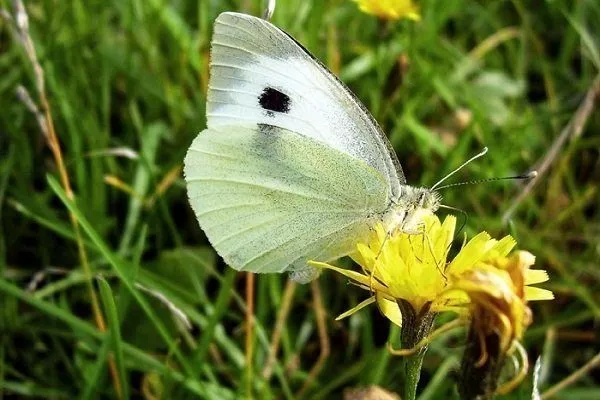
Description of the species
It belongs to the whitefly family. It got its name because it prefers to feed on cruciferous plants, particularly cabbage.
You can recognize a butterfly by the following parameters:
- Body structure. It has 4 wings and a dark body.
- Color. Predominantly white. Females have black spots on their wings.
- Wingspan. Females reach 6 cm in length. Males are shorter.
- Larvae. They stay in groups and have ocher-colored bodies.
- Caterpillars. They can be identified by their greenish coloring. White stripes are visible on their bodies, running lengthwise across the pest's body. They are 2-3 cm in size.
Area of residence
Butterflies live in Europe, Africa, and Asia. In our country, they are widespread throughout almost the entire country, except for the northern regions. They can be seen in forests, meadows, and fields, but their favorite habitat is vegetable gardens.
Lifespan and Life Cycles
There are 4 stages in the life cycle of cabbage white butterflies.
Egg
The number of eggs a cabbage white butterfly lays depends on the regional climate. In warmer climates, the butterflies reproduce more frequently.
Egg laying occurs from April to September.
At the end of their wintering period, the butterflies immediately begin to reproduce. After mating, the female lays about 200 eggs on cruciferous plants. Most often, the first generation does not cause any damage to agriculture, as they lay eggs on wild cruciferous plants. However, the second generation of butterflies prefers to lay eggs in vegetable gardens.
Caterpillar
Depending on environmental conditions, they may appear 2-3 weeks after egg laying. Once the larvae grow, they disperse across the cabbage leaf and begin gnawing from the underside, from the edges to the veins.
- ✓ The presence of white stripes along the body, which are not found in other cabbage-feeding caterpillars.
- ✓ Preference for feeding on the underside of leaves, which is rare for other pests of cruciferous plants.
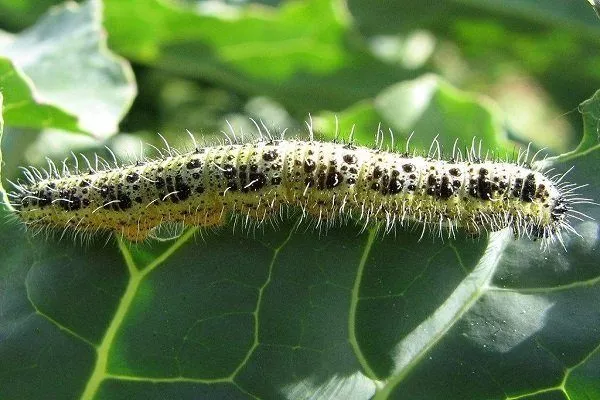
As a caterpillar, cabbage white moths can survive for up to 40 days. During this time, they shed their outer skin several times, every 5-7 days. To maintain normal vital functions, they require dry weather with temperatures no higher than 25 degrees Celsius.
The most harmful form of life of the cabbage white butterfly.
Doll
It resembles a caterpillar in appearance, but does not cause significant damage to plants. It attaches itself to parts of the cabbage plant and remains in this form for up to two weeks. As the season draws to a close, the cabbage butterfly hibernates and emerges from its cocoon only when the weather warms up.
Adult
An adult butterfly lives for about 30 days. During this time, it can cause significant damage to agriculture by laying eggs on cabbage leaves.
Lifestyle. What does it eat?
Caterpillars feed primarily on cabbage, but can also damage radish, turnip, and fruit crops. A brood of caterpillars can completely destroy a crop.
Pests are more active at night. During the day, they gather at the base of the cabbage head.
How to get rid of cabbage butterfly?
To ensure effective pest control, remember these tips:
- Complex struggle. It is recommended to use several methods of insect control simultaneously. Treat not only the affected plants but also nearby ones.
- Early detection. It is necessary to periodically inspect crops for pests.
- Follow the sowing rules. Some crops may be particularly attractive to cabbage whites, making nearby plants vulnerable to the pest.
- Use the products correctly. It's important to remember that chemical treatments are more toxic. If used during the head formation stage, harmful substances can accumulate in the plant's leaves, making it unfit for consumption.
Biological
Popular methods of biological pest control include:
- Small-bellied. This insect is parasitic, laying its eggs in cabbage white larvae, which leads to their death. The small-bellied caterpillar is capable of killing approximately 90% of the caterpillars.
- Trichogramma. Another parasite that attacks cabbage white eggs.
- Flushing. A disease caused by wax moth bacteria. Infected caterpillars turn bright yellow and soon die.
Attracting birds to the site is ineffective, as the caterpillars produce a liquid that is poisonous to birds.
You can also use the following medications:
- Fitoverm;
- Vermicide;
- Actofid.
They contain bacteria that are inedible to caterpillars.
Biological methods are effective only for small areas affected by cabbage whites.
Chemicals
In case of a massive pest infestation, it is better to use chemicals.
Common remedies:
- Karate;
- Spark;
- Kinmix.

Treatment is best carried out in dry, sunny, windless weather. Spray the undersides of leaves, as this is where the caterpillars typically hide.
It's essential to use protective equipment. Make sure you have a mask, protective goggles, gloves, and clothing made of poison-resistant fabric.
Folk remedies
A simple folk remedy for getting rid of caterpillars is to collect them by hand. However, you should wear gloves when doing this, as the caterpillar fluid can irritate the skin. This method is effective if the infestation is small.
Effective recipes:
Pine needle concentrate. What to do:
- take 200 g of cones;
- pour in 1 liter of hot water;
- leave for 1 week;
- strain;
- Place in the refrigerator.
For spraying, mix the infusion with water in a ratio of 1 to 10.
Ash and soap. For preparation:
- take 500 g of sifted wood ash;
- mix with 10 liters of water;
- let it brew for 3-4 hours;
- add 2 tbsp. of liquid soap.
Use the product immediately after preparation.
Syrup trap. Recipe:
- take thick sugar syrup;
- Mix with yeast in a ratio of 1 part yeast to 5 parts syrup.
Place the resulting mixture on saucers and arrange them between the rows. Periodically check how many butterflies have been trapped.
Mustard powder. Procedure:
- take 100 g of mustard powder;
- mix with 10 liters of water;
- Let it brew for 2-3 days.

Before use, mix the product with a small amount of water.
Uses of wormwood. Instructions:
- take 1 kg of wormwood leaves;
- chop well;
- pour in a small amount of water (1-2 l);
- simmer for 15 minutes;
- strain.
Dilute the decoction with 10 liters of water and spray. Repeat treatment should be performed only after 7 days.
Valerian infusion. Directions for use:
- take 1 bottle of pharmacy valerian infusion;
- mix with 3 liters of water.
Spray the leaves with the prepared solution.
Herbal infusion. What actions to take:
- take 200 g each of wormwood, burdock and yarrow;
- pour in 2 liters of hot water;
- Let it brew for 2-3 days.
Strain well and use.
Prevention methods
The appearance of parasites can be prevented by following simple preventative rules:
- Washing off the pupae. All wooden fences around the area should be thoroughly washed with running water to remove any pupae stuck to them.
- Timely weeding. Weeds, especially those from the cruciferous family, should be removed early in the process. Otherwise, they may attract pests.
- The right neighborhood. Avoid planting radishes, horseradish, and turnips nearby. It's better to plant marigolds, lemon balm, and mint around the plot, as their scent repels the butterfly. Dill or carrots can also be planted between the rows, as they attract the cabbage white's natural enemies.
- Shelter for plants. Even at the seedling stage, cabbage can be covered with an impermeable fabric, which will protect it from an invasion of cabbage moths.
- Burning of the area. In the fall, after harvesting, burn the area where the cabbage grew. This will improve the soil quality and kill any remaining pupae.
- Use of preventive measures. During the active growth period, cabbage leaves should be periodically treated with biological products, such as Fitoverm.
- Tree protection. It's also best to wash nearby trees. Treat the trunk with lime.
- Scare away. You can repel butterflies by placing half an eggshell on a wooden pole. The butterfly will mistake this for another member of its species and, thinking the spot is already occupied, will fly past.
You can learn how to properly prepare a repellent to prevent a cabbage white infestation by watching this video:
Reviews
To learn more about the effectiveness of methods for preventing and eliminating cabbage whites, you should read the opinions of people who have already had to deal with the pest.
To protect your crops from cabbage white flies, it's important to take preventative measures promptly. Today, there are a wide variety of products and recipes available to help combat these pests.