
Zucchini, despite its strong immune system, great vitality, and high yield, is still not immune to adverse factors. Most often, plants react to these factors by yellowing of leaves, fruits, and ovaries. If you notice yellowing on any part of the plant, quickly determine the cause and eliminate it.
Causes of yellowing zucchini
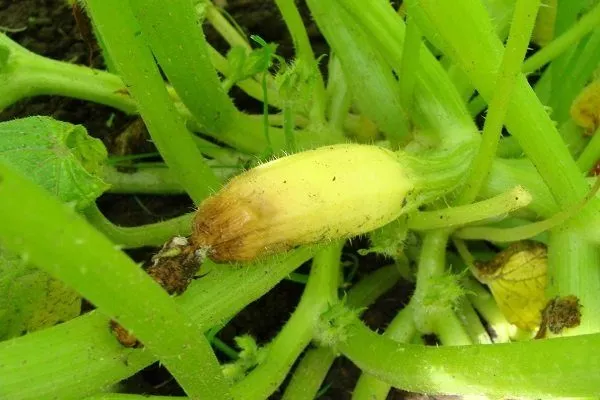
Yellowing of zucchini is only acceptable in one case—if this is typical of the variety. In all other cases, a change in color from green to yellow signals problems.
Failure to observe crop rotation
Many gardeners often neglect crop rotation rules, believing that this agricultural requirement applies only to large farmlands. In fact, proper crop rotation in the garden is an essential requirement for successful vegetable growing.
Zucchini should not be planted after pumpkin crops:
- melons;
- cucumbers;
- squash;
- the zucchini themselves.
The minimum interval for replanting is three years. Crops belonging to the same family extract the same nutrients from the soil and leave pathogens in the soil that affect crops of the same genus.
Incorrect watering
Zucchini needs regular moisture. irrigation regime negatively affects the condition of plants.
- ✓ The water temperature for irrigation should not be lower than 20°C to avoid stress on plants.
- ✓ The watering depth should reach 30-40 cm to ensure sufficient moisture for the root system.
Reasons for yellowing of zucchini:
- plants are experiencing moisture deficiency;
- excessive watering - plant roots began to rot;
- the water is too cold or hard - this damages the underground shoots;
- watering at the wrong time of day - during periods of high sun exposure.
How to properly water zucchini to prevent them from turning yellow:
- water the beds as needed - as soon as the soil in the root zone dries out;
- do not allow the soil to dry out or water to stagnate;
- use water heated by the sun for irrigation;
- water the plants so that water does not get on the leaves - this may cause burns;
- Water your zucchini in the morning or evening when there is no bright sun.
Lack of mineral elements
A lack of nutrition negatively impacts the health of plants, which is immediately reflected in their appearance. Mineral deficiency typically causes chlorosis. Plants wilt, their leaves wilt, and fruits turn yellow and separate from the shoots.
It's difficult to determine by eye which micronutrient plants are lacking. Gardeners prefer to apply complex fertilizers that contain all the necessary minerals that zucchini may need.
How to feed zucchini:
- Agricola;
- Diammophoska;
- boric acid (1 g per 1 l) - spray on the leaves;
- iodine (40 ml per 10 l of water).
Foliar top dressing Spraying is recommended in dry, windless weather, in the morning or evening. If rain washes away the spray, the procedure must be repeated.
Nutrient overload
Yellowing leaves occur not only due to nutrient deficiency but also due to excess. Inexperienced gardeners apply fertilizer too frequently (with the best of intentions), and as a result, their plants suffer. Repeated fertilizers are especially harmful.
Zucchini reacts extremely negatively to excess chlorine in the soil. It causes the fruit to discolor and become tasteless. Potassium chloride is recommended for application in the fall. Potassium sulfate can be used instead.
It is strictly not recommended to apply manure in the spring, as it can cause root burn when planting seedlings. It is best applied in the fall, during tillage.
Thick green mass
If zucchini grows in fertile soil rich in organic matter (nitrogen), they rapidly grow green foliage. Large leaves protect the plant from overheating, but if they become too numerous, the plant's normal air circulation is disrupted.
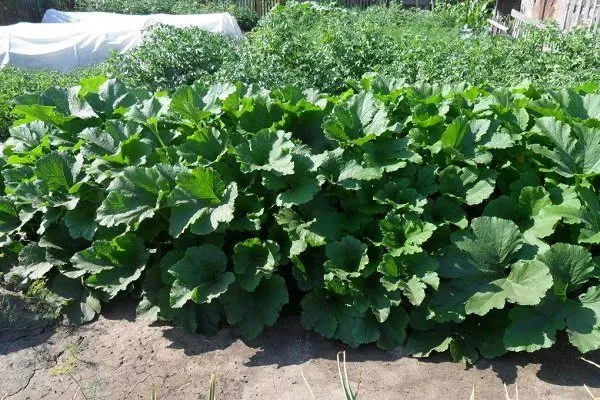
If the rosette is too lush, moisture evaporation is delayed, creating a favorable environment for the development of fungal infections.
How to fix the problem:
- Remove several large leaves located above the fruit.
- Be sure to sprinkle the cut petioles with wood ash or activated carbon to prevent infection.
Sometimes, rotting flowers can infect the fruit, causing their tips to rot. To prevent this, carefully remove all flower petals as soon as the fruit forms.
To prevent the leaves of the bushes from closing and the plantings from becoming too dense, it is important to adhere to the growing pattern when planting: 70-80 x 90-100 cm.
Why do zucchini ovaries turn yellow?
If zucchini plants produce too many ovaries, some of them dry out, as the plant can only produce so many fruits. The plant regulates the number of ovaries it produces based on its own capacity.
If too many of them dry out, there's cause for concern. It's important to find the cause and address it.
Water shortages and extreme heat
Zucchini tolerates drought well because they store moisture in their stems and leaves. However, if the plants regularly experience a lack of moisture, their ovaries turn yellow and drop. This phenomenon in young fruits is caused by heat—temperatures reaching 40°C.
High temperatures literally cook young zucchini. They become soft and cottony. A fabric cover to protect the plants from direct sunlight helps prevent damage. Also, increase watering during hot weather.
Pests
One of the causes of yellowing ovaries followed by fruit drop is a variety of pests, primarily insects that feed on plant sap.
Yellowing and falling of ovaries can occur due to the following pests:
- Spider mite. These tiny, web-sucking insects suck the sap from leaves and shoots. They reproduce rapidly during water shortages and extreme heat. Spraying plants with Iskra, Fitoverm, and other insectoacaricides is recommended.
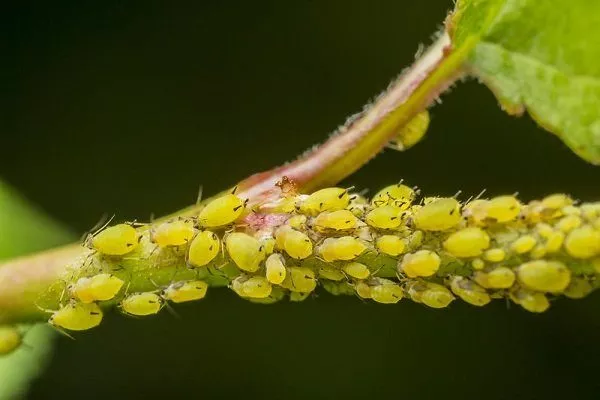
- Aphid. They live in colonies on the undersides of leaves, sucking the sap from plants. Bushes slow growth, dry out, and fruit buds turn yellow and fall off. Treatment with solutions of wood ash (300 g per 1 liter) or soap (200 g per 10 liters) is recommended.
- Whitefly. These are small moths whose larvae suck the juices from the above-ground parts of plants. It's recommended to water the bushes with a pressurized stream to dislodge the pests. Spraying with a solution of grated laundry soap (in the same proportions as for aphids) is also effective.
Lack of pollination
To form fruit, plants require pollination, which transfers pollen from male flowers to female flowers. This task is usually performed by insects. However, they don't fly if the weather is cold and damp. The flowers aren't pollinated, and the ovaries dry up, preventing fruit formation.
To avoid losing a harvest, gardeners should cross-pollinate their plants themselves. To do this, pick male flowers and rub their stamens over the pistils of female flowers. It's easy to distinguish male flowers from females—they have longer, thinner stems. In female flowers, the ovary is visible beneath the petals.
For male flowers used for pollination, remove the petals before pollination. One bud can pollinate 2-3 female flowers.
How to attract insects to your garden:
- Plant flowers with a strong scent near the beds;
- spray the bushes with a honey/sugar solution - 1 tbsp. per 1 liter of water;
- remove the leaves covering the flowers.
Planting parthenocarpic varieties helps alleviate pollination problems. They don't require pollination to develop fruit. These hybrids are seedless, unlike regular varieties.
Causes of yellowing leaves
Yellowing of leaves is a common occurrence when growing zucchini. This reaction is usually observed when cultivation practices are not followed correctly. various diseases.
Early planting and cold weather
Zucchini plants grow vigorously, with robust growth. Their leaves, however, are tender and soft to the touch.
Spring cold snaps and temperature fluctuations negatively impact plants, weakening their immune systems and provoking disease. One of the most common symptoms is yellowing leaves.
Planting zucchini at the right time can help avoid this problem. Avoid planting them too early. Early planting can cause this heat-loving crop to suffer from insufficient heat. This can slow down the plants' chlorophyll production.
Zucchini grows quickly. They will produce a harvest even if planted outdoors in June. Plant them in greenhouses in early May. Until the weather stabilizes, it's recommended to cover the seedlings with agrofibre.
Lack of micro- and macroelements
Nutritional deficiency is the most common cause of yellowing zucchini leaves. Agronomist can determine the specific nutrient deficiency by observing the color nuances. Ordinary gardeners don't understand such subtleties and are advised to address the problem with complex fertilizers.
- ✓ Nitrogen deficiency manifests itself as uniform yellowing of old leaves.
- ✓ Potassium deficiency causes yellowing of the leaf edges followed by curling.
Signs of macro- and microelement deficiency:
- If the leaves of the first tier of the bushes have turned yellow, most likely they need phosphorus, magnesium, potassium, and nitrogen;
- Yellowing of leaves in the upper part of plants indicates a lack of iron, boron, and manganese.
The following fertilizers help solve the problem:
- Ferovit and Antikhloroz for iron chlorosis. These products contain copper sulfate and citric acid.
- Agricola and Diammophoska. These complex fertilizers are rich in nitrogen, phosphorus, potassium, boron, copper, zinc, iron, and manganese.
The problem of micronutrient deficiency can be solved with the help of folk remedies:
- Yeast. They enrich the soil with vitamins, enzymes, minerals, and amino acids. They are only effective in warm soil.
- Boric acid. Used for boron deficiency. Promotes seedling rooting and boosts plant immunity. Dilute 5 g in 10 liters of water. Spray on foliage.
- Wood ash. Apply if potassium is deficient. 200-300 ml per 1 sq. m.
High soil acidity
Zucchini grows poorly in acidic soils. A pH level of around 5.5 is considered too high. The negative effects of growing in acidic soils appear within a few days after planting. The seedlings lose their ability to properly absorb nutrients.
Zucchini planted in acidic soils wilt and dry out. This can be prevented by deacidifying the soil with wood ash or lime—200 g per square meter.
Violations of agricultural practices
Yellowing of zucchini leaves often occurs due to improper agricultural practices. Any neglect of proper growing practices can trigger this phenomenon.
What agricultural practices cause yellowing of leaves?
- Lack of light. If zucchini beds are placed in shade, the stems become elongated and thin. The leaves turn yellow, and few flowers or ovaries are produced.
- Incorrect watering. Zucchini plants need plenty of moisture, but avoid standing water in the beds. To prevent the leaves from turning yellow, water the plants regularly, morning and evening. Avoid getting water on the leaves.
Dense planting
Zucchini have large leaves, which, when planted too densely, block out sunlight. Furthermore, if planted too densely, the plants begin to compete for nutrients.
Following the zucchini planting scheme will help avoid this problem:
- the distance between plants is 70-80 cm;
- the distance between rows is 90-100 cm.
If leaves do turn yellow, carefully remove them. Sprinkle cut or broken parts with wood ash to prevent infection.
Excessive leaf growth, which occurs when organic matter and nitrogen fertilizers are added to stimulate foliage growth, can also cause dense foliage. To prevent this, it is recommended to apply these fertilizers in the fall and early spring, before the onset of vigorous vegetation.
Diseases
Zucchini, like any garden crop, is susceptible to insect attacks and diseases. One symptom of this is yellowing of the leaves. The pattern of yellowing on the leaf helps diagnose the problem.
Downy mildew
The disease is caused by a fungus that becomes especially active in high humidity conditions. The disease can be identified by numerous yellow spots that turn brown over time.

The leaves dry out, curl, and then crumble. The fungus attacks the entire bush, which eventually dies if no action is taken.
Preventative spraying is recommended for disease prevention. For this purpose, apply a 1% Bordeaux mixture to the seedlings. Seed treatment before planting is also recommended. Apply sulfur preparations when signs of disease appear.
Chlorosis
This pathological condition usually occurs when there is insufficient oxygen supply to plant roots. Chlorosis causes leaves to become covered with light yellow spots that eventually dry out.
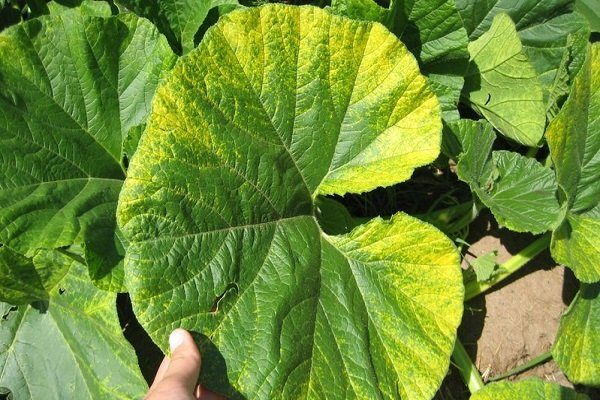
The following helps prevent chlorosis and yellowing of leaves:
- regular loosening of the soil;
- application of wood ash - 200 g per 1 sq. m;
- top dressing with onion peel decoction - 1 liter of raw material per 10 liters of water;
- application of potassium-phosphorus fertilizers - 30-40 g per 1 sq. m.
Fusarium wilt
The disease is caused by soil-borne fungi that can attack zucchini plants at any stage of the growing season. The root is affected first, and then the disease spreads throughout the plant. The leaves turn yellow and wilt, and yield declines.

With fusarium wilt, the leaves at the top of the bushes are the first to turn yellow and weaken. The stems near the roots turn brown, developing a pink-orange coating. The disease attacks the roots, and the plant soon dies.
If the disease is detected early, there's a chance to save the zucchini. First, dust the zucchini and the surrounding soil with wood ash. Subsequently, soil improvement is necessary—gardeners apply calcium supplements and fertilizers, and grow green manure.
Cucumber mosaic
This viral disease affects all melon crops. It can be identified by the characteristic mosaic pattern covering the leaves. It consists of white and yellow spots of varying intensity.
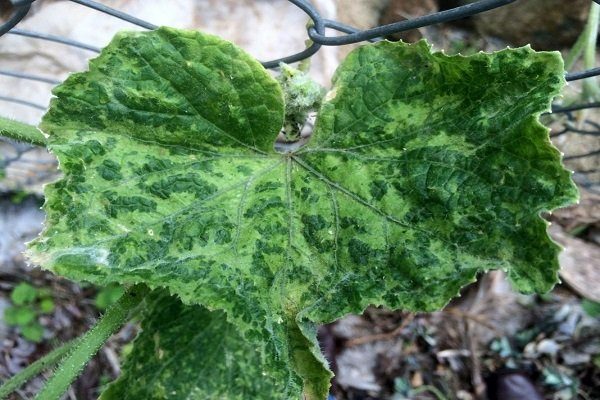
Affected plants are stunted and fail to produce crops. There is no cure; prevention is the only hope.
How to prevent mosaic:
- water the beds regularly;
- observe crop rotation rules;
- destroy infected bushes;
- treat the seeds;
- disinfect the working tool;
- remove and dispose of plant debris.
To prevent mosaic, it is recommended to spray plants with laundry soap dissolved in milk (200 g per 10 l).
Pests
Yellowing of leaves can also be caused by damage caused by insect pests:
- Aphids. They suck the juices from leaves, weaken and even kill plants, and spread viral infections. Control aphid colonies with insecticides—spray your plants with Akarin, Fitoverm, or similar products.
To combat aphids, you can also use a folk remedy: an infusion of onion peels (100 g per 3 liters of boiling water). Let it steep for 5 hours and then top up to 10 liters.

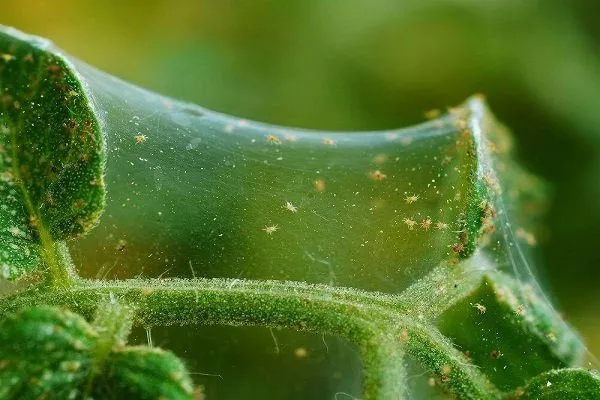
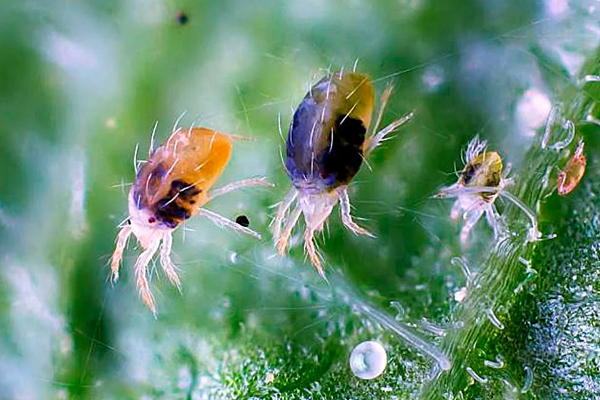
- Spider mite. This tiny insect destroys zucchini plants both inside and out. Infestation can be identified by the thin webbing that envelops the leaves, causing them to develop a mosaic-like appearance. The leaves turn yellow and die. Spraying with Fitoverm, Neoron, and other insectoacaricides is recommended.
- Slugs. Pests can gnaw at stems, weakening plants by causing yellowing leaves. They can also eat the leaves themselves. To repel slugs, gardeners plant fragrant plants such as garlic, mustard, and pepper near zucchini plants. They can also sprinkle ground superphosphate around the plants.

Yellowing of zucchini seedlings
Zucchini isn't a fussy crop, but its seedlings require just as much attention as, say, tomato plants. To grow strong and healthy seedlings, you need to create the most favorable conditions possible. Otherwise, the seedlings become diseased, turn yellow, and even die.
Incorrect watering
Yellowing of seedlings can be caused by improper watering. Infrequent or frequent watering, both too little and too much, are equally harmful. It's important to pay attention to the condition of the substrate—it should be kept slightly moist at all times, but there should be no stagnant water.
If seedlings don't get enough water, they wilt, turn yellow, and dry out. If they're overwatered, their roots rot. They can become infected with blackleg, a deadly disease for seedlings. There's no cure for this disease, and it kills the seedlings outright.
The capacity is too small
When growing seedlings, use small containers, just large enough to provide the seedlings with enough space and nutrients. If planting is delayed, the seedlings begin to feel uncomfortable—the cups become too small. If the seedlings don't have enough space and nutrients to grow, their leaves turn yellow.
A quick transplant—replanting the seedlings into new, larger containers—can help save the situation. The key is to avoid damaging the roots during the process.
Short daylight hours
Zucchini require at least 11 hours of daylight. If planted in April, supplemental lighting is usually not needed—natural light is sufficient. Insufficient sunlight may be caused by dense plantings or by plants located too far from windows.
When plants lack light, photosynthesis is inhibited, leaves turn pale, and they stretch toward the light and become weak. This can be avoided by following a planting pattern and correctly positioning the containers relative to the light source.
Sunburn
Zucchini love light, but direct sunlight can damage the delicate leaves of the seedlings. To prevent this, avoid placing them on south-facing windowsills. Sunburn can also occur from water splashing on the leaves; water carefully at the roots.
Failed transplant
If seedlings turn yellow immediately after transplanting, there's reason to suspect the transplant was done poorly. Most likely, the root system was damaged during the transfer from container to container, preventing the plants from receiving adequate nutrition.
Treating transplanted seedlings with growth and rooting stimulants can help solve this problem. Use:
- Kornevin;
- Epin;
- Zircon;
- succinic acid.
Preventive measures
Yellowing of zucchini isn't always fatal, especially for mature plants, but it does inevitably lead to crop losses. In severe cases, gardeners can lose both plants and fruit. It's far more cost-effective to prevent losses than to deal with the consequences of diseases, poor agricultural practices, and the like.
Preventive measures:
- Selecting a variety. It is better to plant zucchini that are resistant to fungal diseases - Tsukesha, Chakluna, Skvorushka.
- Care. Even the most hardy varieties require high-quality care, according to agricultural standards, including watering, fertilizing, and protection from diseases and pests.
- Using quality seeds. Many problems arise from contaminated seed. Buy seeds from reputable suppliers and disinfect your own.
Zucchini yellowing is most often caused by poor agricultural practices and fungal diseases. Most problems and their consequences can be avoided if addressed early. The best solution is to prevent leaf yellowing through a comprehensive preventative approach.