
Watering zucchini is an important part of basic care. It's important to water wisely, using the right water and an effective method. Avoid over- or under-watering, as this can lead to unpleasant consequences.

General rules for watering zucchini
For success growing zucchini It is necessary to follow certain watering rules:
- Water the crop in the evening, when the light becomes diffuse and the sun's intensity decreases. If the weather is not dry and fairly cool, watering is acceptable until 8-9 a.m., but avoid getting water on the stems and leaves.
- Water the zucchini at the roots. When using a hose, be sure to use a spray nozzle.
- The soil should be moistened to a depth of approximately 40 cm. This condition is especially important during fruiting.
- Avoid overwatering or underwatering. Both situations are dangerous for the plant.
- When growing zucchini in sandy or sandy loam soil, watering is required more frequently. Clay and loamy soils retain moisture better, so watering frequency should be reduced.
- Water must meet certain requirements, including temperature and chemical composition.
- During flowering and fruit formation, abundant watering is necessary. It is recommended to simultaneously use mineral fertilizers.
- To retain moisture, use mulch. Apply it to the soil after loosening it. Chopped straw or sawdust mixed with peat are good choices; the optimal mulch layer is 5-7 cm. Mulching should be done while the bushes are still young and have not yet had time to grow.
- ✓ Use only organic mulch, such as chopped straw or sawdust with peat, to better retain moisture and prevent weed growth.
- ✓ The optimal thickness of the mulch layer should be 5-7 cm to effectively retain moisture and not impede air exchange.
An important rule for watering zucchini is to adjust its frequency and intensity accordingly. It's important to consider the plant's growth and development phase, as well as weather conditions.
Features of watering zucchini at different stages of their cultivation
Zucchini is planted in the ground from seeds or seedlings. The planting method determines the specifics of the first watering:
- When planting crops with seeds The soil becomes moist, which is sufficient for the initial period. Sprouts appear within 1-1.5 weeks. During this period, it's important to maintain a consistent soil moisture level. Water the plant at least every two weeks, and the top layer of soil should always be moist.
- When planting zucchini seedlings in the ground The soil is also moistened. The first waterings will be needed after 3-4 days. The plant should be watered 1-2 times a week. Each plant requires 2-3 liters of water.
In the first few days after planting zucchini, watering is not necessary. This allows the seedlings to take root and the seeds to germinate. Overwatering during this period can cause the plants to die. If heavy rains begin, it is recommended to provide cover.
During flowering and fruit formation, the plant especially needs moisture and nutrients. When the first buds appear, watering should be increased to twice a week. Each bush requires up to 5 liters of water. Avoid allowing the soil to dry out.
During fruit formation, water the plant every 5-6 days, unless there's a drought or heavy rainfall. Double the water volume—10 liters per plant. Once the fruit begins to ripen, reduce watering frequency to once a week.
The plant only needs more frequent watering in hot weather. If the temperature is above 35 degrees Celsius, increase watering to once every three days.
If heavy rainfall begins, there's no need to water your zucchini. If it rains during hot weather, pay attention to the soil condition. You can check its moisture level by squeezing a lump of soil. If it crumbles in your hand, the plant requires more water.
Water requirements
When watering zucchini, it's important to use the right water. It should meet the following requirements:
- The optimal water temperature is 20 degreesIt should be heated in natural conditions, placing containers in the sun.
- The water must be settled.This measure is especially important if the source of moisture is a centralized water supply. Allowing the water to settle ensures the sedimentation of harmful impurities. The sediment should not be used for irrigation.
- Water quality compositionIf it is taken from natural bodies of water, it is recommended to take a sample and have it chemically analyzed. The water may contain fungi and pathogens.
Rainwater is optimally used. Clean containers and drains should be used for collecting it. Rainwater is not suitable for irrigation if there is a hazardous industry nearby or other environmental hazards exist.
Watering methods
There are several ways to water zucchini. When choosing, consider the size of the plot and the characteristics of the water source.
Manual watering
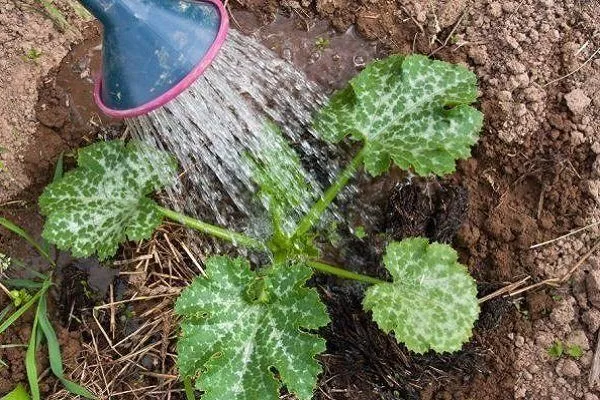
This option is ideal for small areas. It's best to use a watering can; a nozzle is not necessary. Water should be applied at the roots.
Irrigation with a hose
This option is more convenient than hand watering; a spray nozzle is essential. Zucchini shouldn't be watered with cold water, so watering with a hose should only be done when the water is warm. This option is suitable when the water source is a small pond where the water warms up naturally.
Watering the crop with a hose should only be done in the evening. The spray nozzle should be small enough; directing the water stream too close should be avoided to prevent soil erosion.
Drip irrigation
The optimal option and one of the most effective methods for watering various crops. A drip system can be purchased or built independently.
- Choose hoses that have pre-drilled holes or prepare your own using an awl.
- Place hoses along the rows of zucchini, delivering water directly to the roots of each plant.
- Connect the system to the water source and check for uniform water flow before final installation.
The essence of this type of irrigation is that water is delivered individually to each plant. Typically, hoses with small holes are used. The water should reach the roots, not the above-ground parts of the plants.
Dosed watering from plastic bottles
This irrigation system allows you to use not only regular water but also liquid fertilizer. It's easy to set up. You'll need 5-liter plastic bottles—one for each plant. Cut off the bottoms and poke several holes, 2-3 mm in diameter, in the lids. Place each bottle upside down near its plant and bury it 15 cm below the ground.
Another option is to bury the bottles upside down, leaving 15-20 cm of surface. In this case, leave 2 cm from the bottom and make four holes on different sides.
Regardless of the chosen method for using plastic bottles, the next steps are the same. The bottles need to be regularly filled with warm water. This will be gradually released into the soil, ensuring constant moisture.
Instead of burying the bottles, you can hang them so that the water drips next to the plant, not onto it. The downside of this option is that the soil will gradually be eroded by the drips. This can be prevented by using mulch.
Metered watering of zucchini can be used at any stage of their growth. During fruit formation, this method should be combined with another method, as the crop has a particular need for moisture.
Wick watering
The main advantages of this irrigation method are its cost-effectiveness and the elimination of moisture from reaching the above-ground parts of the plant. Setting up a wick system is simple:
- Place suitable containers on different sides of the plot and bury them in the ground. Buckets, jars, discarded pots, bottles, and other containers can be used.
- Prepare fabric strands. The material should be thick. Calculate the strand length based on the area of the plantings.
- Dig in the bundles along the bushes, deepening them by 15 cm.
- Fill the containers with water.
- Place one end of the rope in a container to soak it and transfer the moisture to the soil. It's best to arrange the water containers so that both ends of the rope can be placed in them.
The dangers of over- and under-watering zucchini
Zucchini should be watered moderately, avoiding overwatering or underwatering. Both situations are dangerous.
The consequences of excess moisture are as follows:
- exposure of the root system;
- weakening of the crop's immune system, increasing the risk of damage by diseases and pests;
- the growth of the root system close to the surface, which leads to rapid drying out and fungal infections;
- with prolonged over-watering, root hairs begin to die off - the reason lies in the lack of oxygen;
- the growth of the culture is initially activated, but after the roots die off, it is significantly inhibited;
- fruit tip rot;
- reduction in the storage period of the crop;
- Reduction of sugar content in zucchini due to excessive watering during ripening.
When there is a lack of moisture, the following problems arise:
- slowing down of crop growth and development, formation of ovaries, formation of fruits and their growth;
- the formation of male flowers that are sterile, resulting in a reduction in the number of ovaries;
- reduction in fruit size;
- insufficient juiciness of zucchini;
- loss of taste, appearance of bitterness;
- decrease in crop yield.
You can also learn about the rules for watering zucchini from the following video:
Common mistakes when watering zucchini
When watering zucchini, certain mistakes can be made. The most common ones are:
- Cold water for irrigationIn this case, the required amount of moisture is not absorbed, which can lead to various diseases. When watering zucchini with cold water in hot weather, the temperature change causes a shock reaction, which can lead to the death of peripheral roots. As a result, the plant's growth and development slows.
- Hot water for irrigationIn this case, the growth and development of the culture slows, and the risk of disease increases. Pathogenic microorganisms quickly develop in overheated water, especially if the liquid sits for a long time.
- Frequent or excessive watering fraught with exposed roots and rotting of fruit tips.
- Frequent water splashing on leaves This causes them to turn yellow. If water gets on the leaves during strong sunlight, they become sunburned.
- Morning watering of crops in hot weatherWater getting on the stems and leaves causes burns. The moisture evaporates in the sun without having time to be absorbed into the soil. This results in a water deficit.
- Lack of regular looseningThis leads to the formation of a crust on the soil, preventing water from being absorbed and causing it to stagnate. The plant's roots don't receive the required amount of moisture.
- Lack of regular weedingWeeds take away a significant portion of the moisture and nutrients that zucchini needs.
Proper watering promotes healthy growth and development, a bountiful harvest, and large, juicy, and delicious fruits. Watering should be infrequent, but generous. Maintaining the correct watering intensity is crucial—any deviation is dangerous.