
Gardeners often make mistakes when watering garlic. This crop has relatively simple growing practices, but it has specific watering requirements. Let's learn how and when to water garlic to ensure a high-quality harvest.
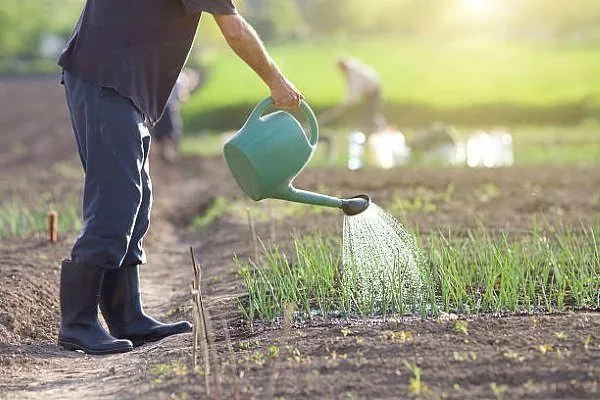
How to water garlic correctly?
When watering garlic, consider the size of its bulbs and the characteristics of its root system. The bulbs are small and the roots are poorly developed, so it draws nutrients primarily from the surface soil. Therefore, garlic requires a lot of water when watering, but overwatering is strictly prohibited. The goal for growers is to maintain a balance and ensure optimal moisture in the beds.
To ensure that soil moisture doesn't harm garlic and provides maximum benefit, it's important to follow these watering guidelines:
- If the soil has cooled to +15°C, moisture will be harmful to the garlic.
- The maximum water temperature for irrigation is +18°C.
- The best way to water garlic is drip irrigation.
- The best time to water garlic beds is early morning and late evening.
- After watering, when the moisture has been absorbed, the soil is loosened to a depth of 2 cm.
- If it rains, watering is cancelled.
- If garlic is grown for long-term storage, watering should be reduced during the period of active bulb growth. This will result in bulbs that are smaller than those grown with intensive watering, but will last much longer.
With frequent and abundant watering, garlic heads grow very large, but you shouldn't count on them being stored for long.
- ✓ Premature yellowing of lower leaves.
- ✓ The appearance of mold on the soil surface.
How does watering affect garlic yield?
Research has shown that the difference in yield between irrigated and non-irrigated garlic is approximately 40%. In arid regions, the difference is even greater – with drip irrigation, it is approximately 70%. An artificial irrigation system maintains optimal soil moisture, and nutrients are delivered directly to the garlic roots in the form of solutions.
Sometimes, gardeners get carried away and overwater their garlic. However, excess moisture can cause irreparable damage to garlic plants—overwatering leads to rotting of the garlic bulbs.
When to start watering?
As soon as the growing season begins, garlic needs watering. If the spring is rainy, artificial irrigation is not necessary. Watering usually begins in April-May or a little later, when the bulbs begin to grow. Winter garlic bulbs grow in May, while spring garlic bulbs grow in July.
In open ground
Watering garlic beds usually begins in April. Garlic leaves begin growing rapidly in late April or early May. By this time, the beds need to be watered twice. But only if the weather is dry.
Indoors
When growing garlic in greenhouses, it is watered especially generously during the active growth period. There is no rain (natural) irrigation, so the number of waterings and water consumption are always higher than when grown outdoors. The beds are watered as the soil dries out. Typically, the frequency of watering is once every 7-10 days.
Watering methods
There are several methods for watering garlic, each with its own pros and cons. Gardeners and vegetable growers often use manual watering, while larger volumes are watered using sprinklers and drip irrigation.
| Irrigation method | Water consumption (l/sq.m) | Efficiency (%) |
|---|---|---|
| Manual | 10-15 | 60-70 |
| Sprinkling | 15-20 | 70-80 |
| Drip | 5-10 | 90-95 |
Manual irrigation
This is the most basic watering method, requiring no investment but a significant amount of time and effort. If you only have a few beds, this can be considered a light exercise.
Advantages of manual watering:
- low cost – no need to spend money on irrigation systems;
- there is no need to supply water to the beds;
- no dependence on electricity.
Cons:
- a lot of physical strain on the gardener if the plantings occupy a large area;
- you have to move around the plantings, trampling down the spaces between the rows;
- The amount of water poured out is not accurately measured.
Sprinkling
Sprinkler irrigation sprays water like rain, causing it to fall on the crops in droplets. This method requires specialized sprinkler systems.
Watch a video about watering garlic using the sprinkler method:
Pros:
- the method allows for compliance with irrigation standards;
- precise and uniform distribution of moisture between plants is achieved;
- Sprinkler systems are mobile;
- Various substances can be sprayed along with water, such as pesticides;
- The system does not interfere with soil cultivation.
Cons:
- high water consumption;
- high cost of the system;
- the need for a lot of energy to create water pressure;
- the quality of irrigation is affected by wind;
- promoting the spread of diseases – due to the evaporation of moisture from the soil surface;
- If watering norms are exceeded, secondary soil salinization is possible, which will negatively affect the quality of garlic;
- low efficiency on heavy soils and in dry climates;
- There is a risk of negative impact on the leaves - sprinkling can provoke mineralization or diseases.
Drip irrigation
There are two types of drip irrigation:
- surface (ground);
- intrasoil (underground).
Surface drip irrigation system. Water is supplied directly to the plants through tubes with drippers. The tube system is laid directly on the soil, close to the garlic.
Advantages of drip irrigation:
- less water consumption than with sprinkling;
- less moisture evaporation;
- You can use alternative irrigation schemes - small amounts of water at short intervals;
- no burns on leaves from water drops.
Disadvantages of surface irrigation:
- It is necessary to replace irrigation tapes every 2-3 years;
- labor intensity of work during laying out, assembling and repairing belts;
- clogging of droppers.
Below is a video of drip irrigation for garlic:
Subsurface irrigation method. It is a permanent system designed for long-term use. Its operating principle is virtually identical to that of an above-ground system, the only difference being its location. Thick-walled tubes are laid underground. Additionally, emitters are used to prevent roots from penetrating the holes.
Advantages of subsurface irrigation:
- does not interfere with soil cultivation;
- there is no need to install and assemble the system every year;
- Water and nutrients are delivered directly to plant roots.
Disadvantages of subsurface irrigation:
- It is difficult to diagnose a breakdown of the emitter - a miniature dropper;
- complexity of repair;
- high cost of the system - it is more expensive than a ground-based one.
The yield of garlic is the same when using above-ground and underground drip irrigation systems.
The optimal moisture level depends on the garlic's growing season. The table provides approximate watering rates calculated for drip irrigation of winter garlic in medium loamy soils. The planting pattern is 60+20 x 6 cm.
| Development phase | Pre-irrigation moisture, % | Control depth, cm | Average daily moisture consumption, cubic meters per 1 ha | Irrigation norm, cubic meters m per 1 ha |
| Autumn | 70 | 25-30 | — | 65-80 |
| From germination to the 3rd leaf | 80 | 15-20 | 7-16 | 35-40 |
| From 3rd to 5th leaf | 80 | 15-20 | 15-23 | 35-40 |
| From 5th to 8th leaf | 80 | 20-25 | 30-57 | 65-80 |
| From the appearance of arrows to the drying of leaves | 70 | 20-25 | 27-47 | 65-80 |
| From mass leaf drying to harvest | 60 | 20-25 | 9-31 | 25-40 |
Frequency and characteristics of watering
To ensure large, shelf-stable, and flavorful garlic bulbs, it's important to follow proper watering guidelines. When choosing the frequency and amount of watering, consider the ripening period and specific weather conditions.
At the beginning of growth
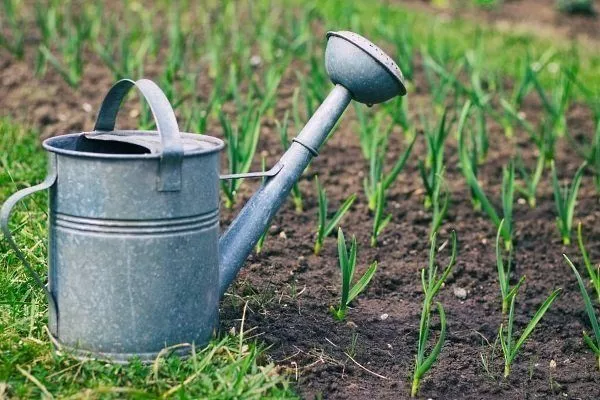
From germination to clove formation, garlic requires adequate moisture. At the beginning of the growing season, garlic is watered generously to a depth of 30 cm. The recommended watering frequency is once every 7-8 days. In early May, garlic beds are watered along with fertilizer.
When ripe
When garlic begins to mature—its bulbs are actively growing—watering becomes more frequent. The recommended watering frequency during bulb growth is once every 5 days, or more frequently, depending on the weather. In hot, windy weather, water the beds every 3 days.
When to stop watering?
To ensure garlic stores well and maintains its high commercial quality, experienced gardeners stop watering before harvest. The timing of the last watering depends on the intended use of the garlic:
- Garlic intended for current use should not be watered for 7 days before being pulled out of the soil.
- If garlic is to be stored for a long time, watering should be stopped 15-20 days before harvesting.
How to combine watering with fertilizing?
Experts recommend combining watering with fertilization:
- When the garlic has 3-4 leaves, prepare a urea solution by adding a tablespoon to a bucket. Or add the same amount of Agricola-Vegeta fertilizer. Pour the solution into a watering can and water the garlic beds. Apply 2-3 liters per square meter.
- Two to three weeks after the first feeding, water the garlic with a nitrophoska or nitroammophoska solution. To prepare the solution, dilute 2 tablespoons of either fertilizer in a bucket of water. Use 3-4 liters of solution per square meter.
- The final feeding is done when the garlic heads are forming, so the timing depends on the variety and the local climate. During watering, the garlic is fed with a superphosphate solution. To prepare it, dissolve 2 tablespoons of superphosphate in a bucket of water. Use 4-5 liters of the solution per 1 square meter of garlic beds.
Watering garlic with salt
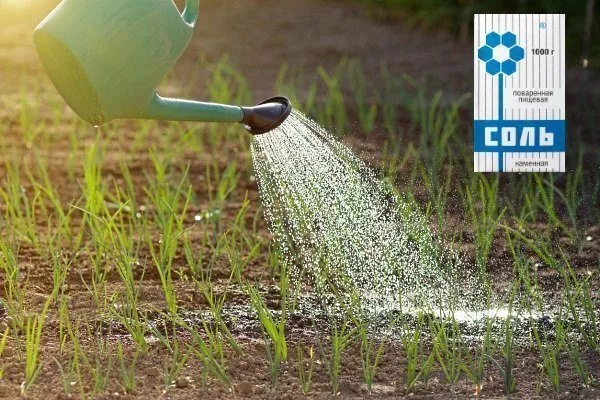
Watering garlic with a salt solution helps repel pests and enriches the soil with beneficial minerals. Garlic is watered with a salt solution when the leaves are 3-5. Recipes for making salt solutions:
- To combat root knot nematodes, use 50 g of salt (2 tablespoons) per 10 liters of water. This amount of solution is sufficient for 2 square meters of beds. Repeat watering after 1.5 weeks.
- To combat onion flies, prepare a more concentrated solution and spray it on the leaves. Use 250 g of salt (10 tablespoons) per bucket of water.
After watering the garlic with salt, water the beds with clean water. Use salt solution with caution—if the soil contains a lot of sodium and chloride, it will negatively impact plant growth.
How to determine the soil moisture level in garlic beds?
To avoid confusion with watering and ensure garlic plantings are properly moistened, gardeners can use a moisture meter. This device measures soil moisture. If it shows less than 70% soil moisture, it's time to water the garlic plantings. If you don't have a moisture meter, you can use the old-fashioned method of determining moisture.
Take a handful of soil from a depth of 10 cm and squeeze it. Open your palm and determine the soil's moisture content based on its condition:
- For indoor use:
- if fingerprints remain on the ground – 70%;
- if the lump has crumbled – 60% (it’s time to water);
- if drops of liquid appear on the ground – more than 80%.
- For open ground:
- the soil does not form a lump – 60% (it’s time to water);
- a lump of dense structure is formed – more than 90%;
- a dense lump is formed, when pressed the palm becomes wet - 80%;
- the lump forms, but falls apart when pressed – 70-75%.
Mistakes when watering
Even experienced gardeners can make mistakes when watering garlic:
- Watering during the day. Avoid watering garlic during periods of intense sunlight. Bright sun can damage wet leaves and cause burns.
- Moisture getting on the leaves. When watering garlic, avoid getting water on the above-ground parts of the plants. Garlic isn't particularly sensitive to this method of watering, but high temperatures increase the risk of fungal diseases.
- Frequent watering with small amounts of water. With this irrigation scheme, water cannot penetrate deep into the soil and will only be available to plants with roots in the topsoil. Water close to the soil surface will evaporate quickly, and the garlic will not receive enough moisture. As a result, a well-developed root system capable of absorbing moisture from the depths will not develop.
- Watering with a strong stream. Strong water pressure can damage garlic leaves and thin stems. This damage, while barely noticeable, can lead to reduced yields. Damaged leaves and stems are at risk of fungal infection. Therefore, watering garlic with a hose is not recommended; it's better to use a watering can. Although this is more difficult and time-consuming, the garlic will be healthy and its heads will be large.
- Late watering. It's not advisable to water garlic too late. If the soil doesn't dry out before nightfall, it will create favorable conditions for fungal growth.
Proper watering—in the right amounts and at the right frequency—not only improves garlic productivity but also the quality of the garlic bulbs. When determining watering rates and frequency, consider the crop's water requirements, as well as regional climate and current weather conditions.