
Dobrynya garlic is a prominent winter variety. It bears fruit early, is hardy, and undemanding. It is a bolting garlic variety. It is suitable for cultivation in all regions of the Russian Federation. This variety is equally suitable for growing in home gardens and farm plots.
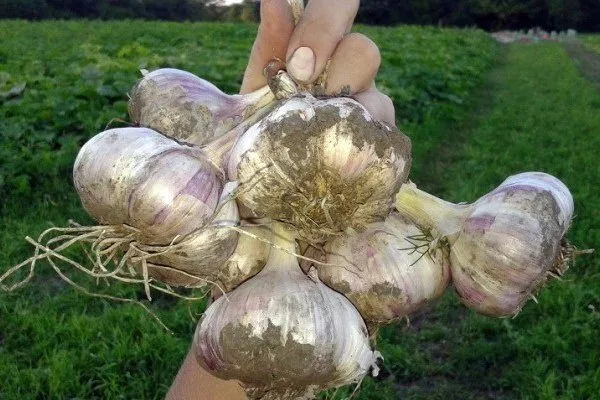
late-ripening winter garlic variety "Dobrynya"
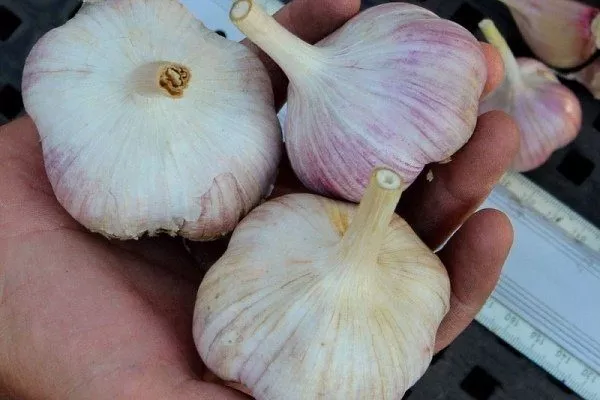
a head of garlic "Dobrynya" weighs up to 65 grams
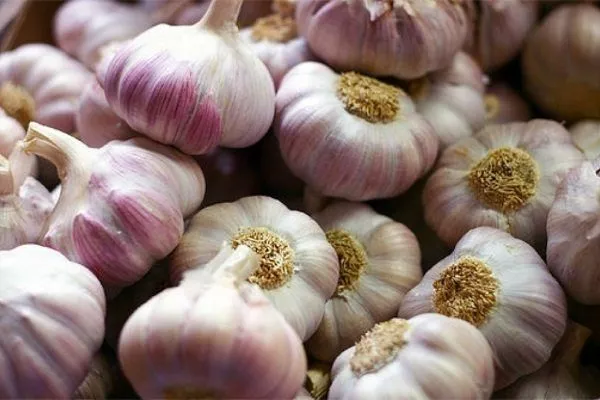
The Dobrynya variety is resistant to cold weather conditions
History of selection
Dobrynya is a domestic variety, relatively new, but already well-established among gardeners. By naming the variety after the legendary hero, its creators likely wanted to emphasize Dobrynya's agricultural prowess—its yield, frost resistance, and other virtues. The variety was added to the State Register in 2002.
Description of the variety and its characteristics
The Dobrynya variety is a late-ripening, all-purpose garlic. It ripens in August and September, making it popular for canning. It's also eaten fresh, used in seasonings, and pickled.
Description of the culture:
- Leaves. Fleshy and juicy. Color: deep green. Has a waxy coating. Length: 40-60 cm. Width: 2-2.5 cm.
- Inflorescences. They consist of aerial bulblets—seeds used for propagation. Inflorescences appear on long stalks, which are usually noticeably curved.
- Head. The shape is round, slightly flattened. It is covered with pale gray scales with pale lilac veins. The cloves are covered with scales with a more pronounced purple hue. The flesh is pale cream, dense, aromatic, and juicy. The taste is sweet and spicy.
Agrotechnical characteristics of Dobrynya garlic:
| Characteristics | Parameters |
| Ripening time | late-ripening |
| Growing season, days | 120-130 |
| Weight of heads/cloves, g | 50-65/5-7 |
| Number of cloves in a head, pcs. | 10-12 |
| Yield, kg/sq.m | 2-2.5 |
Dobrynya garlic bulbs contain 40% dry matter and 24% sugar. 100 g of garlic contains 10 mg of ascorbic acid. Nutritional value: 144 kcal per 100 g.
Advantages and disadvantages of the Dobrynya variety
Consuming garlic boosts immunity, lowers cholesterol and blood sugar levels, and fights inflammation and tumors.
Advantages of the Dobrynya variety:
- high yield;
- large head size;
- long shelf life;
- immunity to many fungi and other garlic diseases;
- high frost resistance, tolerates sudden temperature changes well;
- versatility of use – used in cooking, is an excellent cold remedy;
- excellent taste;
- the possibility of self-renewal of the variety.
Flaws:
- drying out and rotting after 4 months of storage;
- tendency to degeneration.
Features of planting garlic
The quality of grown garlic depends on many factors:
- Planting dates. It's best to plant garlic 1-1.5 months before severe frosts. The planting time is determined individually for each region. In temperate climates, winter garlic is planted from September to mid-October.
- Temperature. Optimal conditions for planting occur when the soil warms up to +12…+13 °C.
- Soil qualities. Garlic thrives in fertile soils, preferring sandy loam or light loam.
- Predecessors. Winter garlic grows well after strawberries, wild strawberries, potatoes, and tomatoes. It is not recommended to plant it after carrots, onions, lettuce, celery, radishes, spinach, turnips, or herbs such as cilantro, mint, coriander, and basil.
- Lighting. Garlic loves the sun, so it is planted in open, well-lit places.
- ✓ Soil acidity levels should be between pH 6.0-6.5 for optimal growth.
- ✓ The soil must have good drainage to avoid water stagnation and root rot.
Why is it important to plant winter garlic on time?
- If you plant garlic too early, it will produce shoots that will freeze at the first frost.
- If you delay planting, the seedlings won't have time to properly take root. And even if they survive the winter successfully, they won't grow vigorously in the spring.
Preparing the site
Prepare the garlic plot 2-3 weeks before planting to allow the dug soil to settle. Garlic planted in overly loose soil will grow small and will not store well.
To increase Dobrynya's yield, enrich the soil with rotted manure or compost during digging. For depleted soils, you can also add:
- superphosphate – 30-50 g per 1 sq. m;
- potassium – 15-20 g per 1 sq. m;
- complex fertilizers.
Before planting garlic, you cannot fertilize the soil with fresh manure – only rotted manure.
Garlic doesn't like heavy soils, so to make them more airy, peat or sand is added. While not particularly fussy, Dobrynya doesn't like dry, poor soils.
Preparation of planting material
Preparing the planting material begins with an inspection. If a batch of garlic prepared for planting contains a high percentage of spoiled cloves, it is rejected. The cloves should be free of rot and spots. The largest heads are selected for planting. Shortly before planting, the heads are separated into cloves; if there are a significant number of cloves, the largest ones are selected.
You shouldn’t plant heads with 3-4 cloves – this is a sign of variety degeneration.
To ensure large heads and prevent them from becoming diseased or rotting during storage, they are treated with disinfectant solutions before planting. The following are commonly used for this purpose:
- A weak solution of potassium permanganate. The liquid should be slightly pink. Immerse the planting material in the solution for 0.5-1 hour.
- Copper sulfate solution 1%. Soak the cloves for 10 hours. If you soak them overnight, they'll be ready for planting in the morning.
- A solution of table salt. Dissolve 3 tablespoons of salt in water (5 liters). Immerse the cloves for 2-3 minutes.
- Ash solution. Add one glass of ash to 1 liter of water. Soak the seeds for 1 hour.
- Purchased drugs:
- "Maxim". It works like an antibiotic, but its ingredients are natural. One ampoule per 1 liter of water. The effect lasts for the entire growing season.
- Fitolavin. Protects against bacterial infections, root rot, fungal diseases.
Planting garlic in the ground
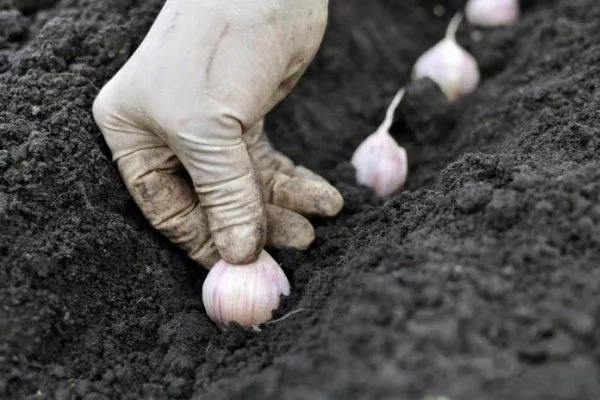
Garlic is planted in rows, leaving 20-25 cm between them. The seeds are spaced 12-15 cm apart. The planting depth should be sufficient to ensure the garlic survives the winter. To achieve this, the cloves are pressed into the soil so that there is a 4-5 cm layer of soil above them.
When planting, do not press hard on the cloves - if you press them too hard into the soil, this will slow down the development of the root system.
The garlic bulbs are planted with their bases down and covered with soil. Watering is not necessary for fall plantings. In regions with particularly cold winters, mulching is another essential step. After planting, the beds are mulched—sawdust, straw, or plant debris are all suitable.
Caring for Dobrynya
Caring for Dobrynya garlic consists of the usual measures for this crop:
- Watering. Water moderately, twice a week. Avoid overwatering the soil.
- Loosening. Prevents the top layer of soil from drying out and forming a hard crust. Loosen the soil approximately an hour after watering.
- Weed removal. Weeding is done as needed until harvest. If weeds are not removed promptly, garlic will grow poorly and its bulbs will become smaller.
- Top dressing. It is applied when the garlic is actively growing. Fertilizing is stopped when the ripening period begins to prevent a deterioration in quality and flavor.
- First feeding – 10 g ammonium nitrate per 1 sq. m.
- Second feeding – carried out at intervals of 2-3 weeks. The beds are watered with a nitroammophoska solution – 40 g per 10 liters.
- Third feeding – is carried out around mid-July. Water with a superphosphate solution – 40 g per 10 l.
- The first feeding should be carried out 2 weeks after the emergence of seedlings, using ammonium nitrate at a rate of 10 g per 1 sq. m.
- The second feeding should be carried out 3 weeks after the first, using a solution of nitroammophoska (40 g per 10 l of water).
- The third feeding should be carried out at the beginning of the formation of heads, using superphosphate (40 g per 10 l of water).
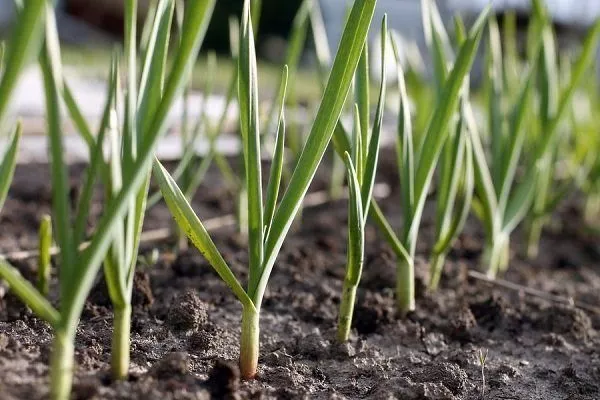
Diseases, pests and their control
The Dobrynya variety has a high immunity, so it is rarely affected by fungal and viral diseases. Preventive measures are sufficient to achieve high yields.
Symptoms and methods of combating pests and diseases of garlic Dobrynya
| Pests and diseases | Symptoms of damage | How to fight? |
| Stem nematode | Garlic leaves are drying out, and the roots are rotting. The pest is a small white worm, 1.5 mm long. | Plant calendula between rows.
Before planting garlic, water the soil with a salt solution (20 g per 3 l). Add peat or sand to clay soils. |
| Root mite | It most often attacks heads during storage, but can also eat heads in the garden. | Purchase healthy planting material.
Burn plant residues. Treat the storage facility with sulfur dioxide gas. |
| Onion fly | It lays eggs at the base of leaves. The larvae eat away the head and young scales. The plant initially grows slowly, then withers and dies. | Plant carrots nearby.
Onions are an undesirable predecessor. Sprinkle the soil with a mixture of ash and tobacco, adding mustard or pepper. Water with a salt solution - 250 g of salt per 10 liters. |
| Fusarium | Occurs due to excessive moisture. It is accompanied by yellowing and wilting of the leaves. The heads become loose, slimy, and easily pulled out of the soil. | Crop rotation.
Treat the soil with fungicides 2 weeks before planting. At the first signs of disease, spray the plantings with fungicides. Thorough drying of heads before storing. You cannot plant bulbous plants in one area for more than 5 years. |
| White rot | Appears during storage. The cloves become soft and rot. | Clearing the beds of plant debris.
Disinfection of soil before planting garlic with the product "Hom". During the growing season, water with a solution of Fitosporin-M. |
Methods of reproduction
Dobrynya garlic is propagated vegetatively, using cloves. Cloves are selected from the largest heads to ensure a larger harvest. Over time, the variety degenerates, losing its original qualities. To preserve the varietal characteristics, renewal is necessary: instead of cloves, aerial bulblets are planted. These bulblets grow on scapes, in inflorescences.
It's recommended to renew garlic plantings with bulblets every 3-4 years. Aerial bulblets are harvested from garlic scapes in the spring, during bolting. The following year, single-clove heads grow from these bulblets. These are planted in the fall, where they grow into full-sized heads.
Harvesting and storage
Harvesting begins in July, with timing varying by region. Gardeners rely not only on timing but also on the garlic's appearance. If the tops have turned yellow and begun to droop toward the ground, it's time to harvest. It's important not to delay harvesting. If the heads are overripe, they will begin to disintegrate into cloves, separating from the stem, making harvesting difficult.
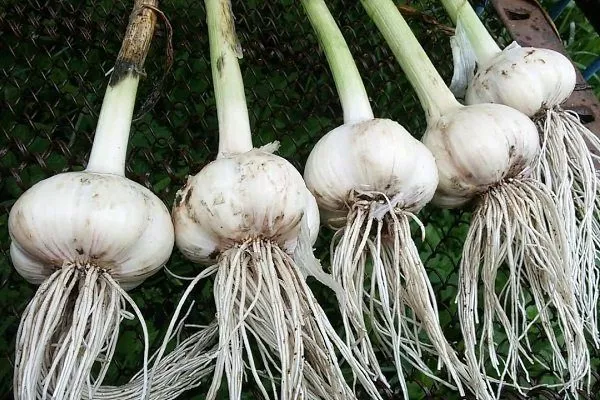
The best weather for harvesting is dry, sunny weather. The dug-up garlic is laid out to dry in the open air. If the weather is cloudy, it's best to harvest it under cover. Once the leaves are dry, trim them off, leaving a couple of centimeters. The roots are also trimmed.
Conditions for long-term storage:
- dry, well-ventilated area;
- temperature – from 0 to +4 °C;
- Garlic is laid out in nets or small boxes.
Garlic bulbs are stored for about four months. During this time, they don't spoil at all—provided the harvest is undamaged and disease-free. After five to six months, the bulbs begin to spoil gradually, with approximately 20% having to be discarded. To prevent spoilage, garlic is processed or consumed promptly.
Reviews from gardeners
Gardeners have given mixed reviews of the Dobrynya variety, with some positive and some extremely negative. Keep in mind that failures in growing are often the gardener's fault, as they violate cultivation practices.
Dobrynya garlic is considered one of the best winter varieties for good reason. It's productive, undemanding, and easy to grow. Unlike most varieties, Dobrynya isn't limited to a specific habitat—it grows equally well in virtually all regions of the country.