
"Bogatyr" is a winter garlic variety with very large cloves. It recently hit the market, but immediately caught the attention of gardeners and culinary enthusiasts. Let's find out what makes "Bogatyr" so special and what determines its yield.
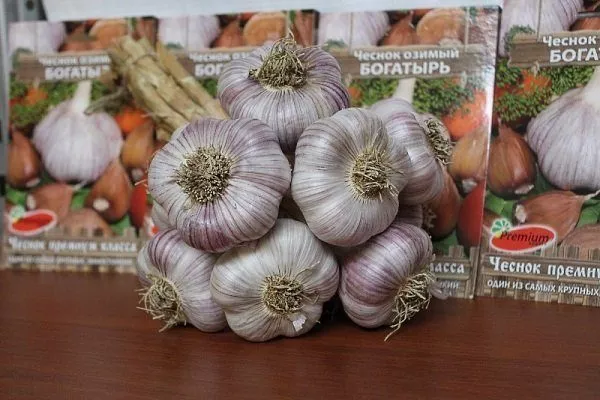
garlic variety "Bogatyr"
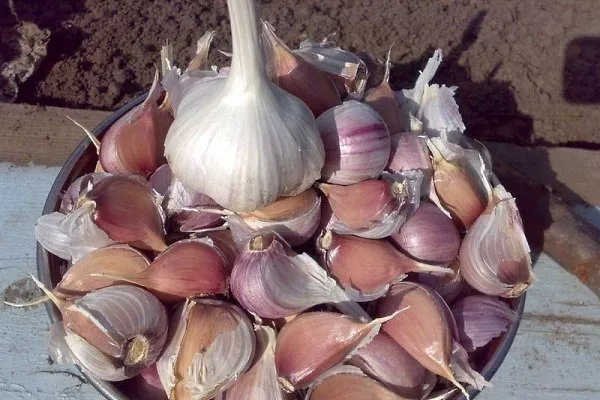
The Bogatyr garlic is productive, all the cloves are large
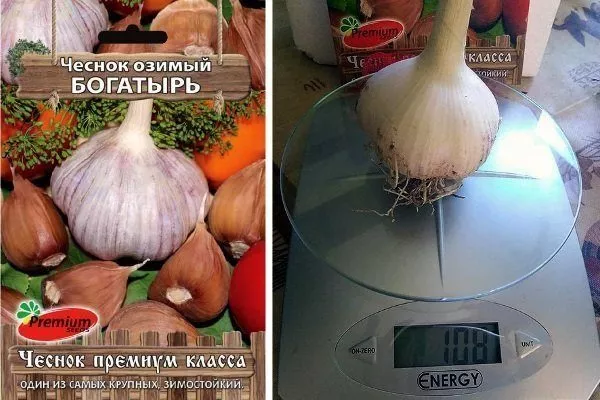
"Bogatyr" is truly like that!
Features of the variety
Bogatyr garlic is a premium variety. It's a bolting annual plant that's productive and frost-hardy. To ensure fresh garlic every summer, this annual variety is planted annually.
Features of the Bogatyr variety:
- The cloves are very large and have impeccable flavor. The pulp of this variety is rich in essential oils and has the traditional garlic aroma and pungency.
- Thanks to the stem growing inside the false stem, the garlic leaves, as they grow, do not fall over during ripening. Even the longest Bogatyr leaves do not droop toward the ground, unlike those of most varieties.
- The leaves consist of two parts—an upper and a lower. The upper part is located above the ground, while the lower, white part protects the garlic clove. After the outer leaves emerge, the next row grows, forming a rosette that supports the tops.
- When grown, the main product is the bulbs. The above-ground portion, compared to the bulbs, is of little economic value. This variety is not suitable for growing for its greens.
- The variety is planted in the fall. Spring planting is done only to ensure larger cloves for the following year.
- It has excellent shelf life – it retains its marketable appearance and taste for six months.
If you decide to grow the "Bogatyr" variety, consider whether you need such large heads and whether your family can consume one clove at a time. Perhaps you'd be better off planting garlic with cloves of varying sizes—large and small. However, for preserves and for sale, the giant-clove variety is ideal.
Description and characteristics of Bogatyr garlic
Bogatyr garlic is visually no different from other varieties. At the end of the false stem is a head of garlic consisting of several cloves. The variety's main distinguishing feature is its unusually large cloves.
Botanical description of Bogatyr garlic
| Part of a plant | Characteristic |
| Stem | The false stem is white and formed by the upper leaves. A stalk forms within it. |
| Leaves | Length: 20-60 cm. Width: 1.5 cm. They consist of two parts: an upper and a lower one. The upper part is located above the ground, while the lower part protects the garlic clove. |
| Bulb | A round-flat head weighs 75-85 g. Maximum weight is 110-120 g. One head of garlic contains 5-7 cloves, sometimes 9. The scales, when drying, change color from purple to brown. |
| Roots | Fibrous. Located at the base of the bottom, branching laterally. |
Productivity
The creators of "Bogatyr" insist that this variety is high-yielding. However, they don't provide any numerical data. However, the originator (creator/owner of the variety) states that:
- heads weigh on average 80 g, maximum weight – 115 g;
- One slice weighs on average 13 g.
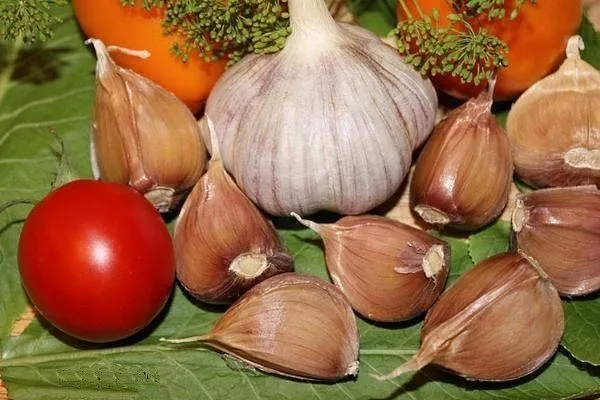
The originator claims that the yield of "Bogatyr" is practically independent of soil characteristics.
Based on the initial data, we will try to calculate the yield of "Bogatyr" ourselves:
- The variety has a powerful root system – its area is about 50 sq. cm.
- When planted according to the 17x45 pattern, 6-7 cloves fit in a 1 m long bed.
- There are 2 rows per square meter, which is 14-16 cloves. Each clove will produce a head of garlic weighing 80 g.
To calculate the yield, multiply the weight of one head by the number of heads grown per square meter: 80 g x 15 pcs = 1200 g. This means that 1.2 kg of garlic is harvested per square meter.
Disease resistance
Like all winter varieties, "Bogatyr" grows rapidly in the spring. It ripens before microbes and pests have a chance to take hold. Thanks to this characteristic, "Bogatyr" avoids most garlic problems. The variety is resistant to nematodes—tiny worms that suck the plant's sap.
Standard disease and pest prevention measures:
- compliance with crop rotation;
- timely removal of plant debris;
- digging the soil before planting;
- disinfection of planting material.
Where is it recommended to plant?
The "Bogatyr" variety is versatile, suitable for both southern and northern regions. This winter garlic variety thrives in any soil and climate conditions.
- ✓ The area should be protected from northern winds to prevent garlic from freezing in winter.
- ✓ The soil must have good drainage to avoid water stagnation and rotting of the cloves.
Other winter garlic varieties are discussed in this article.
To maximize the yield of the Bogatyr variety:
- choose areas with good lighting;
- the area should not be waterlogged or swampy, otherwise the cloves planted in the ground will rot before spring in the wet soil;
- It is advisable to plant garlic after carrots, cucumbers, potatoes, tomatoes or zucchini.
Preparing for landing
Prepare the planting site 7-10 days in advance—this allows the loosened soil to settle, and the garlic cloves planted in the beds will not emerge from the soil. Garlic is easy to grow, and no special preparation is required. Fertilizing is not necessary at planting time, as it's not needed for winter. Fertilize "Bogatyr" in the spring, when the growing season begins.
Priming
If garlic is grown in fertile soil, fertilizing is not necessary. To prepare the area for planting:
- cleaning of plant debris;
- If the soil is poor, then before digging, sprinkle peat mixture, compost, ash, superphosphate or complex fertilizer;
- treating the surface of the area with a solution of potassium permanganate for disinfection;
- digging or processing with a flat cutter;
- breaking up clods of earth and leveling the surface with a rake;
- laying furrows for planting, their depth is 13 cm.
To avoid having to make furrows by hand, gardeners use a special marker to mark out the plot. This marker makes planting garlic easier, ensuring the garlic cloves are evenly distributed across the plot.
Planting material
To ensure a good harvest, cloves for planting are sorted, removing small and damaged ones. To prevent rot, fungal, and mold infections, all planting material is disinfected.
Disinfection of planting material is carried out in two solutions:
- Saline. Prepare by dissolving 1 tbsp in 2 liters of water.
- From copper sulfate. For 2 liters of water – 1 teaspoon.
Garlic cloves are immersed in a saline solution for 3 minutes, then in a second solution for another 3 minutes. After disinfecting the planting material, it is thoroughly dried.
Determining the timing
Winter garlic is planted at different times in different regions. One to one and a half months should pass between planting and the onset of stable frosts. This time is necessary for the crop to establish roots. If the garlic doesn't have time to do so, it will have a hard time surviving the winter.
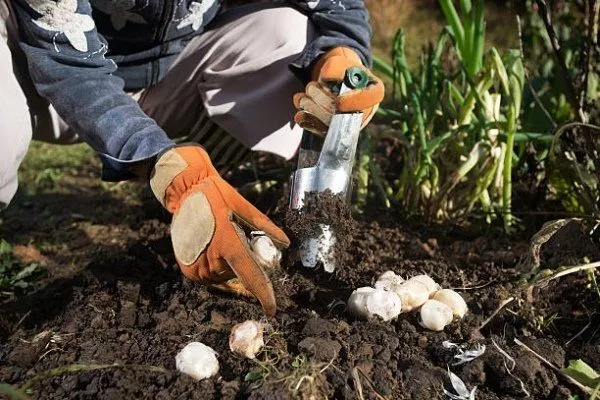
In the north, winter garlic is typically planted in mid-October, and in the south, in November. In the warmest regions, planting can begin as early as December. If you plant early, the garlic will have time to sprout before the first frost kills it. When choosing a planting time, consider the regional climate and long-term weather forecasts.
Step-by-step planting instructions
Bogatyr garlic can be planted in either of two ways: in holes or in furrows. Furrows produce larger heads of garlic.
How to plant Bogatyr garlic:
- The cloves are planted 10-13 cm deep – this is the distance from the bottom to the surface of the ground.
- There should be approximately 45 cm between adjacent rows. This is almost twice as much as when growing other varieties.
- The intervals between adjacent teeth are 16-18 cm.
- There is no need to add manure.
- The planting area is mulched before the onset of frost. Hay, straw, and leaves are used as mulch.
Further care of Bogatyr
Care measures for the Bogatyr variety:
- Watering. In spring, garlic begins to grow vigorously. It requires regular watering. However, overwatering the beds is not recommended, as this can cause root rot.
- Loosening. This is done after each watering. Weeds are removed along the way.
- Removing arrows. All stems are removed when they reach 8-10 cm in length. A few are left if "bulbs" are needed for propagation. If the stems are not removed, they will draw nutrients from the plant, and large bulbs will not grow.
- Apply the first nitrogen fertilizer when seedlings emerge.
- Provide regular watering, especially during active growth periods.
- Remove the stems once they reach 8-10 cm in length to direct the plant's energy towards forming bulbs.
Broken garlic shoots can be used for canning.
How to propagate?
The Bogatyr variety is propagated by two methods:
- With teeth. In the fall, garlic cloves removed from the garlic cloves are planted in the ground. The harvest of full-sized garlic heads is harvested in the summer, 100-120 days after germination.
- Aerial bulbs. When propagated by bulblets growing at the top of the stems, a harvest is obtained only in the second year. In the first year, only single-clove bulblets are produced. This propagation method is usually used to renew a cultivar. Furthermore, aerial bulblets are readily available and free planting material.
When and how to collect?
The signal to harvest garlic is when the lower leaves turn yellow and dry out. Don't delay harvesting—the bulbs, having been "overstayed" in the ground, will crack and darken. Such a harvest won't last long.
When the tops turn yellow and dry out, the heads are removed from the ground. The "Bogatyr" garlic has strong roots and sits firmly in the soil. Dig with a pitchfork or shovel. To avoid damaging the garlic cloves, use a pitchfork or shovel to pry them up from underneath.
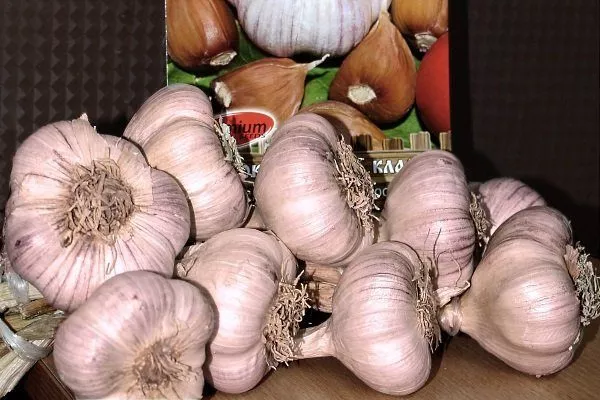
The roots of the dug-up garlic are cut off and tied into bundles by the leaves. The bundles are hung in the shade until completely dry.
Garlic storage requirements and shelf life
Once the garlic is completely dry, trim off the tops, leaving a 3 cm stump, and store the heads. Garlic should be stored in a dry and ventilated area. The optimal temperature is 0 to 5°C.
If garlic starts to spoil during storage, the cloves are planted in shallow boxes in a 3x3 cm pattern to force the greens to be used in salads.
For home use, it's recommended to store Bogatyr garlic in glass jars. Don't seal the jars with lids; instead, tie them with a breathable cloth.
Reviews of the variety
Gardeners couldn't help but be captivated by such an interesting variety. "Bogatyr" garlic appeals not only to its large heads, but also to its ease of cultivation.
The large-fruited Bogatyr garlic stands out from its competitors not only for its gigantic cloves but also for its excellent agronomic characteristics. This variety is easy and low-maintenance, delicious, productive, and has a long shelf life.