
Sweet potato is a tuberous climbing plant. It came to Russia from Spain in the 18th century. It is only now beginning to gain widespread popularity. For many gardeners, this vegetable is considered a new variety of edible root vegetable. This is why growing it is challenging.
Botanical description
Sweet potato is a tuberous perennial plant of the genus Ipomoea. It is often called a sweet potato. It is also used to make the world-famous spice turmeric. Initially, the vegetable was consumed by people of low incomes. It is now found on the menus of fine dining restaurants.
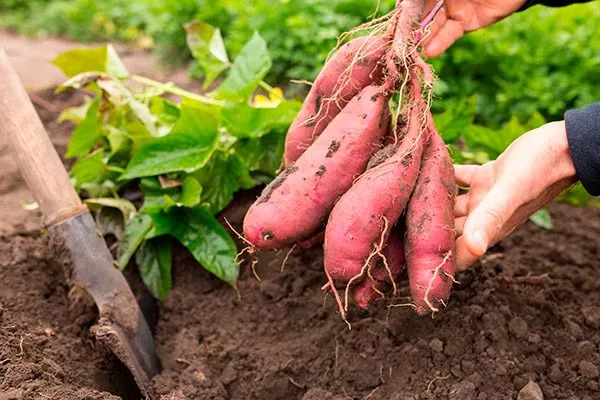
Appearance:
- The leaves are five-pointed, heart-shaped, and are borne on thin, elongated petioles.
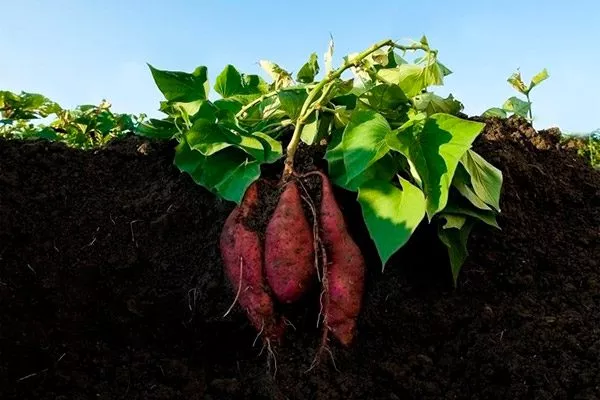
- Stems up to 5 m long, which pass into the root system, forming tubers.
- The flowers are white with a distinct purple hue and a subtle pink undertone. They are funnel-shaped.
- Plant height up to 18 cm.
- The fruit consists of a capsule containing four dark-colored seeds. Each seed weighs between 200 and 500 g. In some regions, it can reach up to 3 kg.
- The length of the vegetable is up to 30 cm.
- The flesh is juicy and tender. The skin is thin. There are no eyes, like in regular potatoes. The sprouts form from hidden buds.
- The shape, color, taste, and texture vary depending on the variety.
Characteristics and yield
Sweet potatoes are valued not only for their flavor but also for their yield, which makes them suitable for commercial forage cultivation. While yield is high, it can fluctuate depending on the variety, soil conditions, and climate.
There are different types:
- high-yielding sweet potato;
- medium-yielding;
- low-yielding.
The higher the index, the coarser the softness and the lower the flavor. These varieties are typically used as livestock feed or for industrial processing.
Other characteristics of the root vegetable:
- Ripening period. Sweet potatoes come in early, mid-season, and late varieties. Harvesting typically begins 4.5-5 months after planting. The flavor is best if harvested after 5 months. Some varieties begin to rot after six months in the soil.
- Resistance to diseases and pests – high. No additional protection is needed. The vegetable can be attacked by mice, slugs, and cockchafers.
- Keeping quality – weak. Large amounts of sugar and other soluble carbohydrates create a favorable environment for the development of all kinds of fermentation and putrefactive microorganisms, causing rapid spoilage of the crop.
- Transportability low. The reason for this is the rapid spoilage of fruits.
- Attitude to bad weather. Sweet potato is a heat-loving crop and is not afraid of drought.
Characteristics of sweet potatoes
Sweet potatoes are native to Peru and Colombia. This isn't the only unique feature; there are a number of other interesting facts:
- Sweet potato can be considered a vine because it has long stems.
- All fruits, regardless of variety, have an oblong shape.
- The color of the pulp depends on the type and can be: purple, orange, red, white, yellow.
- The taste is comparable to carrots. The sweetness comes from the high glucose content.
- Sweet potato is a forage crop that prefers the southern regions of the country.
- The yield is high only under favorable conditions.
- Planting is done using seedlings. Tuber planting is also possible, but the growing season is time-consuming, and a harvest will not be possible before the cold weather sets in.
- The chemical composition varies. Yellow and orange sweet potatoes are rich in beta-carotene. Purple ones are rich in anthocyanins, which are not lost even after prolonged cooking.
- The root vegetable is often used to prevent a number of diseases (for example, cancer, ulcers and cardiovascular diseases).
- The caloric content is 60 kcal per 100 g, which makes the vegetable the basis of dietary nutrition.
- In a country with a tropical climate, sweet potato is a perennial plant.
Types and varieties
| Name | Ripening period | Pulp color | Disease resistance |
|---|---|---|---|
| Forage | 4.5-5 months | Light | High |
| Vegetables | 4.5-5 months | Light with shades | High |
| Desserts | 4.5-5 months | Yellow or orange | High |
There are approximately 7,000 varieties of sweet potato worldwide. They are divided into the following groups:
- Forage. This is a light-fleshed vegetable that retains its texture when cooked. The fruit softens but doesn't become mushy. It's most similar to a regular potato. It's low in sugar and is often used for frying.
- Vegetables. The color is light, with shades of pink, orange, and lilac. The flavor is moderately sweet. It lacks glucose. The flesh is tender. These varieties are suitable for frying, stewing, and making mashed potatoes.
- Dessert. They have a rich yellow or orange flesh. The amount of sucrose and glucose is sufficient to impart a sweet taste. This root vegetable can be compared to a fruit. It is used in desserts, porridges, and pies. The puree is tender because its texture allows it to cook well.
- ✓ High content of sucrose and glucose, which gives a sweet taste.
- ✓ The flesh is rich yellow or orange, indicating a high content of beta-carotene.
Regional cultivation
Sweet potatoes are a forage crop that produces tasty and valuable fruits. Therefore, gardeners in many regions strive to plant them in their plots. However, there are some peculiarities.
Cultivation in the southern regions
Sweet potatoes are tropical in origin. Genetically, the plant prefers warm, sunny climates. Therefore, southern regions are the most suitable. A continental climate allows for the highest yields.
Sweet potatoes are typically propagated by seed, but in Crimea, cuttings can be used. Planting should be done as early as possible—in mid-April.
The climate in the Krasnodar region is conducive to the cultivation of various vegetable varieties. Both early- and late-ripening varieties perform equally well in the region.
Growing sweet potatoes in the temperate zone. Main problems
Growing sweet potatoes in central Russia is possible. Just keep the following guidelines in mind:
- It is better to buy seedlings of cold-resistant varieties that have been bred by breeders specifically for frosty regions: Red Ginseng, White Crystal, Purple Dragon.
- You'll be able to see a harvest if you plant early-ripening varieties. These ripen in no more than 110 days.
- The crop stops growing when the air temperature drops below 10 degrees.
- In temperate latitudes, sweet potatoes can only be grown from seedlings.
Is it possible to grow sweet potatoes in the Urals and Siberia?
Gardeners in Siberia and the Urals also prefer early-ripening and frost-resistant varieties. What are their characteristics?
- Planting only by seedlings.
- The start of cultivation work occurs in the first half of June.
- The seed material can be placed into the soil only if the surface layer has warmed up to at least +18 degrees.
Methods for sprouting sweet potatoes
Sweet potatoes can't be grown from a tuber, like regular potatoes. Therefore, the fruit must be sprouted before planting. There are several options.
Germination in water
A unique feature of this method is that 30 days after germination, the tuber can be planted in the soil, where it will continue to produce cuttings for seedlings. These can be broken off or partially trimmed from the sprout with sharp scissors or garden shears.
What are the initial steps:
- Find a container that can easily accommodate half of the root vegetable. This could be a small glass or a jar.
- Fill a container with water and place the sweet potato so that the liquid covers only 2 cm of the vegetable. Place it cut side down. There's a risk that the sweet potato will fall to the bottom. It's recommended to place it on small lids, such as those from medicine jars. They have a smaller circumference and help keep it in place.
- Wait until the vegetable puts out leaves and roots.
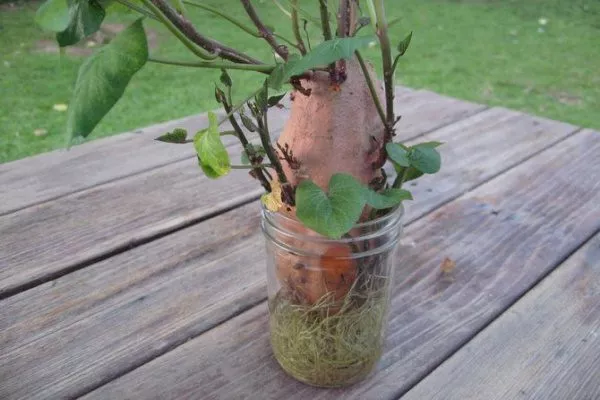
It's best to grow cuttings from sweet potatoes cut in half. There are several reasons:
- This will speed up the seedling formation process, and the number of seedlings will be greater than with a whole vegetable.
- Sweet potatoes have a top, where the leaves grow, and a bottom, where the root system develops. The buds are invisible to humans, so it's impossible to distinguish between the top and bottom. When planting a whole sweet potato, you can confuse the sides. This can lead to disastrously slow sprout development.
- With a half-cut, everything is simpler. The cut is where the roots form.
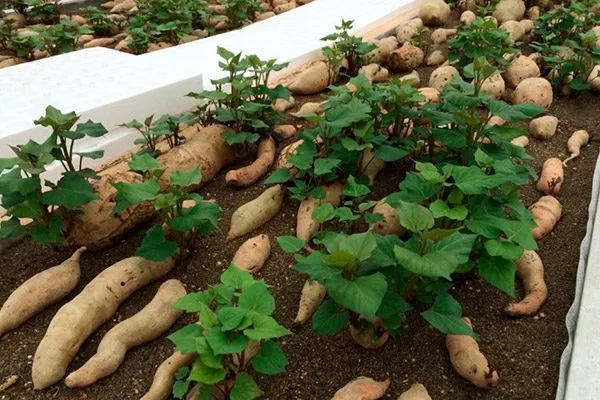
Germination in soil
This method involves rooting the plants in a soil mixture. Proper preparation is important. Sweet potatoes are sensitive to micronutrient deficiencies, so add vermicompost, which contains a full range of minerals, to the mixture.
It's best to prepare the mixture in advance to ensure it's disinfected by watering it with a Fitosporin-M solution. Available in various forms, the recommended powder is 5 g per 10 liters of water, which is enough for 100 square meters. After watering, let the soil sit moist for about two weeks.
The algorithm of action is as follows:
- Fill a container or box with the prepared soil. Cover with a layer of sand mixed with sawdust, about 2 cm thick.
- Press the sweet potato horizontally into the soil.
- Place the container in a dark place where the temperature is above 20 degrees Celsius. Water regularly. Do not allow the soil to dry out.
- Observe the planting process. Once the tubers sprout, move the container into the sunlight.
For best results, you can extend the daylight hours to 16 hours. Use a grow light for this purpose. Watering with warm water will help speed up the germination process.
It's recommended to place sweet potatoes in the box lying down, i.e., horizontally. When storing them standing up, consider the top and bottom, where the leaves and roots will emerge. As mentioned earlier, it's not possible to determine the exact location visually.
Other methods of forcing cuttings
Sweet potato tubers can be sprouted in sawdust, paper towels, or sand. In all cases, maintaining moisture is important. Sprouts and buds will appear regardless. As soon as these formations begin to appear, plant the tubers in soil.
Rules for growing seedlings
Sweet potato seedlings are often grown from seeds. This method has become popular due to its simplicity; even a novice gardener can handle the task.
What is taken into account:
- Start planting seeds in late January or early February. This is because some varieties take quite a while to germinate.
- Good planting material should be 3.5 to 4.5 cm in circumference, black or brown in color, and round in shape. Soak them in warm water for 24 hours. If time allows, leave them for 48 hours. This will speed up germination.
- If desired, you can disinfect the seeds in a manganese solution. Soak them in a potassium permanganate solution (1 g per 100 ml of water) for 20 minutes, rinse, and dry.
- Plant in special garden containers approximately 25 cm in diameter. The substrate should consist of equal parts turf, humus, and sand. The soil should be loose and fertile. Regular potting soil is unsuitable. It lacks nutrients and poses a high risk of pest infestation.
- Place the seeds 1.5-2 cm deep. Cover with soil, compact and water.
- The optimal temperature for seedling germination is +20°C (68°F). The room should be well-ventilated. You can place the box on a windowsill or cover it with transparent film.
Planting sweet potatoes in open ground
Sweet potatoes' similarity to potatoes doesn't affect planting in any way. The crop is rarely grown as root vegetables. Rooting seedlings in open ground has its own unique characteristics.
Combining sweet potatoes with other plants
Sweet potatoes have a strong immune system and are resistant to pests. Therefore, you don't need to worry about neighboring plants that might infect them or those that will protect them. Sweet potatoes tolerate most crops well. They are particularly compatible with legumes.
What time to plant?
Sweet potatoes are heat-loving plants. Therefore, planting should take place during the warmer months. Timing depends on the growing region. Typically, this is done in May-June. By this time, the nighttime chills will have passed, and the soil will have warmed to an optimal 15 degrees Celsius. Acacia blossoms can serve as a guide.
If planting is carried out earlier, then do it in a greenhouse or under a jar.
Site preparation
To ensure a productive sweet potato harvest, choose your location carefully. The crop dislikes shade; the site should be well-drained. The beds should be open but protected from the wind.
The most delicious root vegetables can be extracted from loamy and sandy loam soils with a high nitrogen content.
Prepare the soil for your sweet potato plantings in advance, in the fall. Here's what to do:
- Dig the soil to a depth of 15-20 cm.
- Add rotted manure (5 kg per 1 sq. m). You can replace it with compost (200 g per 1 sq. m).
- Fertilize the soil with superphosphate (25 g per square meter) and potassium sulfate (15 g per square meter). Apply to a depth of up to 15 cm. Exceeding this depth will cause the plant to develop excessively long and thin roots, which will negatively impact the weight of the tubers.
- In the spring, loosen the future bed and add ammonium nitrate (35 g per 1 sq. m).
Rules for planting in open soil
Plant seedlings in open ground in the morning or evening. This will help the plants adapt to the new environment more quickly. If using pot-grown seedlings, place them in the hole along with the root ball. If using jars with water, lightly trim off any branched roots, but only if they reach a significant size.
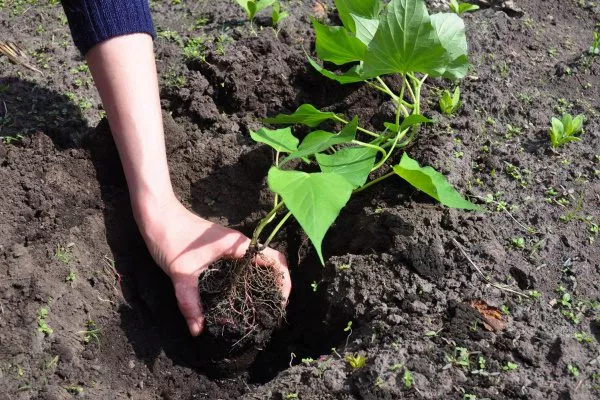
Planting pattern:
- the depth of the planting holes is about 15 cm;
- the distance between seedlings is 40 cm (if the variety is long-vine, then 70 cm);
- distance between rows – 70 cm.
A more compact arrangement is acceptable. Over time, the plant will form a carpet of foliage and shoots that can protect the soil from rapid moisture evaporation.
Landing algorithm:
- Form holes.
- Place the seedlings up to the first bud. Compact the soil.
- Water the plant thoroughly. Use 0.5 ml of water per hole. You can add any organic fertilizer to the water. This will protect the plant from fungal diseases.
- Cover each bush with a cut-down plastic bottle. The key to choosing a covering material is transparency.
- Remove the container once new foliage begins to grow.
In southern regions of Russia, sweet potatoes can be planted from seeds in open ground. To do this:
- Choose an early-ripening variety, as planting should begin immediately after the danger of frost has passed.
- Treat the seeds with potassium permanganate (1 g per 100 ml of water, leave for 20 minutes, dry).
- Place the grains to a depth of 4 cm.
- Water the bed with settled water at room temperature.
- Cover the planting with plastic film. Remove it when the sprouts begin to emerge.
Caring for sweet potatoes
You won't be able to grow healthy, tasty sweet potatoes if you don't care for them properly. The specifics of this process are such that you may need to forgo some standard care.
How to water?
Sweet potatoes are a forage crop with high drought tolerance. Therefore, they don't require abundant watering. However, during the first month after transplanting the seedlings into open ground, water them thoroughly and consistently. Over time, reduce the watering to moderate levels.
From mid-summer onward, water the bed no more than once every 1.5 weeks. If it rains, the plant receives enough precipitation for full growth.
Fertilizing sweet potatoes
The plant doesn't need fertilizer for the first two weeks after planting. During this time, additional fertilizer can harm the young root system.
The following substances are then required:
- Nitrogen. It helps develop leaves and shoots. Slurry is often used – 5 liters per 10 square meters. It's important not to overdo it, as organic matter encourages fungal diseases.
- In mid-July, to increase fruit production, apply potassium and phosphorus. Continue feeding until the end of September. Wood ash is the best choice. It has an optimal balance of nutrients.
Make a solution of 10 liters of water and 35 g of the substance, and leave it for a week. Stir the mixture periodically. Apply 1 liter per bush.
Weeding and loosening
Sweet potatoes generally don't require weeding. They're a climbing plant, and their shoots suppress weed growth.
The specific characteristics of the bush affect the need for hilling. This procedure can be omitted, but only in one case: the root crop does not emerge from the soil surface. If this occurs, hill the soil approximately once every two weeks.
Loosen the soil only before the active growth stage begins. This will allow a dense cover to form, creating optimal conditions for tuber development.
Pests and diseases of sweet potatoes
Sweet potatoes are resistant to diseases and pests. However, even the most delicious, juicy, large, and beautiful tubers are often attacked by cockchafer larvae. Control is essential.
Antikhrushch is often used—an insecticide and acaricide that attacks the pest's nervous system, paralyzing it and quickly killing the larvae. It also indirectly reduces the risk of viral and fungal diseases. Water with a solution of 10 ml per 5 liters of water. This amount is sufficient for 20 square meters.
Who else can harm forage crops:
- Slugs. They appear during periods of prolonged rainfall. To get rid of them, set up bait in your yard—bowls filled with beer. The gastropods are drawn to the scent, so collect them at that time.
- Spider mite. Parasitism occurs during drought. Spray the plant with chamomile infusion. To do this, pour 1 kg of flowers into 5 liters of hot water and let steep for 12 hours. Then strain, dilute with water in equal proportions, and spray.
- Blackleg. A disease that causes stem rot at the root collar. If Fitosporin-M was used during the germination preparation stage, the plant is protected from the disease.
Harvesting and storing sweet potatoes
Sweet potatoes are harvested from mid-September to early October, before the cold weather sets in. Timing varies depending on the growing region. The roots can be dug up 12-16 weeks after planting. Look for yellowing leaves and stems.
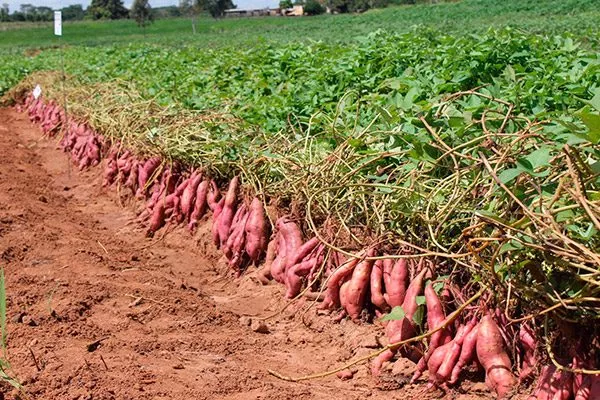
When handling, keep in mind that the vegetable is fragile and breaks easily. It's best to use a pitchfork; this makes it easier to remove the sweet potato without damaging it.
Storage rules:
- place in small trays;
- room temperature from +10 to +15 degrees;
- First, let the fruits “rest” for 4-7 days at around +30 degrees.
Sweet potato as an ornamental houseplant
There are many varieties of sweet potato. One of the most popular is the Ipomoea batata (Buttercup). This ornamental variety is often grown as a houseplant.
Appearance:
- Height up to 30 cm, shoots are long, liana-like, up to 2 m. They can creep and twine around supports.
- Heart-shaped leaves up to 15 cm. Color from green to scarlet or yellow.
- In July, inflorescences of small white, lilac or pink flowers in the shape of gramophones are formed.
- The side shoots bear small tubers. In Mexico and Central America, they are used as food. This is not the case in our country.
Sweet potato morning glory is an attractive plant that can brighten up any windowsill if you keep a few growing guidelines in mind:
- In winter, the bush may lose its leaves if the room is cold. The best location is a south or southeast-facing window with filtered sunlight.
- A strong draft can damage the plant. Ventilate carefully.
- Water at the roots. Frequency: 1-2 times a week, depending on the air temperature.
- Avoid spraying. Otherwise, the decorative effect will be lost.
Sweet potato is a tuberous perennial plant. In our country, in any region of Russia, planting and harvesting this edible root vegetable is done annually, following the rules. The crop prefers warmth and sunlight, but some varieties can grow in Siberia and the Urals. The plant requires care.