
Eggplants, due to their capriciousness and sensitivity, react very quickly to any negative changes that occur during the growing season. Yellowing of the green foliage, ovaries, and fruits is often a sign of dissatisfaction. There are many reasons for this color change. It is important to promptly and correctly diagnose the problem and take corrective action.
Why do seedlings turn yellow?
Yellowing of leaves is common when growing eggplant seedlings. This is due to the plant's sensitivity to growing conditions. This is how seedlings react to various agricultural practices.
- ✓ The optimal temperature for eggplant seed germination is 25-28°C during the day and not lower than 20°C at night.
- ✓ The seed sowing depth should not exceed 1.5 cm, otherwise germination is significantly reduced.
Causes of yellowing leaves on small seedlings and how to avoid them:
- Unsuitable soil. It's recommended to purchase a ready-made, balanced substrate. If you're preparing your own soil mixture, it's important to follow the correct composition and proportions.
- Improper nutrition. Seedlings react quickly to both a deficiency and an overdose of fertilizers.
- Violation of the watering regime. There are no precise guidelines regarding the frequency and amount of watering. It is necessary to closely monitor the soil condition, adjusting watering depending on the degree of its drying.
- Diseases and pests. Seedlings are easily susceptible to fungal and viral diseases and insect attacks if preventative measures are not taken to disinfect the soil, seeds, and spray.
- Dense plantings. Failure to maintain proper spacing between adjacent plants and rows results in a lack of light, moisture and nutrition for individual specimens, which manifests itself in changes in foliage colour.
- Lack of natural light. Sometimes an apartment doesn't have a south-facing window. This prevents the seedlings from receiving the necessary sunlight for photosynthesis, and the leaves take on a pale yellowish tint. If the light is insufficient, install phytolamps.
Why do eggplants turn yellow in both indoor and outdoor soil?
Eggplants can react equally to a wide range of negative factors, from improper watering to pest infestations. To determine the cause of yellowing leaves, you need to carefully examine the plant and analyze all the nuances of your growing practices.
Reaction to transplant
Transplanting is always a significant stress for eggplants, disrupting their normal growth rhythms and conditions. The main cause of yellowing leaves is root damage. To prevent this, transplant the seedlings from their containers into the ground with a large lump of soil.
If everything is done correctly, within a week the plants will recover, take root, signs of stress will disappear, and the leaves will become strong and green.
When transplanting eggplant seedlings to a permanent location, it is recommended to grow them in peat pots. In this case, the seedlings are planted along with the container, which significantly reduces stress and prevents root damage.
Incorrect planting pattern
This problem is most acute in greenhouses, as gardeners strive to use their greenhouse space sparingly. In reality, such savings backfire.
In dense plantings, the lower leaves have no chance to receive their full dose of light. They stop photosynthesis, turn yellow, and the plant sheds them.
A similar phenomenon is observed in open ground, when mature eggplants begin to grow, and the tops of adjacent rows merge. No longer needed, the lower leaves turn yellow and fall to the ground.
To avoid this problem, it's important to follow the planting pattern from the start. If trouble has already occurred, thin out the beds as soon as possible.
Distance between adjacent bushes:
- low-growing varieties - from 60 cm;
- tall - 80–100 cm.
Unsuitable soil
Heavy, highly acidic soils often cause eggplant leaves to turn yellow. Peaty soils are the worst soil for this nightshade crop.
Eggplant requires loose, fertile, well-aerated soil. To improve the soil structure, add sand, perlite, vermiculite, and coconut coir.
If the soil type meets the vegetable's requirements, but the leaves still change color, it means the soil is low in nutrients. This occurs due to improper crop rotation.
Root damage
Damaging plant roots is possible not only when transplanting seedlings but also during subsequent care. Damage to the root system has an extremely negative impact on eggplants, as they are deprived of moisture and nutrients.
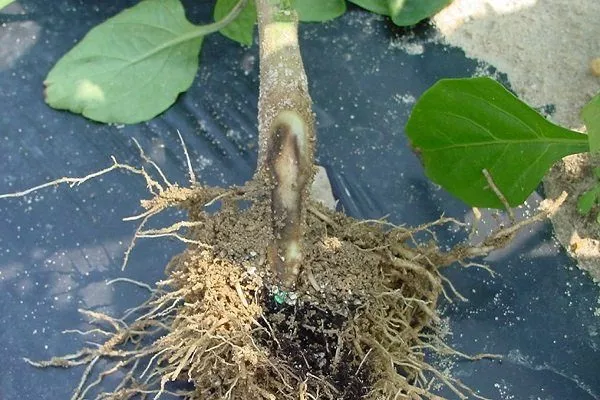
To avoid this problem, all soil-related work—weeding, loosening, and hilling—should be carried out with extreme caution. It's important not to disturb the roots or stems of plants with the hoe.
Irrigation violation
During the seedling stage, eggplants are watered once a week; during flowering and fruiting, the frequency of watering is doubled. Eggplants are watered similarly during hot weather.
Water only at the base of the plant until the soil is completely wet. Avoid getting wet on the leaves and stems. Use settled, sun-warmed water for watering.
If the leaves turn yellow, it is likely that the cause is a violation of watering rules:
- Yellowing occurs both when watering norms are exceeded and when there is a moisture deficiency;
- Yellowed tops indicate an excess of water, if the lower leaves turn yellow, the plants do not have enough moisture.
Temperature changes and sunburn
Eggplants are very sensitive to cold and react poorly to sudden temperature changes. Such cases are common in central Russia. Daytime heat is often followed by cool nights, which leads to a weakened plant immunity and leaf discoloration.
In warmer regions or during dry summers in the country's temperate climate zone, another problem occurs. Direct sunlight burns the delicate eggplant leaves. The spots and specks caused by the sun appear only on the leaf's surface.
Lack and excess of nutrition
If a plant is not receiving enough nutrients, its leaves turn yellow and dry out. The specific nutrient deficiency can be determined by the color changes in the leaf blades.
What do eggplant leaves look like when there is a deficiency of macro and microelements:
- calcium - loss of color and dry ends;
- nitrogen - lightening of the apical leaves;
- iron — the leaves themselves turn yellow, but the veins are green;
- potassium — the edges of the leaves curl upward, turn brown, dry out and crumble;
- zinc — the lower leaves are covered with yellow-brown spots;
- boron - the apical leaves become pale yellow and curl;
- magnesium — the leaves become lighter and covered with yellowish spots.
- ✓ Phosphorus deficiency shows up as a purple tint on the underside of the leaves, which is not mentioned in the article.
- ✓ Manganese deficiency causes interveinal chlorosis, in which the veins remain green, but the tissue between them turns yellow.
Fertilizing the soil before planting eggplants prevents plant starvation. If problems are detected during the growing season, supplement the plant with the appropriate element.
An excess of minerals is no less harmful than a deficiency. This situation occurs when fertilizers are applied excessively or too frequently.
When do leaves turn yellow naturally?
If only the lower leaves of the eggplants have turned yellow, and the plants themselves are quite strong and developed, it is possible that a natural biological process is taking place.
Natural yellowing is observed:
- in seedlings, when the cotyledon leaves die off (the first leaves after germination from the seed);
- in mature bushes, when the natural process of aging of the green mass occurs (usually the leaves of the lower tier).
Disease as a cause of yellowing leaves
One of the most common causes of yellowing eggplant leaves is disease. If prompt intervention is taken, the plants are treatable.
Fusarium
Fusarium wilt is a fungal disease transmitted through seed. Affected vegetable leaves turn yellow at the edges, curl, and then fall off. The pathogen, by infecting the plant's internal structures, disrupts the normal flow of nutrients and causes toxicity.
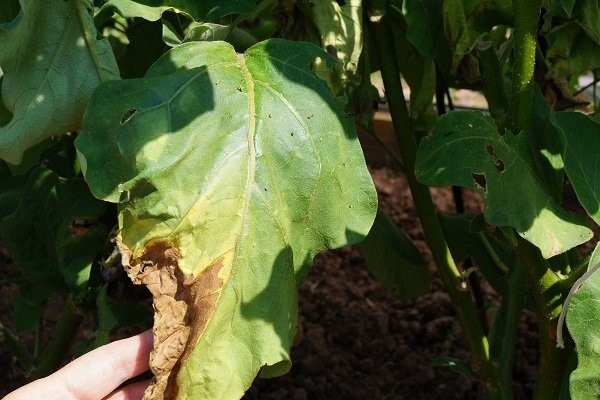
The disease usually results in the death of the plants. Sometimes they grow, but very slowly. A few small eggplants grow on these bushes.
Reasons:
- overwatering;
- increased soil acidity;
- extreme heat.
Pre-sowing seed treatment with a potassium permanganate solution or other disinfectants helps prevent infection. Also, when growing seedlings, treating the soil with quartz lamps is recommended.
Late blight
A fungal infection that is extremely dangerous for nightshade crops. The disease spreads through the air and soil.

Reasons:
- violation of crop rotation;
- overwatering;
- dense plantings;
- lack of phosphorus and potassium fertilizers.
Symptoms of late blight:
- spots appear on the leaves - yellowish, brown, then they turn black and die;
- a white coating appears on the back of the leaves;
- The fruits become covered with brown spots, turn black and dry out.
Severely affected plants are uprooted and disposed of. Other diseased bushes are treated with Hom, Oxyhom, and Profit Gold. For preventative measures, spray the plantings with Fitosporin, Fitoverm, or similar products.
Verticillium wilt
This fungal disease typically appears during the fruit formation stage. First, areas of the leaves turn yellow, followed by brown spots with yellow borders. The disease damages the plant's blood vessels, disrupting the flow of sap and nutrients.

Reasons:
- lack of moisture;
- cooling down to + 16… + 20°C;
- excess nitrogen introduced in the form of organic matter (manure is especially dangerous).
Prevention:
- crop rotation is observed - eggplants are grown in the same place every 4 years;
- compliance with watering standards and frequency;
- disinfection of seed material and soil for seedlings in greenhouses.
Tobacco and cucumber mosaic
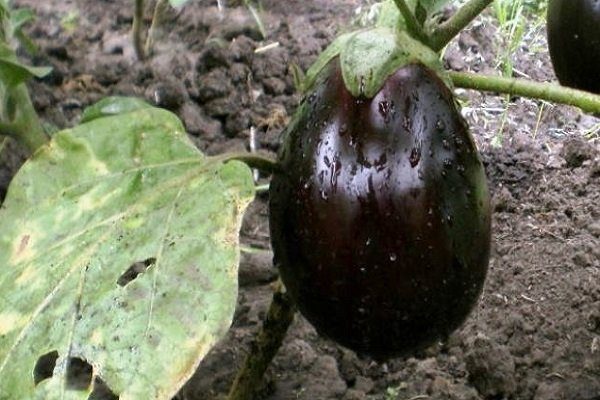
These diseases are viral and typically affect eggplants grown indoors. They cause spots of varying intensity, initially green, then yellow. The main consequence of mosaic disease is stunted fruit growth and lignification of the flesh.
Reasons:
- lack of light;
- decrease in temperature.
The disease is often spread throughout gardens and vegetable plots by insect pests such as whiteflies, aphids, and thrips. The virus cannot be eradicated. It can persist in soil and on equipment for several years. The only hope is to prevent infection.
Prevention:
- regular weeding of the beds;
- compliance with crop rotation;
- destruction of bushes with any signs of disease;
- seed disinfection;
- disinfection of working tools;
- cleaning and disposal of plant residues.
Cercospora leaf spot
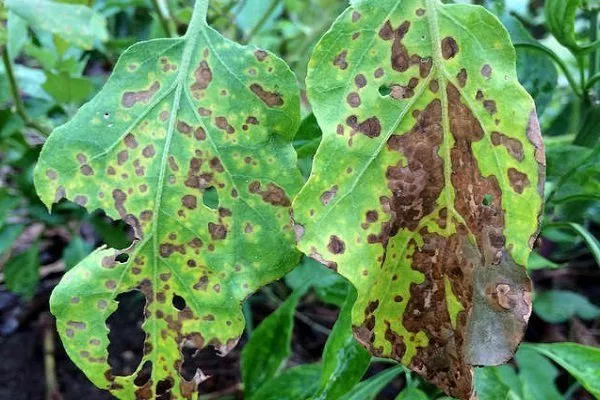
This fungal disease affects eggplant bushes and the harvest. The pathogen can survive for a long time in soil and plant debris. Cercospora leaf spot is often confused with late blight. However, it is easily recognized by the absence of white fluff on the undersides of the leaves.
Reasons:
- contaminated soil;
- high humidity;
- hot weather.
Prevention:
- plant varieties resistant to fungal diseases;
- observe crop rotation;
- eliminate nutrient deficiencies;
- destroy plant debris.
The disease is treatable. It is recommended to use appropriate fungicides (Alirin B, Bordeaux mixture, etc.).
Pests
Eggplant leaves are a significant food source for a variety of pests. Yellowing of the foliage is often caused by sap sucking or root munching.
Spider mite
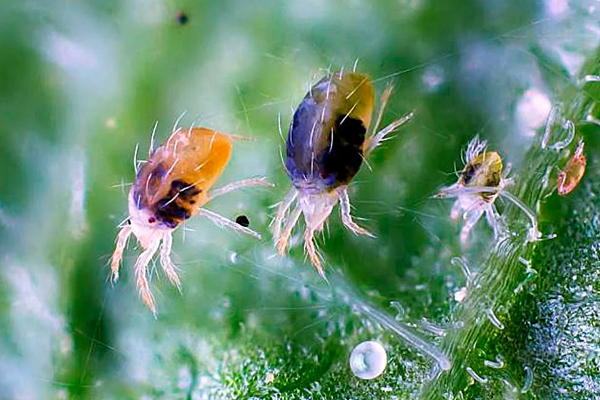
This tiny, sucking insect is difficult to see with the naked eye, but its presence is easily detected by the fine webbing on leaves and stems. Spider mites reproduce especially rapidly in dry air and hot weather.
Control measures:
- When growing crops indoors, regularly ventilate the greenhouse and maintain the humidity level at 60%.
- Infected bushes are sprayed with special anti-mite preparations (insectoacaricides) - Fitoverm, Neoron and others.
Aphid
This is a "universal" pest. Aphids attack virtually all garden crops. Aphids are small green or black insects that live in colonies on the undersides of leaves. They suck the juices from the leaves, leading to the death of the entire plant.
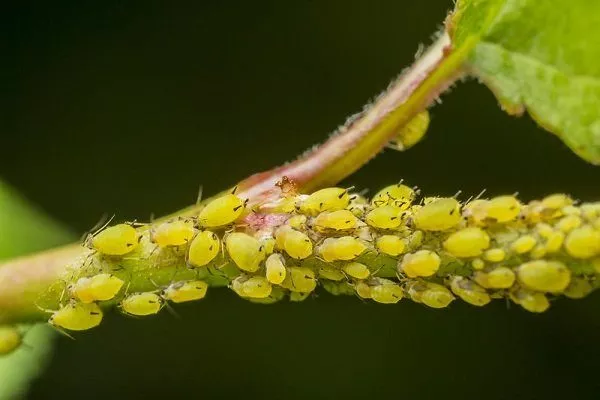
The leaves first turn yellow, then become sticky and deformed. Controlling aphids is difficult due to the long fruiting period. Insecticides should not be used after buds appear.
Control measures:
- treatment with wood ash infusion - 1 glass per 1 liter of water;
- spraying with a soap solution - 1 bar per 10 liters of water;
- in case of severe damage - insecticides Keltan, Karbofos or similar.
Whitefly
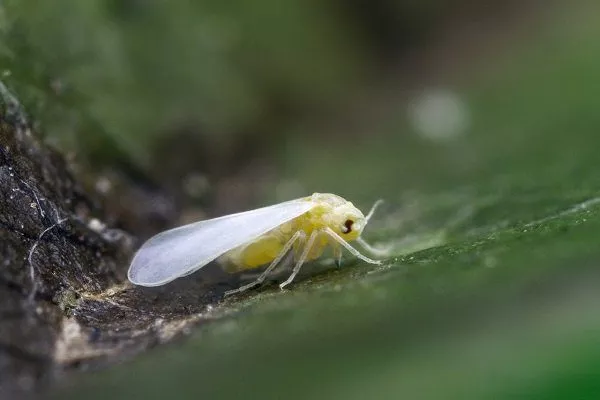
The whitefly is a microscopic moth that lays eggs on the undersides of leaves. The larvae suck the sap from the leaves and shoots, causing plant death.
Signs of damage:
- leaves curl and wither;
- the bushes lag behind in growth and turn yellow;
- the leaf blades become sticky to the touch.
Control measures:
- manual collection of affected leaves;
- treatment of bushes with a jet of water under pressure;
- washing the leaves with a soap solution (200 g of grated laundry soap diluted in 1 liter of water).
Mole cricket
One of the gardener's most dangerous enemies, the mole cricket is a large insect with chitinous armor capable of gnawing through the roots of a wide variety of garden crops, including eggplant. First, the leaves wilt and turn yellow, then the plant dies. There's no way to help it.
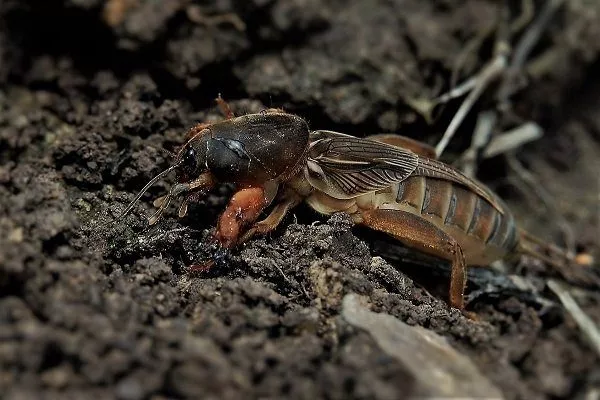
Control measures:
- marigolds are planted along the edges of the beds;
- sprinkle the ground with ground pepper;
- water the soil with garlic or onion broth;
- They scatter special preparations against mole crickets over the beds - Grom or Medvetoks.
Cutworm
The insect's larvae are dangerous to plants. They feed on the leaves and shoots of eggplants. The caterpillars chew out the stems, causing yellowing and wilting of the leaves, and eventually the death of the plant.
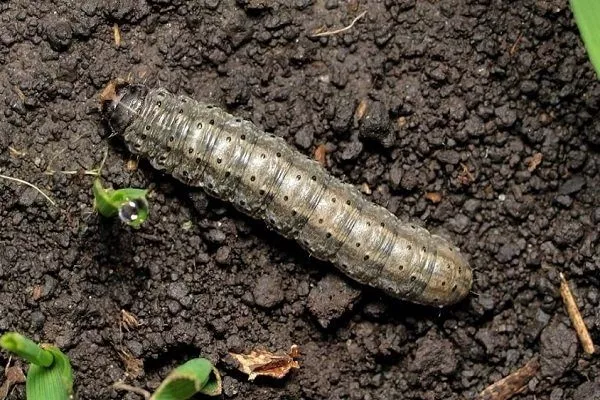
How to fight:
- loosen the space between rows, weed, and observe crop rotation;
- remove caterpillars manually;
- make traps from sour juice, kvass, jam;
- spray with an infusion of potato tops, wormwood or garlic shoots - 1 liter of raw material is poured with 2-3 liters of boiling water and infused for 3 days;
- dust the plantings with wood ash or tobacco dust.
The ovaries are turning yellow
During ovary formation, it's important to provide eggplants with the most favorable conditions possible. Even minor deviations from agricultural requirements can lead to ovary drop. To prevent this phenomenon, which leads to yield loss, it's important to address its causes.
Why do eggplant bushes drop their ovaries?
- lack of moisture;
- sudden change in temperature;
- too bright sun combined with dry winds (dry winds);
- deficiency of nitrogen and microelements in the soil.
The fruits are turning yellow
During the early stages of growth, only the eggplant leaves turn yellow. Later, the fruits sometimes also change color.
Reasons:
- nitrogen deficiency;
- lack of moisture;
- diseases.
Sometimes a plant appears perfectly healthy, the leaves are unblemished, and all necessary preventative measures have been taken, yet the fruit is yellowish. Perhaps you've planted a yellow-fruited variety—there are many such varieties among Asian eggplants.
Fruit may become mummified due to internal necrosis. Mature bushes affected by the disease cannot be treated. The disease can be prevented by treating the seeds with hydrochloric acid before planting (immersing the seed in a 10% solution for half an hour).
The sensitive culture reacts very quickly to the discomfort of growth, diseases and pests, changing the color of leaves, ovaries, and fruits to yellow. This allows for timely identification of the cause and corrective action.