
"Black Prince" is one of the best representatives of the eggplant family. This relatively new variety has already won over many gardeners with the beauty and flavor of its fruits. Let's find out what else makes this variety so appealing and the specifics of growing it.
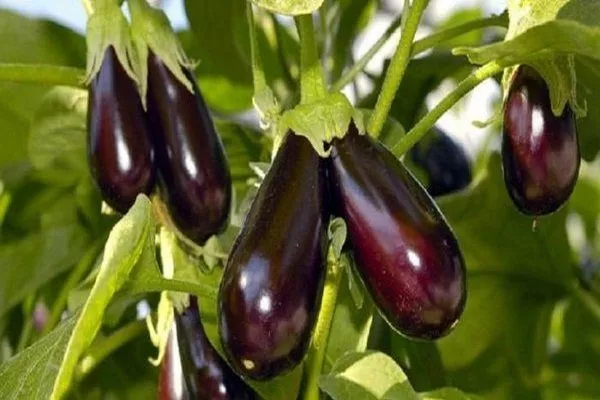
The Black Prince has good taste
Eggplant Black Prince
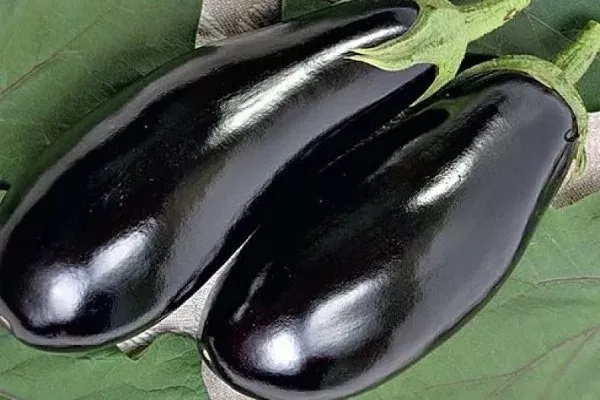
The Black Prince has an excellent marketable appearance.
The history of the Black Prince eggplant breeding
The "Black Prince" variety owes its development to Russian breeders from the major seed company Gavrish. While developing the new variety, the creators emphasized high yields and robust immunity.
The Black Prince variety has been included in the State Register since 2017. It is recommended for outdoor cultivation in southern regions and indoor cultivation in temperate climates.
Description and characteristics of the variety
The "Black Prince" is considered an elite eggplant variety. It attracts gardeners with its large fruits and compact bushes.
Brief botanical description:
- Bushes. Medium-sized, with a semi-spreading crown. Bushes reach 60-80 cm in height. The stems are sparsely pubescent, green at first, turning dark purple as the fruit ripens. The leaves are medium-sized, hairy, light green, and have corrugated edges.
- Fruit. The shape is cylindrical or pear-shaped. The color at technical maturity is deep purple, and at biological maturity, it is purple-black. Length is 20 cm, diameter is 8-12 cm. The skin is glossy. The flesh is dense, beige. The calyx is thornless.
- ✓ The color of the stem changes from green to dark purple as the fruit ripens.
- ✓ The flower calyx is thornless, which is rare among eggplants.
Characteristics of the Black Prince variety:
| Characteristics/parameters | Description/Meaning |
| Ripening time | Mid-early. Ripening occurs 105-110 days after planting. |
| Productivity | 6-8 kg per 1 sq. m |
| Fruit weight, g | 150-250 g |
| Shelf life | High |
| Transportability | High |
| Number of seeds | Average |
| Taste | Pleasant, with a slight bitterness |
| Resistance to diseases and pests | The variety has a high immunity. Its main enemies are the Colorado potato beetle larvae and, in high humidity, aphids. |
This variety is versatile and suitable for any purpose. It is grown for both domestic and industrial use.
Areas of use of the Black Prince:
- Commerce. The variety is ideal for growing for sale.
- Cooking. The fruits make delicious dishes, both hot and cold.
- Public catering.Used in restaurants for preparing oriental cuisine.
- Food industry. Caviar is prepared on an industrial scale.
Advantages and disadvantages
The Black Prince variety is popular among gardeners for good reason – it has many advantages and practically no disadvantages.
Pros:
- high and stable yields;
- good shelf life and transportability;
- excellent presentation;
- excellent taste;
- undemanding to soil composition;
- high immunity to late blight and powdery mildew;
- universal use;
- the low height allows the variety to be grown under small shelters;
- extended fruiting period – ovaries appear throughout the entire growing season;
- Possibility of growing in open and closed ground.
Peculiarities of planting seedlings
The seedling method of growing allows for earlier harvests than when sowing seeds in open ground. To grow high-quality eggplant seedlings, it is important to properly prepare the seed material, soil, containers, and provide the seedlings with proper care.
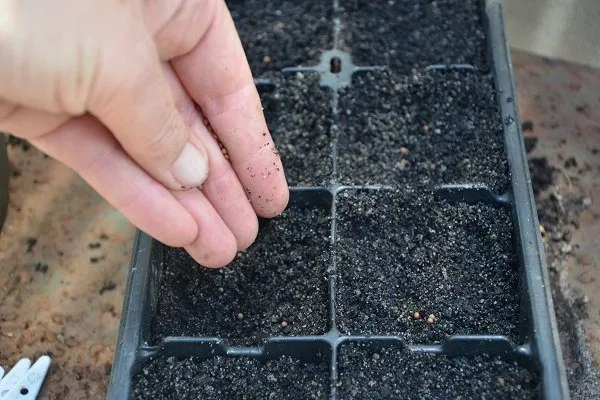
Timing of sowing seeds for seedlings
When determining the timing of sowing seeds for seedlings, it's important to consider the planting location. Seedlings are transplanted into open ground 2-3 weeks later than into a greenhouse.
Black Prince seedlings are ready for planting 65-70 days after sowing.
Optimal timing for sowing seedlings:
- for a greenhouse – mid-February;
- for open ground – mid-March.
The exact planting time depends on specific weather conditions. Plants should not be planted until the weather becomes consistently warm.
Soil preparation
The soil for seedlings is prepared two weeks before sowing. However, it's easier to buy ready-made substrate—it's ready to use, requires no preparation, and, most importantly, the seedlings don't need any additional feeding—it contains all the necessary elements for growth and development.
How to prepare a soil mixture yourself:
- Mix peat or humus, sand and garden soil in equal parts.
- Disinfect the mixture with "Aktara", "Thunder" or another disinfectant.
- Add wood ash to adjust soil acidity. Use 1 cup of ash per bucket of potting mix.
Signs of a good soil mixture:
- light and loose;
- presence of all necessary macro- and microelements;
- ability to absorb and retain water well;
- neutral acidity;
- absence of weed seeds, toxins and fungi;
- no signs of decay.
How to choose a container?
Seedlings can be grown in a variety of containers. The key is to choose between individual or shared containers. If you plant seeds in individual cups, they won't need to be pricked out, but if you plant them in containers or boxes, the seedlings will need to be transplanted at the cotyledon stage—a process gardeners call "pricking out."
Options for containers for seedlings:
- Plastic containers. Seedlings are sown in rows and then pricked out. Wooden boxes can also be used. The optimal height is 8-10 cm. Drainage holes are essential.
The advantage of this solution is its compact size and the ability to quickly transplant seedlings from one location to another. The disadvantage is the need for thinning and transplanting. - Individual plastic cups. They take up little space, are inexpensive, and can be reused. They have drainage holes. Each cup grows one plant, from seed to planting.
There's no need to transplant seedlings planted in cups—this is a plus, as eggplant seedlings don't transplant well. The downside of cups is that the soil dries out quickly and the thin walls may not be tall enough for the seedlings' roots to develop properly. - Peat pots. They are made from compressed peat with added nutrients. The advantage is that they don't require picking, and they are planted in the pot, ensuring a high survival rate. The disadvantage is the high cost and one-time use.
Peat pellets can also be used. However, they don't hold enough for seedlings, so as they grow, they need to be moved to larger containers.
How to prepare seeds?
Store-bought seeds don't need to be treated before planting—they've already been treated and disinfected. If you've grown your own seeds, be sure to test them for germination and disinfect them.
- ✓ Optimum soil temperature for seed germination: +25…+30 °C.
- ✓ The need to use growth stimulants to increase seed germination.
Seed treatment procedure:
- Soak. Immerse the seed material in a light pink solution of potassium permanganate for half an hour.
- Stimulation. Remove the seeds from the potassium permanganate solution and rinse them with water. The water should be at room temperature. Place the seeds in a stimulator for a couple of hours, such as Energen or Zircon.
- Hardening. Remove the seeds from the stimulator and dry them; no need to rinse. Place the seeds in a water-moistened bag and refrigerate. Keep it on the bottom shelf for two days. Then remove it and place it in a warm place (25…30°C) for one day. Then return it to the refrigerator for another two days.
Plant the seeds that have gone through all the processing stages in prepared containers.
How to sow seeds?
The sowing characteristics depend on the chosen container: 1-2 seeds are planted in cups, while in larger boxes they are sown in rows.
How to sow eggplant seeds:
- Firm the soil in the planting containers to a depth of 6-8 cm.
- Make furrows in the containers and water them with warm water. Leave 5-6 cm between adjacent rows.
- Scatter the seeds 2 cm apart. Plant them no deeper than 1-1.5 cm. If sowing in individual cups or peat pellets, center the seed and press it in.
- Cover the furrows with soil, compact it, and cover with transparent film. Glass can be used instead of film. The optimal temperature for eggplant seedling growth is between 25 and 30°C.
Caring for seedlings
Once the seedlings emerge, the plastic or glass cover is removed. The crops are moved closer to the light. To grow strong seedlings, they need to be provided with favorable conditions.
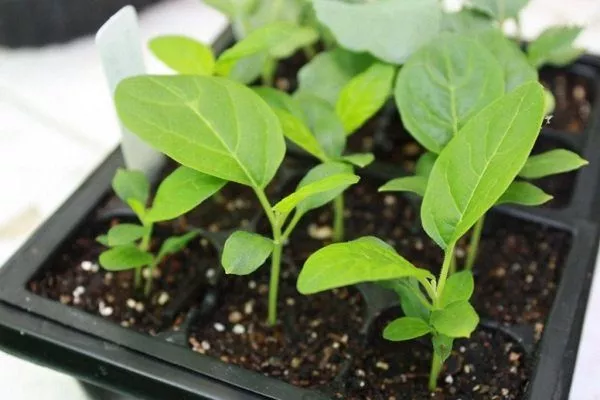
Seedling care:
- Temperature. Once the seedlings emerge, lower the temperature slightly to 15–20°C. Cover the seedlings with black film at night.
- Watering. For watering, use only warm water (25…28°C). During the first days of growth, seedlings can be watered by spraying to avoid washing away the soil. Subsequently, water the seedlings only at the roots, avoiding contact with the leaves.
Watering frequency: About once a week. Pay attention to the soil condition—don't let it dry out. Increase the frequency of watering if necessary. - Picking. If the seedlings are planted in shared containers, transplant them into individual containers at the cotyledon stage. The seedlings should be transplanted into soil that has the same composition as the soil in which they were grown. Transplant the seedlings carefully to avoid damaging the roots.
- Top dressing. Apply fertilizer simultaneously with watering. Fertilize the plants for the first time a week after transplanting, and then every 7-10 days. Apply fertilizer according to the recommended dosage. The best eggplant fertilizers are:
- superphosphate;
- ammonium nitrate;
- potassium chloride.
- Hardening. Before planting the seedlings in the ground, harden them off for 10-14 days. During this period, reduce watering and increase ventilation by opening the windows for several hours. Gradually increase the ventilation period to one day.
A week before transplanting, treat the seedlings with a 0.5% solution of copper sulfate.
Transplanting seedlings
When planting eggplants, two factors are taken into account: the age of the seedlings and weather conditions. It's important not to over-expose the seedlings, but planting them prematurely before the temperature has stabilized is also unacceptable.
Optimal timing
Eggplants thrive in warmth, and the Black Prince variety is no exception. Its seedlings are planted no earlier than early June, when the threat of night frosts has completely passed.
Conditions for transplantation:
- Air temperature. Daytime temperatures have settled at +20…+25 °C, and nighttime temperatures do not fall below +15 °C.
- Soil temperature. At a depth of 15-20 cm the soil warmed up to +15 °C.
- Seedling. The seedlings are 20-25 cm tall and 50-60 days old. They have a well-developed root system and 6-8 leaves.
Selecting a location and preparing the soil
To ensure eggplants grow well and bear fruit, it is necessary to choose the right site and prepare the soil for planting.
Site requirements:
- Good lighting. Eggplants prefer sunny areas.
- Protection from winds and drafts.
- Places with high groundwater levels, lowlands where water accumulates, and swampy areas are not suitable.
- Eggplants should not be planted after nightshade crops. They should also avoid growing them near fennel and garlic. Good predecessors include cucumbers, pumpkins, cabbage, onions, and legumes.
Eggplants are planted in one place at intervals of 2-3 years.
The beds for planting eggplant seedlings are prepared in the fall. If this isn't possible, the process is postponed until spring. However, the soil should be prepared at least 2-3 weeks before planting.
Add manure or compost when digging. If you dig the soil in the fall, you can use fresh manure; in the spring, use only well-rotted manure. Add 4-5 kg of organic fertilizer and 300 g of wood ash per square meter.
You can also add mineral fertilizers to the soil – 20 g of superphosphate or potassium chloride per 1 sq. m.
Planting seedlings in a permanent location
Water the seedlings a couple of hours before transplanting to make them easier to remove from their containers. Transplant in the morning or evening, if the weather is dry.
How to transplant seedlings:
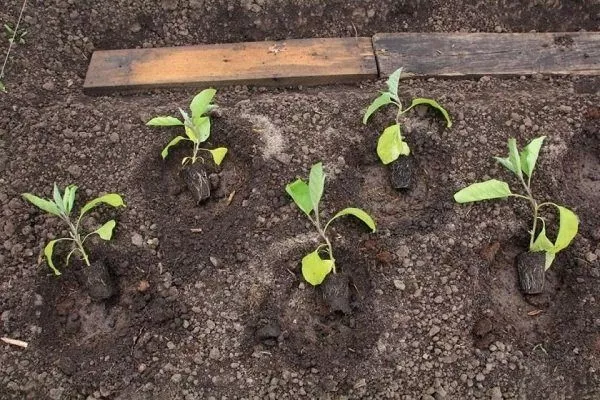
- Prepare planting sites for the seedlings. Eggplants can be planted in parallel rows or staggered. Space rows 50-60 cm apart, and adjacent plants 35-40 cm apart. Make the holes and furrows 15 cm deep.
- Water the planting holes or rows with warm water.
- Once the water has soaked in, transplant the seedlings into the holes. Move them very carefully, along with the soil clod, being careful not to damage the roots. Space the seedlings so that the bottom leaves of the seedlings are 4-5 cm above the soil.
- Cover the roots with soil and gently compact it with your hands. Water the plantings again and cover with mulch—peat moss, humus, or sawdust.
Outdoor care
During the first few days after transplanting, do not fertilize or water the seedlings until they have time to establish themselves. Subsequently, the "Black Prince" will require standard care—watering, fertilizing, loosening the soil, and other maintenance.
Watering and fertilizing
The Black Prince is characterized by increased sensitivity to watering, so you should be very careful with them.
Irrigation principles:
- Use only heated water. It's poured into large containers—for example, an old bathtub or barrel—where it's heated by the sun.
- The best way to water is into a depression made around the perimeter of the plant.
- It is better to water eggplants in the evenings, when the heat subsides.
- The approximate watering rate is 1 liter per bush. Frequency: once every 3-4 days.
Features of eggplant feeding:
- Fertilizers are applied 3-4 times during the growing season.
- The first fertilizer application is three weeks after planting. Pour 1 liter of humus or mullein solution under each bush. Dissolve one or the other organic fertilizer in a bucket of water—2 kg and 1 kg, respectively.
- After two weeks, apply a second fertilizer—a superphosphate solution. Dissolve 20 mg of fertilizer in 10 liters of water. Water the plant at a rate of 1 liter per bush.
- At the stage of fruit formation, organic matter is added again, as during the first feeding.
- After two weeks, water the plantings with a solution of fresh mullein diluted with water 1:10.
Soil care
Loosening and weeding are mandatory activities when growing eggplants.
Soil care rules:
- The soil is loosened after each moistening – watering or rain – to prevent the formation of a surface crust.
- In parallel with loosening, weeding is carried out.
- After loosening, the soil is mulched with mown grass or sawdust.
Diseases and pests
The variety is distinguished by its good immunity. "Black Prince" is virtually immune to late blight, phytoplasmosis, and tobacco mosaic.
Diseases and pests:
- Blackleg. To prevent this dangerous disease, it's important to water and loosen the soil properly. Avoid overwatering.
- Gray rot. Crop rotation, soil disinfection, and removal of plant debris prevent the disease. Treatment is achieved by spraying the bushes with Fitosporin or Trichodermin.
- Colorado beetle. This is the main enemy of eggplants. Its larvae can destroy entire plants in a matter of days. Control methods:
- manual collection – daily or even more often;
- dusting bushes with sifted ash - 10 kg per 100 square meters;
- spraying with Fitoverm (1 ml per 1 liter of water) or Akarin (2 ml per 1 liter of water);
- Aphid. This insect sucks the sap from plants, reducing yields and even causing death. There are several ways to combat aphids:
- mechanical destruction – insects are washed off with warm water;
- spray with a soap-ash solution, garlic, onion or tobacco decoction;
- treated with Fitoverm, Aktara, Iskra, etc.
Harvesting and storage
Eggplants are characterized by their extended fruiting period. However, to ensure continued fruiting, the fruits must be harvested regularly, as they ripen sequentially.
Rules for harvesting eggplants:
- The fruits begin to ripen from mid-July.
- Ripeness of the fruit is determined by its appearance—it turns glossy, dark purple, and reaches the length typical of the "Black Prince." Ripe eggplants are firm to the touch, and the seeds are small and few in number.
- Overripe fruits become hard, difficult to cut, and most importantly, their taste deteriorates – it becomes bitter.
- Don't pluck the eggplants; instead, carefully trim them using scissors or pruning shears. When cutting, leave a "stem" of about 2 cm.
How to store eggplants:
- The storage location should be dry and cool. The optimal temperature is between +4 and +6°C.
- To keep the fruits fresh longer, they are placed in plastic bags.
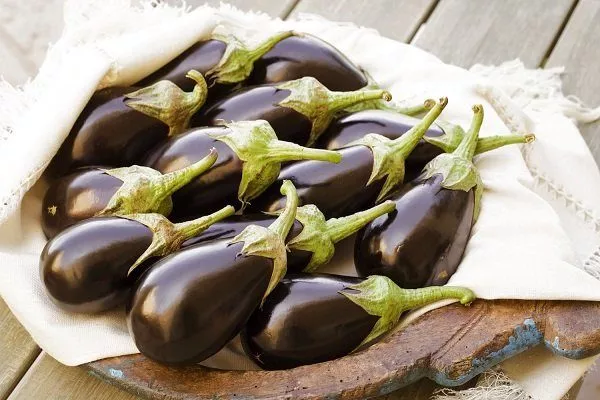
Eggplants typically retain their shelf life and flavor for no more than a month. However, if you create favorable conditions for them and promptly remove spoiled ones, their shelf life can be doubled.
Reviews from gardeners
The "Black Prince" eggplant has only recently appeared on the market, but it has already earned the attention of our gardeners. This undemanding, hardy, and productive variety is equally suitable for both home and commercial cultivation.
AFTAR drink yadu!
How could you possibly get it into your head that a storage space should be, AT THE SAME TIME (!), warm and cool?!
Segun480, thanks for the feedback! The author made a typo. We've made the corrections. The location should be dry and cool.
A typo would be "warm" instead of "dark"! This is, at the very least, sloppiness!
The author misspoke in one word, and you started shouting and hurling indirect insults.
Thanks for the information. I left a review of this variety in gratitude. However, for some reason I can't see it.
Rey, thank you! This is truly valuable to us and our readers. PS: Your review will appear after moderation.