
Artichokes are a vegetable considered exotic in our country. Even experienced vegetable growers hesitate to plant them. They are often chosen by enthusiasts. However, the only time one should refuse this rare guest is if it doesn't suit one's taste preferences. Growing them is straightforward.
General information and characteristics
Artichoke – a vegetable from the Asteraceae or Compositae family. The inflorescences are used as food. Native to the Mediterranean, Central and Southern Europe, California, South America, and North Africa.
Appearance features:
- The plant grows 1.5-2 m tall and has a spreading bush. It resembles a thistle, which is a weed.
- The roots are long and taproot.
- The leaves are oblong, long, spiny, pinnately dissected. The color is gray-green.
- The inflorescences are round, ranging from 10 to 25 cm in circumference. They form at the crown of the bush. They are also edible. They consist of thick scales of green, purple, or blue color. They are tightly pressed together like tiles. The outer edible part can be compared to a pine cone.
Main characteristics of the plant:
- The inflorescences are delicate, tasting like unripe walnuts. The scales of mature buds become prickly, but they are still edible.
- Artichokes don't always bloom in their first year of growth. You'll need to wait at least two growing cycles.
- The plant's growth and development period is about 180 days, often longer. This is the reason growing through seedlings.
- The plant prefers warmth. It grows best in areas with temperatures around 25 degrees Celsius.
- The plant can be propagated in several ways: by seeds and by dividing the mother plant.
- The heads don't grow to the desired size all at once. This is an important factor when harvesting.
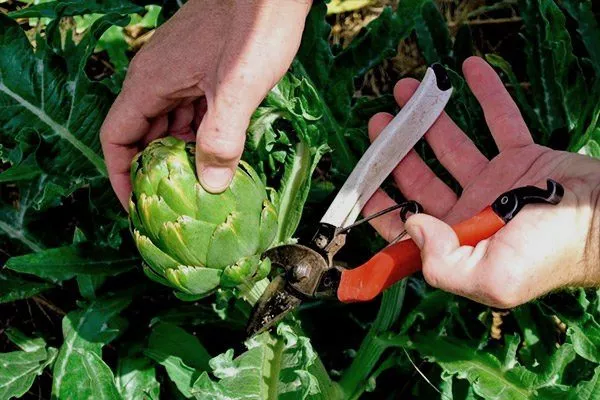
Artichoke varieties
| Name | Ripening period (days) | Bush height (m) | Color of buds | Yield (kg per 1 sq.m) |
|---|---|---|---|---|
| Artist | 120-130 | 1.5 | purple | 1.5 |
| Gourmet | 120-130 | 1.5 | light green | 1.5 |
| Carciofiore | 210 | 1.5 | purple with green stripes | 1.5 |
| Handsome man | 165 | 1.1 | green | 1.2 |
| Sultan | 120 | 2 | green | 1.5 |
| Caesar | 120 | 1 | green | 1.9 |
There are approximately 140 varieties of artichoke worldwide. But not all are suitable for Russia. The State Register lists only a few varieties as approved for planting in our country:
- Artist. A mid-season variety, the plant matures in 120-130 days. The bush grows to 1.5 m tall. The edible flower buds weigh 90 g and have purple scales. Yields are up to 1.5 kg per square meter. The first year, the number of inflorescences is 5-7, and in subsequent years, up to 12.
- Gourmet. This mid-season variety matures in 120-130 days. Height: 1.5 m. Buds are light green, 9-10 cm in circumference. Weight: 90 g. A single bush can yield up to 1.5 kg.
- Carciofiore. The edible basket is purple with green stripes. Ripening period is 210 days. All other characteristics are the same as for the Artist.
- Handsome man. The period from germination to harvest is 165 days. The plant is small – 110 cm – and branches sparsely. The buds are green, weighing up to 120 g. There are 4-6 of them in the first year, and 12 from the second year onwards.
- Sultan. Height: 2 m. Baskets can be used for cooking starting 120 days after planting, when the upper scales begin to separate. Inflorescences are large (25 cm in diameter). Number: 5-7.
- Caesar. A compact plant, growing up to 1 m tall. Flower heads are 10-15 cm, weighing 85-120 g. There are up to 12 of them. The most productive variety yields 1.9 kg per square meter.
- ✓ The 'Artist' variety has increased drought resistance, which is critical for southern regions.
- ✓ 'Karciofiore' requires a longer growing season, which limits its cultivation in northern regions.
Regionalism
Artichokes are heat-loving plants. However, they are planted not only in the southern regions, but also in central Russia and beyond the Urals. In the latter case, a harvest can only be achieved in a spacious, high greenhouse.
The Moscow region is often considered outside the central zone, but the climate is the same – moderate continental. Artichokes are grown only from seedlings. Seeds grown in open ground are only available in the south.
Combination of culture with other plants
Artichoke yield is influenced by its proximity. The crop is compatible with parsley, onions, celery, carrots, and corn.
It's not recommended to plant near horseradish, tomatoes, or beans. The greatest yield of this exotic vegetable is achieved by planting it near cabbage, legumes, or potatoes.
When can artichokes be planted in garden beds?
The timing of planting artichokes in the garden depends on the region and its climatic conditions:
- in the Moscow region – mid-May, early June, seedling method;
- Central Russia – second ten days of May, seedlings;
- Ural – beginning, middle of June in a greenhouse;
- Siberia – mid-June, in greenhouse conditions;
- South – May, seedlings or seeds in open ground.
How to grow artichoke from seeds?
Gardeners who decide to grow artichokes prefer to plant from seed, first growing seedlings. Any variety adapted to the country's climate is suitable for harvesting this exotic vegetable.
Soil for artichoke
Prepare the seedling transplanting beds in advance. The plant prefers cultivated, moisture-retentive soils. It will not bear fruit in poor or heavy soil. Its heat-loving nature requires planting in a sunny location, but with minimal exposure to cold winds.
Dig over the planting area and add compost (200 g per 1 sq. m) and a phosphorus-potassium fertilizer (40 g of granular superphosphate and 15 g of potassium sulfate per 1 sq. m). If the soil is too acidic, add lime (400 g per 1 sq. m).
Vernalization of artichoke seeds
Vernalization is a series of measures aimed at increasing crop yields and accelerating the ripening of edible flower buds. If vernalization is omitted, the plant will bear fruit only in the second year of growth.
What to do:
- Place artichoke seeds in moist, warm sand. Cover with plastic wrap to encourage germination. Maintain a temperature of around 22 degrees Celsius (72 degrees Fahrenheit). Moisten the soil regularly; don't allow it to dry out.
- In a week, the seedlings will sprout. Transfer the container to the refrigerator, on the bottom shelf, where the temperature is 0 degrees Celsius.
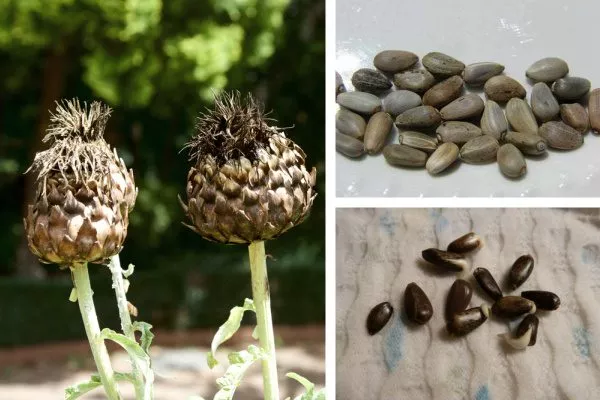
Sowing for seedlings
To grow artichoke seedlings, you only need one packet of seeds. Buy one variety. Start preparing the seeds at the end of February, a few weeks before planting.
Algorithm of actions:
- Place the grains in water at room temperature for 11 hours.
- Once they've swelled, place them on damp cheesecloth and wrap them. Cover with plastic wrap. This will prevent moisture from evaporating. Place the bundle in a warm place (25°C/77°F) for 5 days.
- Fill the prepared containers with a mixture of equal parts humus, sand, and turf. Make furrows about 4 cm deep, but no deeper.
- Plant the seeds 4 cm apart. Work carefully to avoid damaging the seedlings.
- Cover the seedlings with 1 cm of soil. Moisten using a spray bottle.
- Make sure the soil is always moderately moist.
Picking and caring for seedlings
Pricking out seedlings involves transplanting them into individual 0.5-liter containers. This should be done two weeks after the first shoots emerge. By this point, the seedlings should have one true leaf.
Use the same soil as in the main container. When transferring the plant to individual pots, trim off some of the root shoots. This is necessary to allow the artichoke to develop a strong root system. Finally, thoroughly moisten the soil.
The seedlings don't require any special care. Simply keep the soil consistently moist and apply a complex mineral fertilizer.
Water with a solution of 50 g of the product per 10 liters of water per 1 square meter. The number of treatments is 2: the first 14 days after picking, the second - after another 14 days.
Ten days before the scheduled planting date, harden off the seedlings. The seeds must be acclimated to wind, sun, and temperature fluctuations. If you neglect this hardening process, the plants will die and will not be able to adapt to life in the garden.
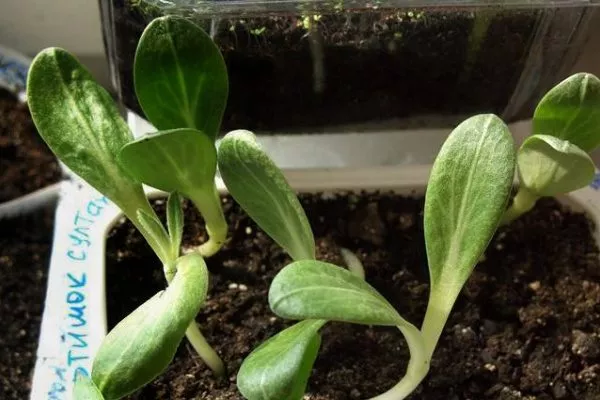
Planting seedlings in open ground
Choose a planting date based on your climate. This usually coincides with the rooting time of tomatoes.
Algorithm of actions:
- In a pre-prepared bed, make small holes at intervals of 70 cm.
- Place the seedlings into the holes one by one. No more than two can be placed in one hole. Do not bury the planting material too deeply.
- Water the plants generously.
- Mulch the soil. Flax, shredded leaves, or tree bark are all suitable. Apply a 5 cm thick mulch.
If there's a risk of overnight frost, cover the planting with garden film or agrofibre. Remove the covering only after the weather becomes consistently warm.
Growing by root cuttings
Another method of propagating artichokes is by transplanting shoots from a mature mother plant. The necessary shoots form in the plant's third year.
What to do:
- Select healthy parts coming from the root.
- Dig it out carefully, being careful not to damage the root system.
- Soak the cuttings in a growth stimulator (for example, Heteroauxin, 0.2 g per 10 l of water for 16 hours).
- Transplant into a pre-prepared bed.
Plant care
Caring for artichokes is the easiest part of harvesting. To enjoy this exotic vegetable, continue cultivating the plants.
Watering
Water artichokes moderately in the afternoon, every other day. You can apply 5 liters of water per plant once every two weeks. Just be sure to avoid over-watering or over-drying the soil.
Top dressing
Artichokes require standard mineral supplements. Nitrophoska is a good choice. Apply 30 g of product per 10 liters of water per square meter. Apply directly to the roots.
Spraying with a mixture of 25 g superphosphate, 10 g potassium chloride, and 10 g wood ash is especially beneficial for the crop. Apply this treatment once a month. This will not only replenish any micronutrient deficiencies but also protect the plant from aphids and moths.
Loosening the soil and removing weeds
Loosen the soil one day after watering. This will prevent moisture from leaching out too quickly and prevent root rot.
Artichokes require weeding as needed. Remove weeds promptly and avoid neglecting the plants. Standard weed control provides oxygen to the root system and ensures soil aeration.
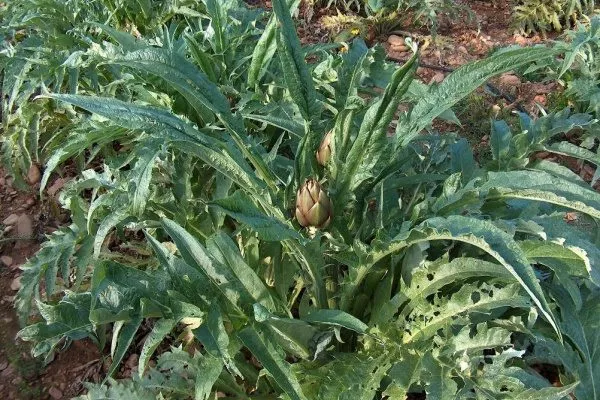
Shelter for the winter
Artichokes must be prepared for winter. Here's how:
- Cut the plant stems so that the tips are up to 30 cm from the ground.
- Cover the bush with burlap.
- Cover the soil around the crop with sawdust, straw, or fallen leaves. The mound should be 30 cm thick.
- When snow falls, cover the base of the bush tightly with it.
Diseases and pests of artichoke
Artichokes are not a plant with a strong immune system. A number of pests can destroy crops, including black and white aphids, sunflower moths, slugs, and the green tortoiseshell beetle.
The crop is susceptible to black rot. The disease occurs during cool summers with prolonged rainfall or when fertilization is neglected.
Harvesting and storage
Begin harvesting artichokes when the inflorescences are approximately two weeks old. Harvest the edible portion selectively, as ripening is erratic. A good starting point is when the outer scales open and begin to curl back.
Cut the heads off with a sharp knife, cutting off up to 5 cm of the stalk. Once harvested, the vegetables will keep for about 3 months, provided they are kept in a room with a temperature of 0 to +1 degrees Celsius. Do not freeze them, as this will destroy all their nutritional value and flavor.
Reviews from vegetable growers
Artichoke is an unusual vegetable, similar in appearance to a weedy thistle. The inflorescences are eaten at a certain stage of growth. The crop is grown in several ways, the most productive being the cultivation of the edible flower pods. In some regions, this is the only way to obtain these exotic edible pods. Care is simple.