
The Silginka honeysuckle is a domestic, high-yielding variety with fairly large, fleshy, and aromatic berries. It is undemanding, hardy, adaptable, and suitable for high-risk farming areas.
The history of the Silginka variety
The Silginka honeysuckle was developed in 2004 by breeders at the Bakcharskoye Federal State Unitary Enterprise. Two honeysuckle varieties, Tulchaninova and Roxana, were used to develop this new variety. In 2011, the variety was officially registered and added to the State Register.
Description of the Silginka variety
The Selginka honeysuckle bushes are medium-sized, reaching 1.5-1.8 m in height and 1.2 m in width. The crown is medium-dense and spherical-oval in shape. The branches are erect, stiff, and resilient, with peeling bark.
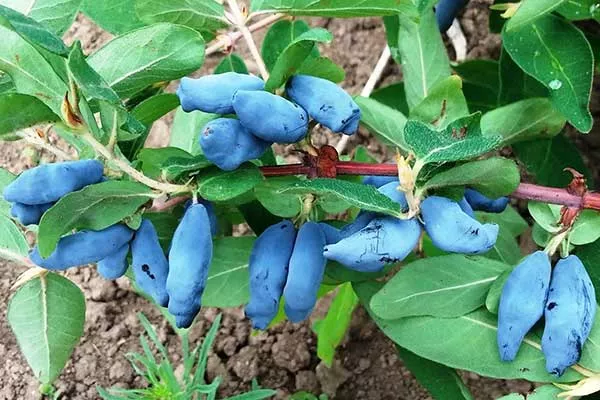
Young shoots have straight, medium-thick stems. The shoots are green and leathery. The leaves are matte, oval, and smooth.
Description of fruits
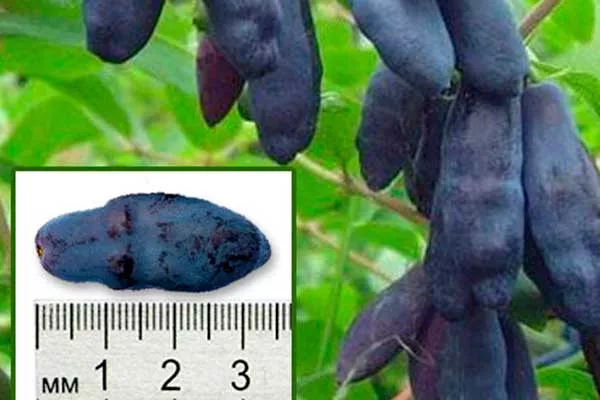
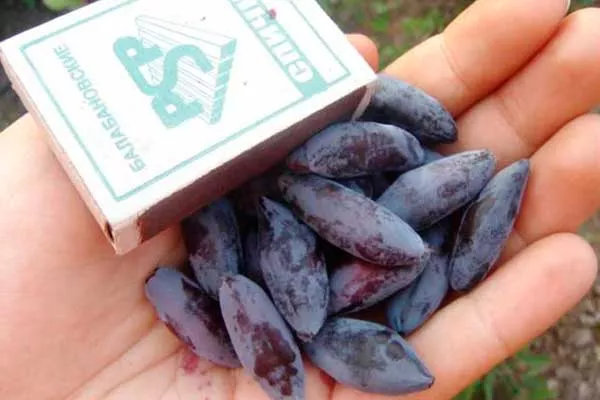
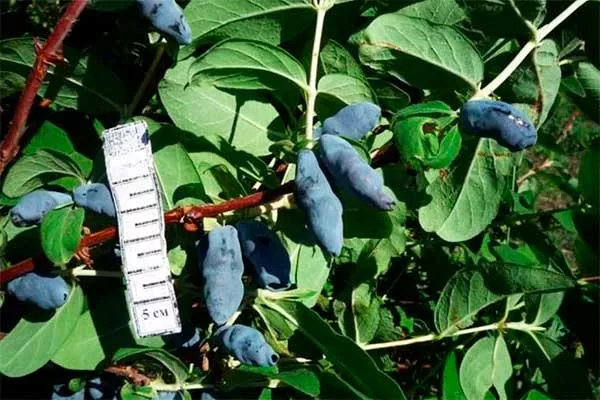
Silginka's berries are quite large, but compared to those of the Bakcharsky Velikan honeysuckle, they are of medium size. The fruit is dark blue with a patina. Its shape is elongated oval, with pointed tips. The fruit length is up to 3.5 cm. The average berry weight is 1-1.4 g.
Taste qualities
Silginka's berries are delicious and sweet—one of the best varieties in terms of flavor. Experts gave it a tasting score of 4.9. The fruits are very aromatic, with tender, juicy flesh.
Fruit composition:
- sugars - 9.8%;
- titratable acids - 1.32%;
- Vitamin C - 42.3 mg/100 g.
Ripening and fruiting
The Silginka honeysuckle is an early-falling variety. About 30% of the ripe berries fall to the ground. The fruits easily detach from the branches. If you shake the bush, they fall en masse. The plant can live for over 30 years.
Productivity
The Silginka honeysuckle is a high-yielding variety. A mature bush weighs between 2.5 and 3.2 kg. When grown commercially, yields range from 8.2 to 10.6 tons per hectare, with the maximum yield observed in favorable years reaching 11.5 tons per hectare.
Frost resistance
The Silginka honeysuckle is distinguished by its exceptional frost resistance. It easily tolerates temperatures down to -50°C. This variety is completely resistant to recurrent frosts, and its flowers do not fall off at -7°C.
Pollinators
| Name | Frost resistance | Productivity | Taste qualities |
|---|---|---|---|
| Honeysuckle Silginka | Up to -50 °C | 2.5-3.2 kg per bush | 4.9 points |
| Honeysuckle Bakcharsky Giant | Up to -45 °C | 3.0-3.5 kg per bush | 4.7 points |
| Honeysuckle The Giant's Daughter | Up to -47 °C | 2.8-3.3 kg per bush | 4.8 points |
| Honeysuckle Delight | Up to -49 °C | 2.7-3.1 kg per bush | 4.9 points |
| Honeysuckle Yugan | Up to -48 °C | 2.9-3.4 kg per bush | 4.8 points |
Like many other honeysuckle varieties, Silginka is self-sterile. It requires pollinators that bloom at the same time as Silginka. The best pollinators for this variety are considered to be Bakcharsky Velikan, Doch Velikana, Vostorg, and Yugana.
Pros and cons
The relatively new Silginka variety has many advantages worth knowing about before planting. But it's even more important to familiarize yourself with its drawbacks to determine whether this honeysuckle is suitable for your needs and specific climate conditions.
Landing features
Honeysuckle thrives in temperate climates. If positioned correctly, it will be virtually unaffected by adverse conditions.
In southern regions, it requires more careful care; the further south you go, the more problems gardeners encounter. However, with proper care, the Silginka variety produces good yields even in the south.
Landing features:
- Selection of planting material. It's best to purchase seedlings from specialized garden centers and nurseries. Plants should have smooth bark, no defects or signs of disease, and well-developed roots.
The optimal age is 2-3 years. Seedlings should have straight branches and uniform internodes. When purchasing Silginka honeysuckle, it is recommended to buy pollinator varieties at the same time. - Disembarkation times. The best time for planting is late summer and fall. Spring is usually the only time to transplant bushes—for example, if they're in an unfavorable location.
- ✓ Check that the seller has a certificate of conformity for the variety.
- ✓ Pay attention to the root system: it should be moist, without signs of rot or drying out.
- Selecting a site. It should be sunny and protected from the wind. Gullies and lowlands are contraindicated, as they will collect cold air and water, which will adversely affect the growth and development of honeysuckle. Any soil is suitable, except sandstone.
- Planting diagram. It is recommended to maintain a spacing of 1.5 m between plants and 2 m between rows. For industrial cultivation and mechanized harvesting, bushes can be planted more densely, but the aisles should be made wider to allow for the free passage of harvesting equipment.
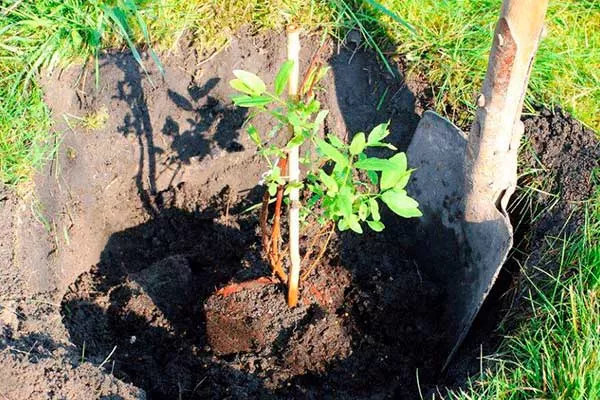
- Preparing the pit. The recommended dimensions are 40x40x40 cm. The soil is prepared taking into account its fertility and structure. If the soil is poor, clayey, or sandy, 20 liters of humus are added; for fertile soil, 10 liters is sufficient. Mineral fertilizers are also added to the soil mixture placed in the hole: 50 g each of superphosphate and potassium salt.
- Preparing the seedling. The roots are soaked in water before planting. There's no need to trim the branches, as this slows the honeysuckle's growth.
- The landing process. The day before planting, water the hole. Add fertile soil mixture to the center, forming a mound. Place the seedling on top, carefully spreading out the roots. The honeysuckle's crown should be buried 3-5 cm deep. Cover the roots with soil, compact it, and then water with settled, room-temperature water. Once the moisture has been absorbed, mulch the area around the trunk.
Subtleties of care
Only young honeysuckle requires regular care. Mature plants require much less attention, requiring only watering during dry periods, pruning, and mulching.
Care features:
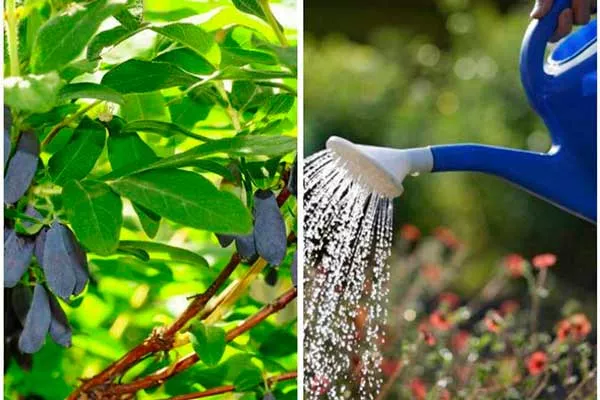
- Immediately after planting, young honeysuckle plants are watered 2-3 times a week. The soil around the trunk should not dry out, but it should also not become overwatered. Mature bushes are generally watered only during dry periods.
- After each watering or rain, thoroughly loosen the soil and remove weeds. The recommended loosening depth is 5 cm. Mulch the soil with peat, humus, sawdust, or other organic material.
- Dry, diseased, thickening, and broken branches are regularly removed. Sanitary pruning is performed in the spring and fall. Honeysuckle requires no other pruning until it's 15 years old. After this time, thick branches are removed, and at 20 years of age, the entire bush is pruned to a height of 20 cm. After rejuvenation, the plant is completely renewed and bears fruit for another 10 years.
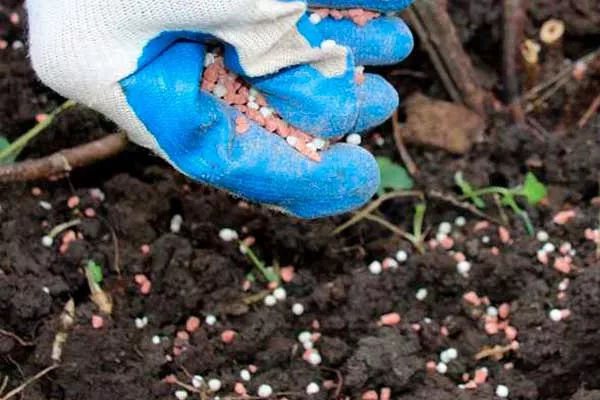
- Honeysuckle begins to be fed in the third year after planting; for the first two years, the fertilizer placed in the hole is sufficient. In early spring, 10 liters of urea or ammonium nitrate solution are added to the bushes.
- In spring, apply complex mineral fertilizer at a rate of 50 g per bush.
- In the summer, after harvesting, feed the honeysuckle with potassium-phosphorus fertilizers to prepare it for winter.
- In autumn, mulch the tree trunk circle with humus or compost in a layer of 5-7 cm.
Reproduction
Silginka honeysuckle is easily propagated by layering and division. Seed propagation is extremely labor-intensive and time-consuming, preventing young plants from inheriting parental traits. It is used only by breeders when developing new varieties.
Harvesting and application
Early Silginka honeysuckle is harvested by shaking the ripe berries off the branches. The berries fall easily to the ground, which is covered with plastic or tarpaulin. The berries ripen evenly, making mechanical harvesting convenient for large-scale cultivation.
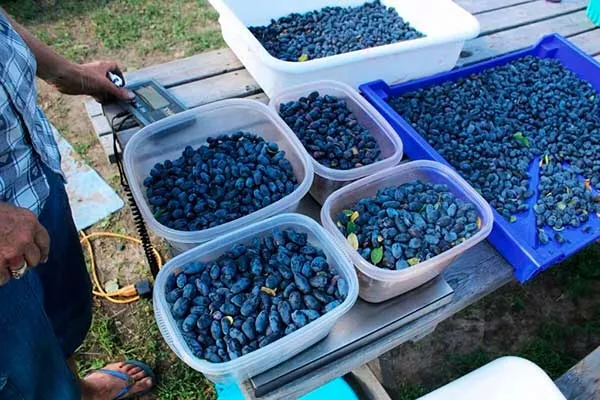
Ripe Silginka honeysuckle fruits are eaten fresh, but they can also be frozen to make delicious preserves and desserts.
The Silginka honeysuckle, although undemanding, produces excellent-quality fruit—juicy, fleshy, with a pleasant flavor and aroma. This variety thrives in most regions of the country, including those with harsh climates.