
By planting edible honeysuckle varieties, you'll decorate your property with a decorative and productive shrub. Each honeysuckle bush, requiring little care, will yield delicious and nutritious fruits year after year. Let's learn how to plant and care for honeysuckle.
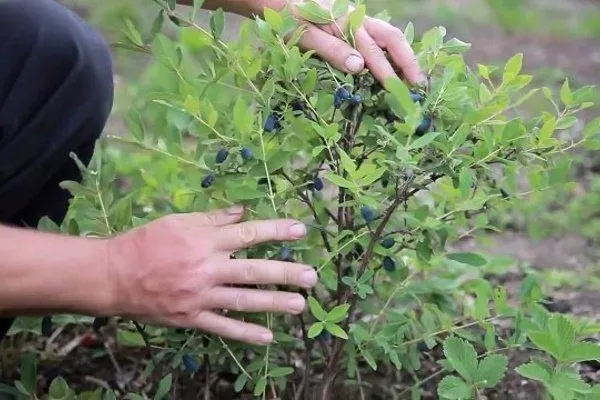
Selecting and purchasing a variety
Honeysuckle bushes can grow up to 3 meters tall. They are dense and make excellent hedges. For this purpose, it's more cost-effective to buy tall varieties, but sometimes it's more profitable to grow dwarf honeysuckle.
When purchasing edible honeysuckle seedlings, inquire about the variety details:
- productivity;
- ripening periods.
Understanding honeysuckle varieties on your own can be difficult, so when purchasing seedlings, it's best to consult with a nursery salesperson. It's best to buy seedlings there, as this increases the likelihood of purchasing the desired variety and high-quality seedlings.
Requirements for a healthy seedling
Rules for selecting seedlings:
- Two-year-old seedlings are used for planting.
- The seedling should have 2-3 branches.
- Optimal height is 30-40 cm.
- The branches should be free of damage and fresh, not dried out.
- If the seedlings have peeling bark, this is a normal phenomenon for honeysuckle.
- The roots must be healthy, and there must be buds on the branches.
- ✓ Check the root system for fungal diseases that are not visible during a cursory examination.
- ✓ Ensure that the seedlings were grown in conditions similar to your region for best adaptation.
Honeysuckle is a self-sterile plant; to bear fruit, it requires pollinator varieties for cross-pollination. When purchasing seedlings, choose several honeysuckle varieties at once for pollination.
What types of edible honeysuckle are there?
Of the two hundred species of honeysuckle, about fifty grow in Russia, and most of them are inedible. Each region has its own varieties. Honeysuckle for Siberia and northern regions should be selected especially carefully, taking frost resistance into account.
Among edible honeysuckle, there are separate groups of varieties: early, mid-season, late, large-fruited, sweet, decorative, and resistant to shedding.
Criteria for choosing a variety of edible honeysuckle:
- Regionality. When choosing a variety, compare the lowest winter temperatures and frost resistance of the specific variety. Preference is given to regionalized varieties.
- Form. While the color of edible honeysuckle fruits is approximately uniform, ranging from blue to purple, their shape can be quite varied:
- oval;
- round-oval;
- cylindrical;
- spindle-shaped;
- elongated;
- with a truncated end
- Color. Poisonous honeysuckle fruits are usually yellow, orange, or red, while edible honeysuckle varieties produce berries that are only blue or purple, sometimes almost black. The fruits are covered with a whitish-blue bloom.
- Fruit size. The maximum fruit size is 2 cm, and the maximum length is 8 mm. These berry parameters are typical of large-fruited varieties. Small fruits weigh up to 0.5 g, while large fruits weigh up to 1.5 g.
- The taste of the fruit. Berries of different varieties differ in taste: they can be sweet, sweet and sour, bitter, or not bitter, and there are also varieties with unusual flavor nuances.
- Productivity. The minimum yield is 0.5 kg per bush, the maximum is 4 kg.
If the plot is small, or the honeysuckle will serve as a fence, then when choosing a variety, consider the shape and size of the bush.
Edible honeysuckle varieties for regions of Russia:
| Region | Recommended varieties |
| Ural | Raisin, Sorceress, Blue-Eyes, Blueberry |
| Leningrad Oblast | Lenarola, Volkhova, Malvina, Yulia |
| Central Russia and Moscow Region | Moscow, Kucha Mala |
| Primorye | Dawn, Lightning, Blueberry |
| Siberia | Pride of Bakchar, Gerda, Cinderella, Siberian |
Among all edible honeysuckle, the most prized varieties are those with high yields and large berries – such as the Veliga honeysuckle, Moraine, Laura, Slavyanka, Violet.
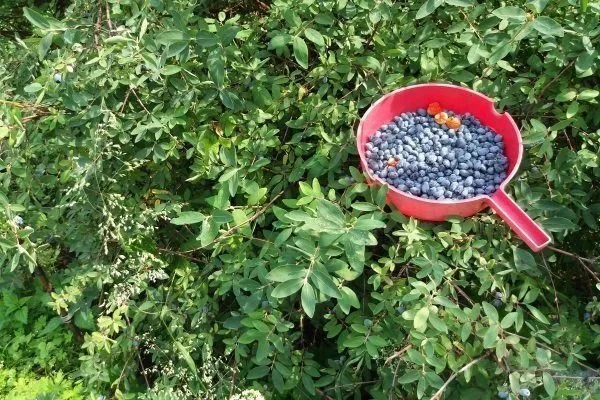
The best varieties with descriptions and characteristics
Breeders are constantly improving the characteristics of honeysuckle, so today gardeners in all regions can select varieties that best meet their needs.
The best varieties of edible honeysuckle:
| Variety | Productivity | Fruit | Other features |
| Vasyuganskaya | up to 5 kg | Weight: up to 1 g. Sweet and sour, without bitterness. Dark blue, with a waxy coating. Jug-shaped, flat tops. | This is a half-tree, half-bush variety. It has very high frost resistance. It has moderate fruit drop rate. It ripens quickly and is highly transportable. |
| Lightning | about 2 kg | Weight: 1 g. Sweet and sour, with a slight tartness. Spindle-shaped. Dark blue in color. | These are very decorative, spreading, hemispherical bushes. They are drought and frost resistant. The fruit almost never falls off. |
| Willow | up to 3.5 kg | Weight: 0.75 g. Dark blue fruits with a slightly sour taste. Shape: spindle-shaped. The berries are bumpy and dark blue. | Spreading, low, spherical bushes. High in vitamin C. Early-bearing and productive variety. |
| Pavlovskaya | about 2 kg | Weight: 1.3 g. Dark blue, sweet and sour. Elongated shape, pointed tips. | The bushes are inverted-conical in shape. Height – up to 1.7 m. High winter hardiness. |
| Nymph | up to 3 kg | Weight: 1 g. Bluish-blue, spindle-shaped. Large, elongated, with a bumpy surface. Sweet, with a pleasant aroma. | New. The best honeysuckle variety available today. Bushes are rounded, 1.5 m tall, and highly frost-resistant. |
| Moraine | up to 2.5 kg | Weight: 1.7 g. Blue-light blue, with a waxy coating. Sweet and sour, without bitterness, with a faint aroma. Shape: pitcher-shaped. | This variety is very decorative and early maturing. The bush height is 1.7 m. |
The benefits and harms of honeysuckle
Honeysuckle berries taste like blueberries, bilberries, and some varieties even have hints of pineapple. The fruit has a host of beneficial properties:
- strengthen the immune system;
- stabilize blood pressure;
- reduce stomach acidity;
- have antipyretic properties;
- heal stomach and intestinal ulcers;
- remove waste and toxins from the body;
- have antibacterial and anti-inflammatory effects;
- strengthen blood vessels;
- improve blood circulation.
Honeysuckle consumption should be moderate. Avoid eating large quantities, as the fruits and flowers can trigger an allergic reaction. Flowering honeysuckle can also trigger an allergic reaction in those with allergies. The berries should not be consumed by children under 5 years of age.
The following video talks about the benefits of eating honeysuckle and a little about its varieties:
Planting features and step-by-step instructions
The most important things when planting honeysuckle are high-quality planting material and proper hole preparation. If done correctly, there won't be any problems with the seedlings taking root.
Landing dates
Honeysuckle is planted in spring or fall. Fall planting is preferred. The recommended planting time is from mid-September to mid-October. In spring, planting should be done very early, as honeysuckle buds open early.
Choosing a location
Optimal conditions for honeysuckle:
- wind protection;
- groundwater level – no more than 1.5 m to the ground surface;
- soils – neutral, sandy or loamy, well-moistened;
- good lighting for the crown and shading for the roots.
Unlike most crops, honeysuckle thrives in lowlands. It thrives alongside other shrubs and trees. When planting honeysuckle, it's important to ensure easy berry picking—the bush must be accessible from all sides.
Honeysuckle can grow even on marshy soils, the main thing is that they are not overly acidic.
Soil preparation
The soil is dug over with a spade, removing weed roots. If necessary, deacidify the soil by adding 400 g of slaked lime per square meter. Fertilize the area to help the honeysuckle seedlings take root quickly and gain strength for fruiting. The following is added per square meter of soil during digging:
- superphosphate – 30 g;
- potassium salt – 30 g;
- humus – 10 kg.
Fresh manure is applied only in the fall. In the spring, the soil is fertilized with humus or rotted plant compost.
Preparing the pits
Features of preparing holes for planting honeysuckle:
- the holes are prepared approximately two weeks before planting;
- depth of holes – 40 cm;
- the soil mixture is added to the dug holes;
- The hole is covered with non-woven material.
Composition of the soil mixture for application to the planting hole:
- fertile soil layer;
- humus – 3 kg;
- ash – 200 ml;
- nitrophos – 30-40 g;
- slaked lime – 250 ml (the solution is prepared from 250 ml of lime and 10 l of water).
The minimum time for planting honeysuckle in prepared holes is 4 days after applying fertilizer.
Landing
Honeysuckle seedlings are planted according to a pattern: 1.5 m between adjacent bushes and 2 m between rows. If the seedlings have exposed roots, they are dipped in a clay slurry (1 liter of clay per 10 liters of water) before planting.
Honeysuckle planting procedure:
- A hill is formed from fertilizer poured into the hole.
- The roots of the seedling are placed at the top of the hill; bending them is not allowed.
- The roots are covered with soil and carefully compacted so that all the voids are filled.
- The seedling is watered generously.
- They mulch tree trunk circle with peat, hay, sawdust, bark.
Watch the video below to see the planting procedure for edible honeysuckle:
The honeysuckle seedling is positioned so that the root collar is 5 cm deep into the soil.
How does it bloom?
Honeysuckle is a versatile plant, one of its main functions being ornamental. The shrub is especially beautiful during its flowering period. This blooming period lasts not just a few days, as with many fruit crops, but 3-4 weeks.
Flowering begins 3 or 4 years after planting. Flowering time depends on the variety's maturity. Honeysuckle flowers are large and, depending on the variety, can range from white to pink or blue.
Plant care
The first fruits will appear on honeysuckle trees two years after planting. Initially, the yield will be small—about 300 grams of berries. But with proper care, the plant will produce more and more fruits each year. With proper care, honeysuckle trees will bear fruit for 30 years.
Top dressing
The order of feeding honeysuckle:
- Before bud break, apply 15 g of ammonium nitrate per square meter. Or apply 1 tablespoon of urea solution per 10 liters of water. One bucket of urea solution per bush.
- During flowering, a strengthening ash solution is applied to the roots. Add 1 kg of ash per bucket of water.
- After picking the berries, add a solution of nitrophoska – 25 g per 10 l, or liquid manure (1:4).
- In autumn, add 5 kg of compost under each bush, 50 g of superphosphate and 100 g of ash.
You can get more information on how to care for honeysuckle in the fall from this article.
Watering
Honeysuckle is easy to grow and doesn't require special watering. It tolerates drought very well, requiring watering only during the most prolonged droughts. And if it is watered, it's done generously. Young bushes, unlike mature ones, require regular watering.
The recommended watering frequency for young bushes is 1-2 buckets. After watering, sprinkle the soil with peat, humus, or sawdust. If weeding around the trunk, do so very carefully, as honeysuckle roots are located very close to the soil surface.
Formation of bushes
To improve fruiting and enhance the bush's decorative appeal, formative pruning is performed. Bush formation techniques include:
- The first pruning is done immediately after planting. The seedling is pruned, leaving 3-5 of the strongest branches. Each of the remaining branches is shortened by a third.
- Sanitary pruning is performed annually in the spring, removing damaged and dry shoots. Pruning should be done no later than March.
- Formative pruning is carried out in the fall, after the leaves have fallen. Thickening branches are trimmed, but one-year-old shoots are left alone.
- By the age of 7, honeysuckle grows many new shoots, some of which are cut out.
- At 10-12 years of age, rejuvenation pruning is performed. Branches 5-6 years old are removed.
- ✓ Yellowing of leaves in the upper part of the bush indicates a lack of nitrogen.
- ✓ Leaf curling can be a sign of spider mite infestation, even if webbing is not visible.
Radical pruning is suitable for honeysuckle: the old bush is cut back to the root. After a few years, the plant will recover and bear fruit.
Propagation of edible honeysuckle
Honeysuckle can be propagated in a variety of ways. This hardy plant easily grows by cuttings, layering, and other methods.
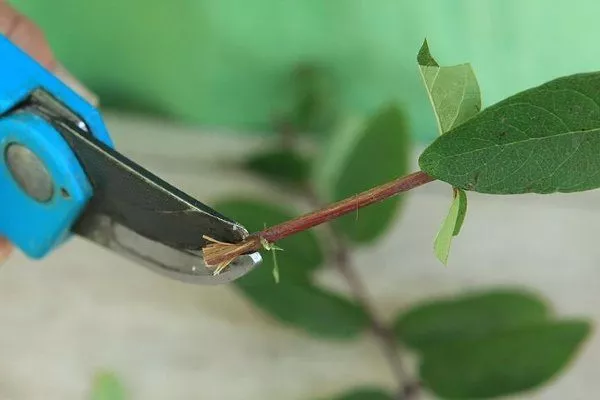
Green cuttings
Cuttings are taken from flowering plants when green fruit appears. Cuttings are taken in cloudy, cool weather. Propagation procedure:
- Using a sharp knife, cut the shoots diagonally.
- Then the young shoots are divided into several cuttings, each with 2-3 buds.
- The lower leaves are torn off. The upper leaves are trimmed. The cuttings are placed in water for 24 hours. They are planted in the ground and insulated for the winter. In the spring, the strongest seedlings are transplanted to their permanent location.
Lignified cuttings
Planting material is prepared after the leaves have fallen. Propagation procedure:
- Cut branches 7-8 mm in diameter.
- The roots are wrapped in a damp cloth and buried in the sand.
- In the spring, woody branches are cut into cuttings and planted using the same technique as green ones. By fall, they will have their own root system. After another year, they can be transplanted to their permanent location.
Horizontal layering
In early spring, the lower branches are pressed to the ground and secured with staples. By autumn, the shoot will have developed roots. The shoot is separated from the mother plant the following spring. The separated shoot is planted in its permanent location.
To stimulate root formation in the cutting, cuts are made in the bark where the shoot touches the soil.
By dividing the bush
Division is used to propagate mature, but not old, bushes with 6-7 skeletal branches buried in the ground. A healthy bush is essential.
In the fall, the bush is removed from the ground and divided into several sections with pruning shears. Each section should have several shoots and a sufficient number of roots. They are immediately replanted into prepared holes.
Root cuttings
Honeysuckle produces few root suckers. For a root sucker to form, adventitious buds must emerge from the roots, which will grow into an above-ground shoot. These root suckers are further nurtured near the mother plant. After two years, the grown suckers are separated from the mother plant and transplanted to a permanent location.
Transfer
Honeysuckle can be replanted if necessary. To do this, prepare a planting hole in advance, just as you would for planting. Consider the size of the root system being transplanted. If the bush is large, divide it into sections with a sharp shovel. The resulting plants are planted like regular seedlings.
Diseases and their control
Honeysuckle poses no problems for its owners. This plant is highly resistant to disease and rarely gets sick, especially if sprayed prophylactically.
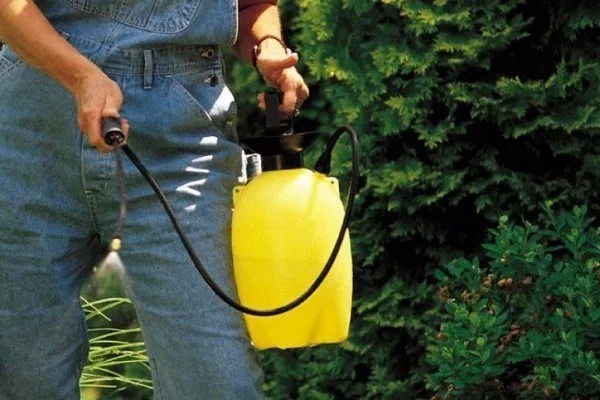
In damp and cold years, honeysuckle can be affected by the following diseases:
- White spot. It is accompanied by the appearance of gray-brown spots with white centers on the leaves. Fundazol helps eliminate the disease.
- Powdery mildew. A fungal disease characterized by the appearance of gray spots on the leaves, and then throughout the plant. To prevent powdery mildew, treat the plant twice with Bordeaux mixture: early in the spring and after flowering.
To combat fungal infections, honeysuckle is sprayed with Folicur, Topaz, and other fungicides. Treatments are carried out before fruit set or after harvest.
Spraying with a solution of copper sulfate and laundry soap has a good preventative effect. Add 10 grams of copper sulfate and 1 tablespoon of grated soap to a bucket of water.
Pests and prevention
Honeysuckle is pest-resistant, but some pests can attack the plant. The most common enemies of honeysuckle are:
- Spider mite. The parasite sucks the sap from the leaves, causing them to curl, turn brown, and become riddled with holes. Thinning the shoots helps prevent an infestation. Treatments include Mavrik, Omite, and Tedion.
- Scale insect. The pest sucks the juices from the green parts of the plant. Eventually, the bush dies. For treatment and prevention, the crop is sprayed with Rogor after harvest.
- Caterpillars. These pests can be removed from bushes by hand. If there are numerous caterpillars, the bushes can be sprayed with Inta-Vir or Eleksar.
- Aphid. This insect is particularly fond of honeysuckle that is overfed with nitrogen. The leaves turn yellow and fall off. Spraying with Actellic, Confidor, and Rogor helps.
We recommend reading the article about diseases and pests of honeysuckle.
Harvesting
Blue fruits don't mean it's time to harvest—you need to wait at least a week. And if the variety is a non-shedding variety, you can wait longer—the berries will be sweeter.
What else do you need to know about harvesting and storing honeysuckle fruits:
- The easiest way to harvest honeysuckle is by shaking it. This method is suitable for varieties that shed their leaves. The berries are shaken onto a piece of plastic placed under the bush. The second option is to harvest by hand.
- As the fruit ripens, it becomes soft. To prevent bruising, it is placed in a shallow container in a thin layer.
- Honeysuckle doesn't keep for long; even in the refrigerator, the berries spoil quickly. They should be processed or eaten within 2-3 days.
Even the laziest gardener can manage edible honeysuckle cultivation. Growing this unique plant is quite simple. By planting it in your garden, you can harvest several kilograms of valuable fruit annually, while also decorating your property with an ornamental shrub.