
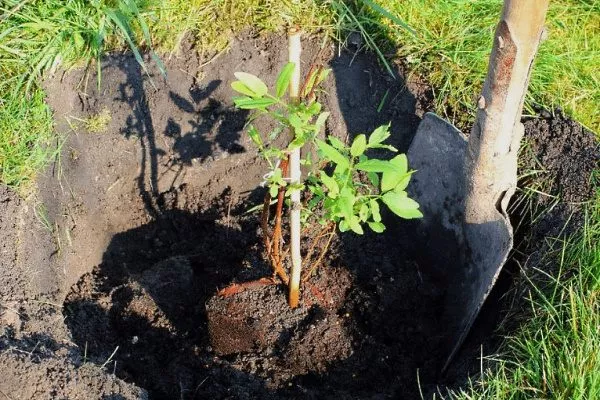
Honeysuckle is planted according to agricultural practices. It is a perennial shrub, either erect, creeping, or climbing, with an elliptical or spherical crown. Its Latin name is Lonicera caerulea L., and its genus and family are Caprifoliaceae. There are approximately 200 varieties.
What is honeysuckle and its characteristics?
Honeysuckle comes in two main varieties: edible and ornamental. The most popular is blue or light blue. This plant is characterized by a rich composition, among which the following are particularly notable:
- group of vitamins – P, B, A, C;
- iron;
- selenium;
- pectin;
- sodium;
- potassium, etc.
The plant has its own unique characteristics:
- Bush. Its height, depending on the variety, varies from 50 to 250 cm (the maximum length of branches for edible crops is 100 cm).
- Escapes. When young, their bark is initially green, then turns light brown, sometimes with a reddish-purple tint. As they mature, the bark woodies and takes on a brownish tint. This peels off in strips.
- Root system. It is considered superficial and is located deep into the soil to a maximum depth of 15-20 cm.
- Foliage. Quite large, dark green, and oppositely arranged. The leaves are elongated-oval.
- Flowers. They are tubular and require insect pollination, with flowers forming in the leaf axils. They are yellow, sometimes with a greenish tint.
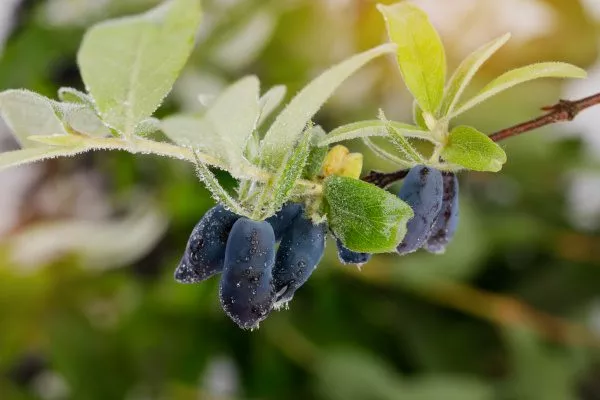
- Berries. Their color varies by variety, but is typically blue, light blue, purple, and even blackish. Each fruit weighs between 0.7 and 4 grams, reaches a maximum length of 3-4 cm, and is typically oval, spindle-shaped, or cylindrical in shape.
The surface is smooth, but with a waxy coating. The berries tend to fall off, so when growing them, a plastic film is spread under the bush. - Pulp. Always dark red with a purple tint. Juiciness is enhanced, and the flavor is sweet and sour, with a hint of bitterness when unripe. The aroma is not pronounced.
Planting dates
Honeysuckle is a crop that awakens very early, especially the edible varieties. Buds form at 3°C, and flowering begins at 9-10°C. Seedlings are usually planted when the sap has not yet started flowing, but the optimal temperature has stabilized.
Peculiarities:
- The best period for different regions is April-May. The timing also depends largely on weather conditions, which vary annually.
- Honeysuckle can be planted in garden beds throughout the season, so if you can't pinpoint the optimal planting time or can't work on it at that time, place the seedling in a pot first and then transfer it to the ground.
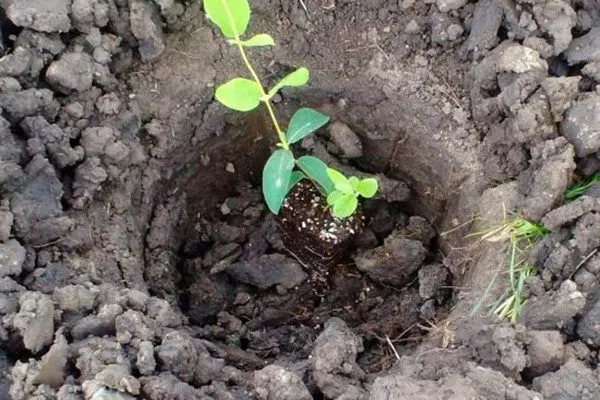
The planting time is also influenced by such factors as season:
- Spring. This is the best time for dividing bushes, taking cuttings, and replanting the entire bush to another site. The main requirement is undamaged roots, so prefer the transshipment method, that is, with a root ball.
- Summer. The best time to transplant cuttings is August, when the plant is preparing for the end of its growing season.
- Autumn. The time for planting cuttings varies from early September to mid-November. For example, in the North, this should be done earlier, and in the South, later. Rooting takes 3-4 weeks, so plant at least 4-6 weeks before the onset of frost.
Planting honeysuckle in the regions
Honeysuckle planting dates vary depending on the region. This also affects cultivation practices, even the choice of variety, as some honeysuckle varieties tolerate frost well, while others are intolerant.
In Belarus
Belarus is renowned for its long and warm autumns, so planting is best between August and November. The best varieties are those with a long dormant period, such as Lakomka, Goluboe Vereteno, Morena, Rannyaya Nizhegorodskaya, and Vasilyevskaya.
In the Southern regions
Planting begins in late March and continues through November. The key is to avoid exposing the bushes to the scorching midday sun. Optimal varieties:
- Kingfisher.
- Amphora.
- Moscow-23.
- Parabelskaya.
- Ramenskaya.
In the Moscow region, the central zone
The main requirements for these regions are plenty of light, few drafts, and neutral soil. The planting period in spring is mid-April, and in autumn, no later than mid-October, but can be done in favorable weather conditions.
The best varieties of honeysuckle for the Central Belt and the Moscow Region:
- Silginka.
- Nymph.
- Moraine.
- The chosen one.
- The pile is small.
- Moscow.
In Siberia, in the Urals
| Name | Bush height (cm) | Color of berries | Taste |
|---|---|---|---|
| Blue Spindle | 150-200 | Blue | Sweet and sour |
| Fire opal | 100-150 | Orange | Sweet |
| Sirius | 200-250 | Blue | Sweet and sour |
| Blue Bird | 150-200 | Blue | Sweet |
| The Iliad | 100-150 | Violet | Sweet and sour |
| Cinderella | 50-100 | Blue | Sweet |
| Berel | 150-200 | Blue | Sweet and sour |
| Blue-eyed | 100-150 | Blue | Sweet |
| The highlight | 50-100 | Violet | Sweet and sour |
| Blueberry | 100-150 | Black | Sweet |
| Sorceress | 150-200 | Violet | Sweet |
| Gerda | 100-150 | Blue | Sweet and sour |
| Siberian | 150-200 | Blue | Sweet |
| Pride of Bakchar | 200-250 | Blue | Sweet and sour |
| Kamchadalka | 100-150 | Blue | Sweet |
| Maria | 50-100 | Violet | Sweet and sour |
| Yugana | 150-200 | Black | Sweet |
| Bakcharskaya | 100-150 | Blue | Sweet and sour |
These regions are characterized by harsh climate conditions, but since honeysuckle can withstand temperatures down to -40 degrees Celsius, it can be successfully grown here as well. The main thing is to adhere to the following requirements:
- planting in the sunniest area;
- seedlings must be at least 3 years old;
- planting is best done in rainy weather, starting from the beginning of March and ending in August;
- Feeding with nitrogen-containing fertilizers before wintering, starting in July, is excluded.
Best varieties:
- Blue Spindle.
- Fire opal.
- Sirius.
- Blue bird.
- Iliad.
- Cinderella.
- Berel.
- Blue-eyed.
- The highlight.
- Blueberry.
- Sorceress.
- Gerda.
- Siberian.
- Pride of Bakchar.
- Kamchadal woman.
- Maria.
- Yugana.
- Bakcharskaya.
Other varieties of honeysuckle are described Here.
Planting honeysuckle
Before planting, be sure to familiarize yourself with the planting plan and instructions, prepare the site and seedlings, and choose the right location. Pay particular attention to soil quality and the application of fertilizers to enrich the soil.
Choosing a location
The honeysuckle's yield, fruit quality, and plant health depend on its growing location. Therefore, pay attention to the following requirements:
- Lighting. The plant prefers bright locations, but not too much sun, as this will cause the berries to bake under the scorching rays. The top of the tree should receive more light, while the middle and lower parts of the tree should receive less.
There are some nuances:- large-fruited species and modern hybrids require more light;
- when planting in hilly areas, give preference to partial shade;
- When growing in a lowland, maximum light is required;
- In the North the area is more illuminated than in the South.
- Wind. The presence of drafts directly depends on climate conditions. In sunny and hot weather, a breeze is acceptable, but in cooler weather, it's absolutely not.
- Terrain relief and soil moisture. Honeysuckle thrives in lowlands and consistently moist conditions, but not overwatering. Therefore, it should not be planted in a marshy area, with standing water, or at a very low elevation.
In sandy soils, on the contrary, higher elevations are preferred, as insufficient moisture will result in small fruits. The optimal groundwater depth is 70-90 cm. - Quality of land. Honeysuckle doesn't require overly fertile soil, but the ratio of nutrients to the turf should be even. Key requirements:
- if the soil is too light, add clay mixed half and half with humus; if the soil is too heavy, add sand or peat;
- The optimal acidity levels are from 5.5 to 6.5 pH, but if the soil is acidic, the berries will be small and will fall off before they have time to ripen;
- The best humidity level in the root zone is from 70 to 80%.
Honeysuckle planting scheme
The planting method directly influences the arrangement of honeysuckle bushes. For example:
- in large areas, it is customary to plant bushes in rows, the distance between which is about 2 m, and between plantings in one line from 1 to 1.2 m;
- when constructing a hedge, you need to maintain a distance of 50-60 cm between trees;
- To increase yields, the optimal planting pattern is 2.5-3 m by 1.5-2 m.
It is forbidden to plant more often, as the bushes tend to grow quickly and abundantly.
Neighbors for honeysuckle
Planting just one honeysuckle variety in a plot is strictly prohibited. This is due to cross-pollination of flowers—if only one variety is used, yields will decrease, and the berries will not gain their full weight. Therefore, on large plantations, it's perfectly normal to plant 10 honeysuckle varieties in alternating rows.
The following crops are considered the best neighbors:
- black currant;
- hawthorn;
- bakhcha – watermelon, pumpkin, etc.;
- plum;
- pear;
- cherries;
- barberry;
- buckthorn;
- grape;
- gooseberry;
- tomatoes;
- cucumbers;
- basil;
- pepper;
- juniper;
- maple;
- thuja and fir;
- aspen;
- periwinkle;
- elder.
It is not advisable to plant honeysuckle next to the following plants:
- blueberry;
- bird cherry;
- apple;
- rowan;
- nut;
- hyssop;
- sea buckthorn;
- cherry;
- raspberry;
- apricot;
- fennel;
- pine and spruce.
Selecting a seedling
Honeysuckle seedlings are most often sold at local nurseries, but you can also buy imported varieties or grow your own. In all cases, it's important to choose the right bush or cutting.
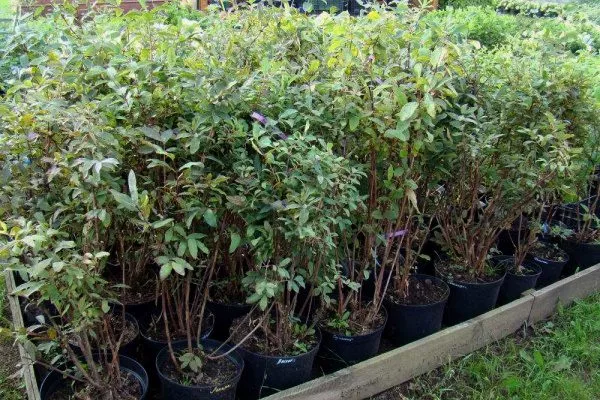
To do this, please pay attention to the basic requirements:
- the age of the seedling for planting is from 2 to 3 years (during this period the bush adapts most easily to new conditions);
- To obtain a good harvest, buy different varieties of the same species. For example, you cannot plant edible honeysuckle next to ornamental honeysuckle (in this case, the yield will be low, as cross-pollination occurs);
- The quality of the root system must meet the following criteria:
- without damage, signs of disease, or mold;
- with the presence of branches and developed shoots;
- seedling height – 40-50 cm;
- buds - there should be at least 2-3 of them on the shoot;
- branches - not broken, not overdried, without infections.
- ✓ Check for at least 3 healthy buds on each shoot.
- ✓ Make sure that the root system has at least 3 main branches.
Pay special attention to the form in which the planting material is sold, and consider a few nuances:
- Open root system. This is when the bush's root system is free of soil, allowing the buyer to see all the root shoots and assess their condition. This is a huge advantage, but there are also disadvantages:
- Bushes with open roots can be planted only in autumn;
- You will definitely have to soak the roots, since during transportation and storage before sale the roots have had time to dry out.
- Closed root system. These seedlings are usually sold with a large lump of soil or in pots or containers (ranging in capacity from 2 to 10 liters). The main drawback is that it's impossible to see the roots. However, if you buy the tree from a nursery representative (i.e., a reputable seller), you won't have any problems. However, if you buy seedlings from unknown sources, you risk purchasing a very low-quality product.
There are also significant advantages:- rapid survival and adaptation to new conditions;
- no need to soak the roots;
- minimal risk that the tree is affected by diseases.
Planting honeysuckle correctly
Since honeysuckle can be low-growing (around 50 cm), it can be planted not only in open ground but also in larger pots. Initially, the pots should be about 2 liters in size, then transplanted into containers of 7-10 liters or more. In this case, consider the following rules:
- Be sure to install a drainage system using expanded clay, perlite, broken bricks or stones;
- To ensure that the bush grows evenly, install support stakes on both sides of the pot, and secure the central shoots and trunk to them using light twine;
- Try to place containers near walls, as they may tip over as they grow.
There are also soil requirements (when planting honeysuckle in pots or in open ground). It must be prepared:
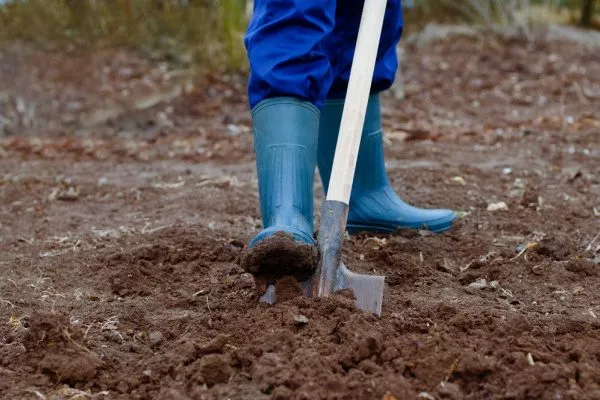
- First, the beds need to be dug up (a spade's depth is enough);
- Along with this, it is important to remove from the soil all remains of weeds or roots of crops that grew in this area previously;
- slaked lime is used to deoxidize the soil (for 1 sq. m it is enough to add 400 g of limestone);
- When digging, add organic matter - rotted plant compost or humus (the exact dosage depends on the level of soil fertility).
- Two weeks before planting, add 5 kg of humus per 1 sq.m. to the soil.
- Check the soil acidity, the optimal pH level is 5.5-6.5.
- A week before planting, loosen the soil to a depth of 20 cm.
The planting hole also needs to be prepared. The following options are available:
- 15 g of superphosphate, the same amount of potassium salt and about 5 kg of humus;
- turf soil – 3 kg, humus – 2.5-3 kg, wood ash – 200 g, slaked lime – 250 g (only if the soil was not deoxidized in advance), nitrophoska – 30 g;
- If the seedling is weak or too young - 5 kg of humus and turf soil, 200 g of any complex fertilizer and 1 kg of wood ash.
The planting process is as follows:
- After digging, level the garden with a rake and prepare the planting holes. Dig holes according to the root system (about 35-45 cm deep and about 50 cm wide). Add the prepared soil mixture and cover with non-woven fabric for two weeks.
- After the specified time, add more soil mixture to form a mound. Place the seedling in the hole. Keep in mind that the root collar should be level with the ground surface. Don't forget to spread the roots along the slope. If the bush has a closed root system, you can skip the mound and simply place the seedling in the hole.
- Fill the planting area with potting soil and compact it. Water the soil—10-20 liters is sufficient, depending on the age and size of the seedling.
- Mulch. Spruce branches, wood shavings, sawdust, freshly cut grass, or straw are all excellent options.
Finally, watch a video about the secrets of planting honeysuckle:
Types of planting and propagation methods
Honeysuckle planting stock is most often purchased, but it is also possible to grow your own seedlings. The main thing is to choose method of reproduction, suitable for this crop and specifically for the gardener.
Classic transplant
If you need to transplant a honeysuckle from a pot to a new location, simply moisten the soil slightly, loosen it, and lift it out of the container using a garden tool. To make the job easier, tilt the pot so the seedling can be easily removed by tipping it over.
When transplanting from a garden bed, proceed as follows:
- Make a trench around the bush. Loosen the soil along it with a pitchfork, but be careful not to damage the root shoots.
- Dig 30 cm deep.
- Now pull the stem of the seedling and remove it from the hole.
- Transplant into a pre-prepared planting hole.
Propagation by dividing the bush
To divide a bush for propagation, purchase a 5-6 year-old seedling. If the tree is younger, it won't produce full-fledged seedlings; if it's older, the procedure will severely damage the plant.
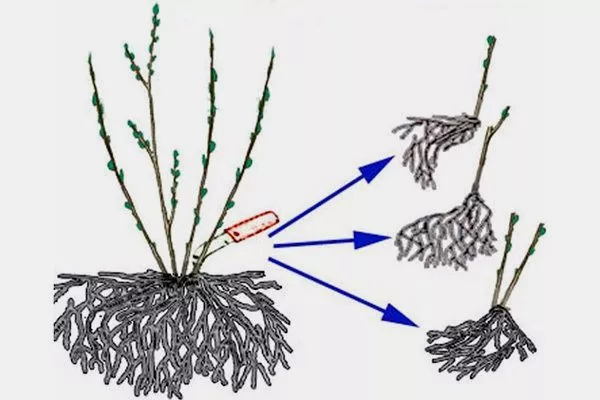
Separation process:
- Dig up the bush as you would for a regular transplant.
- Place it in a vertical position, holding it with your hands. This is difficult for a gardener to do alone, so it's best to ask family members for help.
- Mark the locations where the cut will be made. Keep in mind that each section should have a well-developed root and strong branches.
- Using a small hatchet, garden pruning shears, or a saw, divide the tree into the required number of pieces.
- Plant the seedlings in the standard way.
Planting by seeds
The process of growing a honeysuckle bush from seed is lengthy – it will take 4 to 5 years, and only then can you get the very first harvest.
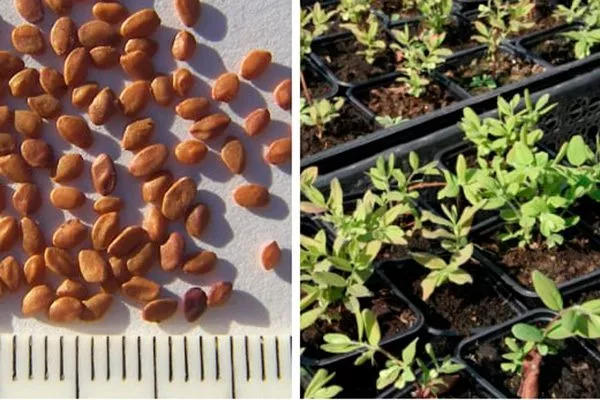
Step-by-step instructions for propagating honeysuckle by seed:
- Prepare a thick paper towel and the berries. Lay the cloth on a table surface, crush the berries, and spread the pulp over the towel. Leave about 1 cm between the seeds.
- Roll the towel into a roll and leave it at room temperature until you're ready to plant the seeds. This method will keep the seeds viable for up to four years.
- Now it's time to plant. This is best done during June. To do this, remove the seedlings from the paper towel, rinse thoroughly, and soak them in a clear solution of potassium permanganate for 30 minutes. If you need to speed up the germination process, soak them in a growth stimulant.
- Prepare the soil mixture and containers.
- Moisten the soil, let the liquid soak in, then plant the seeds 1-2 mm deep.
- Cover the container with glass or thick plastic. Place it in a warm place. Greenhouse conditions are ideal for honeysuckle seeds.
- Check the plantings daily for 15-25 days to ensure they are moist (the soil should not be crusty). Ventilate the plants for 15-30 minutes once a day.
- When the seedlings appear, open the shelter.
- After the first 3 leaves have formed, transfer the containers with seedlings to the beds.
- Around September-October, transplant the seedlings into open ground using a 20x20 cm pattern.
- Exactly one year later, plant the seedlings in a permanent location.
Planting by cuttings
Shoots 1-1.5 years old and 8 mm in diameter are suitable for propagation by cuttings. This method is considered quite simple and effective for honeysuckle. Cuttings should be taken before the buds open.
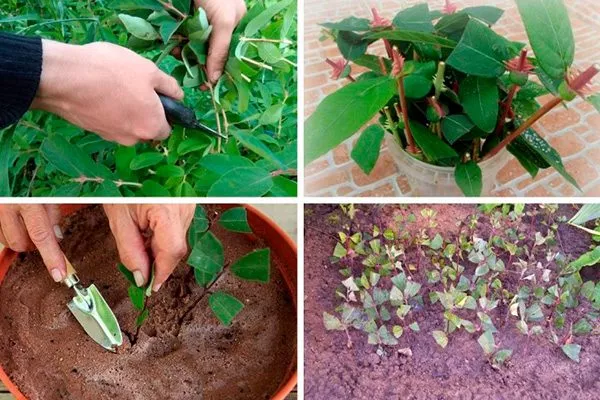
Standard rules for cuttings:
- Take cuttings from the bush so that they have at least five buds. The shoot length should be 15 to 20 cm.
- Place the cut side down in water for 24 hours. Experts also recommend using growth stimulants.
- Prepare holes 10 cm deep and 15 cm in diameter. Place the prepared soil mixture inside.
- Insert the cuttings (they should be 9-10 cm deep in the soil).
- Tamp down and water.
There is another method of propagation by cuttings - using green shoots:
- Once the berries have turned dark blue (June), cut the green stem from the bush. The cut should be at a 45-degree angle and about 20-25 cm long.
- Place the cut part in a Heteroauxin solution for a couple of hours.
- Plant in a pot in the standard way.
- In September or October (depending on climate conditions), transplant the seedling into open ground and carefully insulate it. Use non-woven materials for this purpose.
- When the buds on the honeysuckle awaken, transplant the cuttings to a permanent location.
Layering
This is the most simplified propagation technique. This process can be carried out in spring, summer, and fall, but in the latter case, the formed cuttings will first need to be potted and then transplanted into the ground in the spring. An alternative option is to install a mini-greenhouse over the cuttings.
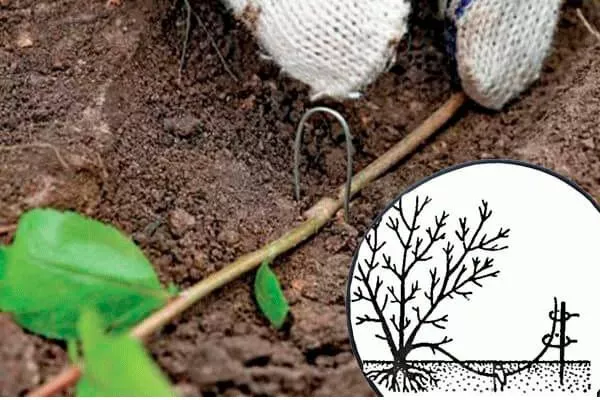
How to perform the procedure:
- Select 2-4 stems from the bush. They should be one-year-old, healthy, and strong.
- Loosen the soil in the direction where the vines will be laid.
- Bend the stem to the ground.
- Spread over the surface and secure with special staples or wire.
- Add a layer of soil about 4-6 cm thick along the entire length of the vine.
- Water the stem along its entire length approximately 1-2 times a week.
- After 1 month, when the cuttings have taken root, cut the stem from the mother plant and divide it into sections (based on the number of rooted spots). Replant in soil or a pot.
Gardeners' reviews
Olga Volkova, 45 years old, Ural. I've been growing honeysuckle varieties Volshebnitsa and Sibiryachka in my garden for about four years now. Both trees complement each other well, pollination is reliable, and the yield is good. The only problem is that they need to be covered for the winter.
Leonid Karpov, 51 years old, Voronezh region. We've had honeysuckle growing in our garden for about 20 years; my father used to take care of it. Over the years, we've replanted the garden six times, always trying to buy new varieties. Now we have 14. And what's amazing is how diverse the jams turn out when we experiment.
Viktor Lykin, 39 years old, Krasnodar region, Art. Kholmskaya. The whole family loves honeysuckle. And best of all, we've been picking the berries since June. I can say that after purchasing eight seedlings, every single one has taken root. This is my second year of propagating, so to speak, for sale. I've tried various methods, but my favorites are cuttings and layering. However, the latter method is more suitable for climbing honeysuckle.
To plant honeysuckle, you need to select a variety appropriate for the climate, prepare the site and planting hole, and follow the planting pattern. Caring for the plant is also easy—it's low-maintenance. The berries are versatile—made into jam, juice, preserves, and eaten fresh.