
The Malvina honeysuckle produces early-ripening fruit, is completely unpretentious, and produces average yields. This variety is self-sterile and easily tolerates drought and severe frosts. Its rich composition allows it to have antibacterial, anti-inflammatory, and antipyretic properties (it contains more vitamin C than lemons).
History of origin
The Malvina honeysuckle variety was developed by breeders at the N. I. Vavilov Pavlovsk Experimental Station in St. Petersburg. Its origins are traced back to the elite honeysuckle variety No. 21-5 from Primorsky Krai and the Leningradsky Velikan variety.
Breeders M. N. Plekhanov and A. V. Kondrikov are the creators of the Malvina variety. Since 2002, the variety has been included in the State Register of Breeding Achievements and recommended for cultivation in various regions of the country.
Appearance of the plant
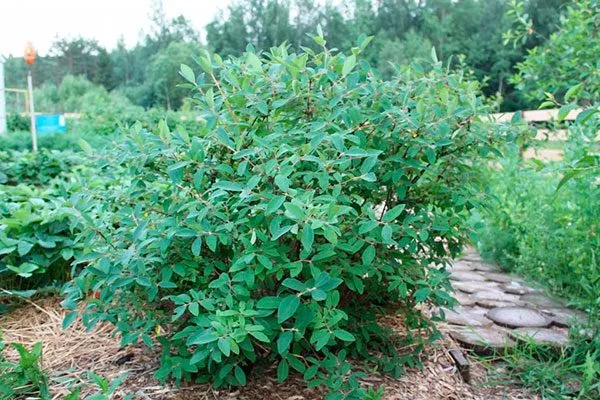
Malvina is a vigorous shrub, reaching a height of 130-160 cm. The crown is quite dense and oval, with pubescent stems. Other characteristic features of the plant include:
- shoots – erect, growing only upwards, of slight thickness;
- color of branches – light green when young, later becoming brownish-brown;
- bark – is subject to cracking over time, resulting in the red subcutaneous layer of wood becoming visible;
- crown – compact;
- foliage – oval and large, its length reaches up to 4-6 cm, and its width up to 2-3 cm;
- leaf blade color – dark green;
- leaf surface – with barely noticeable pubescence;
- flowers – small in size, bell-shaped, pale yellow in color;
- inflorescences – nodular type, each containing about 8-10 buds.
Berries and their taste qualities
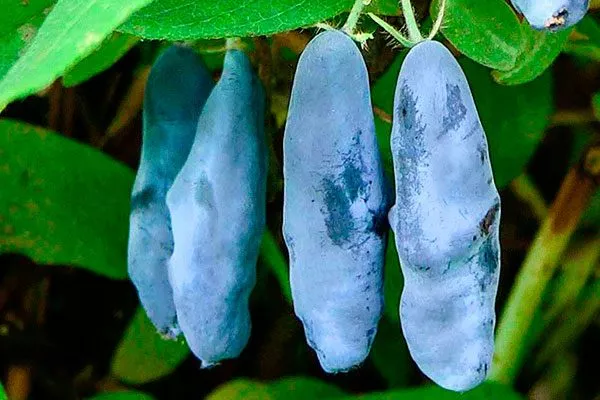
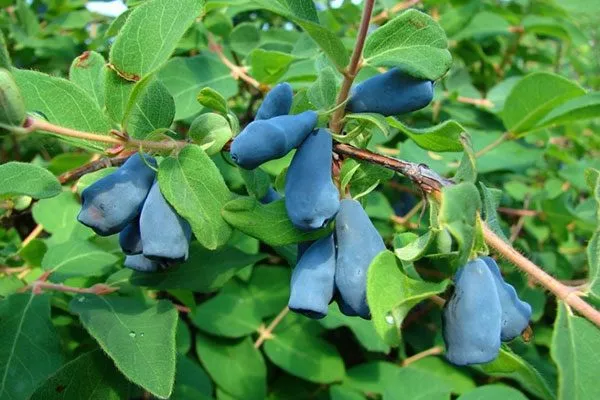
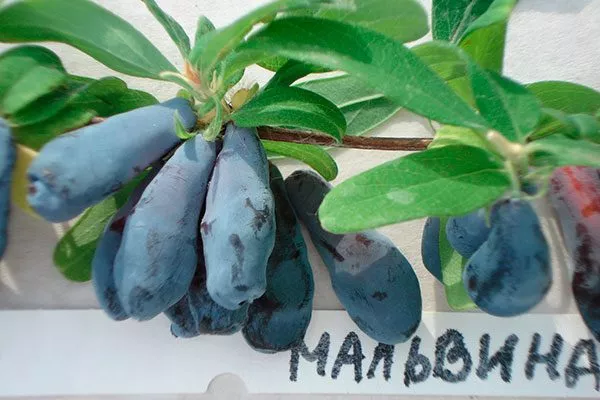
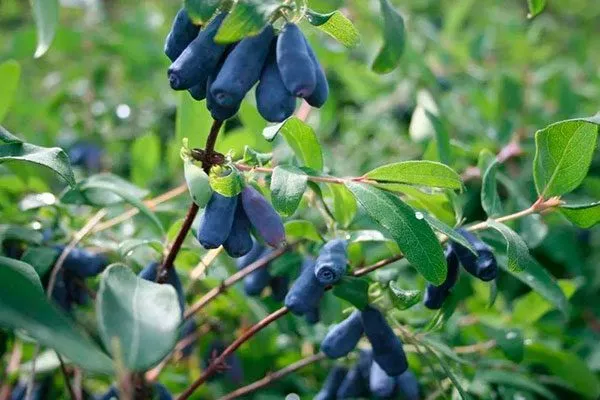
Gardeners pay special attention to the quality of the berries. Malvina's berries are large—weighing 1-1.2 g, 3 cm long, and 1.1-1.2 cm in diameter. Other characteristics:
- fruit surface – slightly bumpy, no pubescence;
- form - resembles a long pear, since the base is elongated, and the top is created like a roller;
- edge – uneven;
- color - bluish-blue;
- skin – with a waxy coating and a smooth surface, compacted texture;
- pulp – fibrous but juicy;
- aroma – typical for honeysuckle, but weakly expressed;
- taste - sweet and sour (sugar content – 8%, acid – 1.8%).
Based on the tasting evaluation, the variety was classified as a dessert variety and awarded a score of 4.9, which is considered high. The berries are virtually non-shedding and can be stored in cool conditions for 20 days. If the berries are picked overripe, they must be processed immediately, as they will spoil and ferment within three days.
Temperature resistance
Malvina is frost-resistant – the bushes can withstand temperatures as low as -50°C with the use of a protective covering, the root system can withstand temperatures as low as -40°C, and flower buds can survive temperatures as low as -6°C to -8°C. However, the plant may suffer at even deeper temperature drops.
Moisture and drought resistance
Although Malvina honeysuckle can tolerate heat, it still requires regular watering. It's not particularly drought-resistant—a lack of moisture leads to reduced yields, smaller berries, and a deterioration in flavor.
Pollinators of honeysuckle Malvina
| Name | Frost resistance | Ripening period | Productivity |
|---|---|---|---|
| Malvina | High | Early | Average |
| Blue Spindle | Average | Average | High |
| Moraine | High | Early | High |
| Kamchadalka | Low | Late | Average |
| Blue Bird | Average | Average | High |
| Start | High | Early | High |
| In memory of Kuminov | Average | Average | High |
Since Malvina is self-sterile, other donor plants are required to produce a harvest. It is recommended to have different varieties in the same plot to ensure cross-pollination and improve yield.
The following varieties are recommended as suitable pollinators: Goluboe Vereteno, Morena, Kamchadalka, Sinyaya Ptitsa, Start, Pamyati Kuminova, as well as the Malvina variety itself.
Ripening period and yield
Malvina berries begin to ripen after June 15th. The average yield is over 1.5 kg per bush, and the maximum can reach 3.2 kg. Harvesting is done by hand when the berries are fully ripe but not yet overripe.
Beneficial properties
Malvina honeysuckle berries are renowned for their beneficial effects on health, thanks to their unique composition, which includes vitamins C and P. They are effective in the prevention and treatment of anemia and hypertension.
These fruits are rich in vitamins and microelements such as A, B1, B2, B9 (folic acid), carotene, calcium, potassium, magnesium, phosphorus, sodium, and also contain pectin and tannins.
Honeysuckle also boasts a high iodine content, second only to strawberries, making it an important natural remedy for preventing serious illnesses, including atherosclerosis, heart attacks, and blood and liver cancer.
Application areas
Malvina berries have a wide variety of uses: they are eaten fresh, frozen, dried, and used to make preserves, jellies, jams, juices, compotes, kissels, and even homemade wine.
Advantages and disadvantages of the variety
The Malvina variety's advantages include resistance to frost, disease, and pests, making it not only suitable for commercial cultivation but also easy to care for. However, other positive qualities are also highlighted:
- The berries are large, have low shedding, are easy to transport and have a long shelf life thanks to their taste and rich composition.
- Early ripening and high yield.
- Possibility of reproduction by almost all methods available to culture.
The variety's disadvantages are minor and include the plants' need for regular watering, pollinators, and some difficulties in harvesting the berries, which are difficult to separate from the stalks.
Planting and caring for Malvina honeysuckle
Successful cultivation of Malvina requires careful preparation of the planting material, as well as the correct location and time for planting. Please note the following:
- It is recommended to use two-year-old seedlings with a minimum height of 40-45 cm, 2-3 branches above ground level, and a well-developed root system. It is important to select specimens with elastic stems and healthy, large buds.
- The best conditions for Malvina to grow are places protected from strong winds and drafts, with sufficient sunlight, as shade can negatively affect the yield of the bushes.
- Plants prefer moderately moist, nutrient-rich soil with a neutral to moderate pH. Loamy soil is ideal. An acidic environment negatively affects the plant: it grows slowly and may die, and the leaves turn pale.
- When choosing a planting site, avoid lowlands and areas where groundwater is close to the soil surface, as this can cause moisture stagnation and root rot.
- The most favorable time is from August to November. Spring planting is not recommended due to the early start of the growing season, although in southern regions, transshipment is acceptable.
- ✓ Soil pH should be between 6.0-7.5 for optimal growth.
- ✓ The depth of groundwater is at least 1.5 meters from the surface.
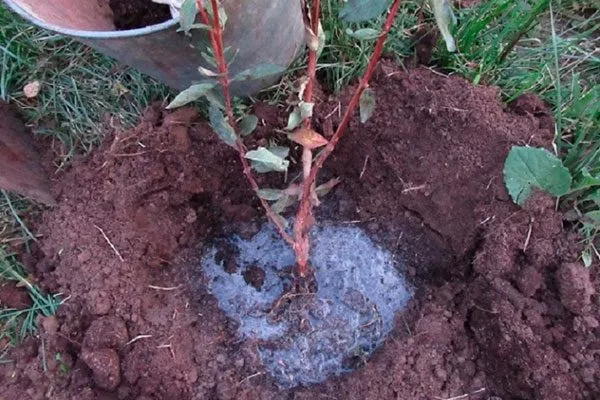
Planting instructions:
- 1.5-2 weeks before planting, dig up the beds and clear them of weeds and plant debris.
- Dig holes measuring 40x40x40 cm (+/- 5 cm).
- Place a drainage layer of expanded clay, gravel or broken red brick at the bottom of the hole, and pour a nutrient mixture of soil, humus, superphosphate and crushed wood charcoal on top.
- Form a small mound in the center of the hole and place the seedling on it, carefully spreading the roots out to the sides.
- Cover with soil so that the root collar of the seedling is buried no more than 2.5-3 cm deep.
- Tamp the hilled planting well and water generously.
- Mulch the soil surface with peat, sawdust or bark to better retain moisture.
The care procedures are standard, but there are some nuances:
- Young plants need to be watered 2-3 times per month, while mature plants should be watered 5-6 times per season, using water that has been left to stand in the sun. The recommended watering volume per plant is approximately 13-20 liters, but in hot and dry weather, this can be increased to 30 liters per plant. Water carefully, avoiding contact with flowers during flowering to avoid washing away pollen.
- To maintain soil moisture and control weeds, the soil surface should be mulched with hay, straw or compost.
- From the beginning of the third year after planting honeysuckle, it is recommended to fertilize with organic fertilizers according to the following plan:
- In the spring, after the snow melts, each bush is fertilized with 7-10 kg of humus.
- During the period of bud and ovary formation, an ash solution is used (600 g diluted in 10 liters of water).
- At the end of the growing season, a mixture consisting of 4-6 kg of compost, 100-150 g of ash and 45 g of superphosphate per 1 sq. m is added.
- Additionally, once every three years in the fall, honeysuckle is fed with potassium fertilizers at a rate of 15-20 g per 1 square meter, which helps increase the bushes' resistance to various diseases.
- When the shrub reaches three years of age, regular pruning should begin. This is done in the spring before the growing season begins or in the fall after it has ended. During this procedure, all damaged, dried, crooked, and irregularly growing branches are removed.
- In spring, add 7-10 kg of humus under each bush.
- During the period of bud formation, use an ash solution (600 g per 10 l of water).
- In autumn, apply a mixture of 4-6 kg of compost, 100-150 g of ash and 45 g of superphosphate per 1 sq. m.
Wintering
Malvina bushes don't require special winter protection, except in cases of extreme frost. Winter preparation includes generous watering (at least 30 liters per bush) two weeks before the expected frost and mulching the trunk area with compost. If the tips of young shoots experience slight frost damage, simply trim them back to healthy tissue in the spring.
Propagation of honeysuckle variety Malvina
Edible Malvina can be propagated by various methods:
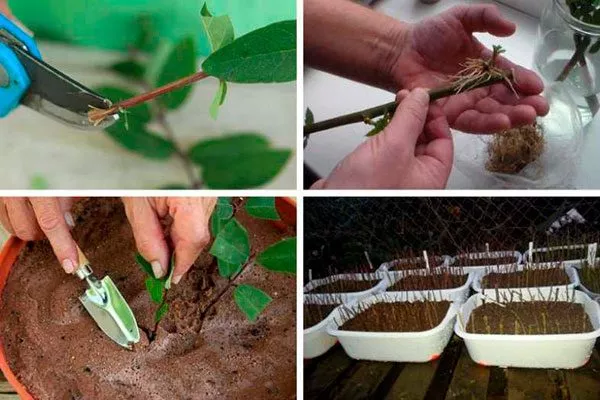
- Cuttings of young shoots. Cuttings are taken from branches up to 15 cm long after flowering. The cuttings are planted in fertile soil under greenhouse-like conditions. Water and ventilate the plants daily.
The seed material obtained in the fall is planted in the ground in the second ten days of October, which ensures better survival of young shoots. - Cuttings of old shoots. Similar to the previous method, but 20-cm-long cuttings are harvested in late autumn and stored, covered with sand, in a cool place until spring. At the first opportunity, they are planted in a greenhouse, positioned at a 45° angle to the ground.
- By layering. In June, the top of the shoot is bent to the ground, secured, then covered with a 5-7 cm layer of soil and watered regularly. A year later, in the fall, the plant is ready for transplanting.
The seed propagation method is very labor-intensive and is rarely used at home.
Diseases and pests
Although honeysuckle is considered resistant to most diseases, in humid climates or with excessive rainfall during the warm period, it can develop fungal diseases such as sooty mold, powdery mildew, or tuberculosis.
To prevent fungal diseases, you can treat your plants with an ash solution: soak 100-120 g of charcoal in 1 liter of water for 24 hours, then add 15 g of soap to the solution. Treat your plants three times in the spring, with a week between treatments.
If signs of fungal infection are detected, spraying with Bordeaux mixture at a concentration of 1% is recommended. This honeysuckle is not susceptible to pests.
Reviews of the Malvina honeysuckle variety
Malvina is a large-fruited, high-yielding variety grown throughout Russia due to its high frost resistance, sweet flavor, and delicate flesh when ripe. The plant produces large yields when other varieties are present in the plot to ensure pollination.