
The Leningradsky Velikan variety has gained widespread popularity and recognition among gardeners for its high yield and low maintenance. In this article, we'll take a closer look at this honeysuckle and explore the specifics of planting, growing, and pest control.
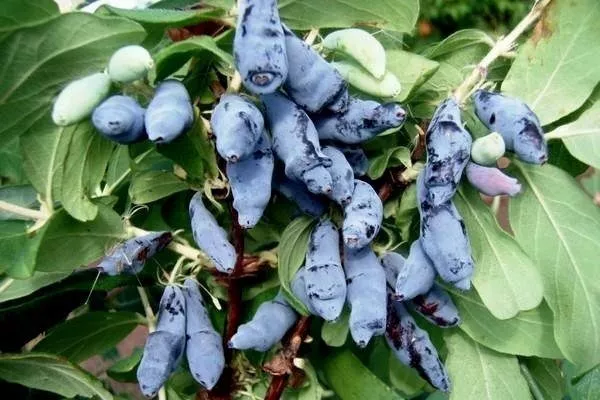
honeysuckle variety "Leningrad Giant"
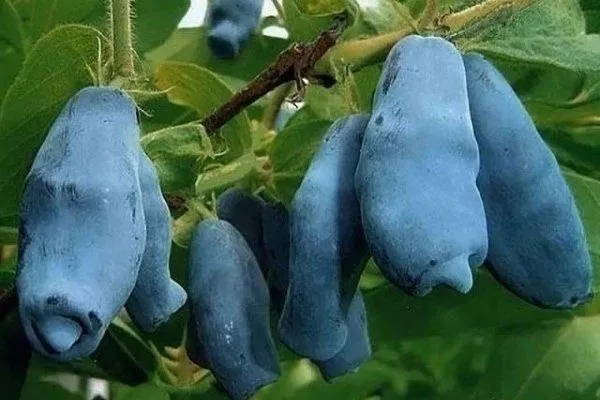
The impressive sugar content of the fruits gives them an amazing dessert taste
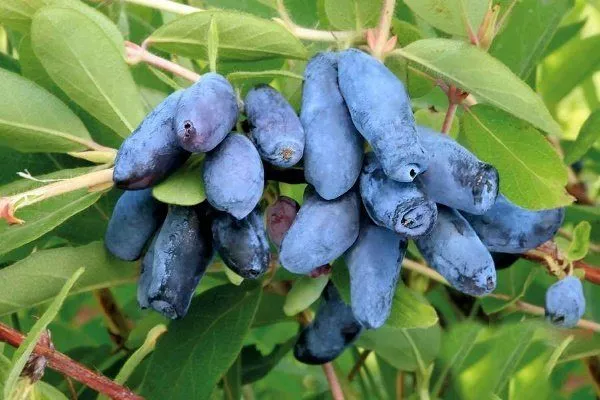
One of the promising honeysuckle varieties for industrial cultivation is the "Leningrad Giant"
Origin
This variety was developed at the Pavlovsk Experimental Station in St. Petersburg. It is a third-generation seedling of selected wild Kamchatka honeysuckle.
Description
The Leningrad giant has the following characteristics:
- A medium-sized bush 1.6-2 m high with a rounded crown up to 1.5 m in diameter.
- The leaves are dark green, slightly pubescent, oval-elongated.
- Mature bark is dark and mature, and easily peels off from the trunk.
- The flowers are pale yellow.
- The berries are dark blue, elongated-cylindrical in shape with a pointed tip, large, slightly bumpy, weighing up to 5 g, and up to 3.5 cm in length. The skin has a bluish bloom and is pubescent.
Quality varietal characteristics of the Leningrad giant
The variety has a number of features:
- Versatile—the berries are suitable for making preserves and jams. Thanks to their thick skin, they withstand storage and transportation well.
- Ripening period: mid-season (late June – early July).
- Productive - a young plant yields from 1 to 3 kg per bush, in subsequent years, under favorable conditions, it can yield up to 5 kg.
- Early-growing - the first fruits appear already in the second or third year and maintain a good yield for 25-30 years.
- ✓ Make sure that pollinators bloom at the same time as the Leningrad Giant.
- ✓ The distance between pollinator bushes and the Leningrad Giant should not exceed 50 meters for effective cross-pollination.
Advantages and disadvantages
Like any variety, the Leningrad Giant has its strengths and weaknesses.
The advantages of the variety include:
- The berries are sweet and large, without any bitterness, so the variety is considered elite and is used as a donor for the creation of new varieties.
- Resistant to powdery mildew and pests.
- The berries are collected in clusters, which simplifies harvesting.
- Thanks to its frost resistance (up to -40 degrees), it grows well in open areas without additional fencing.
- Resistant to repeated flowering.
- Reduced berry shedding - ripe berries stay on the stalk longer, reducing crop losses.
- The bush holds its shape well and does not fall apart.
The disadvantages are:
- The variety is self-sterile and requires pollinators (Blue Spindle, Pamyati Kuminova, Morena, Malvina, Start and Blue Bird).
- The berries ripen unevenly.
- Faint aroma.
Landing rules
The variety grows well in the central and northwestern zones of Russia.
Where to plant?
It is advisable to place the bushes in a sunny area, since in the shade the yield is significantly reduced.
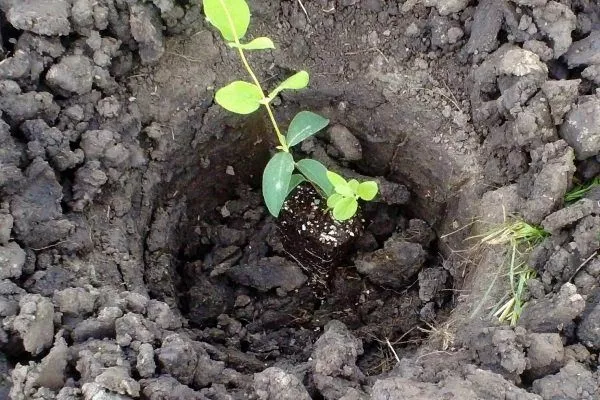
It's not particularly picky about soil; it prefers loose, fertile soil with a slightly acidic pH, or sandy loam. It does poorly in sandy soil and also dislikes areas with a high water table.
In acidic soil, foliage loses its color saturation and yields are significantly reduced.
- Conduct a soil acidity analysis 3-4 weeks before planting.
- Make any necessary adjustments (lime to reduce acidity or sulfur to increase it).
- Add organic fertilizers (humus or compost) at a rate of 10 kg per 1 m².
Planting dates
Seedlings are planted during the plant's dormant period. For honeysuckle, this period is from late July (when fruiting ends) to early August through November. Honeysuckle plants begin to awaken early in the spring, so survival rates drop by 20% during the spring months.
Selection of seedlings
To select good, viable seedlings, choose container-grown plants when purchasing. The plant should have a certificate detailing the variety, age, and pollinators.
Carefully examine the seedlings and select those that have:
- Age 2-3 years.
- Height up to 40 cm.
- 2-3 flexible branches.
- Live buds.
- Equal internodes.
It is not worth buying large plants, they tolerate transplanting worse and begin to bear fruit later.
Subtleties of planting
Since the crown of this honeysuckle variety is large, plant the bushes at a distance of at least 2.5-3 meters from each other.
When planting, there is no need to shorten the branches, as this will delay growth and fruiting.
Landing rules:
- Three weeks before planting, dig a hole measuring 50x50 cm.
Place drainage and soil consisting of:- 20 l of humus;
- 30 g superphosphate;
- 30 g potassium salt (500 g ash).
- 2 hours before planting, to awaken and saturate the plant with moisture, place the roots in water (you can use a growth stimulator).
- Fill the planting hole with water. Once the water has soaked in, form a mound of soil in the center of the hole and place the plant on it.
- Carefully straighten the roots.
- Sprinkle the seedling, deepen the root collar by 5 cm, and compact the soil.
Pour 10 liters of water under the bush. - Tree trunk circle mulch hay or straw about 10 cm thick.
Agrotechnical measures
Watering and loosening
Honeysuckle loves watering, so it is important to monitor the soil moisture in the trunk circle:
- Water the young seedling regularly, preventing the soil from drying out.
One bush requires 10-15 liters of water, and in hot and dry periods up to 30 liters. - When the soil on top dries out, loosen it, but not deeper than 5-8 cm, since honeysuckle has a superficial root system and the roots can be damaged.
- Water the mature bush only during periods of severe drought.
- Regularly loosen the tree trunk circle and remove weeds.
- Honeysuckle also appreciates sprinkling, especially during fruit set in the second half of May, but not during flowering and berry ripening. Water can dislodge pollen from the flowers, resulting in a poor harvest.
Top dressing
Since the necessary fertilizers were added to the hole when the seedling was planted, it is sufficient to water the plant with a solution of ammonium nitrate (urea) in the spring for the first couple of years – 10 liters per bush.
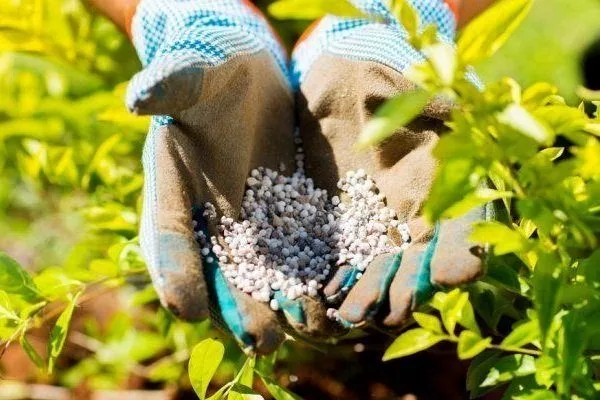
Then the nutrient reserves in the soil are depleted, and from the age of 3 the plants require additional feeding:
- In early spring, before the snow melts, apply nitrogen-containing fertilizer.
- In summer, after fruiting has finished, feed with complex mineral fertilizer.
- At the beginning of autumn, apply potassium-phosphorus fertilizer (per 1 sq. m: 30 g of superphosphate and 20 g of potassium salt); it is advisable to add rotted compost or humus every 3-4 years.
Trimming
From the age of three, in the fall, during the dormant period, only sanitary pruning is carried out, during which only weak, broken, crown-thickening, ground-hanging and diseased branches are removed.
At the age of 6-7 years, the bushes are rejuvenated once, for this purpose, 2-3 old shoots are gradually cut out over several seasons, leaving the same number of young ones in their place.
Further, until the age of 15, only sanitary pruning is sufficient.
In subsequent years, old branches are cut back each season. After 20 years (if the yield has significantly decreased), the bush is pruned, leaving stumps 15-20 cm long. After such a radical rejuvenation, the honeysuckle will bear fruit for another 10 years.
We recommend reading the article about How to care for honeysuckle in autumn.
Preparing for winter
The Leningradsky Velikan is frost-hardy (down to -40°C), so it doesn't require winter protection. Simply remove all fallen leaves and any remaining mulch from the tree's tree trunks after the leaves fall.
Reproduction
There are three ways to propagate honeysuckle:
- Dividing the bush — the simplest, performed only on plants 6-7 years old and older. The bush is dug up and divided. The halves are planted in planting holes. The honeysuckle will begin to bear fruit as early as the second year.
- Propagation by layering The lower branches are bent to the ground and dug in. The following year, when these branches have rooted, they are separated from the parent bush and transplanted to a permanent location. Fruiting begins in the third year.
- Propagation by cuttings This method isn't very productive, as cuttings are difficult to root and require specific conditions. To propagate, cut a 15-cm-long branch from a 2-year-old bush (or older), and remove the top.
The cuttings are placed in a growth stimulator for 2-3 hours. They are then planted in wet sand under plastic for 3-4 weeks. The rooted cuttings are brought into the garden for the winter and then planted in their permanent location in the spring. - Propagation by seeds Honeysuckle's parental traits are not passed on, and the result is unpredictable, so it's only of interest to breeders. Seeds are sown in containers and planted in a garden bed in the spring. After a year, the seedlings are transplanted to their permanent location. They begin bearing fruit in three to four years from sowing.
Prevention of diseases and pests
The Leningrad Giant is resistant to pests and diseases. For prevention, the plant is treated with special preparations.
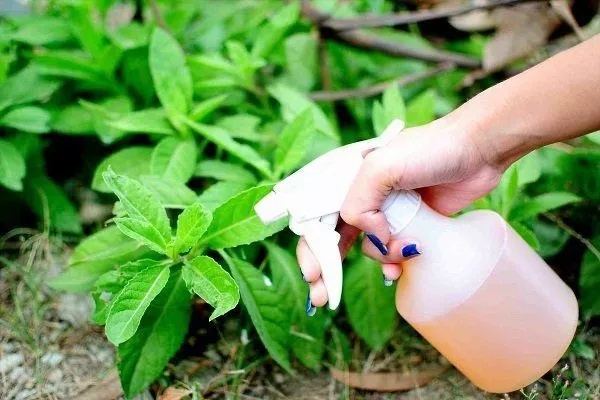
Pesticides can be sprayed on bushes only during the dormant period and in the spring before the leaves emerge. During fruit set and fruiting, all fungicide treatments are prohibited, so organic products are used to combat fungi and pests during this period.
Table of the main diseases and pests of honeysuckle, methods of control:
| Pests and diseases | Signs | What to do? |
| Leaf roller caterpillars, jewel beetles | Leaves and shoots are eaten by larvae. The leaves on the branch become smaller and dry out. | Treat with appropriate insecticides or biological products (Decis, Intra-Vir, Eleksar). In case of severe infestation, cut off branches at the base and burn. |
| Aphids | Small insects, aphids, are visible on the branches; the shoots are withering and turning yellow. | Treat with bioinsecticides (phytoverm, tobacco-garlic infusion), or in early spring before the buds open with Actellik, Rogor, Confidor. |
| Scale insects | Growths appear on the branches that do not separate from the branch - these are larvae. | Cut off and burn the affected branches, and spray the plant with Fitoverm or Actellik, Rogor, or Confidor. |
| Honeysuckle mite | The leaves curl and fall off. | Treat with insecticides. |
| Nematode | A speckled pattern appears on the leaves. | Tear off and burn all damaged leaves. |
| Fingerwing | The fruits become wilted and wrinkled. | An infusion of tomato and potato shoots. Treat the bush with 0,2% Chlorophos solution. To kill larvae, use Rogor 0.2%, as well as Intra-Vir. |
| Powdery mildew | There is a white, web-like coating on the shoots and leaves. | The bushes are treated with insecticides and biological preparations (Skol, Topaz, Fundazol). Affected shoots are cut out and burned. |
| Cress mosaic virus | The internodes shrink sharply. Lateral shoots begin to grow rapidly from the axillary buds. The plant dries up and dies. | Choose plants carefully when purchasing. If shoots are damaged by frost in winter, prune them to prevent viruses from entering the plant through the wounds. |
Harvesting
The berries are picked as they ripen.
Honeysuckle berries ripen in stages: the fruits at the top of the bush ripen first, then those in the depths of the bush, and the lower berries ripen last.
Overripe berries fall to the ground, so before harvesting, it's advisable to lay a thick cloth under the bush to catch the fallen berries. Fruits that are still attached to the stem are left to ripen, rather than picked. After harvesting, the berries are carefully poured from the cloth into the rest of the harvest.
Reviews of the Leningrad Giant honeysuckle
The "Leningradsky Velikan" honeysuckle variety is well-suited for beginning gardeners and will delight with sweet fruits and a bountiful harvest for years to come. It also requires minimal care and is resistant to most diseases and pests.