
Honeysuckle Caprifolium is ideal for landscaping a garden plot. This "hedge" is used in landscape design, beautifying the area, providing shade, and creating a cozy place to relax. There are over 10 known species of honeysuckle, including the climbing honeysuckle.
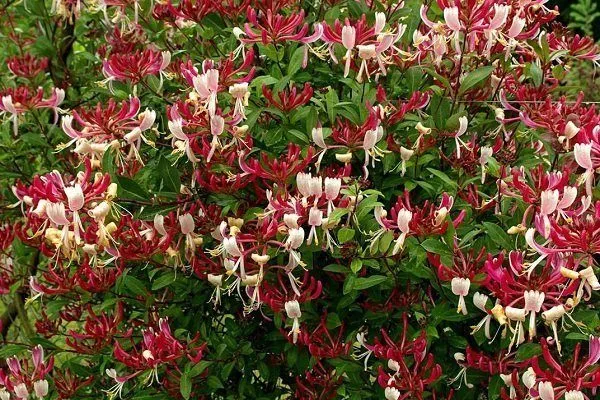
Honeysuckle Caprifolium
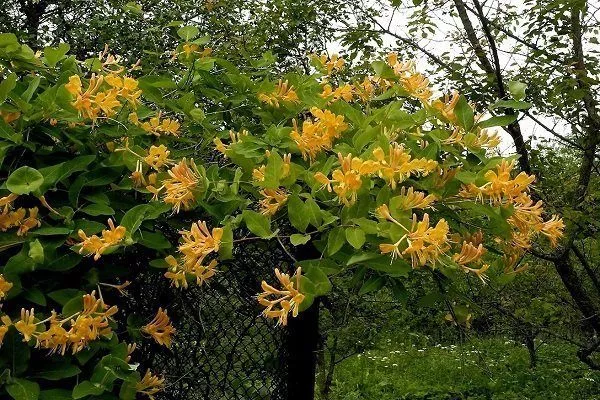
Honeysuckle Caprifolium blooms for about 3 weeks.
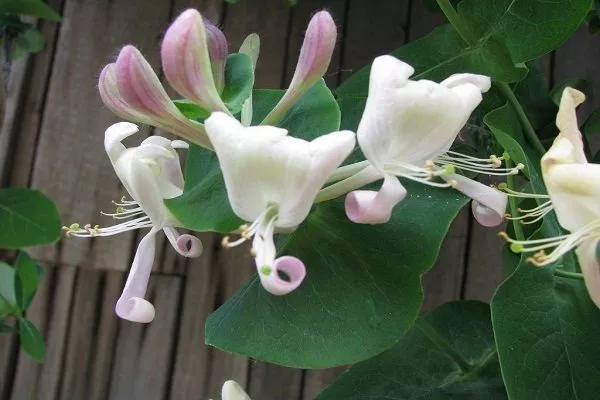
Honeysuckle flowers have a pleasant aroma.
Description of honeysuckle Caprifol
Honeysuckle Caprifolium has a pleasant aroma and unique flowers, creating a cozy and shady spot in a garden plot or gazebo. In the wild, the plant is found in southern Europe and the Caucasus Mountains and can live up to 50 years.
The original name of the honeysuckle is Lonicera caprifolium, which translates as "folium" (leaf) and "carpa" (goat). These curly bushes, up to 6 meters long, come in a variety of colors and always attract the attention of passersby.
Appearance
The shrub has bright green, elliptical leaves and vertically growing branches 4-5 meters long (depending on the age of the honeysuckle). Gray-green shoots turn red in the sun and tightly twine around any support. The leaves gradually fuse into a disk, in the center of which a flower forms, then a cluster of ripe berries.
Honeysuckle flowers have a delicate, pleasant aroma and are decorative. They are a source of inspiration and a symbol of beauty, yet they are not edible and have no medicinal properties. This distinguishes Honeysuckle from other honeysuckle varieties. The plant is intensely fragrant in summer, with the scent intensifying in the evening.
Honeysuckle flowers come in red, blue, purple, white, and yellow. They ripen in late July and early August, turning a rich orange or bright red. Each individual flower lasts no more than three days before wilting. The entire shrub's bloom period lasts no longer than three weeks.
Growing
With support, honeysuckle grows up to 6 meters in length. This property makes the shrub a perfect vertical gardening option for gardens and backyards. To ensure proper growth, train the bush at planting time and provide it with reliable support. Otherwise, honeysuckle loses its decorative appearance.
In the wild, honeysuckle grows in sunny clearings and forests, growing up to 1 meter in length per year. Due to its beauty and vertical twist, it has been planted in Russian gardens since the 19th century.
Honeysuckle varieties
| Name | Flower color | Flowering period | Plant height |
|---|---|---|---|
| Few-flowered | pale red | June-July | up to 3 m |
| Alba | blue or white | May-June | up to 4 m |
| Inga | white, pink, red, yellow | June-August | up to 5 m |
| Telman | yellow-hot | July-August | up to 6 m |
| Belgica Select | purple or pink | May, August-September | up to 4 m |
| Harlequin | soft pink | June-July | up to 3 m |
| Graham Thomas | white and yellow | July-September | up to 5 m |
Honeysuckle is considered the most beautiful of the 10 honeysuckle varieties. Gardeners are drawn to the variety of colors and shades, and the bush retains its decorative appearance even after flowering. The most popular honeysuckle varieties, with brief descriptions, are:
- Few-floweredThe bush is pale red with a small number of flowers.
- AlbaThe bush is early flowering, the flowers are blue or white.
Other decorative varieties of honeysuckle are also used for landscape design:
- IngaFlowers are white, pink, red and yellow, with an intense scent, collected in capitate inflorescences.
- TelmanThe flowers are a hot yellow color with a moderate aroma, and look like little flames on the bushes.
- Belgica SelectThe flowers are purple or pink, the fruits are red. The plant blooms twice a year: in May and then in August-September.
- HarlequinThe flowers are soft pink with a moderate fragrance, a perfect addition to many garden gazebos.
- Graham ThomasThe flowers are long, white and yellow, and have a pleasant fragrance. They bloom from the second half of July to September.
Advantages and disadvantages
Having appreciated the significant benefits of honeysuckle, many designers have incorporated this ornamental plant into their landscape designs. Positive aspects of honeysuckle:
- easy to care for;
- decorative appearance;
- variety of colors;
- quick adaptation to weather conditions;
- pleasant aroma;
- rapid growth;
- hedge;
- creating shade and comfort in the fresh air;
- strong immunity.
When choosing a variety, keep in mind that the Caprifolium honeysuckle has certain disadvantages and is difficult to care for:
- inedible fruits;
- fast flowering;
- pruning branches;
- formation of support;
- deterioration of external appearance during transplantation;
- the need for bush formation and regular watering.
Planting honeysuckle Caprifolium
The plant thrives in all regions of Russia, but is less common in the northern part. This is due to the harsh climate. At low temperatures, honeysuckle requires special care and can be damaged by frost.
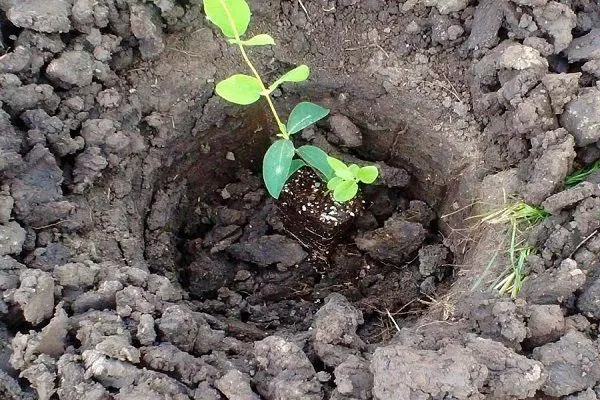
Choose the right time to plant, follow the correct sequence, and ensure proper care for seedlings and young shoots.
Landing time
Plant honeysuckle outdoors only in early spring; until then, keep it in a hothouse. The plant blooms in May, which is a favorable time for root development and fruiting.
When planted in early summer, the honeysuckle bush grows in early autumn, and its fruits are a delightful, rich red. During this period, the plant quickly finishes flowering.
Choosing a location
Before planting seedlings, decide on a permanent location. Honeysuckle doesn't like being moved. This causes the shoots to grow more slowly, and flowers to appear less frequently and in fewer quantities.
Honeysuckle requires vertical support to grow, so it thrives near house walls, posts, and fences. It's important to consider all these factors, including light, soil composition, and moisture.
Soil preparation
When choosing soil, remember that honeysuckle lives for over 10 years, so it needs fertile soil. Make sure there's no deep water in the area, and if there is, use drainage. Otherwise, the root system will rot and the plant will die.
Loosen the soil to ensure it receives sufficient light and oxygen. To improve soil fertility, use the following ingredients:
- Peat, sand, humus, and turf soil serve as a base. The ratio of components is 1:1:1:3.
- Two buckets of compost, 500 ml of slaked lime, 100 g of double superphosphate, 30 g of potassium sulfate.
When preparing the soil, evaluate its conditions. Neutral soil, with a pH of 7.5-8.5, is ideal. Pre-treat acidic soil with slaked lime. Honeysuckle does not grow well in clay soil.
Support
Honeysuckle requires support. This can be any vertical surface in your garden: a fence, a shed, a wall, a house wall, or a gazebo. If desired, you can make your own support from scrap materials (wood, metal, nylon mesh).
- ✓ The support must be resistant to wind loads, especially in regions with strong winds.
- ✓ The support material must be resistant to corrosion and decay; it is preferable to use metal or plastic structures.
Large-mesh netting, cords, and lattice trellises are most commonly used for support. Initially, the plant grows upward, and after the tops are pruned, it produces side shoots and spreads outward. With high support, honeysuckle grows to 4-5 meters in length within five years of planting.
Selection of planting material
Plant growth depends on the health and strength of the seedlings. Choose two-year-old seedlings with 2-3 branches and a length of 30 cm. Other recommendations when purchasing planting material:
- Study the branches carefullyDry branches with damaged bark are not suitable. The main selection criteria are elasticity and surface integrity.
- Inspect the barkSpots indicate a plant health problem. Peeling of shoots is a negative sign.
- Look at the rootsThe presence of growths, poor branching, brittleness, and an unpleasant odor are signs of root disease. Such a plant will not grow quickly.
- ✓ Presence of living buds on shoots, even in a dormant state.
- ✓ No mechanical damage to the bark and roots.
Step-by-step planting diagram
When planting honeysuckle, maintain a distance of 1.5 m between adjacent seedlings, otherwise the growth of the honeysuckle will slow down.
Sequence of actions:
- Dig a hole 40 cm deep and wide.
- Pour drainage material (expanded clay, crushed stone, gravel, sand, etc.) onto the bottom.
- Use organic fertilizer (manure, humus, compost).
- Make a mound in the hole, plant the seedlings, and spread out the roots.
- Fill the hole so that the root goes 5-7 cm deep.
- Water each seedling generously (up to 1 bucket per plant).
- Lay down a 10cm layer of mulch.
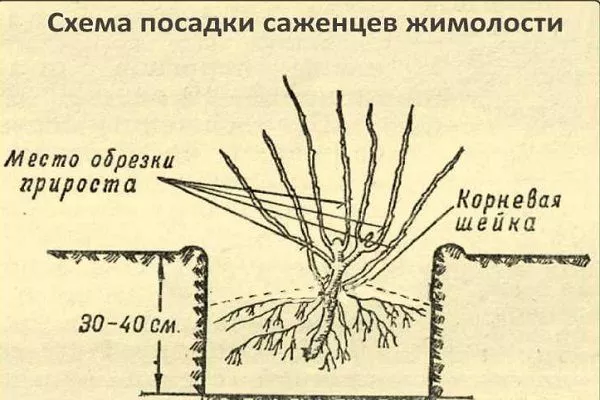
Young honeysuckle leaves will appear within a week. To help the plant establish itself quickly, water it, loosen the soil, and promptly remove weeds, especially perennial ones.
Caring for honeysuckle
Honeysuckle Caprifolium is easy to care for, grows quickly, and climbs along supports. Regular monitoring of growth will help prevent disease, improper bush formation, and shoot depletion. The soil should not be allowed to dry out, and weeds should be removed immediately if they appear.
Watering
The plant is easy to care for, the main thing is to water it periodically. If the summer is rainy, additional watering is not necessary. Otherwise, the root system will rot.
Honeysuckle Caprifolium does not tolerate severe drought, so in hot weather, double the frequency and amount of watering – twice a week. Make sure the soil around the base of the plant is not cracked and keep it moist.
Top dressing
Honeysuckle grows well. To speed up this process and create a hedge faster, apply additional fertilizer. The choice of fertilizer and nutrients depends on the time of year:
- In spring, the plant requires nitrogen fertilizer. A solution of manure or bird droppings is considered good. Concentrated fertilizers can burn the root system. To prevent this, dilute the fertilizer with water at a ratio of 1:10.
- In autumn, focus on phosphorus and potassium fertilizers, using well-rotted manure or compost for top dressing. Special superphosphates are especially in demand during this period.
- In summer, use nitrophoska, dilute 20 g of the composition in 1 bucket of water.
Read more about how to fertilize honeysuckle in spring, summer and autumn. next article.
Loosening and weeding
Honeysuckle doesn't tolerate close proximity. Before planting honeysuckle, remove all weeds and perennials, and weed the soil as the bush grows. The loosened soil receives warmth and oxygen. If there is no mulch, weed the soil twice a week.
Pruning and shaping the bush
As the seedlings grow, select the three strongest shoots and carefully pluck the rest. As the honeysuckle grows tall, trim the tops. This is necessary to encourage the honeysuckle to spread out and form a hedge.
As the hedge grows, the lower leaves fall off, leaving gaps. To conceal these, plant another bush with new leaves to cover the white spots on the vertical support.
Regular pruning will help your plant grow faster, produce beautiful, richly colored flowers, and attractive fruit. Pruning is essential for creating a flawless landscape. After winter storage, prune dead and weak shoots in the spring (pruning).
For information on pruning honeysuckle, see the following video:
Reproduction
Replant honeysuckle in the spring, choosing a suitable location immediately, otherwise you risk ruining the bush. The plant can be propagated in several ways: by cuttings, layering, seeds, and division. The choice is up to the gardener.
Seeds
This is a complex process that is carried out in the following sequence:
- Prepare the seeds: remove the grains from the pulp, rinse and dry on a radiator.
- To help the seeds germinate faster, place them in damp sand.
- Store in the refrigerator for 2-4 weeks, moistening periodically.
- Prepare a box with nutritious soil and fluff it up.
- Cover with seeds and place a layer of soil on top.
- Cover the container with glass or cling film.
- Do not open until young shoots appear.
- Afterwards, remove the film/glass and ensure regular watering.
Once the plant has established itself and reached a certain height, transplant it to its permanent location. Planting seeds is a laborious process, the success of which also depends on the quality of the seeds. Therefore, most gardeners prefer to work with seedlings.
To learn how to collect honeysuckle seeds for planting, watch the following video:
Cuttings
Cuttings are taken when the bush has finished flowering—in mid-July. Avoid direct sunlight when young shoots are sprouting. Preparation instructions:
- Choose older shoots that break easily.
- The length of the cuttings is up to 10 cm, the number of nodes is 2-3 pcs.
- Cut the top at a 90 degree angle and the bottom of the cutting at a 45 degree angle.
- Plant in a greenhouse, add equal proportions of peat and sand to the garden soil.
- Choose a distance between cuttings of 15-25 cm and a hole depth of 2-3 cm.
- In spring, transplant the young plant with leaves into open ground.
Layering
This method of honeysuckle propagation is the simplest and most accessible, requiring no special preparation or subtleties. The gardener's steps are as follows:
- Bend the honeysuckle branch and cover it with soil.
- To prevent it from returning to its original position, secure it with a rope or staple.
- Loosen the soil well and water after planting.
- After rooting, separate the young and adult plants.
- Dig it up and transplant it to a permanent location.
By dividing the bush
In this case, you'll need to disturb the root system of a mature honeysuckle. For example, detach a shoot by the root, trim it, and plant it in a separate container. For rapid growth, water the honeysuckle regularly and monitor the emergence of the first leaves.
Second option: dig up the bush and use a shovel to divide it into two halves. Treat the cuts with ash and trim the shoots. Plant both bushes in separate containers and monitor their vigorous growth. Later, transplant the mature honeysuckle into open ground.
Preparing for winter
Mature plants don't require winter insulation, but frost is a serious challenge for young shoots. To preserve your hedge, insulate the bush with a layer of humus or peat (apply around the trunk).
When cold weather hits, remove the honeysuckle shoots from their supports, carefully lay them on the ground, and cover them with plastic, roofing felt, or slate. Leave the plant alone until spring, when it will be replanted on its vertical support. Prune off any dead shoots beforehand.
Diseases and pests
If the plant wilts, some of the leaves turn yellow and fall off, these are signs of the appearance diseases or harmful insects, which weaken once-strong shoots and attack the root system. Potential pests are described in the table:
| Pests | Brief description of pest activity |
| Fingerwing | The caterpillar eats half-ripe berries, spoiling the appearance of the plant. |
| Leaf roller | The caterpillar sucks all the juices from the leaves, causing them to turn yellow and curl into a tube. |
| Scale insect | The insect damages the integrity of the bark, drinks the plant's sap, and leads to its gradual death. |
| Plant aphid | The pest attacks green leaves, causing them to turn yellow and fall off en masse. |
To get rid of pests or prevent their appearance, use products such as Condifor, Eleksar, and Inta-VIR. Spray the leaves with a solution prepared strictly according to the instructions.
Another enemy of honeysuckle is fungus. Brown bumps (nodules) appear on the leaves. The crown wilts and falls off. Remove shoots affected by fungus. To preserve the hedge, treat the plant with a copper sulfate solution. Use fungicides, such as 1% Bordeaux mixture or Aga-Peak.
Viral activity causes streaks to appear on the leaves. You can try to save the honeysuckle by treating it with a copper sulfate solution or Fundazol. If this doesn't work, dig up and burn the affected plant. Follow the same procedure for ramularia and cercospora leaf spot, where brown spots on the leaves lead to the death of green shrubs.
For advanced honeysuckle diseases, use chemical treatments. Antitlin, Actellic, Biotlin, and Akarin are particularly effective, provided the recommended dosages are followed. To prevent insect pests, spray Caprifol with a 5% urea solution in the fall.
Gardeners' reviews
Honeysuckle Caprifolium is used as an ornamental shrub. It beautifully complements any vertical surface, offering magnificent flowers and an unforgettable fragrance. Landscape designers often use this plant in their work.