
To increase the number of honeysuckle plants, you don't need to purchase planting material; you can easily propagate your favorite varieties yourself. To do this, you just need to thoroughly familiarize yourself with the plant's characteristics and the intricacies of its cultivation. In this article, we'll cover the main propagation methods and the sequence of their implementation.
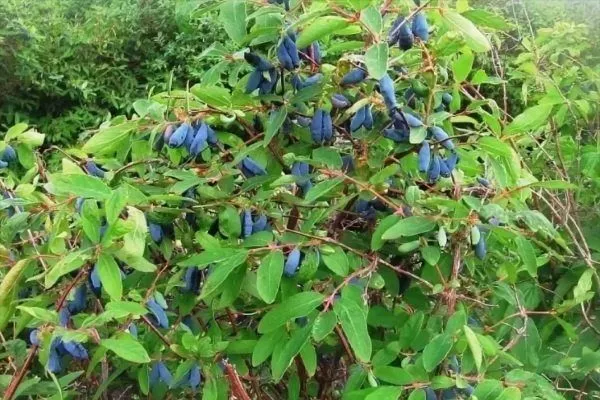
Conditions for successful cultivation of honeysuckle
To obtain good planting material and harvest, you need:
- Select strong and young bushes that are not susceptible to diseases and pests.
- Create conditions for active root system formation (maintain a temperature of 24-28 °C, air humidity of 90-95%).
- Don't rush to plant rooted plants; it's best to let them grow for another year so the roots have time to grow.
- Plant the plants outside in the garden when they are 2-3 years old.
- It is advisable to plant 3-5 varieties of honeysuckle, or more, on your plot.
You can read about the diseases and pests of honeysuckle Here.
Honeysuckle propagation times
Honeysuckle is propagated almost all year round.
The time frame depends on the chosen method:
- By layering – in spring before the buds open.
- By cuttings – from the moment of flowering until leaf fall.
- By division - in the autumn, when the plants have shed all their leaves, or in the spring, before the buds swell.
- Seeds can be sown from spring to autumn, with the exception of winter.
Methods of vegetative propagation
Vegetative propagation is the formation of a new plant from a portion of the parent plant. This method preserves the plant's varietal characteristics and ensures good survival. This method can be used to rejuvenate a garden or increase the number of plants.
Honeysuckle can be propagated:
- Stems or young shoots. Cuttings can be made from both green and woody branches, but the former have a higher survival rate.
- By layering - from branches that are in contact with the ground.
- Root shoots are sprouts from awakened dormant buds on the roots.
- By dividing the root.
From one bush you can harvest and root about 200 plants.
Green cuttings
This method is used for summer propagation of honeysuckle.
Recommended time for harvesting green cuttings:
- Simultaneously with flowering and formation of green fruits.
- After harvesting, the shoot has already strengthened, hardened, and become less susceptible to rotting, and there is time until autumn to form a good root system.
- The best time for cuttings is from approximately May (second half of the month) to mid-June.
- The cuttings should be about the thickness of a pencil.
Requirements for collecting cuttings:
- Branches intended for cuttings should still be green but already brittle (they snap with a distinctive crunch when bent). If the shoots bend easily, give them time to grow further.
- Choose the most powerful young shoots.
- Cut cuttings in cloudy weather, in the morning or evening hours.
Sequence of actions:
- Take cuttings from the middle of the branch, making them 8 to 13 cm long. Leave 3 or 4 buds on each cutting. Make the lower cut at a 45°C angle. Make the upper cut at a right angle, 1.5 to 2 cm above the internode.
- Remove the leaves from the bottom half of the cutting and reduce the number of leaves from the top half by half. This will allow the cutting to retain more moisture, which is necessary for the formation of full-fledged roots.
- To stimulate root growth, make small cuts (grooves) at the bottom edge of the cutting.
- Before planting, soak the cuttings for 24 hours, immersing them 2-3 cm deep in rooting stimulator. Dust the bottom cut with Kornevin powder.
- Treat the lower edge of the cuttings with a root formation stimulator (Kornevin, Epin or Zircon).
- Rooting of cuttings takes approximately 1 month.
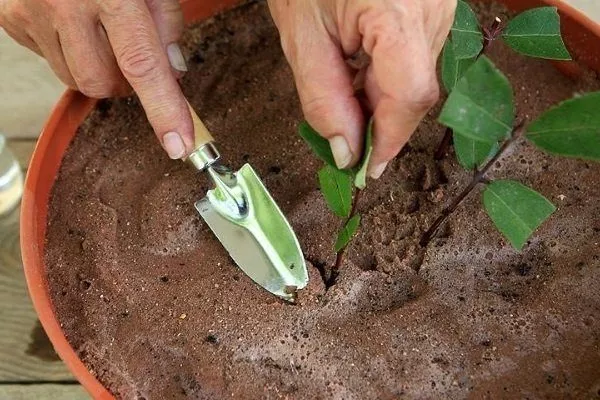
Green cuttings are rooted in two ways:
- In water, with subsequent planting in substrate after root formation:
- Place the cuttings in a container with water, with the lower part and one internode.
- To speed up root formation, place them in a solution of hetero-waxin for the first day, and then place them in regular water.
- As the water evaporates, add water periodically, but do not replace it.
- When the first roots appear, plant in a container with substrate.
- In moist, light soil:
- Plant the cuttings in light, loose soil (mix 1 part peat with three parts sand, or in equal parts) so that the lower internode is in the ground.
- Cover with transparent film to create a greenhouse effect and protect from bright sunlight.
- After 2-3 weeks, when roots have formed, reduce watering, open the cuttings for ventilation, but keep the cover for a while longer, gradually acclimating the young plants to the outdoors.
- In autumn, cover the rooted cuttings with spruce branches or leaves.
- With the arrival of spring they will begin to grow, grow them for another season, and next spring plant them in the garden.
Optimal conditions for rooting- ✓ Maintain the substrate temperature within 20-22°C for better rooting.
- ✓ Use rainwater or settled water for watering to avoid chlorosis.
Lignified cuttings
For this, select one-year-old shoots with brown bark. They can be cut after the plants shed their leaves or in early spring before bud break.
Rules for collection and rooting:
- Select healthy branches with a diameter of 6-9 mm.
- To store, wrap the prepared branches in a damp cloth and bury them in the sand in the basement.
- In spring, when the honeysuckle begins to grow, cut the cuttings into 2-5 internodes each and plant them in the substrate. Only one bud should remain above the surface.
- After wintering, continue growing the cuttings for another season to allow a good root system to form.
- Plant the rooted plants in a permanent location.
Root and horizontal layering
If propagation by cuttings seems too difficult, you can try layering. This method is quite simple, but only applies to varieties that produce good one-year shoots.
Honeysuckle rarely produces root suckers—only when a dormant bud awakens on the rhizomes. Then, nurture the emerging shoot for two years, then separate it from the main bush and plant it in its permanent location.
Another option is to try propagating by horizontal layering.
This must be done before the sap starts to flow:
- In the spring, dig up the soil around the main bush and remove the weeds.
- Select 3 or 4 good one-year-old shoots from the lower part of the plant. Gently pull the branches to the ground and pin them in place with a wire arch.
- To stimulate root formation, make small cuts in the bark (grooving) at the point where the branch touches the ground.
- Cover the cutting with soil to a depth of 5 cm and water and hill it regularly throughout the season.
- In autumn, the rooted cutting will already have its own roots.
- In the spring, separate it from the mother bush with pruning shears and plant it in a permanent location.
Air layering
This option is used when all the branches grow vertically and there is no way to bend them to the ground.
Sequence of actions:
- Select the appropriate branch.
- Step back 15-20 cm from the top of the branch.
- Make a furrow under one of the buds, or remove a 1 cm wide layer of bark in a ring.
- Cover the injured area with moisture-absorbing material (moss).
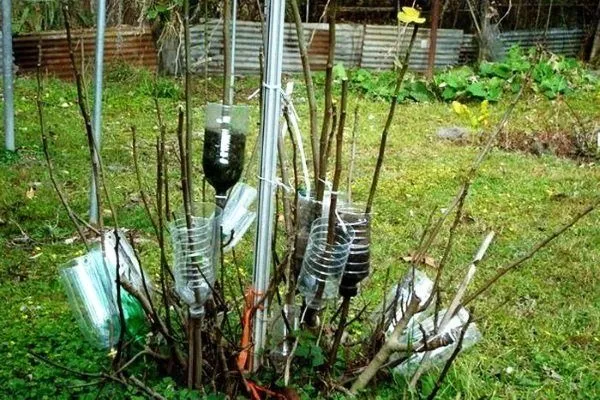
- Cut a bottle or other suitable container lengthwise and fill it halfway with moist substrate. You can wrap it in film filled with moss and secure it with tape.
- Place the container with soil on the branch at the furrow location, connect the halves and secure with tape.
- Water the soil in the container throughout the season, preventing it from drying out.
- After the roots appear, use pruning shears to separate them from the bush below the planting container and plant them for further growth.
Dividing the bush and replanting
If an adult bush (3-6 years old) is strong enough and has 6-9 skeletal branches, deepened into the ground at the root, then it can be divided into parts and get several plants (from 6 to 12 divisions).
You can prepare the bush in advance by hilling it up high (approximately 20 cm) in the fall to stimulate lateral root growth. Division should be done in the spring, before bud break, or in the fall, after the leaves have fallen.
Sequence of actions:
- Dig up the bush and divide it into individual sections. Each section should have 2-3 shoots and a good rhizome.
- Disinfect the cuts with ash or a weak solution of potassium permanganate.
- Plant the cuttings in a permanent location, following the same technology as planting regular seedlings: in pre-prepared holes with nutritious soil, water the plantings generously.
Partial division can also be performed; for this, the mother plant is hilled in the spring, and in the fall it is not dug up, but only the lateral branches with their own roots that have grown over the summer are separated.
Generative propagation of honeysuckle
When propagating by seed, it is impossible to predict the varietal characteristics of the future plant, since honeysuckle is cross-pollinated and as a result, both an edible and a wild form can grow.
Sequence of actions:
- During the summer harvest, select the largest, ripest berries and crush them.
- Rinse the seeds to remove the pulp and dry.
- You can sow:
- In the summer, immediately after preparing the seeds, they will sprout in the fall. Cover the young shoots with a covering material for the winter; they will continue growing in the spring.
- Sowing before winter will allow the seeds to undergo natural stratification, resulting in stronger, more established seeds with more powerful roots. Transplant them in the summer for further growth.
- Sow in early spring – sow in cups or containers in a nutrient-rich medium indoors. Cover the seeds with soil to a depth of 1 cm, water gently, and cover with plastic wrap or glass. Remove the cover when the first leaves appear. A year later, in the spring, plant them outdoors.
Common mistakes gardeners make
When propagating honeysuckle, it happens that failure to root and the death of a young seedling occurs due to mistakes.
Here is a list of the most common ones:
- When propagating by seed, gardeners plant one-year-old seedlings in open ground. However, the plants haven't yet developed a defense mechanism against cold weather and will freeze at the first frost.
- When rooting from green cuttings, the cuttings are taken much larger than necessary. This will cause the plant to grow at the expense of its roots.
- When dividing, begin dividing the bush just before the cold weather sets in. In this case, the honeysuckle does not have time to take root well and prepare for frost and may freeze over the winter.
Growing honeysuckle doesn't require any special knowledge or skills. The main thing is to follow the basic rules for rooting plants. Don't be afraid to experiment, and your efforts will be rewarded with good harvests from your home-grown varieties.