
Honeysuckle is one of the most easy-to-grow fruit and berry crops. For a healthy and fruitful plant, timely pruning is all that's needed. We'll discuss the types, timing, and nuances of honeysuckle pruning in our article.
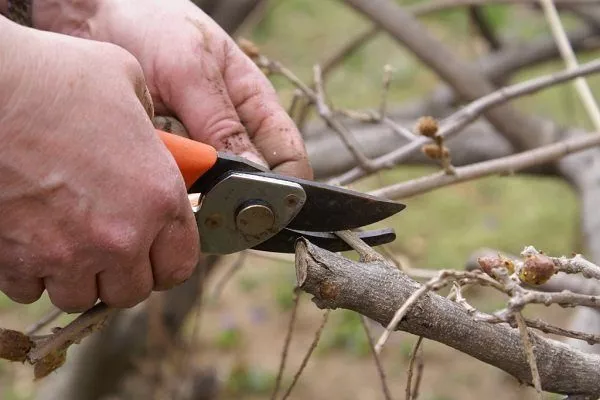
What is the purpose of pruning?
Without timely care, bushes prone to overgrowth quickly degenerate into wild thickets of diseased and stunted plants, the number of young shoots decreases, and the quantity and quality of berries declines. Therefore, regular pruning of honeysuckle serves several purposes:
- rejuvenation and healing;
- increasing crop yields;
- maintaining the decorative appearance of plantings.
Features of the procedure
Honeysuckle is a slow-growing plant. Radical pruning isn't necessary in the first few years after planting. Primary care involves removing diseased branches lying on the ground or growing into the bush. This type of pruning is called sanitary pruning.
Thinning is done no earlier than 3-5 years of age for both ornamental and edible honeysuckle varieties. During this period, the plant will gain strength and become spreading and wide. Pruning will rejuvenate the bush, promote growth, and shape it. The flowers will be exposed to pollinating insects and sunlight, which will positively impact the yield. Berries will be more numerous and larger in size.
Maintenance pruning involves removing lateral shoots to maintain the shrub's decorative shape. This is typically done over several years unless major changes to the planting's appearance are desired.
Timing of honeysuckle pruning
The timing of pruning depends on its purpose and the local climate. The most common types of pruning are:
- spring pruning;
- autumn pruning.
Pruning in spring
Honeysuckle has an early growing season, so when choosing the right time to prune, it's important to consider local weather conditions. For example, in Siberia, spring care is recommended when the average daily temperature is at least 5°C (41°F), typically in April or May. In southern regions, pruning begins as early as March.
Pruning of honeysuckle is carried out in spring before the buds begin to open.
Before the beginning of the growing season, sanitary and health-improving care is carried out:
- old branches aged 8-10 years are cut out;
- sick, deformed, located on the lower tier and touching the ground;
- young shoots growing into the crown.
Sometimes dead branches are only noticed after the first leaves emerge. In this case, the procedure is repeated with particular care to avoid damaging the fragile, healthy shoots.
Pruning in autumn
Traditional autumn care for honeysuckle – thinning and rejuvenating pruning. The main difference between thinning and rejuvenating pruning is the removal of healthy branches.
The plant, which has ensured its survival in the wild through the rapid growth of new shoots, is prone to dense growth and poor development of branches growing close together. Cultivating honeysuckle and artificial pruning allow the shrub to grow fully and bear fruit.
Autumn pruning begins after the leaves have fallen, but before the onset of persistent cold weather.
Trimming the bush too early can cause the buds to awaken and begin to grow, while trimming it too late can lead to freezing of the cuts and the death of the plant.
Rules and methods for pruning honeysuckle
When pruning, it is important to take the following points into account:
- the procedure is carried out carefully with sharp pruning shears or a hatchet to preserve the integrity of fragile branches;
- fruiting buds are mainly located at the tops of annual shoots, so to preserve the harvest they are not shortened;
- dormant buds are located on the forks of skeletal branches and are not cut to the base to form a new crown;
- In the year of pruning, young shoots from dormant buds can reach 60-70 cm; before lignification, they require support, which can be made from pegs and rope.
- ✓ The pruning shears must be sharp to minimize damage to the branches.
- ✓ For thick branches, it is recommended to use a garden saw with fine teeth.
Pruning is divided into several types:
- formative;
- rejuvenating;
- sanitary.
Formative pruning
Formative pruning is aimed at creating a healthy plant shape. For ornamental shrubs, it's performed in the first year, and for edible shrubs, it's performed 3-5 years after planting. Thinning is then carried out over the next 5 years to maintain the proper bush habit.
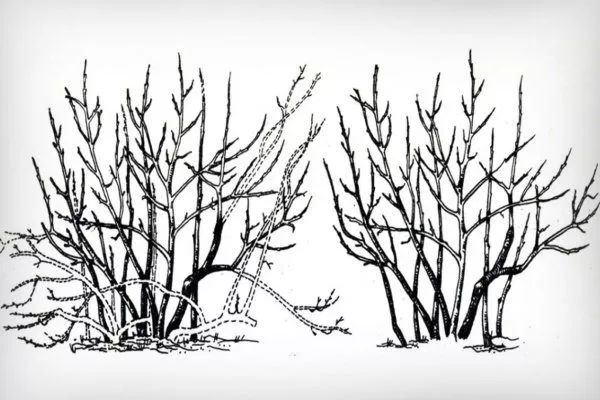
Edible honeysuckle pruning chart
The cutting scheme is as follows:
- selection of 4-7 skeletal branches;
- removal of lower branches touching the ground;
- cutting off shoots growing deep into the bush;
- cutting out weak and thin shoots;
- shortening shoots with weak growth;
- treating cuts with garden pitch or oil paint.
- ✓ Provide the plant with abundant watering for a week after pruning.
- ✓ Apply a complex fertilizer 2-3 weeks after the procedure to support growth.
Rejuvenating pruning
In the 8th to 9th year of a bush's life, the first signs of aging begin to appear: drying of shoot tips, slower growth and reduced yield, and longitudinal peeling of the bark on skeletal branches. In such cases, rejuvenation pruning is performed, removing shoots to the area of regeneration, a few centimeters above the base.
Trimming order:
- strong thinning inside the bush;
- the closest possible distance from the base of branches that have stopped growing;
- selection and preservation of young shoots located in the center.
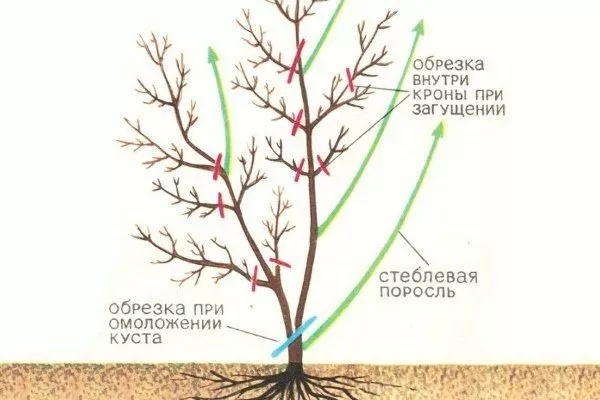
Rejuvenating pruning scheme
In advanced cases, when old branches make up 70% of the bush, radical pruning is performed. All stems are cut back, leaving 30-40 cm from the base. Over the course of the season, 40-60 new shoots up to 50 cm long will emerge. The following year, after rejuvenation, the honeysuckle will delight with an excellent harvest. In the spring of the third season, 10-15 of the strongest branches are selected, removing the rest during thinning.
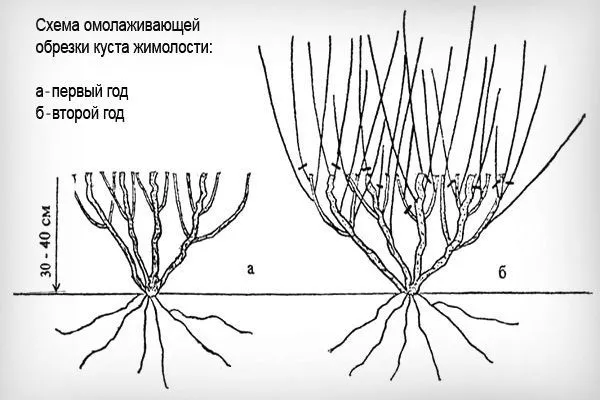
Stump pruning diagram
Sanitary pruning
Sanitary pruning is carried out as needed:
- in the presence of dried shoots;
- when branches are infected with diseases;
- when pests appear on the plant (aphids, scale insects, leafhoppers, geometer moths, leaf rollers);
- if the crown habit is damaged.
If fungus or insect attack occurs, the following measures are taken to save the bush:
- remove infected shoots along with part of the healthy stem;
- carry out treatment with chemicals, pesticides or folk remedies;
- contaminated waste after circumcision is collected and burned;
- In the fall, the soil is thoroughly dug up to destroy the larvae and burrows of pests.
Sometimes the damage is so extensive that the only option is to uproot the bush.
The video shows how to prune honeysuckle correctly:
Do I need to prune my ornamental honeysuckle?
Ornamental honeysuckle is widely used to create hedges and plant sculptures. Regular pruning is necessary to maintain the aesthetic appearance of the plantings. Typically, 2-3 prunings are required per season:
- The first procedure is carried out in early spring before the buds swell. The shoots are trimmed to the required height, dead branches and vines are removed, and the bundles are tied to guide the shoots. The overall shape of the plant is maintained.
- The second procedure takes place after the vines have finished flowering. Young shoots extending beyond the outline are removed, and the supporting older branches are used as a framework.
- After the leaves have fallen, it is time for the third pruning, which is essentially sanitary and health-improving.
Helpful tips
To ensure an excellent harvest and healthy bushes, you can, and sometimes should, take advantage of the experience of experienced gardeners.
Processing of cuts
To protect against diseases and pests Plant cuts must be treated with garden pitch or oil paint.
Top dressing
The stressful situation for the shrub in the form of pruning will be smoothed out by good fertilizing:
- In spring, nitrogen fertilizers are used: an aqueous infusion of manure or bird droppings, compost, or humus. Mineral fertilizers such as urea, carbamide, and saltpeter can also be used.
- In autumn – potassium and phosphorus, ash, potassium salt, complex fertilizers.
Read also about how to fertilize honeysuckle in spring, summer and autumn next article.
Options for preparing a solution for feeding:
- 200 g of bird droppings per bucket of water;
- 2 kg of manure or humus per bucket of water;
- 150 g of ash per bucket of water.
If fertilizing is done with mineral fertilizers:
- abundant watering of the soil;
- 30-40 g of fertilizer per 1 sq. m at a depth of 10 cm.
Treatment with boiling water
A proven method for preventing diseases and pest infestations is boiling water treatment. A hot shower is believed to kill pests, eggs, and fungal spores. It's done in early spring, immediately after the snow melts.
To treat the plant, cover the soil under the bush with available material and water the plant with hot water, being careful not to miss the branches. Optionally, you can add one teaspoon of caustic soda per bucket of water.
For information on treating honeysuckle in spring, watch the following video:
Every gardener dreams of a harvest without spending too much. Honeysuckle is a great way to make those wishes come true. Just give it a little care.