
The Blue Banana variety is a mid-season honeysuckle cultivar developed by Canadian breeders. It is adapted for outdoor cultivation in temperate and cool climates. Honeysuckle is multifunctional: its berries are suitable for fresh consumption, processing, and freezing.
Characteristic features of the variety
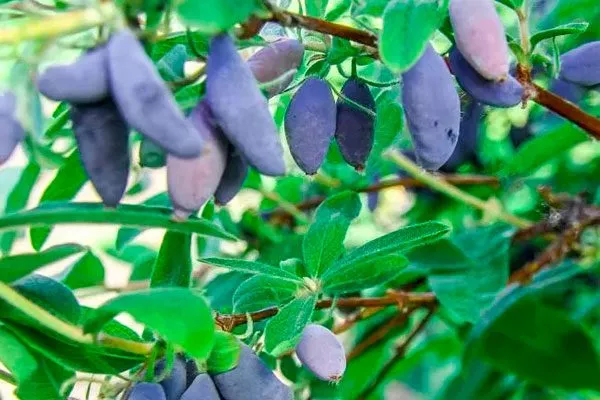
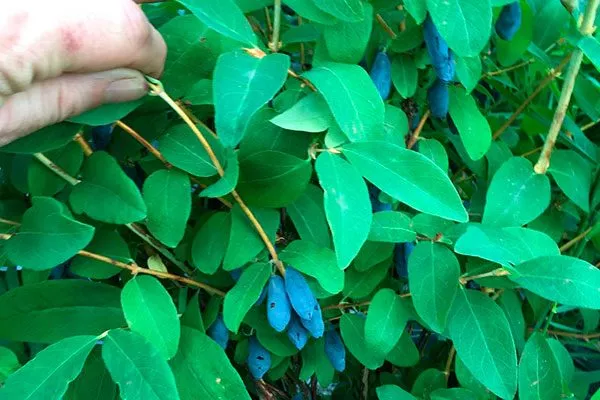
The blue banana is a vigorous shrub with a wide-spreading habit. Its crown, which can be obovate or dome-shaped, is densely covered with vibrant green leaves. Strong, tall shoots contribute to the formation of a bush that reaches 120-160 cm in height and a similar diameter.
Fruit indicators
Blue bananas are classified as large-fruited varieties. Note the berries' key qualities:
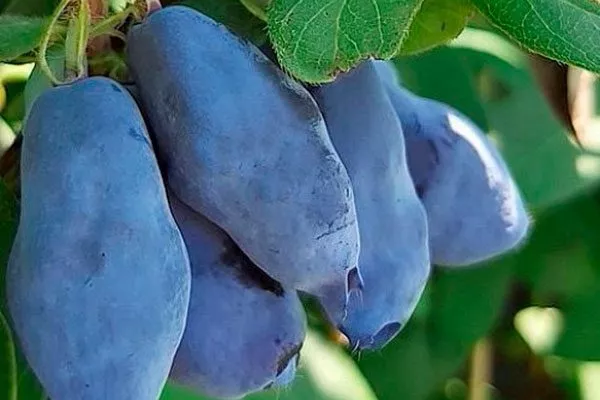
- An adult bush can produce ripening berries weighing up to 3-5 g and up to 2.5-3.5 cm in length.
- The fruits have a classic elongated oval shape with pointed ends.
- Ripe berries have an attractive purple color and a visible bluish bloom.
- The berries have a moderately dense skin with a bumpy texture that is not tough.
- They are held on shortened and at the same time thickened stalks and are easily removed during harvesting without falling off initially.
Features of taste
Blue Banana stands out as one of the most delicious honeysuckle varieties. The berries are rich in fleshy, dense, tender, and juicy pulp. The flavor profile is extremely sweet, with a subtle sophistication, without the characteristic bitterness or cloyingness, and is complemented by a pleasant sugary aroma.
Ripening and fruiting
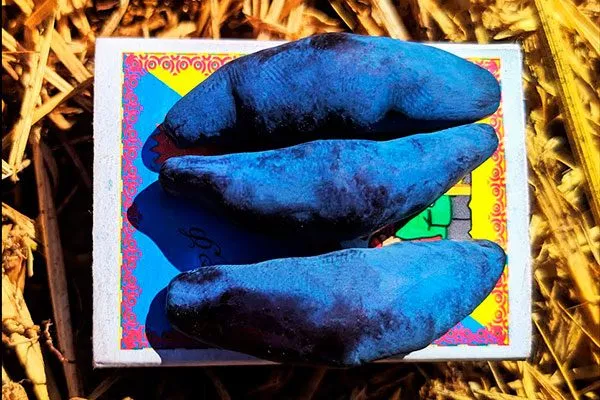
It is characterized by a medium-late ripening period and equally fruitful fruiting (the first berries appear in the third year after planting). Since the berries ripen unevenly, their ripening period can extend up to four to five weeks.
Productivity
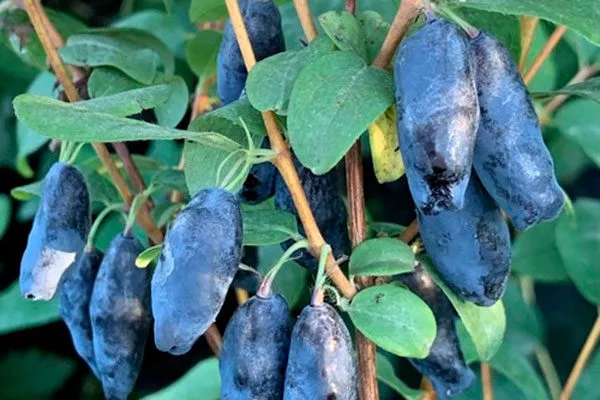
It is characterized by high yields. On average, each bush can produce up to 3.5-4 kg of fruit per season, with a maximum of 4.5 kg per bush recorded. Up to 10-15 tons of harvest can be obtained per hectare.
Self-fertility and the need for pollinators
| Name | Disease resistance | Flowering period | Soil requirements |
|---|---|---|---|
| Heart of a Giant | High | Early | Neutral |
| Cubic zirconia | Average | Average | Subacidic |
| The Giant's Daughter | High | Late | Neutral |
| Northern Lights | Average | Early | Subacidic |
| Honey Bee | High | Average | Neutral |
| Aurora | Average | Late | Subacidic |
To ensure full fruiting, the Blue Banana variety requires cross-pollination with other honeysuckle varieties. Planting two to three pollinator plants is recommended for maximum efficiency. Among the most effective pollinator plants are:
- Heart of a giant.
- Cubic zirconia.
- The Giant's Daughter.
- Northern Lights.
- Honey Bee.
- Aurora.
- ✓ The distance between pollinator bushes and Blue Banana should be no more than 50 meters for effective cross-pollination.
- ✓ Pollinators must bloom at the same time as Blue Banana to ensure pollination synchrony.
Winter hardiness and need for shelter
It is distinguished by its increased resistance to low temperatures and can withstand temperatures down to -35-45 degrees Celsius. Another distinctive feature of this shrub is the frost-hardiness of its flower buds and young shoots, eliminating the need for additional winter protection for mature plants.
Location and soil requirements
To ensure honeysuckle thrives and thrives, it's important to carefully select a planting location. The shrub prefers sunny, wind-protected sites with fertile, well-drained, loose, and permeable soil with a neutral pH—from pH 4.5 to pH 7.5.
Features of planting honeysuckle
When planting honeysuckle, it is recommended to observe the following requirements:
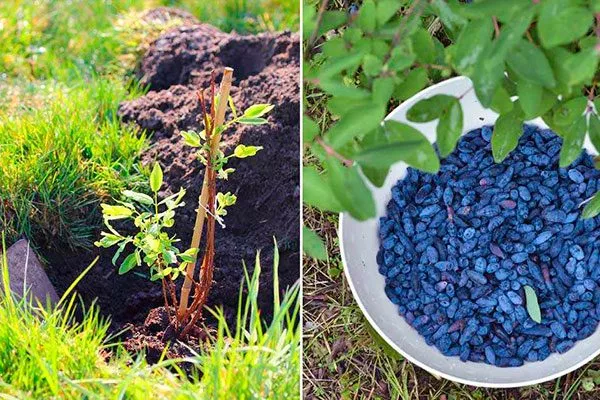
- Prepare a planting hole in advance measuring 45x45 cm and 45 cm deep.
- Pour 20 kg of rotted compost into the hole per bush.
- Add 400-500 g of wood ash (or a chalk-dolomite mixture) and 2.5-3 tbsp of superphosphate (it should be granular and double-strength). On sandy soils, increase the amount of organic fertilizer to 30 kg.
- Mix all the ingredients added to the cavity thoroughly and pour in plenty of water.
- In the central part, form a hill-like structure, on which carefully distribute the plant roots.
- Fill the hole with soil, compact it well and water again.
- If necessary, deepen the root collar slightly by 5 cm.
- Mulch the soil around the planted plant to retain moisture.
Plant care after planting and later
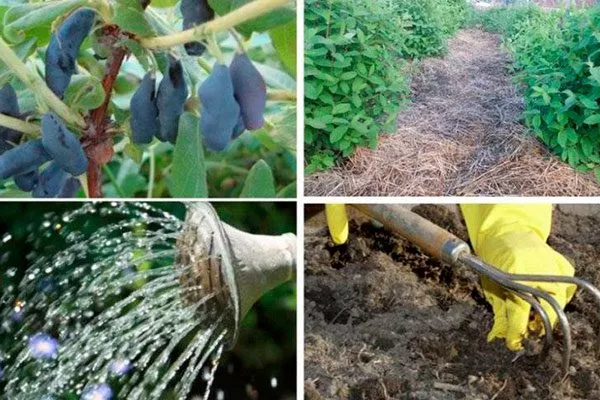
The following year, it should be watered regularly. As the plant matures, the frequency of watering should be adjusted based on climatic conditions, but avoid allowing the soil to dry out.
Other features:
- During periods of intense heat, honeysuckle may require daily watering. The temperature of the water and the time of day are not critical, but it is recommended to use water pre-warmed by the sun and water the plants in the evening.
- After a couple of years, the bush needs additional feeding, primarily organic. In the spring, apply 9-10 kg of humus mixture to each bush, which is then carefully mixed into the soil using garden tools.
- Annual loosening of the soil near the bushes is encouraged, but it is important to consider the location of the root system so as not to damage it.
- After the leaves have fallen, it is recommended to spread a thin layer of wood ash around the plants, mixing it shallowly into the soil.
- If it is not possible to use organic fertilizer in the spring, the plant can be fed with nitrogen compounds (urea), and a complete mineral fertilizer can be applied before wintering.
- Over time, honeysuckle bushes may become dense and require thinning through pruning, which is easy to perform. This involves removing broken, dried, and excessively old branches. Pruning should be done in the first days of spring before the sap begins to flow or after the leaves fall in the fall.
- ✓ Do the first pruning no earlier than 3 years after planting, so as not to delay the onset of fruiting.
- ✓ Remove only old, damaged or bush-thickening branches, leaving at least 5-7 strong shoots for the future harvest.
Reviews
The Blue Banana honeysuckle variety is part of a series of future varieties. It stands out for its high yield and strong immunity. However, when growing this variety, it is important to remember the need for cross-pollination to ensure abundant fruiting and delicious berries.