
The Blue Spindle honeysuckle variety boasts large, sweet-tart berries, an attractive, ornamental appearance, and low maintenance requirements. This article will explain how to select and plant the plant, what to do to ensure a good harvest, and other aspects of growing Blue Spindle.
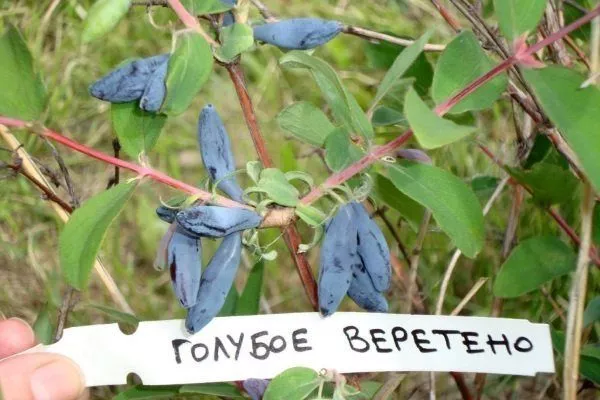
honeysuckle variety 'Blue Spindle'
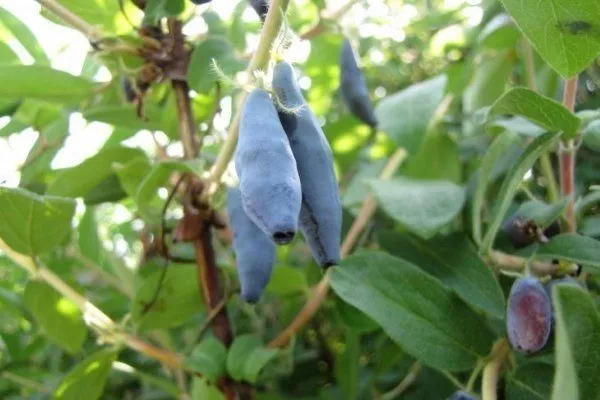
The variety received its name "Blue Spindle" for the shape and color of its berries.
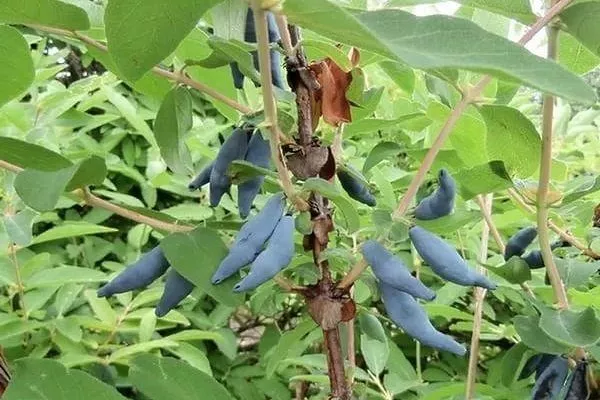
According to tasters, the taste of the Blue Spindle honeysuckle berries depends on the growing region.
How did the variety originate?
Blue Spindle is a Siberian honeysuckle variety, developed over 30 years ago from the Kamchatka variety Start by breeders at the Siberian Horticultural Research Institute. It was registered in the State Register of Breeding Achievements in 1989.
This variety is recommended for cultivation in all regions, but this recommendation is conditional – in hot climates with low rainfall, the plant will feel uncomfortable, which will affect the yield.
Description and technical specifications
Table of the main characteristics of the variety:
| Bush height, m | Frost resistance, °C | Fruiting period, years | Maturity | Yield, t/ha | Tasting score, points |
| 1-1.5 | up to -45 | 20 | early | up to 7 | 3.5-4.3 |
Bush
The bushes are vigorous and quite large. The crown is round and moderately dense. The shoots are green, turning brown in the sun, thin, without pubescence, and directed upward at an acute angle. The leaves are large, folded along the midline, forming an elongated oval with pointed tips. The color is dark green.
Fruit
The large berries grow up to 3 cm in length and over 1 cm in diameter. They are spindle-shaped, with a flat base and a pointed tip, and are bumpy. The skin is thick, blue, almost black, and covered with a thick waxy coating.
The pulp is tender, sweet and sour. It contains:
- dry matter – 12.1-12.7%;
- sugars – 6.4-7.6%;
- acids – 2.2-3.1%;
- ascorbic acid – 18.5-61 mg/100g;
- vitamin P – 386-992 mg/100g;
- pectin – up to 1.14%.
Fruiting and yield
Honeysuckle bushes begin bearing fruit at 4-5 years of age. However, the first few berries can be harvested as early as the following year after planting.
A plant with a short growing season. It blooms very early, during the first spring thaw. The flowers are frost-resistant.
The berries ripen unevenly, from early June until the third week. In warmer climates, this occurs from late May.
The yield has received good marks and can reach 1.2-2 kg from one adult plant.
A review of the Blue Spindle honeysuckle variety is presented in the video below:
The older the plant, the greater its yield.
Pollinators
| Name | Frost resistance, °C | Fruiting period, years | Yield, t/ha |
|---|---|---|---|
| Blue Bird | up to -40 | 18 | up to 6 |
| Azure | up to -42 | 19 | up to 6.5 |
| Cinderella | up to -38 | 17 | up to 5.5 |
| Kamchadalka | up to -45 | 20 | up to 7 |
| Tomsk resident | up to -43 | 19 | up to 6.8 |
The Blue Spindle variety is self-sterile. Unless other honeysuckle varieties are planted nearby, a harvest will not be possible.
The most successful pollinating varieties include:
- Blue bird;
- Azure;
- Cinderella;
- Kamchadalka;
- Tomsk resident.
Pollinator plants are planted on the windward side either in groups or alternating with Blue Spindle bushes.
The best yield results were recorded when planting 3-4 varieties of honeysuckle in 1 plot.
Advantages and disadvantages
The main advantages of the variety include:
- ripening periods;
- stable and high yields regardless of growing conditions;
- size and taste of berries;
- ease of care;
- frost resistance;
- drought resistance;
- high resistance to pests and diseases;
- decorative appeal, can be planted as a hedge or used to decorate unsightly structures.
There are far fewer disadvantages, these include:
- in the absence of precipitation the berries taste bitter;
- high shedding of ripe berries;
- Pollinators are needed to form the ovary.
Growing
Growing Blue Spindle Honeysuckle is easy. All a gardener needs to do is familiarize themselves with a few nuances and follow some general plant care guidelines.
How to choose healthy seedlings?
Choosing a healthy seedling is crucial to ensuring your honeysuckle thrives in its new location. It's best to purchase them from a nursery.
- ✓ Check the seedlings for active buds, which indicates their viability.
- ✓ Make sure that the root system of the seedling does not show signs of rot or pest damage.
When purchasing, please note:
- the plant must be 2 years old;
- the root system must be well developed;
- cuttings should reach a height of 25 cm;
- the seedling itself should not be more than 1.5 m tall, as taller plants do not take root well;
- there should be no broken branches on the seedlings;
- there should be no signs of illness.
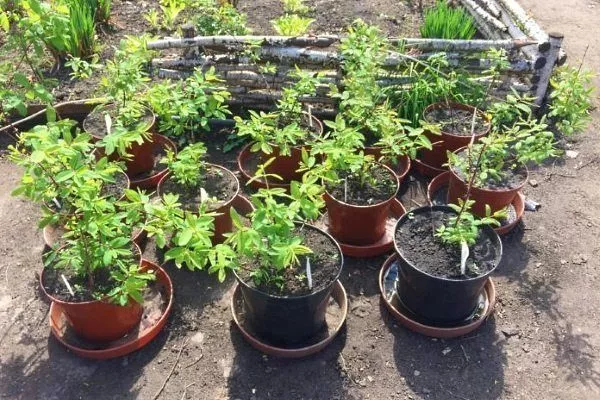
When purchasing potted plants, pay attention to the condition of the roots: they should be moderately intertwined with the root ball, not emit unpleasant odors, and look healthy.
Planting dates
The timing and time of planting are influenced by the condition of the root system of the seedling:
- Open root system. Plan your planting in the fall. The best time is a month before the expected frost. If you plant such bushes in the spring, the plant will spend all its energy growing leaves and shoots, but the root system will remain underdeveloped. The honeysuckle may become diseased or even die.
- Closed root system. Such seedlings can be planted at any convenient time of the year.
Selecting a site
Since the Blue Spindle honeysuckle bush will grow in one place for a long time, you should take a responsible approach to its selection.
Please adhere to the following rules:
- Landing site. Choose a sunny location, protected from the wind, for example, near the south wall of a house or other building.
- Groundwater. They should not be closer than 1 m from the surface to avoid damaging the root system.
- Presence of nutrients in the soil. If you're planting honeysuckle in poor soil, add nutrients to the planting hole. Dry branches or wood chips work well. As they decompose, they'll nourish the plant, and the decomposition process itself, accompanied by the release of heat, will warm the roots.
- A month before planting, add organic fertilizer to the soil to improve its structure and nutritional value.
- Check the soil pH, the optimal level for honeysuckle is 6.0-6.5.
- Provide good drainage, especially in clay soils, to prevent waterlogging.
Step-by-step instructions for planting a bush
Planting seedlings includes the following stages:
- Row markings. Divide the plot into rows if you need many plants. Leave 2 m between rows.
- Digging holes. Dig holes 40-50 cm wide and 40-50 cm deep (on clay soils, deeper to allow for 10-12 cm of drainage) at a distance of 1-1.2 m from each other in each row.
- Fertilizer. Place drainage material in the bottom of each hole, if necessary. Next, mix the soil with compost (1 bucket), ash (300 g), potassium sulfate (30 g), and superphosphate (100 g).
- Distribution of roots. Make a mound of fertilizer inside the hole. Spread the roots over the surface and water with a bucket's worth of water.
- Instillation. Cover the roots with soil, deepen the root collar by 5-7 cm.
- Tamping. Lightly compact the soil around the bush and pour in another bucket of water.
- Mulching. Apply a 5-7 cm layer of mulch to the planting area. Use a light mulch, such as fallen leaves, peat moss, compost, or sawdust. This will help retain moisture in the soil.
Seedlings with a closed root system are not planted deep when planting.
Care
Subsequent care of honeysuckle includes simple agricultural measures.
We recommend reading the article about How to care for honeysuckle in autumn.
Irrigation scheme
Blue Spindle Honeysuckle is a drought-resistant plant. However, with little rainfall, the berries become bitter. Therefore, in the driest regions or during dry springs and summers, pour 2-3 buckets of water under each bush every week.
Watering is important during flowering and fruit ripening.
When, how and what to feed?
Apply fertilizer 4 times per season:
- Spring. Apply the first fertilizer before the snow melts completely. Add 0.5 buckets of compost or humus mixed with mulch under each bush.
- During the period of bud formation. Pour 0.5-1 cup of wood ash under each plant.
- At the end of summer. After harvesting, when the buds for the next year are forming, in August, apply another ash fertilizer.
- During the period of growth cessation. In the fall, between September and November, make a 20 cm deep furrow around the bush. Add 1 tablespoon of superphosphate and cover with soil. Water the plant.
Pruning and shaping
During the first 2-3 years, the crown actively develops, and the plant grows in height. After this period, the apical buds die off and the lateral buds begin to grow vigorously. If pruning is not done in a timely manner, the bushes will become overly dense, which will negatively impact fruiting.
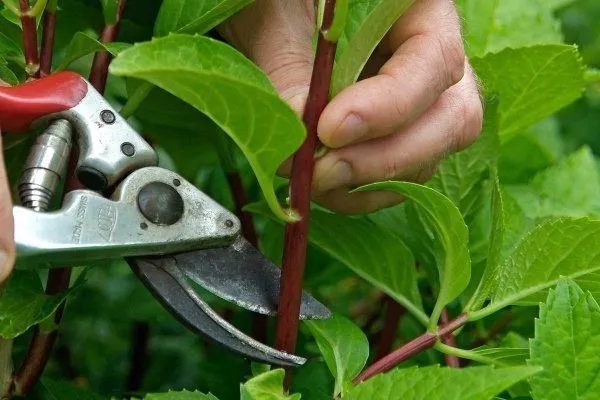
During the first 2-3 years of growth, the bushes do not require any pruning other than sanitary ones.
Carry out pruning to shape the bushes according to the following rules:
- Sanitary pruning. This is done as needed until the tree reaches six years of age, in the fall or early spring. Branches that grow inward and toward the ground, as well as broken or diseased ones, are pruned. For this purpose, skeletal branches are shortened by a third.
Crooked branches are cut and pulled out of the bush in sections. Pulling out a whole branch can damage the plant.
- Thinning. Do this no earlier than the 4th year of plant growth, in late autumn.
- For the purpose of replacement. This is done on older plants. Each year, several of the oldest branches are cut down to replace them with young shoots.
- Rejuvenation. The timing of this pruning is determined by the decline in the old bush's yield. Cut off all branches, leaving a stump 20-30 cm high. New shoots will grow from these stumps, thus resuming fruiting.
No more than 15 skeletal branches are left on each Blue Spindle bush.
Loosening
Since the root system of the Blue Spindle is not located far underground, loosening of the soil under the bushes is not carried out.
Loosening the soil can damage the shallow root system of Blue Spindle honeysuckle.
Place mulch of hay, straw or sawdust around the root collar to prevent the soil from drying out and cracking.
If the soil is still dry, poke it with a pitchfork in several places, and then lay down mulch.
Preparing for winter
Honeysuckle is a plant with a very high frost tolerance. It doesn't freeze even in the harshest winters, so it doesn't require any special preparation for winter.
Honeysuckle Blue Spindle overwinters without additional shelter.
Reproduction
The following methods are suitable for propagating honeysuckle at home:
- Cuttings from one-year-old shoots. To do this, young shoots are plucked from the mother plant, along with the heel. They are rooted in a greenhouse.
However, this method is difficult for a novice gardener because it requires certain skills and maintaining conditions, such as high humidity throughout the month. - Divisions of the bush. A part of the peripheral root system with young shoots is separated from the old bush.
- By layering. The young branch is covered with soil and waited for roots to appear at the bottom. After this, it is separated from the mother plant.
Propagating honeysuckle from seed is impossible. Almost all seedlings die. The few that survive will grow into wild plants that have lost their pedigree. Their berries will be inedible.
Diseases and pests
Many gardeners note the Blue Spindle variety's high resistance to diseases and pests. However, there are some pests that can attack the bushes.
Sometimes cracked and drooping bark is mistaken for a sign of disease, but this is the biological structure of honeysuckle bark.
Common diseases:
- Cladosporiosis or brown spot. The fungal disease first appears on the lower leaves, then spreads throughout the plant. Brown spots appear on the upper side of the leaf, between the veins. A gray, velvety coating forms on the underside of the spots.
- Megaloseptoria or blackening of branches. The fungus thrives in conditions of high humidity. As the buds develop, they turn black and die.
- Powdery mildew. A fungal infection. It manifests itself as the formation of whitish-gray, plaque-like spots, which eventually become oozing with fluid, resembling dewdrops.
- Tuberculosis. The disease is fungal in origin. The first symptoms appear on the underside of the leaf as red, bumpy spots. Later, the branches of the shrub are affected.
Diseases can be overcome using a 3-4% solution of Bordeaux mixture or the drug Skor.
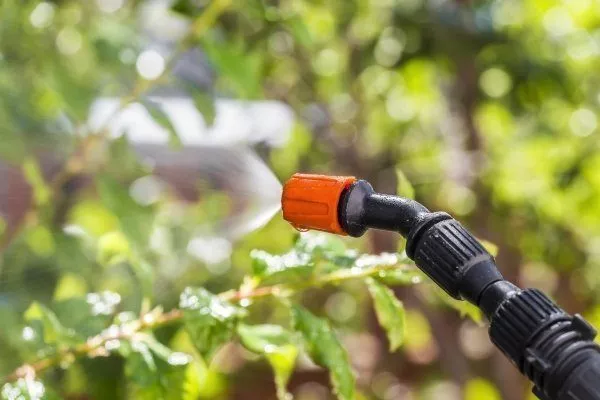
Honeysuckle berries are a favorite food source for honeysuckle berries. The following pest control products can be used:
- Confidor;
- Inta-vir;
- Decis;
- Actellic.
Preventive treatments against pests and diseases are not carried out.
Harvesting, processing
Ripe berries should be picked immediately. The stems weaken and the fruit doesn't stay on the branches for long, resulting in a loss of up to 15% of the harvest.
After the first berries ripen, harvest them every 2-3 days as they ripen. Be very careful when picking the berries, as the movement of the branches will cause other berries to fall.
Before you begin harvesting, lay a clean cloth or paper under the bush. Any berries that fall will remain on it.
Picked berries can be stored in the refrigerator for up to 5 days. Fresh berries are not particularly sweet, so they are eaten mashed with sugar.
In addition, Blue Spindle makes excellent:
- compotes;
- fruit drinks;
- jam;
- jam;
- dried berries;
- frozen berries.
Reviews
Every year it delights us with the earliest, largest berries. We eat them fresh and freeze them for the winter. The fruits just need to be picked on time, otherwise they fall off. The Amphora honeysuckle bush is used for pollination. I'm very happy with the plant and plan to grow several more.
It bloomed profusely in the spring, and there were plenty of berries in June. We picked them every two days. We tried freezing them and making jam. A big plus is that the plant is low-maintenance—just water it in hot weather and remove the weeds. I've never seen any diseases or pests.
Blue Spindle Honeysuckle is a low-maintenance plant, rarely susceptible to disease or pest damage, and overwinters well in severe frosts. The bush not only produces a consistently high yield but also makes a beautiful addition to any garden. Gardeners highly value this plant and enjoy planting it in their gardens.