
The Bakcharsky Velikan honeysuckle variety is the largest-fruited honeysuckle variety. While the yield isn't particularly high, many gardeners love growing it specifically for its large berries, calling them "blue miracles." The Bakcharsky Velikan yields tasty and juicy fruit, is easy to care for, and is resistant to many diseases. The bush bears fruit actively for 15 years or more.
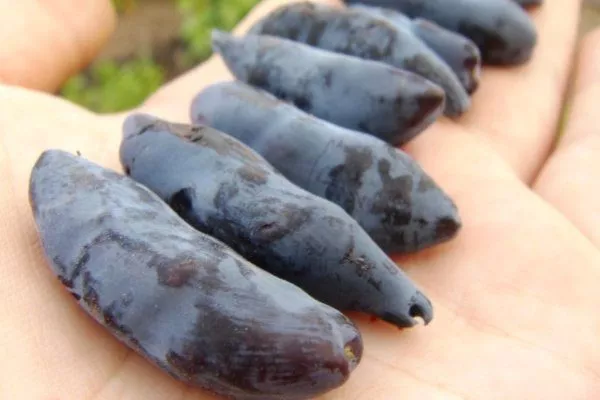
Honeysuckle variety "Bakcharsky Giant"
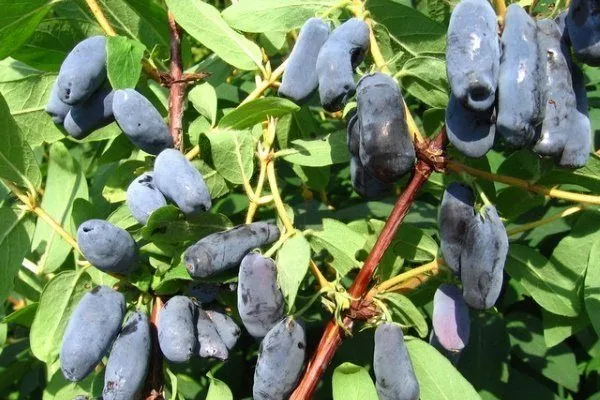
The Bakcharsky Giant variety can withstand temperatures down to -35 degrees Celsius.
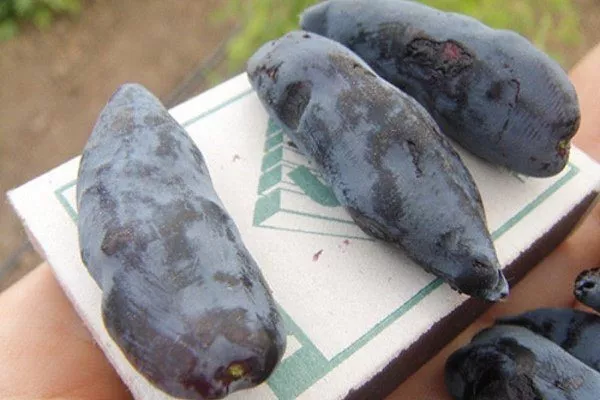
The distinctive feature of the honeysuckle "Bakcharsky Giant" is its large berries
History of the variety's development
The plant originates from the Federal State Unitary Enterprise "Bakcharskoye," located in a village in the Tomsk Region. Breeders: I.K. Gidzyuk, N.V. Savinkova, and A.P. Pavlov. This honeysuckle variety was developed specifically for winter cultivation. Gardeners recommend growing it in Siberia and temperate climates. The plant is not suitable for growing in southern regions.
Description of the variety
This variety is renowned for its mid-season ripening and large, tasty fruits. It grows into a vigorous shrub, reaching 2 meters in height. The crown is round with a slightly pointed tip. The branches are straight and thick, reaching 0.5 meters in length. The crown is heavily covered with large, matte green leaves.
The Bakcharsky Velikan honeysuckle produces large berries, each weighing approximately 1.8 g and reaching 5 cm in length. Some fruits can reach 2.5 g in weight. The berries are cylindrical with a waxy coating. The skin is blue. Sometimes, small hollow spaces can be seen underneath.
The pulp is juicy, and the seeds are barely noticeable. The flavor is piquant with a hint of sourness. A tasting session was held, and scientists awarded the Bakcharsky Velikan berries a score of 4.8 out of 5.0. This score deserves respect and pride for this domestically bred variety.
Honeysuckle can be eaten fresh, or frozen. The berries are used to make various preserves, such as compotes, juices, jams, liqueurs, and wines.
Productivity
The first harvest from this honeysuckle variety can be obtained in the third or fourth year after planting. The first berries delight gardeners in early summer, so the honeysuckle harvest appears much earlier than that of strawberries or raspberries.
A single bush can yield approximately 2-3 kg of fruit. Under favorable care and climate conditions, up to 4.5 kg can be harvested. Gardeners can obtain 8 to 15 tons of fruit per hectare.
Pollinators
| Name | Productivity | Frost resistance | Fruit size |
|---|---|---|---|
| In memory of Gidzyuk | 2.5 kg per bush | -35°C | 1.5 g |
| Pride of Bakchar | 3 kg per bush | -40°C | 1.8 g |
| Nymph | 2 kg per bush | -30°C | 1.2 g |
| Amphora | 2.8 kg per bush | -35°C | 1.6 g |
| Azure | 2.3 kg per bush | -30°C | 1.4 g |
Cross-pollination is essential for the Bakcharsky Velikan honeysuckle variety, as the flowers are not self-pollinating. To ensure a good harvest, other honeysuckle varieties should be planted near the Velikan variety. The best varieties for pollinating the Bakcharsky Velikan variety are:
- In memory of Gidzyuk.
- Pride of Bakchar.
- Nymph.
- Amphora.
- Azure.
Advantages and disadvantages of the variety
Gardeners' reviews claim that the positive aspects of this plant far outweigh the negatives. Let's take a closer look.
Advantages of honeysuckle Bakcharsky Giant:
- regular fruiting;
- large and tasty berries;
- piquant taste of fruits;
- the harvest can be collected quickly and easily because the branches are spaced apart;
- excellent resistance to fungal diseases;
- high frost resistance, in winter honeysuckle can withstand temperatures of about -35 degrees Celsius;
- The fruits can be transported from one place to another, the berries do not spoil, and their taste does not deteriorate.
Disadvantages of growing honeysuckle Bakcharsky Velikan:
- Ripe berries fall off. They must be picked immediately after full ripeness, otherwise the entire harvest will end up on the ground. Experienced gardeners quickly solve this problem by laying down plastic sheeting onto which the berries fall;
- Low yield. Because the berries are large, the bush cannot produce a large number of them.
Watch a review of the honeysuckle variety "Bakcharsky Velikan" in the video below:
Rules for growing honeysuckle Bakcharsky Giant
Growing this honeysuckle variety is not difficult. However, to ensure the plant thrives, it's important to follow basic planting guidelines.
Planting dates
Planting can be done in either spring or fall. The shrub produces buds quickly but is slow to root in the soil.
To ensure the successful development of the Bakcharsky Velikan honeysuckle, it's best to plant the seedling in the fall (September or October). Over the fall and winter, the plant will establish itself, become established, and grow stronger, and in early spring, it will delight the gardener with fruit buds and rapidly growing foliage.
Choosing a location
Honeysuckle 'Bakcharsky Velikan' doesn't tolerate strong winds, so it should be planted near various barriers. Honeysuckle doesn't tolerate high humidity; groundwater levels should be no higher than 1.5 meters above the water surface.
It is better to plant the shrub in elevated areas, since cold air and water accumulate in low-lying areas.
Selection of seedlings
An experienced gardener knows that when choosing a seedling, it's important to pay attention to the number of leaves on the plant. An excellent specimen, one that will easily establish itself in the garden and produce a bountiful harvest, has 4-5 leaves. Of course, seedlings should be purchased only from trusted sellers.
- ✓ The seedling must have at least 4-5 healthy leaves.
- ✓ The root system must be well developed, without signs of rot.
- ✓ Preference should be given to seedlings with a closed root system for better survival.
Soil and lighting
This variety prefers sunny locations, but the lower branches should be shaded. It should be planted in a group with other pollinator varieties. This way, the crown will be in the sun, while the basal branches are shaded.
- ✓ The soil should be neutral (pH 6.0-6.5).
- ✓ The distance between bushes is not less than 1.5-2 m.
- ✓ The lower branches should be in the shade, and the crown in the sun.
Honeysuckle isn't particularly picky about soil, but it produces a large harvest in fertile soil. Loamy soil is best. The soil should be neutral; if it's too acidic, add lime to the planting hole.
Step-by-step planting diagram
Before planting, seedlings are soaked in a growth stimulant, after which the following algorithm is followed:
- Clear the area of excess debris and organic matter.
- Sprinkle humus, rotted manure, peat, or compost onto the soil surface. Apply 10 kg of product per square meter.
- Dig up the area.
- Prepare 40x40 cm recesses.
- Place drainage at the bottom and add 50 g of superphosphate and potassium salt into the hole.
- Spread the roots of the plant and place them in the soil so that the root collar is above the ground.
- Fill the holes with soil and compact them lightly.
- Water the plants (5 liters per bush).
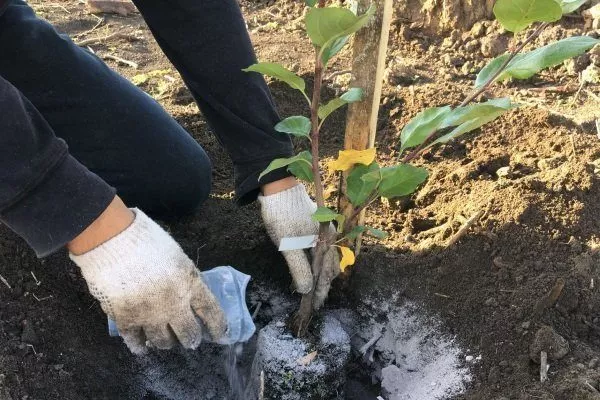
Don't forget to leave a distance of 1.5-2 m between seedlings, as the honeysuckle crown is wide and the root system is large.
Reproduction
The Bakcharsky Velikan variety can be propagated in several ways:
- By layering. In early summer, dig up the soil around the plant, but do this very carefully to avoid damaging the root system. Bend a couple of the lower branches down to the ground, cover with soil, and secure with wire. After a year, the branches will root and can be separated from the shrub.
- Cuttings. In late spring, cut a section of the first shoot with three buds. The size should be approximately 0.1-0.15 m. Soak the seedling in a growth medium and place it in a pot with soil. Use a plastic bottle to create an artificial greenhouse.
- With bones. This is the longest and most difficult part of growing honeysuckle. Collect the seeds from overripe berries, plant them in containers, cover them with snow, and wait for spring to arrive. When the weather warms up, cover the pots with plastic wrap and wait for the sprouts to emerge. Before planting, treat the seeds.
Caring for honeysuckle
The plant is undemanding in terms of care, but the high-quality appearance of the bush guarantees abundant fruiting.
We recommend reading the article about How to care for honeysuckle in autumn.
Watering
The bush is watered once or twice a week; each root requires 8-10 liters of water. If it's not enough, the berries will taste bitter. Overwatering will cause the root system to rot. Therefore, it's important to consider the climate conditions in your region.
If the weather is dry, increase the frequency of watering; if it's rainy, decrease it. In autumn, the shrub requires little or no watering. After watering, loosen the soil without damaging the roots.
Top dressing
This honeysuckle variety requires three fertilizations. In spring, nitrogen-containing fertilizers are used as the plant grows foliage. Ammonium nitrate can be used at 15 g per plant.
Nitrophoska (25 g per 5 liters of water) will help restore honeysuckle fruiting. If you don't have it, you can use phosphorus-potassium fertilizers. In the fall, add organic fertilizer. To do this, mix manure with water in a 1:4 ratio. One plant requires 10 liters of the mixture.
Trimming
Young seedlings don't need pruning; this won't help them, but rather harm them. The first pruning is done in the third year after planting.
Broken, old, and dried branches should be removed. Bent shoots should also be trimmed. The plant should have 10 to 15 branches remaining, depending on the age of the bush. The more sunlight that penetrates the center of the honeysuckle, the larger the fruit will be.
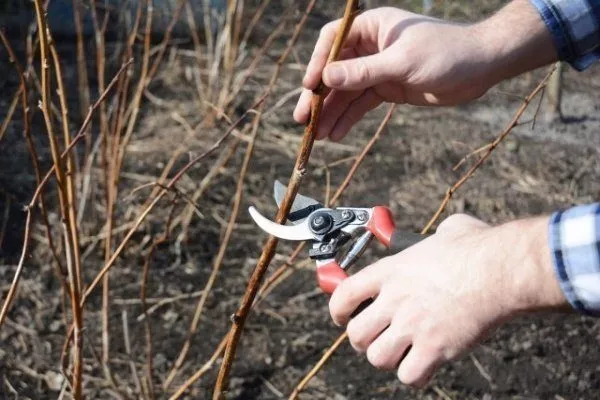
If the Bakcharsky Giant honeysuckle is already an old bush, then a rejuvenation procedure can be carried out; for this, all branches are removed at a level of 0.3-0.35 m.
Harvesting
The berries of the Bakcharsky Velikan honeysuckle fall very quickly, so they should be picked immediately after ripening. They peel easily from the stem, and the bush is wide, making harvesting easy.
Preparing for winter
This variety is native to Siberia, where it can withstand temperatures as low as -50 degrees Celsius. It doesn't require any covering. It shouldn't be planted in southern regions, as excessively warm winters can cause the plant to rebloom, which is unnecessary.
Diseases and pests
The Bakcharsky Giant is not susceptible to disease. However, the plant suffers from attacks by a variety of pests. Therefore, preventative measures such as spraying are necessary in the spring. Suitable products include Mavrik, Confidor, and Inta-Vir.
Gardeners' reviews of the Bakcharsky Giant
The second bush grows near the currant bush, so it's protected from the wind. It has no frozen branches, and the harvest was impressive – 2 kg of berries! It's a significant difference. Now I'm thinking about putting a fence around the first seedling, because I want to get the same delicious fruit from it.
The Bakcharsky Velikan variety is a godsend for many gardeners living in the Siberian region. It's cold-hardy and designed for growing in cold regions. To ensure a bountiful harvest, it requires regular care and adherence to all agricultural practices.