
Grapes are a fruit and berry crop that can grow in any region of the country. Depending on climate, plant health, or the gardener's preferences, they can be transplanted. However, this is stressful for a mature vine, so it's important to follow the proper guidelines when transplanting.
Is it possible to transplant grapes, and why do it?
Relocating grapes to a new location is not recommended. This procedure is recommended only in extreme cases. There may be several reasons:
- The location for the plant was initially chosen incorrectly. Light intensity, soil quality, and the absence of drafts are not taken into account. As a result, the plant either fails to bear fruit or becomes diseased.
- Varietal characteristics were not studied. For example, vigorous bushes are planted too close to each other.
- Negative influence of neighbors. Often, mature trees with a massive root system hinder the development of grapes.
- Redevelopment of a garden plot. In this case, it is better to reconsider your project than to subject the perennial to stress.
- ✓ Make sure that the soil temperature in the new location is +8 degrees for spring transplantation.
- ✓ Check the groundwater level - at least 1 m from the surface.
When replanting, every gardener needs to understand that there is a risk:
- destroy a plant by cutting its roots;
- changes in taste;
- disturbances in fruiting for 2-3 years;
- infection with dangerous diseases.
When is the best time to transplant grapes to a new location?
There are no universal dates for replanting grapes. People rely on the local climate. Autumn and spring are considered the optimal time to carry out the work. The time should coincide with the relative dormancy stages.
- ✓ For spring replanting, wait until the threat of frost has passed.
- ✓ Carry out autumn replanting only after the leaves have begun to fall, but before the first frost.
Timing and features of spring and summer migration
In spring, find a new location for the grape vine before the sap begins to flow and the buds begin to swell. Soil temperature is important, reaching 8°C (46°F). In the south, this occurs in March, and in central Russia, in April. Grapevines can be replanted in northern cities in May.
To speed up the plant's activation and establishment, water the hole with hot water. Afterwards, cover the above-ground portion with soil. This will slow the growth of branches and leaves, allowing time for the root system to recover.
Some gardeners are puzzled by the question: can grapes be replanted in June? This is a critical time. But everything depends on the heat. It's difficult for plants to adapt to life in new soil at high temperatures. Favorable conditions for summer replanting are found in the Leningrad Region and Karelia.
How to properly transplant in autumn?
Begin autumn repotting 1.5 to 2 weeks before the leaves fall. During this period, the upper part of the bush enters a dormant state, but the root system is still active, meaning the plant has a better chance of establishing itself before the first frost.
Favorable period:
- in the south – beginning of November;
- in the central part of the Russian Federation – from mid to late October;
- Siberia and the Urals – early October.
Don't ignore weather forecasts. There's a chance that colder temperatures will hit the region earlier than usual.
What do you need to know about the root system for proper replanting?
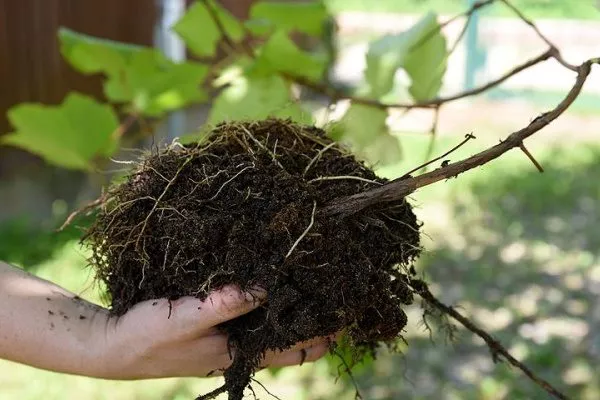
Grapevine root development begins immediately after planting a cutting or seed. During the first few years, roots develop and grow rapidly, but after six years, their growth rate slows. Therefore, soil composition and proper care are essential for a young vine.
The roots that make up a variety are divided into types:
- dew, located at a depth of 10-15 cm;
- middle, can have 1-2 tiers;
- calcaneal, growing from the lower node of the cutting and located most deeply.
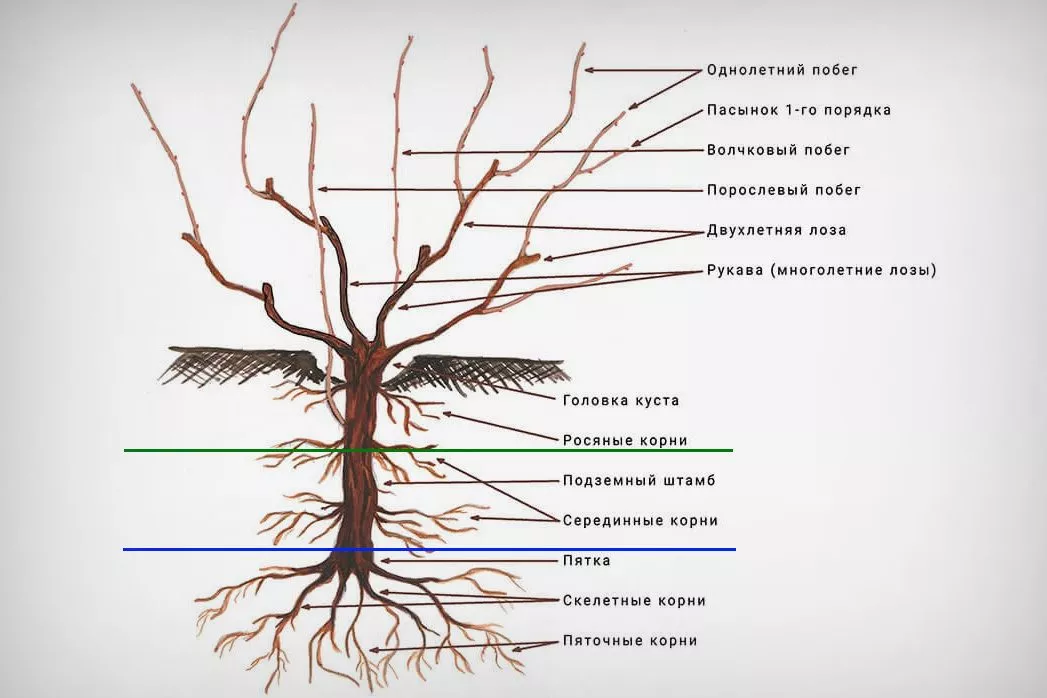
To repot a plant correctly, it's important to understand the root structure. Several zones are distinguished:
- active growth;
- absorption;
- conductive.
The second sector is responsible for nutrition. Maximum accumulation is observed in soil layers with more water, beneficial micronutrients, and aeration. During the growing season, absorption activity is observed at a depth of 30-60 cm. However, during drought periods, shifting is likely. Take this into account when changing locations.
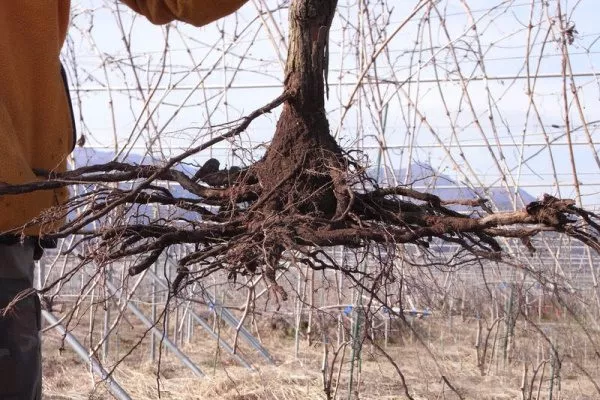
If the plant has been starved and thirsty throughout its life, its roots will be deep. Digging up the perennial will be difficult. You'll have to dig around the bush extensively and for a long time. There's a high risk of damaging parts of the root system and causing its death.
Basic methods of transplantation
There are several ways to transplant grapes. The choice depends on the plant's condition. It's important to consider the specifics of each method and follow the procedure.
Transshipment
This option is suitable for summer, when the crop is in the active growth phase. It's suitable for three-year-old grapes.
What to do:
- Cut off the above-ground part. Height – 20 cm.
- Dig up the bush to a depth of half a meter. Use a shovel to cut off the largest, deep-lying roots.
- Using the shoots, carefully pull the plant out of the ground. Transfer it to a tarp.
- Move to a new location.
- Plant a crop.
- Water generously, mulch the area around the trunk with dry grass, layer – 10 cm.
Also watch a video about how grape bushes are transshipped:
Transplantation with a cleaned root system
This method is suitable for mature bushes with a developed root system. Perform the procedure before the first frost, immediately after the leaves fall.
Step-by-step instructions for transplantation:
- Carefully clear the thick part of the trunk, located directly above the root, of soil.
- Remove old, deformed, and dead parts of the root system. Leave only one-year-old shoots. This rule applies to plants aged 5-7 years.
- At the top, cut off the immature shoots of the current year, leaving the strongest and most promising ones, shortening them by 3-4 buds.
- Dip the cuts in clay slurry or cover with garden pitch.
- Place the bush in a pre-prepared hole. Water.
Watch a video about replanting a perennial grape bush with a large root system:
Propagation by layering as a method of moving grapes
This technique is only useful when the plant needs to be moved a short distance from the parent plant. This means a new plant will grow in the new location, and the old one can be uprooted later.
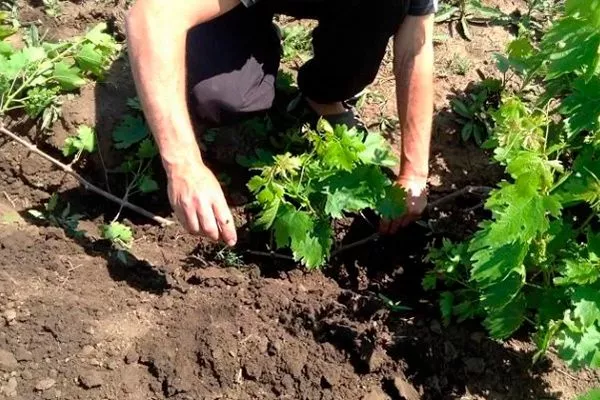
Execution algorithm:
- Dig a trench 20-30 cm from the trunk, about 50 cm deep, with the bottom at a 40-degree angle. The sides are vertical.
- Fill the ditch with soil and humus. The recommended rate is 10 kg per square meter.
- Remove all leaves from the selected shoot, leaving only the three outermost leaves with the growing point.
- Fix the branch to the bottom of the groove with special garden staples.
- Sprinkle the planting with soil.
- Pour in 20 liters of water.
- After the moisture has been absorbed, add more soil so that there is no hole left.
See also the video instructions on propagating grapes by layering:
Katavlak (grape cuttings from a whole bush)
This variation is similar to layering, but it takes more time. It's used for vineyard reconstruction and rejuvenation of perennial vines.
The work can be carried out in spring or fall; summer replanting is not recommended. It is noted that this type of relocation is the least traumatic for the plant.
What to do:
- Step back 0.6 m from the outermost plantings. Drive stakes into the ground. Stretch a string to guide the future row.
- Mark the planting areas along the string. The distance between roots should be 1.3-2 m, and between rows, 2 m.
- Dig a hole around the grapes measuring 60 by 80 cm.
- From the hole, dig a trench with a sloping bottom. The depth should be about 50 cm, reaching the center of the future bushes.
- Trim off any excess shoots from the mother plant. Place the plant in the hole and secure it in place.
- Pull the vine, left to root, into the trench. Bring the crown to the surface, where it is secured to a previously installed stake, trimming back to 3-4 buds.

- Fill the furrow and the planting hole with a specialized mineral mixture. Cover the tops of the shoots with soil.
- In spring, tie the formed fruiting link to the bottom horizontal of the installed trellis. Leave one fruiting shoot and a replacement branch on each branch.
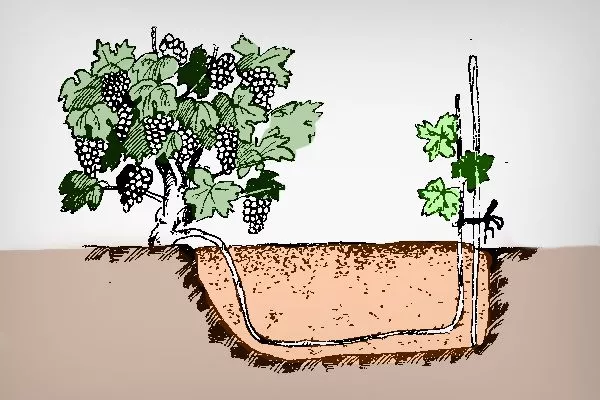
Watch a video tutorial on how to transplant young grapes without digging them up:
Transplantation by cuttings
Sometimes it's impractical to completely replant a grape bush, but you still want to preserve the variety. In such cases, you can resort to cuttings.
How to transplant grapes using cuttings:
- Choose a fall day and healthy shoots. They should be mature, with brown bark, green at the cut, and about 1 cm thick.
- Cut cuttings 30 to 70 cm long, making cuts at a distance of 3-4 cm from the bud, removing all foliage.
- Place the seedlings in a glass of water to germinate, after soaking them in a solution of Kornevin for 15 minutes.
- You can plant the future plant in the fall, in September, to give it time to take root. Or you can postpone the planting until spring.
Video instructions for planting grapes from cuttings:
Preparation for the procedure
Once the transplanting method has been determined, preparatory work can begin. This process affects both the soil and the planting material itself.
Choosing a location
Grapes thrive in warm conditions, so the location should be well-lit and protected from wind and drafts. The best option is to plant the vine on the south side of the plot. An important requirement is that the groundwater table be at least 1 meter below the soil surface.
Walls and fences provide additional support for comfortable growth, as they can reflect heat. However, this only applies to structures over 1 m tall. A mistake is to plant vines near a mesh fence. The shoots will entwine around it, and the planting will need to be untangled for the winter. There's a high risk of damaging the fragile plant.
Tall trees and dense shrubs are poor neighbors. They stunt the perennial's growth by robbing it of nutrients.
How to prepare a planting hole?
Prepare the planting hole one month before replanting. Otherwise, it will begin to settle and deepen the root system. Here's what to keep in mind:
- the dimensions depend on the size of the bush- the larger it is, the larger the hole you need;
- on light soils the depth can be 50-60 cm, on heavy soils – 70-80 cm;
- in cold regions the bush is placed deeper;
- When moving a large number of bushes, the distance between them is determined based on the growth strength of the bush: for compact varieties - 2 m, for vigorous varieties - 3 m;
- organic matter is placed at the bottom of the pit - 8 kg of humus.
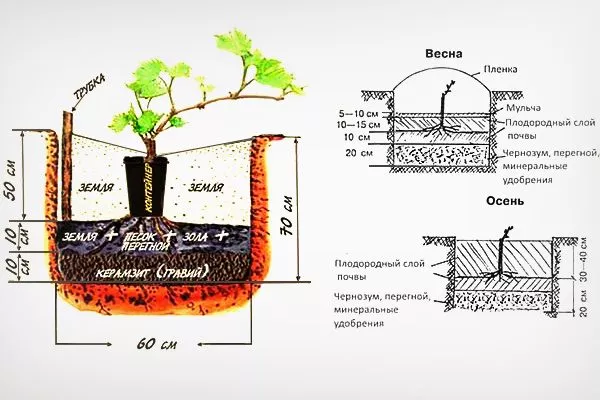
Preparing the grapevine
Before relocating, prepare the grapes. This procedure is only suitable for plants with a developed root system and a growth rate of 35 cm. Shorten the roots to 30 cm. Remove any diseased or dead parts.
You can soak the roots for 12 hours in Kornevin (1 g per 1 liter of water). This will help them adapt to the soil more quickly.
Features of transplanting grapes of different ages
The age of the grape plant influences the transplanting technique, as its development varies significantly. The specific factor is the depth of the trench around the bush. The root system of a fruit tree develops throughout its life.
Two-year-old
At this stage of development, the root system is already well developed. Dig around the bush at a distance of 30 cm from the main stem. The recommended depth is 50-60 cm. Before replanting, trim the shoots back to 2-3 buds.
Three-year-old
The roots of this grapevine grow to a depth of up to 90 cm, but most remain at a depth of up to 60 cm. The growing circumference is approximately 1 m. Dig around the bush at a distance of 50 cm from the base, and insert the spade to a depth of 80 cm. In this case, pruning is done to four buds.
Four- to five-year-old bushes
It's impossible to dig up the plant without damaging its roots. By the time it's five years old, they've grown 1 meter deep, but the main mass is around 60 cm deep. Dig around 50 cm from the trunk. Prune short, leaving six buds.
Old grapes
A crop grown in the same location for more than six years develops roots 1.5 meters deep. 75% of the system remains within a 60 cm radius. Grapes older than 20 years develop roots at a depth of 1.2 meters.
These indicators indicate that it is impossible to dig up the plant while preserving the roots. Most of the shoots will be damaged, meaning the perennial will not be able to establish itself in a new location.
In this case, it's better to use the katavlak method or layering. However, separating the seedling from the mother plant can only be done after two years. An alternative is to take cuttings and start growing a new plant.
Caring for grapes after transplanting
The essence of care after transplantation is to protect the plant from the negative influence of external factors and help it adapt to the new location.
Watering
Transplanted grapevines can be watered above or below ground. In June, the plant requires watering once a week. Starting in July, water once every two weeks. The last watering is done at the end of summer. Then, preparation for winter begins.
Watering this perennial is prohibited. There is a high risk of fungal infections. Avoid this type of care during flowering and ripening.
Top dressing
If fertilizer was added to the hole when replanting, the plant will not require additional feeding for the first two years after moving. Fertilizing should only be done if any micronutrient deficiencies are noted.
Frost protection
During the winter, grapes need to be covered. The procedure is as follows:
- Cut the vines back, leaving 6 to 8 buds.
- Place the plant branches in the dug trench and cover with spruce branches.
- Build a shelter from metal rods on top and stretch non-woven material over the structure.
Video instructions for covering grapes for winter:
Pest and disease control
Any grape variety can be affected by diseases or pests. The plant requires treatment during the dormant period—immediately after the snow melts. During the growing season, treat the bushes with a fungicide or 1% Bordeaux mixture.
To combat pests, purchase specialized pest control products from gardening stores. When treating transplanted grapes, it's important not only to adhere to the prescribed dosage, but also to reduce the dose by approximately one-half.
Secrets to helping grapes thrive in a new location
A transplanted grape bush will establish itself more quickly if a handful of barley seeds is added to the roots. Poor soils can be fertilized with iron. Some experienced gardeners bury a few rusty nails in the soil near the main stem.
Watering can disrupt the adaptation process. If the bush is spreading but weak, there's a high risk of it leaning over, damaging the shoots. Therefore, it's a good idea to immediately install a piece of pipe around the edge of the planting hole.
Mistakes when transplanting grapes
If the plant is well-cared for, but the grapes are struggling to grow, it's likely that errors were made during the transplanting process. The most common mistakes made by novice gardeners are:
- Late moving in spring. The crop did not have enough time to take root before the air temperature began to rise.
- Early transplantation in spring. It is likely that the soil has not yet warmed up and the roots died in the cold.
- The pruning was done incorrectly. Having lost its heel roots, an adult bush cannot restore them and receive adequate nutrition, and therefore cannot develop.
Transplanting grapevines is a procedure every gardener can face. Most often, the cause lies with the person themselves—the initial location was poorly chosen, resulting in the plant becoming ill, bearing little fruit, or being stunted by the proximity of larger trees. The relocation process is a delicate one, carried out according to many rules.