
The Severny grape variety is designed for cultivation in harsh climates. It is divided into four main subvarieties, all of which originated from the Severny variety. It is a table grape variety characterized by high yields, robustness, and early ripening—a combined temperature of 2500 degrees Celsius is sufficient to reach technical maturity.
Origin of the Severny grape variety
Severny is not an independent grape variety, but a hybrid developed by breeder Ya. I. Potapenko at the All-Russian Research Institute of Viticulture and Winemaking. Another specialist, E. I. Zakharova, also participated in the selection process. The goal of the work was to achieve maximum frost resistance in the grapes, so that residents of the central and northern regions could enjoy their berries during the season.
Characteristics of the variety
The Severny grape is considered very frost-resistant and has many positive qualities, which is why other varieties have continued to be hybridized from it.
Taste characteristics
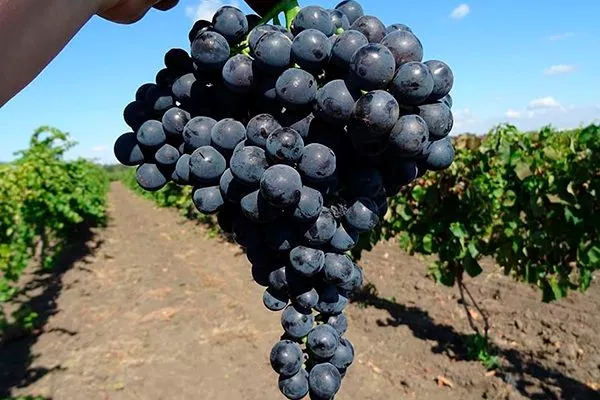
The berries are more sweet than sour, with sugar content ranging from 19 to 25% and acidity from 6 to 11%. These values are influenced by weather and climate conditions, as well as the timing of the harvest—the longer the bunches hang on the vine, the sweeter they become.
Ripening period
The harvest period should be 110-115 days from the start of bud swelling. This is especially important for regions with cool and cold climates, as summers there are typically short. If you grow grapes in the Moscow region and the south, you can harvest bunches of ripe berries after just 90 days.
Bush
The shoots of the Northern vine are quite long—the bush can reach 200 cm in height, sometimes more. This characteristic necessitates the installation of a trellis or other structure to support the vines. At the beginning of growth, they are flexible, so they can be shaped in any direction—horizontal, vertical, fan-shaped, arched, etc.—which is an undeniable advantage.
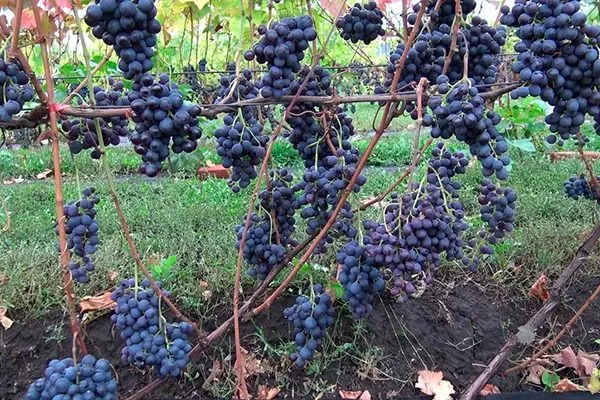
The leaves are dissected, a standard green shade, and medium in size. The surface is wrinkled and reticulate, the foliage is trilobate, and the underside is sparsely bristled.
Clusters and berries
The Severny variety is easy to recognize by its external characteristics:
- Clusters. They are medium-sized and cone-shaped. They are characterized by a loose density and winged appearance. Each bunch weighs 100-120 g.
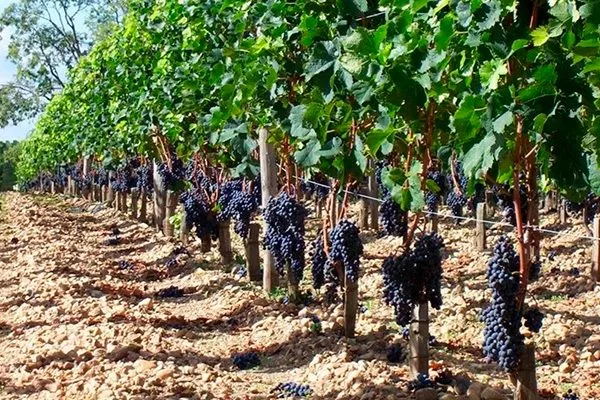
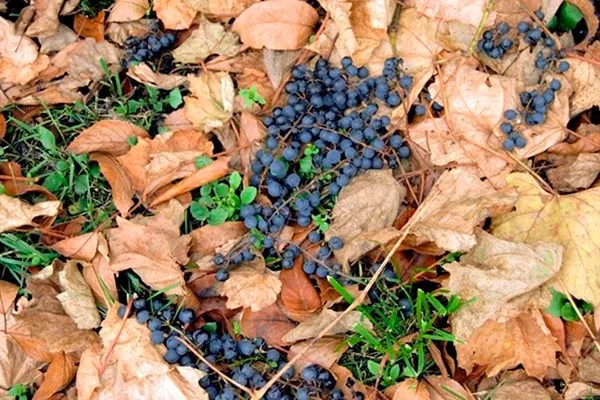
- Berries. They are quite large, with a strong, elastic skin that doesn't crack under the influence of precipitation. The flesh is juicy, round, and dark blue.
Productivity and fruiting
The yield is high – a single bush can yield 8-10 buckets of fruit, equivalent to 70 to 90 centners per hectare. Fruiting begins in the third year, but peaks at five years of age.
Properties and uses of grapes
As a table variety, Severny possesses a wealth of nutritional properties. The berries contain vitamins and various microelements. It is used in a variety of ways:
- for making homemade wine and juice;
- cooking compote;
- fresh consumption;
- for desserts.
Climate, growing region
The Severny variety is suitable for planting in absolutely any region of Russia, but it was originally adapted to harsh climates. The most delicious berries can be found in the northern regions and central Russia, where exposure to the scorching sun is avoided.
Frost resistance, winter hardiness
A distinctive feature is its high level of frost resistance, as the bushes do not freeze at temperatures as low as -30 degrees Celsius. According to some sources, shoots are not damaged even at -45 degrees Celsius.
Winter hardiness, which is defined as a plant's ability to survive sudden temperature changes, is weak. Exposure to recurrent frosts should be avoided.
Immediately after the weather warms, grape sap begins to flow and buds begin to open, and if a sudden frost occurs, frost damage will occur. To prevent this from happening during the fall and winter, it's important to properly prepare the plants for winter.
Resistance to diseases and pests
The variety has a good immune system, making it resistant to pests and many diseases, but not fungal ones. Severny is sensitive to these.
Pollination, flowering period
The bushes require pollinators such as early-ripening grapes or insects, as the variety produces only female flowers. If natural pollinators are unavailable, artificial pollination methods will have to be used.
Other types of the Severny grape variety
| Name | Frost resistance | Ripening period | Productivity |
|---|---|---|---|
| Northern sweet | High | Average | High |
| Northern Saperavi | High | Early | Average |
| White Northern | High | Early | High |
| Northern shoulder | High | Average | Very high |
Other identical varieties were bred from the Severny grape by crossing it with other grapes:
- Northern sweet. It's considered the most popular due to its exceptional sweetness, but its ripening period is average (at least 130 days). The large berries are dark blue with a matte finish, conical in shape, and weigh up to 2 g per berry, with clusters weighing around 110 g. The plant requires shaping, as the shoots grow rapidly.

- Northern Saperavi. This is an unusual blue-violet grape variety whose flavor is directly dependent on the location and weather. The hybrid was created using Severny Sladki (Northern Sweet) and Saperavi, resulting in a frost-resistant variety.
The clusters are large and conical, weighing around 200 g each, with a bloomy surface. A distinctive feature is the bisexual flowers, meaning the plant does not require pollinators. The berries weigh 1.2-1.5 g, and have a harmonious sweet-tart flavor.
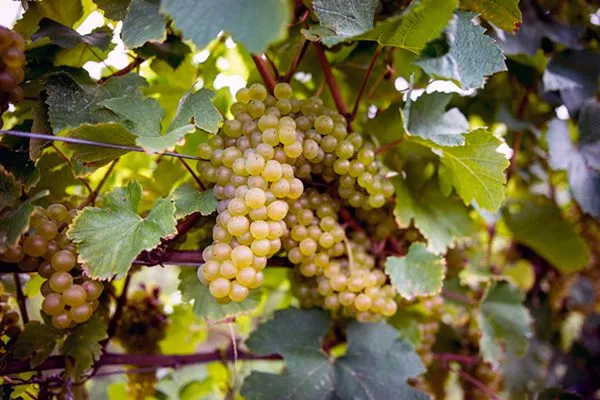
- White northern. This hybrid is characterized not only by excellent frost resistance but also by a strong immune system. It features white skin and a high sugar content in its juicy flesh. The large berries have a matte surface, and the clusters are medium-dense.
- Northern shoulder blade. Characterized by very large clusters, weighing between 350 and 700 g, the berries are round, blue-skinned, and weigh just over 2 g. The clusters are loose, but the berries hold together firmly. The variety has a moderate immunity, so preventative treatments are important.
Peculiarities of planting grapes in the northern regions
Growing conditions for Northern grapes in the south and in harsher climates vary significantly, so carefully review all the details before planting:
- Soil. It's prepared in the fall—this is important for northern regions, as the soil will have time to absorb the necessary moisture, settle, and compact over the winter. If this frost-resistant variety is planted in the south, it can be done before planting in the fall. Manure or compost must be added at a rate of 10 kg per square meter.
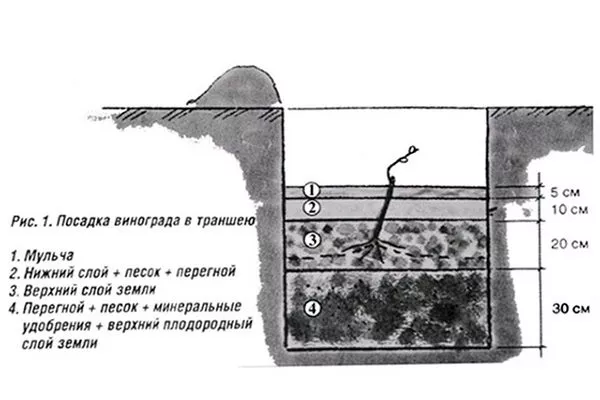
- Planting in a hole (trench). This technique is effective in regions with deep groundwater or snowless winters. It's not suitable for harsh climates, as the root system won't have time to warm up fully during the short, warm days, which will slow down the plant's growth.
If this option is chosen, then you need to prepare the substrate and properly fill the hole:- bottom layer – drainage;
- on top - in equal proportions the top layer of soil, sand, humus and any mineral complex;
- then a layer of top soil is laid;
- followed by humus with sand and the bottom layer of soil;
- the last tier is mulch.
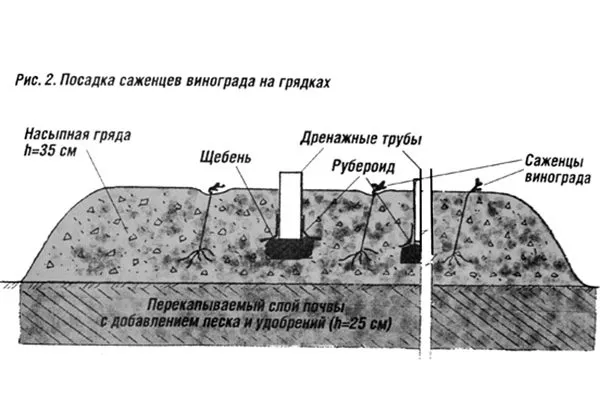
- Planting on ridges. It's used in the northern parts of the country, as the elevated elevation warms the entire root system and the bush grows faster. This technique is also used in areas with high groundwater levels. To do this, follow these steps:
- Dig up the area and add fertilizer;
- Place a fertile mixture of equal parts loamy soil and humus and 0.5 parts sand and gravel on the surface of the soil (height 1.5-2 cm);
- insert a pipe with drainage holes into the center of the embankment;
- Plant seedlings on the sides.
- Where to place a vineyard. If planted in northern climates, grapes require full sun; in the south, on the contrary, they require partial shade in the afternoon. It's important to avoid drafts.
- ✓ The seedling planting depth should be at least 50 cm to protect the root system from frost.
- ✓ The distance between bushes should be 2-2.5 m to ensure sufficient feeding area.
Features of cultivation
To get decent harvests, pay attention to the following care procedures:
- Watering. Young bushes are watered once a week until pea-sized berries form, then watered as needed. Mature plants require less frequent watering—about once a month.
- Fertilizing the soil. It is applied several times per season according to a standard scheme: nitrogen in the spring, mineral complexes during flowering and berry formation, and potassium to a greater extent in the fall.
- Trimming. The Northern rhododendron doesn't require frequent shaping or pruning. In spring and fall, sanitation procedures are carried out, and when young, shoots are pruned so that the plant has only 3-4 branches.
- Diseases and pests. To prevent these problems, spray your plants with insecticides and fungicides starting in early spring. You can use a 1% Bordeaux mixture, which is considered a universal preventative.
- Preparing for winter. Despite their frost resistance, grapes need to be prepared for winter. The procedure is simple: water the plants, prune the shoots, fertilize, hill them up to a height of 20 cm, and apply mulch.
If frosts below -30 degrees are expected, wrap the bushes in non-woven material, and when snow falls, sprinkle the plants with it.
Pros and cons of the variety
The Severny grape variety has the following positive characteristics:
Disadvantages include poor resistance to fungal diseases.
Harvesting and storage
When removing bunches from the fruit, use sharp pruning shears—do not pluck the bunches by hand or twist them. Store the bunches in wooden boxes, laying them in a single layer. Line the bottom and top with paper. Ideal storage conditions are a room with a temperature between 0 and 4°C (32°F and 4°F).
Reviews
The Severny grape variety is intended for cultivation in harsh climates. It is characterized by high yields but weak disease resistance. The variety is easy to care for, but it is important to strictly adhere to standard agricultural practices.