
Grafting grapes is an agronomic practice that achieves several goals simultaneously. To ensure a healthy and productive vineyard, learn how to graft grape vines. Let's learn about the different grafting methods, how to perform them, and why they are needed.
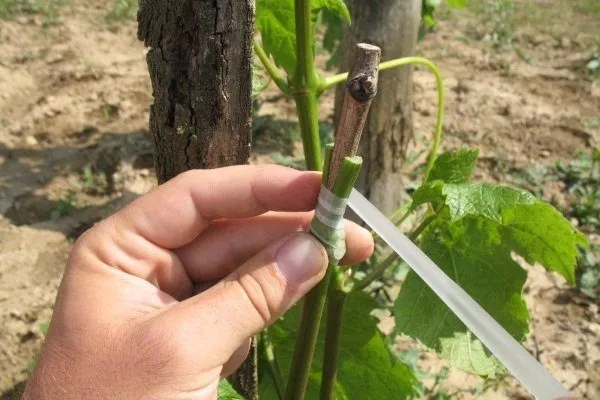
Features of grape grafting
To graft grapes, you will need:
- Scion. This is a bud or cutting grafted onto a rootstock. The berry's varietal quality and yield depend on the scion.
- Rootstock. This is the base onto which the scion is grafted. The rootstock determines how frost-hardy and vigorous the grapevine will be. It also influences certain fruit characteristics and the plant's immunity. The purpose of the rootstock is to provide nutrition and growth.
- ✓ The rootstock must not only be frost-resistant, but also resistant to diseases specific to your region, such as mildew and oidium.
- ✓ The scion should be selected not only based on varietal qualities, but also on compatibility with the rootstock, taking into account the rate of growth and development.
The most important thing a gardener should understand when starting grafting is that not all scions take root on rootstocks. Some varieties are incompatible. However, incompatibility (affinity) is usually determined through experimentation.
There are different types of vaccinations:
- Green ones. These include procedures carried out from spring to autumn, from leaf emergence to leaf fall. Types of green grafting:
- in the standard;
- to the root;
- green to green;
- black on black;
- black to green.
- Tabletop. They are carried out in winter, artificially breaking the dormancy of the cuttings. This is done so that the already established graft can be planted in the ground in the spring.
Pros and cons of the procedure
By grafting grape bushes, gardeners receive several benefits at once:
- Grapes grafted onto rootstock develop a strong immunity to phylloxera, a dangerous pest of grapes.
- The ability to quickly grow a maximum of grape varieties and hybrids in a limited space. No need to dig up old bushes and plant new ones, resulting in a faster harvest.
- In poorly fruiting bushes, the yield increases after grafting.
- If a bush has completely lost its shoots – due to frost, damping off, or damage by rodents – it can be restored within a few seasons.
- Grafting is used to quickly propagate hard-to-reach and valuable varieties.
- The use of frost-resistant rootstocks increases the variety's resistance to frost.
- Demanding varieties become more tolerant of adverse conditions. Grafted onto a stable and resilient rootstock, these demanding varieties can thrive in acidic, calcareous soils, as well as in areas with high groundwater levels.
- By grafting varietal cuttings onto the rootstock of an early and fast-ripening variety, fruit ripening is accelerated. This is especially beneficial in areas with short summers.
- Several varieties can be grafted onto a single rootstock, creating family bushes. This is both cost-effective and decorative.
- Combining rootstock and scion varieties influences the characteristics of the fruit – size and taste.
The root system is the most valuable asset of old grape vines. It's not advisable to uproot them—they can serve as a foundation for growing other varieties.
Preparation and storage of scion
To obtain high-quality scions, cuttings (saplings) are prepared in the fall. These cuttings are prepared in October-November, before the onset of frost. For a successful graft, the cuttings must be perfectly straight. Before performing the procedure, it's a good idea to practice by cutting off unwanted branches.
Do not use the upper part of the shoots – about 30 cm – as cuttings. Also avoid fat, damaged, immature, crooked and thin shoots.
Cutting parameters:
- The shoot diameter is not less than 8 mm.
- The minimum number of eyes is 2-3 pieces.
- Average length: 9-12 cm.
- The runner—the shoot that holds the grapevine to its support—should fall off at the lower node. The node is where leaves, inflorescences, buds, and runners are located. A fallen runner indicates the maturity of the cutting and increases its chances of survival. A well-developed, woody node should be selected.
- If you plan to graft several scions onto one root at the same time, they must have the same cross-section.
For harvesting scions, only healthy bushes that have been bearing fruit for at least 3 years are used.
The prepared cuttings must be properly prepared for storage:
- Disinfect by dipping in 3% copper sulfate for 30 seconds.
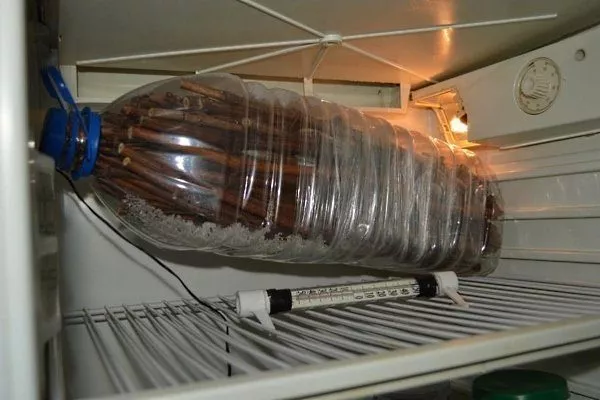
- Once dried, the cuttings are wrapped in plastic or a wet cotton cloth and stored. This can be done on the bottom shelf of the refrigerator or in a cellar. In the latter, they can be stored in boxes filled with sand or sawdust. The optimal storage temperature is -2 to +2°C.
Selection and preparation of rootstock
It's best not to use very old bushes as rootstocks. The best option is plants between 3 and 5 years old. Scions take root better on these bushes.
Characteristics of a good rootstock:
- high frost resistance;
- vigorous bushes;
- disease resistance;
- well-developed underground trunk.
The rootstock is also prepared for grafting, from spring to fall. A few days before the procedure, the bush is fertilized. Foliar feeding is used. Preference is given to fertilizers containing potassium and phosphorus. Many gardeners feed the vines with honey, spreading it on the branches a few days before pruning.
A week before the vaccination, it is also necessary:
- Cut off young shoots, tendrils and leaves on the rootstock growing from the bottom to the place of the future graft.
- Water generously the bush that will serve as the rootstock.
Methods of grafting
There are several methods of grafting. There's nothing complicated about the procedure. The main thing is to learn the technique and follow it precisely. All the methods discussed below ensure high survival rates.
In the standard
The advantage of this method is that two different varieties can be grafted onto a single rootstock simultaneously. Each cutting should have at least three buds. The grafting procedure is as follows:
- Dig the trunk to a depth of 30 cm. The hole width is 50 cm. Having determined the grafting site, make a cut in it – perpendicular to the trunk.
- Clean the cut with a knife, removing any rough edges.
- Use a rag to remove old bark, dirt and sawdust.
- Split the trunk along the largest diameter of the cut. The split depth is 2-3 cm. Insert a wedge, such as a screwdriver, into the split.
- Prepare the scions by making conical cuts 2.5 cm long on the cuttings. Make the cuts 5-7 cm below the lowest bud.
- Place the cuttings in water. Then dip them in a growth stimulant (humiam or another) for 7 seconds.
- Insert the cuttings into the trunk so that their outer parts align. The lower bud should face outward.
- Remove the wedge and seal the space between the scion and rootstock with paper. Place plastic film on top and tie the trunk with it.
- Coat the trunk with clay, leaving the scions untouched. This will protect the trunk and graft from the cold during the winter.
- Cover the grafting site with soil and cover it with a cut plastic bottle.
See how to graft grapes onto a bush trunk:
Into the cleft
The "black-on-black" method is typically used for grafting in March-April. The scion is taken from a thick branch with dark bark. The bark is cut 5 cm from the node. Procedure:
- A couple of days before grafting, remove the cuttings from storage. Sharpen the bottom end to a height of 3-4 cm. Soak them in a stimulating solution.
- Dig around the trunk of the bush and remove the bark.
- Make a 3-4 cm deep longitudinal cut down the center of the trunk. The cutting tool should be sharp.
- Insert two cuttings into the cleft from opposite sides. Secure the graft with string and seal with clay mortar.
- Treat the grafting site with garden pitch. Sprinkle sawdust on top, then soil.
Half-split
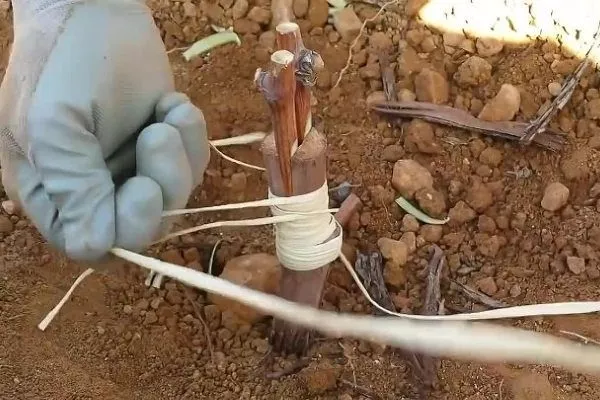
This method is similar to the previous one. The difference is in the number of scions grafted. Cleft grafting is performed using the "two scions per rootstock" pattern, while half-cleft grafting follows the "one scion per rootstock" pattern. Grafting is performed in March-April.
Drilling
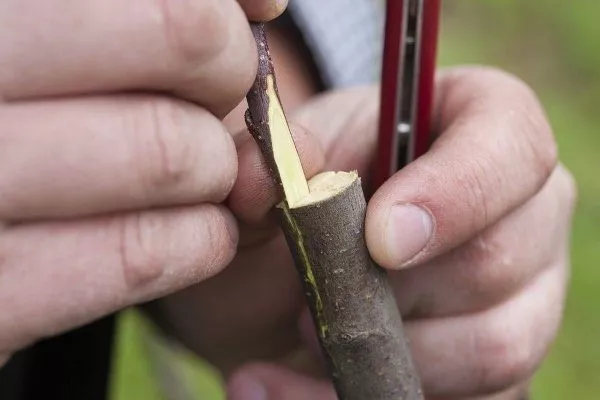
Drill grafting is even simpler than cleft grafting. This method has a high survival rate for the scions. The grafting procedure is as follows:
- Remove the cuttings from the cellar. Wrap them in a damp cloth. Let them sit at room temperature.
- Strip the ends of the cuttings of 0.5 cm of bark.
- Find a drill bit the same diameter as the scion. Disinfect it in potassium permanganate.
- Drill a hole 4-5 cm deep in the center of the trunk.
- Insert the scion into the hole. Seal the graft with clay solution.
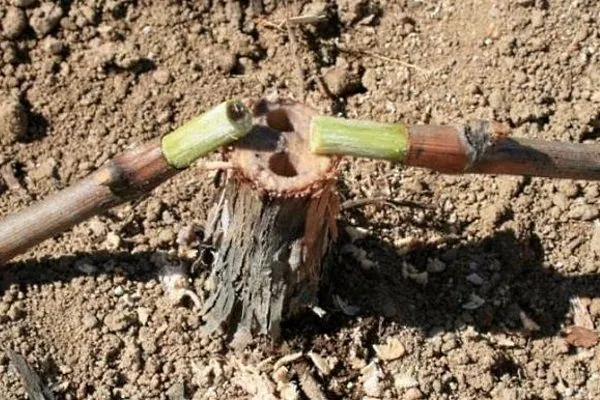
To increase the chance of survival, graft several cuttings onto one trunk by drilling.
Copulation
For direct propagation, select cuttings of the same diameter and soak them in water for two days. Here's how:
- Make a diagonal cut on the rootstock. The length of the cut should be twice the trunk diameter.
- Make a cut on the scion that is the same size as the cut on the rootstock.
- Join the scion and rootstock with cuts. Tie the graft with garden pitch.
- Cover the graft with loose soil. If the graft is done correctly, sap will appear on the top after a while.
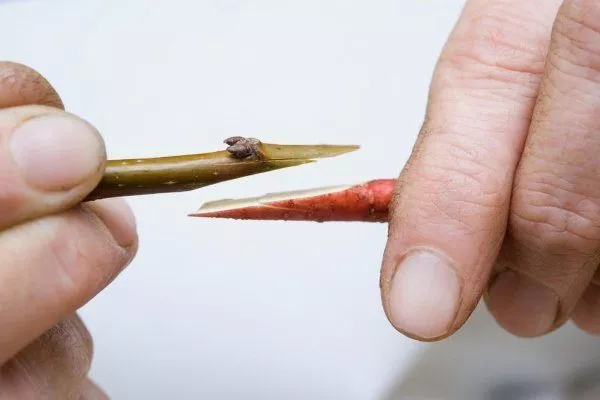
Sap is a liquid that is released from damaged wood.
Budding in the butt
This is the best method for spring grafting. It ensures a high survival rate. It is especially suitable for areas with high humidity.
The order of grafting into the butt:
- Remove side shoots and leaves from the vine on the rootstock.
- Make the wedge of the cutting pointed and tetrahedral.
- On the rootstock, make angular cuts on the sides of the trunk that match the size of the scion wedges.
- Place the wedge of the scion onto the cut on the rootstock, tie it with twine and treat with garden pitch.
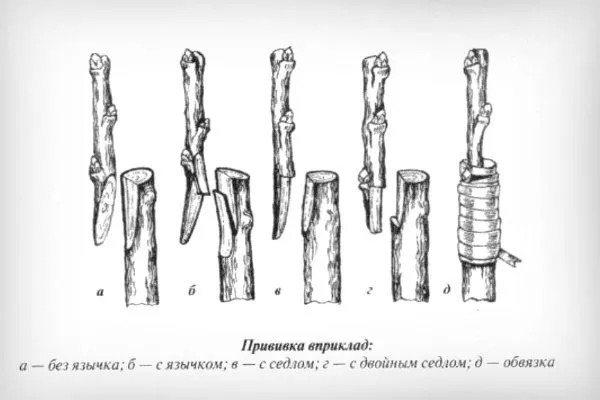
Grafting is performed from late May to early July. Woody cuttings are grafted in the spring, and green cuttings in the summer.
Right on target
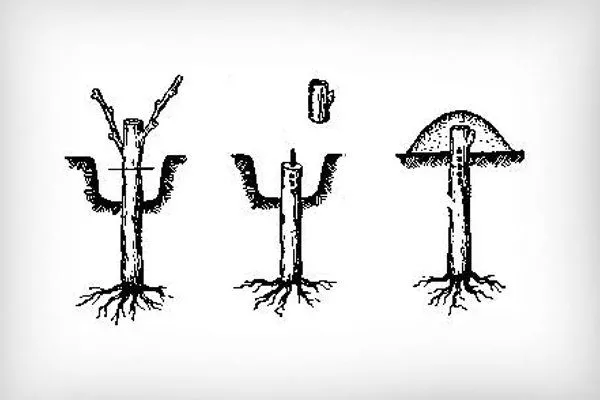
This is an underground graft that is very easy to do in the spring:
- Dig up the rootstock to a depth of 10 cm. Remove soil from the rootstock.
- Cut the trunk at a depth of 5 cm. Select the rootstock and the rootstock so that they are perfectly straight and of the same diameter.
- Insert a thin wooden pin into the center of the rootstock, perpendicular to the ground. Place the scion on top of it—this will secure the scion and rootstock together.
- Wrap the grafting site with cotton wool soaked in potassium permanganate, and then with paper.
- Fill the hole with wet sawdust and cover it with plastic wrap or a bag.
On the old bush
Grafting onto an existing bush allows for an earlier harvest than if a young seedling were planted. A grafted bush begins to bear fruit within 1-2 years. It's best to take cuttings in the fall. Any variety can be grafted this way.
The procedure for grafting onto an old bush:
- Dig a hole 20 cm deep near the rootstock. Remove all above-ground parts of the tree. You can graft one to four scions onto the remaining rootstock.
- Sharpen the cuttings into a wedge shape. The sides are 2 cm long and the sharpening angle is 20-30 degrees.
- Split the trunk with a knife 3 cm deep. Insert the scions along the edges. To graft 4 scions, the trunk diameter should be at least 7 cm. For this number of scions, make 2 splits. Insert 2 scions into each split.
- Tighten the grafting site. Fill the hole near the rootstock with soil and water thoroughly.
To the root
A skeletal root graft is chosen when the underground trunk is very short and it is impossible to make a good cleft. The skeletal root of the trunk serves as the rootstock. It is separated from the trunk and secured by tying it to a small support. The scion can be grafted into the root using any of the methods described above—cleft, semi-cleft, and others.
Re-grafting
Inexperienced gardeners, dissatisfied with the taste of their grapes, dig up the bush and plant a new sapling in its place. But this approach is impractical. It's easier to regraft the bush if it's strong and healthy. Then, a harvest will be ready in the third year after grafting.
Re-grafting is done in early spring or late autumn, completely removing the above-ground portion of the bush. The cutting is cleft-grafted or "black-to-green."
Below is a video about grape grafting:
Conditions for good survival
The main conditions for successful engraftment:
- Tight contact between the cuts of the rootstock and scion.
- The cambial layers between the wood and the bark must match exactly.
- Maintaining the moisture content of prepared cuttings. Preventing them from freezing or spoiling from overwatering.
- ✓ The air temperature during grafting should be no lower than +10°C and no higher than +25°C for optimal fusion.
- ✓ Air humidity should be high, but without direct water contact with the grafting site.
Vaccination at different times of the year
The time of year affects not only the survival rate of the scion but also the choice of grafting method. Grafting can be done in any season, even in winter. However, different methods are used.
Spring
Winegrowers prefer to graft grapevines in the spring. The grafting period is April to early May. They focus not so much on dates as on temperature and the condition of the vines. Grafting begins after the sap begins to flow—this is when the survival rate is highest.
Peculiarities of grafting in spring:
- it is protected from the sun and frost if the scion begins to grow earlier than the rootstock;
- To activate sap flow, the bushes are watered generously a few days before grafting.
In the spring, a procedure called "black-to-black" is performed. Both parts—the scion and the rootstock—are in the early stages of budding.
Grafting is done using cuttings prepared in the fall. This method is used to graft individual shoots of the bush and mature rootstocks.
The following video explains and demonstrates how to graft grapes in the spring:
Summer
In summer, grapevines are grafted in June or July. The advantage of summer grafting is the ability to take cuttings just before the procedure. Grafting can be done using either the green-on-green or black-on-green method.
Conditions for vaccination:
- cloudy weather;
- temperature up to +25°C;
- no precipitation;
- before 10 am and after 6 pm.
Green-on-green grafting is used in the summer. It requires no advance preparation of the rootstock. Cuttings are directly grafted onto the rootstock, most often by copulation.
In summer, you can also graft cuttings prepared in the fall. A new cut is made, which should be lower than the lower bud. The cuttings have been dormant for a long time, so they are activated by soaking them in an Epin solution for 15 minutes.
The rootstock is prepared by making one cut on the shoot and a second cut in the middle of the first. The scion is inserted into the cut, with the buds of the scion and rootstock facing in opposite directions. The graft is secured. A similar technique is used for "green-on-green" grafting—except that in this case, soaking the scion is not necessary.
Autumn
In the fall, grapevines are usually grafted onto old roots using one of two methods: cleft grafting or rootstock grafting. This approach allows for the revitalization of old vines, increasing yields, and harvesting within a year.
Conditions for grafting and its specific features in autumn:
- Temperature not less than +15°C. Grafting period: October-November.
- The bunches are fully collected, the leaves should turn yellow.
- The cuttings are kept in a growth stimulator for 2 days before the procedure, and then grafted using any suitable method.
Winter
Tabletop grafting is performed in January-March. One- or two-year-old bushes are used. Scions for scion are prepared in the fall using the usual method. Winter grafting procedure:
- In late autumn, when all the leaves have fallen from the bush, dig up the entire bush. Trim it back, leaving a 10 cm (4 in) trunk.
- Disinfect the cut in a weak solution of potassium permanganate.
- Place the rootstock in a box filled with wet sand. Sprinkle with sawdust and store in a cellar at below freezing.
- The day before the procedure, remove the rootstock from the cellar. Clean and inspect the roots, trimming any damaged ones completely and healthy ones to 15 cm. Move the bush to a room with a temperature of 18-20°C for several hours.
- When the bush warms up, place the roots in water at a temperature of 15°C for 24 hours.
- Dry the roots with a cloth, and then graft the cutting using any of the methods described above.
- Place the grafted bush in a container and cover with plastic wrap. Let it sit in a warm place for several weeks.
- After 2-3 weeks, move the bush to the cellar and let it wait for spring.
- In spring, once the temperature reaches 15°C, take the bush outside to harden it off. Start with just a few hours, gradually increasing the intervals. After 2-3 days, plant the bush in the ground.
In this video, a gardener demonstrates in detail how he performs home, tabletop, and winter grafting of grapes:
Caring for grafted grapes
The survival of a graft depends not only on the correct procedure but also on subsequent care. How to care for a grafted bush:
- For a whole year after grafting, loosen the mound of soil around the seedling.
- Thirty to forty days after grafting, remove the soil from one side and clean out the roots that have appeared on the scion. Trim them off. The scion and rootstock should fuse together. After trimming the roots, fill the mound with soil.
- Trim off emerging shoots from time to time.
- Spray the shoots with Bordeaux mixture every 10 days. First, use a 0.5% solution, then a 1% solution.
- If there is little rainfall in the first half of summer, water the soil every week.
- If the soil is poor, add fertilizer. Fertilize the soil no more than three times per season.
- To prevent damage to the connection, attach shoots longer than 40 cm to supports or trellises.
- When the shoots become woody – in August – remove the mound of earth near the grafted bush.
To ensure proper distribution of nutrients, prune the shoots every 4 years.
Common mistakes
Mistakes that prevent cuttings from taking root:
- Due to improper storage of cuttings—failure to maintain humidity, temperature, and other conditions. If the cuttings dry out, they will never take root. To be on the safe side, wrap the cuttings in plastic wrap or dip them in paraffin.
- If the split is too deep, it begins to rot. Moist air gets inside the split, causing the rot.
- If the cut is uneven, the cutting will not take root. Uneven cuts are often caused by a poorly sharpened tool.
Tips for Beginners
When getting vaccinated, please follow these rules:
- use only clean, disinfected instruments;
- Follow the instructions for the method you choose exactly;
- To ensure that the cutting takes root, ensure the closest possible contact between the scion and the rootstock;
- choose a scion with high resistance to diseases typical for a particular region;
- choose rootstock and scion with the same growth rate;
- Prepare material for spring grafting in the fall;
- in summer and autumn use fresh material for grafting;
- cut the cuttings away from you so that the cut is concave;
- cut the vine at a right angle to the direction of growth;
- carry out the vaccination at a temperature of +15 °C;
- Care for grafted bushes using a special technology until the cutting is fully rooted.
At first glance, grafting seems like a laborious undertaking, unlike all other agricultural practices. Mastering the art of grafting requires patience and responsibility—all steps must be completed precisely and on time. But the rewards are high: high yields, improved immunity and resilience, as well as new opportunities, discoveries, and exciting experiments.