
The Coastal Grape variety is not a table grape, as its primary use is as a rootstock for other varieties. Despite this, the berries are quite edible, making them suitable for a wide range of uses. The variety's distinguishing feature is its exceptional frost resistance and resistance to root phylloxera.
Description and characteristics
Coastal grapevine, known internationally as Vitis riparia, is a perennial, deciduous-vine crop. Due to its characteristics, it is used by breeders as a rootstock to improve the qualities of its varietal relatives.
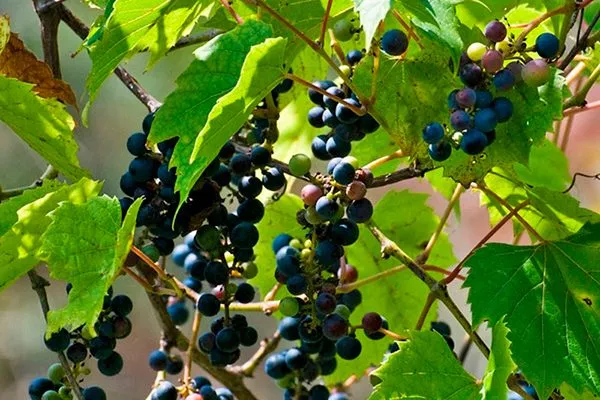
The appearance and main characteristics of Coastal Grapes:
- Bushes. They are characterized by a woody, tendril-bearing vine that spreads its vines over distances of 10 to 25 meters. The shoots are rounded or faceted, and mature stems reach up to 20 cm in diameter. The crown is dense, with light openings throughout.
- Root system. Not as powerful as it might seem at first, because it has many thin and short yellow-colored shoots.
- Bark. When young, the shoots are very smooth and light green, but as they mature, they become loose and rough, making them easily susceptible to cracking and peeling. The color turns brown.
- Kidneys. They have a narrow egg-shaped form, a light greenish color and a spreading arrangement.
- Leaves. They range in length from 5 to 25 cm and in width from 4 to 20 cm. The shape is three-lobed, alternate, and broadly ovate. The surface is shiny, but some specimens have a small amount of hairs on the underside. The color is typically green and yellow in autumn.
- Inflorescences. They are characterized by a paniculate type with a loose structure. Their maximum length is 15-18 cm. The flowers are very small – no more than 3 mm in diameter – and both male and female flowers form on the same bush. The color is white or slightly greenish, with a slightly pointed tip. The flowers have five petals and are very fragrant. The calyx is miniature.
- Fruit. They are distinguished by their very small size—from 6 to 15 mm in diameter. The berries are spherical, purple-black in color, and have a thick, bluish-gray, waxy coating on the surface.
- Taste qualities. The flesh is quite tart, but becomes sweet after freezing. The flavor has herbal notes.
- Flowering and ripening time. Budding begins in May and ends in June, and the harvest can be in August or September, depending on growing conditions, weather, and climate. Ripening is mid-early, with the berries ripening within 120-130 days of the growing season.
- Resistance to adverse factors. Coastal grapes are completely resistant to air pollution and chemical deposits in the soil, but their resistance to cold winds is average.
- Resistance to diseases and pests. At high levels, it's susceptible to phylloxera, black rot, and mold. Despite the berries' high acidity, the plant is often attacked by spider mites, aphids, scale insects, thrips, and leaf galls.
- Frost and heat resistance. The average temperature is -34°C, but some specimens easily adapt to temperatures as low as -57°C. Even if the vines freeze, the shoots will regenerate with the arrival of a thaw. The variety also easily tolerates heat—the highest recorded temperatures reach +40°C.
- Growth type. The variety is considered fast-growing, as the annual growth is 2 m.
- Methods of reproduction. Only two methods are used: cuttings and seeds.
Spreading
Coastal grapevine is native to North America, which is where it is most widespread. However, today the variety can be found throughout the world, particularly in Canada, France, the Czech Republic, Spain, Slovakia, Sicily, Sardinia, Italy, and Russia. Due to its introduction, it grows in private plots, large plantations, and in the wild.
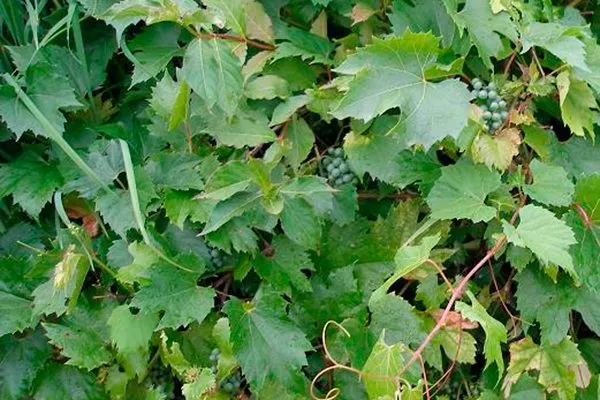
It's most often found near rivers and wetlands, as it prefers high moisture. It grows in forest edges, clearings, along roadsides, etc.
Usage
Despite the wild appearance of the coastal grape, it has a wide range of uses. For example:
- Ornamental landscape gardening. Long vines are used for vertical landscaping and naturalization in wooded areas. Leafy vines serve as hedges, decorate unsightly walls, and are used for arches, terraces, pergolas, and gazebos.
- Production of beverages. The berries produce delicious juices and even wine. But juice can also be extracted from the shoots, as it is valued for its beneficial properties.
- Preparing desserts. In America, sour berries are used to make jelly, jam, and preserves.
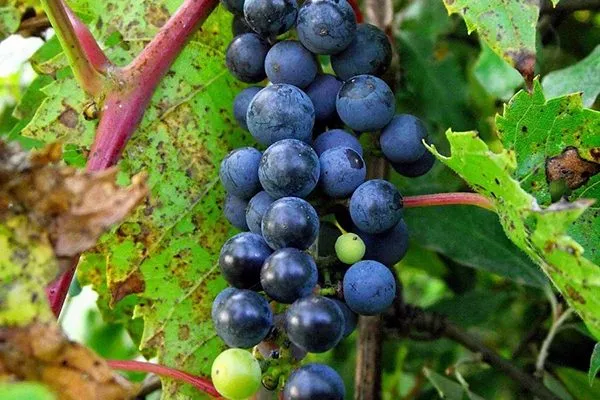
The Coastal Grape rootstock was used to develop famous grape varieties such as Triumph of Alsace, Marshal Foch, Taiga Emerald, Northern Black and White, Baco Noir, etc.
Advantages and disadvantages
Coastal grapes have quite a few positive characteristics:
There are also a few disadvantages: the berries are sour, they are resistant to only two diseases, and they are not resistant to pests and birds.
How to plant Coastal Grape and the basics of its care
The specifics of planting coastal grapes are classic, but it is important to pay attention to the following aspects:
- acidity level – 5.5-7.0 pH;
- should not be planted on calcareous soils;
- the soil must be fertile;
- the plant loves moisture, but stagnant water is unacceptable, so groundwater should be located at least 100 cm from the surface of the earth (the roots are short);
- the area should be as sunny as possible – the variety does not like even partial shade;
- distance between bushes – from 1.5 to 2.5 m;
- for multi-tiered planting, the distance is 70-100 cm.
Care measures are also standard - the variety does not impose any special requirements.
Common pests and diseases
Coastal grapes are most often affected by three diseases:
- Mildew. All parts of the shrub except the root system are susceptible to damage. Symptoms include oily spots, foliage deformation, and a gray, web-like coating.
- Oidium. Damage is caused to the above-ground part – a whitish coating with blackish dots and spots forms.
- Anthracnose. It is detected by through holes in the leaves and curvature of the shoots.
Treatment is long-term and involves the use of fungicides. However, it's better to carry out preventative treatments in the spring, at least with Bordeaux mixture. Insecticides are used against pests.
How to assemble?
The harvest takes place when the grapes reach technical maturity. To do this, the bunches are trimmed with sharp pruning shears and placed in perforated boxes or wicker baskets.
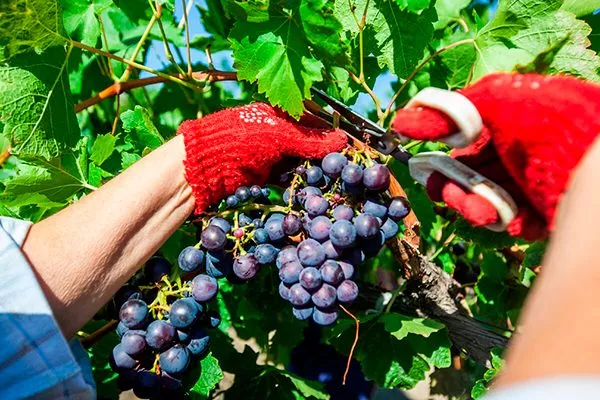
Coastal grapevine resembles wild grapes both in appearance and in their intended use. It's an excellent rootstock for improving the characteristics of table grape varieties. Planting and growing are straightforward—all you need to do is create favorable conditions.