
The early grape variety Preobrazhenie is considered one of the most productive, large-fruited, and beautiful. Its excellent characteristics and ease of cultivation have earned it recognition from both professional winegrowers and amateur gardeners.
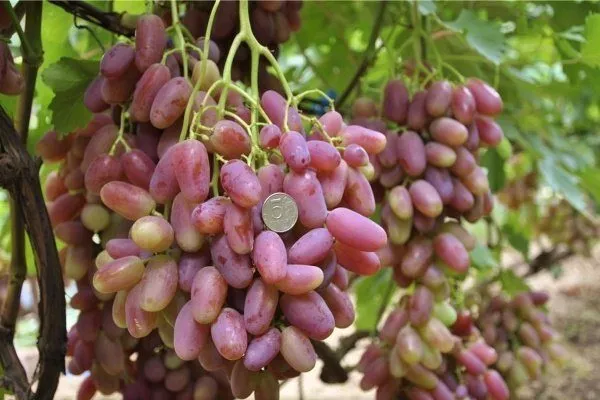
The elite grape variety "Preobrazhenie" is distinguished by its high yield and dessert-like taste of berries
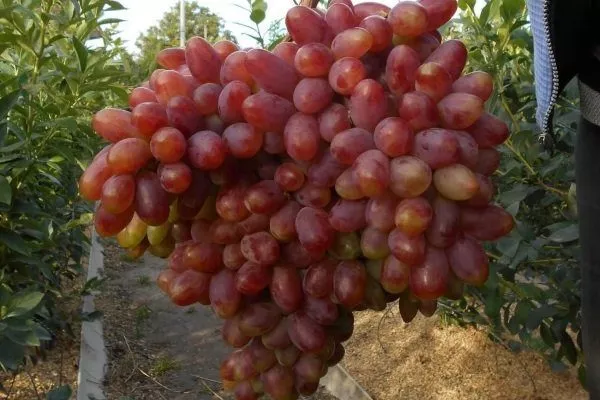
grape variety "Preobrazhenie"
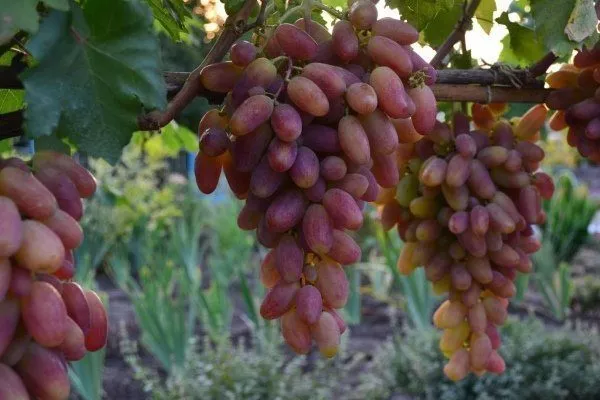
Bunches of Preobrazhenie grapes tolerate transportation well and have an attractive presentation
History of selection
The Preobrazhenie grape variety was developed through a complex cross between the Kishmish Luchistyi and Talisman varieties by V.N. Kraynov, a practicing grape breeder from Novocherkassk. In 2014, the variety was included in the State Register of the Russian Federation.
The grape form inherited the best characteristics from the basic varieties:
- early ripening of the crop;
- excellent taste of fruits;
- high yield.
Through breeding, three similar varieties were developed: Preobrazhenie, Viktor, and Yubiley Novocherkasska. These varieties make up the famous "Kraynov Troika."
Description of grapes
Botanical description of the Preobrazhenie grape:
- Vine. The bush is vigorous, with vigorous shoot growth and a robust root system. The leaves are glossy, medium-sized, pubescent, five-lobed, and on long petioles. The shoots are 2.5-3 m long.
- Clusters. The grapes form heavy, medium-density, cylindrical-conical clusters. With proper care and favorable weather, they can weigh up to 2-3 kg. The average bunch weight ranges from 800 g to 1 kg. The grapes are not prone to pea formation, and the berries in the clusters do not become deformed.
- Berries. Ripe berries are amber-pink in color, very large, reaching 4.5 cm in length and about 2.5 cm in width, and cylindrical in shape. The dense pulp is filled with clear juice. The seeds are medium-sized, with 2-3 per berry. The fruits are not prone to cracking; even after prolonged use, they peel off the bunch with difficulty. The skin is of medium thickness and density, with a light waxy coating.
When the vines are overloaded with berries, their flavor deteriorates. The fruits become bland and watery.
Key Features of the Transfiguration
The bushes grow quickly and require little care. This short-season variety allows for decent harvests in areas with short summers. An important factor contributing to the expansion of the Preobrazhenie variety's growing geography is its good frost resistance.
Watch a video review of the Preobrazhenie grape variety below:
Below are the characteristics of the variety:
| Characteristics/parameters | Description/Meaning |
| Ripening time | Early to very early. Harvesting time depends on growing region and weather conditions. Full maturity takes 105-115 days. The first fruits can be tasted on the 100th day. |
| Frost/drought resistance | Average. The plant can freeze at temperatures as low as -18ºC. Requires reliable shelter. Drought tolerance is average. |
| Pollination | Self-pollinating, flowers are bisexual. |
| Productivity and fruiting | A consistently high-yielding variety, with one bush averaging 20 kg and 236 centners per hectare. In southern climates, two harvests can be harvested per season (in July and October). |
| Resistance to diseases and pests | Low resistance to diseases: powdery mildew, bacterial canker, spotted necrosis, etc. Wasps, grape flea beetles, and cushion beetles can cause significant damage to vineyards. |
| Taste qualities | Pleasant, delicate, and harmonious flavor. Slightly acidic, no aroma. Sugar content: 17-19%, acidity: 7 g/l. The pulp is meaty, juicy, and sweet. Fresh grapes receive a tasting score of 8.5. |
| Weight of berries | Average – 14 g, maximum – up to 20 g. |
| Direction of use | Table variety. |
| Scope of application | They are used fresh, to make raisins, homemade wine, and juice. Grapes are also suitable for compotes, preserves, jams, and pickling. |
| Regionalism | All regions of the Russian Federation where grapes are traditionally grown, as well as the central part of Russia. |
| Transportability, storage | It transports well. It retains its marketable appearance for a long time when stored in a cool, ventilated area (at a temperature of 8-10 degrees Celsius). The shelf life is up to 6 months. |
Advantages and disadvantages of the variety
The strengths of the variety are:
- high yield;
- large-fruited;
- self-pollination, which makes it possible to grow Preobrazhenie in greenhouses; pollinator varieties are not required;
- early ripening of fruits;
- undemanding to the type and composition of soil;
- high commercial quality: beautiful, large bunches of grapes attract attention;
- does not lose its marketable appearance for a long time, good transportability;
- not prone to pea formation;
- the ability to harvest a second crop per season from stepchildren in regions with a warm climate;
- good rooting of seedlings;
- the variety easily takes root on various rootstocks;
- adapted to different climatic zones.
Disadvantages of the Preobrazhenie grape:
- low resistance to fungal diseases;
- predisposition of shoots to fattening;
- the variety is attractive to insects;
- When the vines are overloaded, the taste of the fruit deteriorates.
Peculiarities of planting grapes
The hybrid form Preobrazhenie has a good survival rate, and the seedling quickly adapts to its current location. However, to ensure rooting, intensive growth, and development, the plant must be properly prepared and planted.
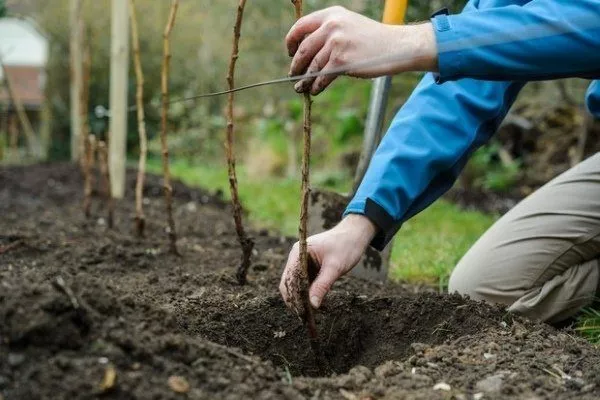
When to plant?
The planting time is chosen based on the climate of your region. Grafted and own-rooted Preobrazhenie grape seedlings can be planted in spring and fall. This is most often done in spring, when the soil warms to 7-8ºC.
Planting cuttings from one-year-old fruiting vines is done later, when the soil temperature is 10-12ºC and the air temperature is at least 15ºC. It is best not to plant such planting material in the fall.
Selecting a location and preparing a planting hole
The flavor of grapes and the richness of their color depend largely on the light level of the area. Sweet, intensely blushed berries are produced when the plant receives ample light. Therefore, it's important to choose a location away from large trees and shrubs.
The site should be windless, sunny, and on the south side of the plot, ideally protected from the wind by a building wall or fence. The groundwater level should be at least 1.5 meters below the soil surface.
For spring planting of a seedling, a hole is prepared in the fall:
- Dig a hole 60x60 cm in size, the same depth.
- Place the top layer of soil close to the hole.
- Place the less fertile bottom layer of soil on the other side.
- Place 1 bucket of compost or rotted manure (you can mix organic matter 1:1) on the bottom of the hole.
- Add potassium and phosphorus fertilizers (100 g each).
- Fill with half of the soil taken from the top layer.
- Mix, add another bucket of organic matter and the same dose of fertilizer.
- Rake the second part of fertile soil into the hole and mix it.
- Fill the hole to the top with soil from the bottom layer.
With this method of distributing nutrients, the roots will be unable to find nourishment in the upper layers and will instead grow deeper. This root system arrangement will help the grapes withstand both drought and winter cold.
Preparing seedlings
Grapes planted in the spring have the best survival rate. Buy seedlings in advance or prepare cuttings yourself. The root system of a healthy seedling will be whitish, and the cut stem will be green. Check the integrity of the bark; there should be no damage.
- ✓ Seedlings should have a whitish root system, which indicates their health and viability.
- ✓ The cut stem should be green, which indicates the freshness and good condition of the seedling.
If the plant has sprouted new shoots from the buds, remove them, leaving the largest one. Remove dried branches and leaves, if any. Trim the top of the main shoot, leaving a section of the stem with five eyes.
- ✓ The water temperature for soaking cuttings should be strictly within 22-24°C for optimal activation of root formation.
- ✓ The length of the roots after pruning should not exceed 15-17 cm to avoid them twisting and ensure better development.
The root tips are trimmed so that their total length does not exceed 15-17 cm. Next, the plant roots are soaked in room-temperature water with the addition of a root stimulant, such as Kornevin or Humate. This is done 1-2 days before planting.
Step-by-step instructions for planting
In mid-spring, when the soil has warmed, grape planting begins. This process consists of the following steps:
- make a hole with a mound in the middle in the hole prepared in the fall;
- Place the seedling on the mound and spread the roots of the plant evenly;
- fill with soil, compacting it well;
- water generously;
- mulch the tree trunk circle.
Care after planting and further cultivation
Subsequent care of grapes consists of pruning, watering, fertilizing and protection from diseases and pests.
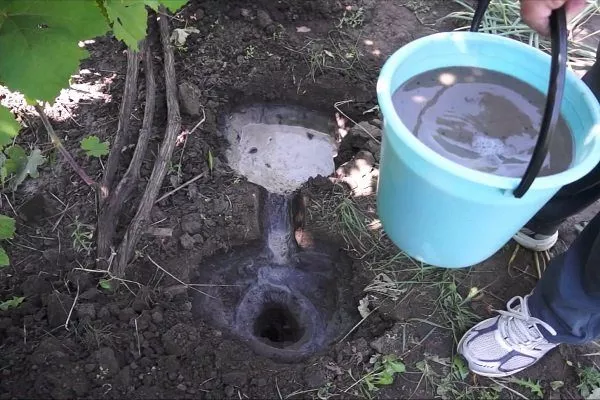
Watering
The hybrid form, Transfiguration, requires regular watering but does not tolerate excessive amounts of water. The plant's root system extends deep into the soil, and to ensure moisture reaches all the roots, it requires generous amounts of water.
Overwatering negatively impacts the taste of berries. The fruits become tasteless and have watery flesh.
Plants are watered according to the following scheme:
- During the first period after planting, pour out two buckets of water once a week.
- After a month – once every 3-4 weeks (4 buckets).
- Moisture-recharging irrigation is carried out in spring and autumn, regardless of the presence of precipitation:
- autumn – so that the vine can more easily survive the frost period;
- spring – to activate the buds.
For surface watering, if a subsurface irrigation system is not provided, dig a 20 cm deep trench around the bush, 30 cm from the root collar. Water is poured into this trench.
When, how and what to fertilize with?
The plant must receive a full range of essential nutrients. This table will help you understand when, what, and why to feed your growing grapes:
| Top dressing | How? | When? | For what? |
| 1st root feeding | 40-50 g of nitrophoska per 1 sq. m | 7-14 days before flowering. | The pollination process is better and the bunches are larger. |
| 1st foliar feeding | Typically, this is done in conjunction with spraying the bushes with fungicides. Mix 2-3 g of copper sulfate, 10-20 g of boric acid, and 23 g of iron sulfate in 10 liters of water. | 2-3 days before flowering. | Reduces ovary shedding. |
| 2nd root feeding | 30-60 g of nitrophoska per square meter | 14-16 days after flowering. | Ensures active growth of berries and shoots. |
| 2nd foliar feeding | 1 g potassium permanganate, 30-40 g urea, 20 g citric acid, 10-15 g ferrous sulfate. | The fruits are at the small pea stage. | Prevents ridge paralysis and chlorosis of grapes. |
| 3rd root feeding | 1 tbsp. potassium magnesium sulfate, 15 g potassium salt, 20 g superphosphate. | 7-14 days before fruit ripening. | Improves the taste of berries, prevents them from cracking and slightly accelerates ripening. |
| 4th root feeding | For 10 liters of water, 1-2 tablets of microfertilizers or ash infusion. | Before the berries ripen. | Prevents gray mold and improves the taste of fruits. |
| 5th root feeding | 30-40 g superphosphate, 20-30 g potassium sulfate. | After harvesting. | Improves shoot maturation. |
Features of mulching
In order to preserve moisture and nutrients in the soil, as well as to protect the plant from slugs, mulching In the fall and spring, peat, humus, bark, sawdust, or straw are used. A 3-cm layer of organic matter is applied to the trunk circle. During periods of frost, the mulch acts as an insulator for the grapevine.
Pruning and shaping
Without shaping and pruning, a good grape harvest will be impossible. Crowded vines promote disease. Pruning can be done before bud swelling in the spring or fall. The average number of shoots on a vine is 24-30.
We recommend reading the article about spring pruning of grapes.
Using cropping:
- the number of grape clusters is adjustable;
- the shape of the bush is formed;
- shoot growth is activated.
For the Transfiguration, fan-shaped training is recommended. Fruiting vines are shortened to 6-8 buds. During the growing season, side shoots are removed to ensure a full main harvest. If a second harvest is expected in October, this step is not necessary.
Due to the large size of the fruits and bunches, the Preobrazhenie variety requires harvest rationing. Only one grape bunch is left on a shoot. Alternatively, you can solve this problem by pinching off the lower part of the bunch by 1/3 or 1/4. This is done at the initial stage of bunch formation, when the fruits are about the size of a pea.
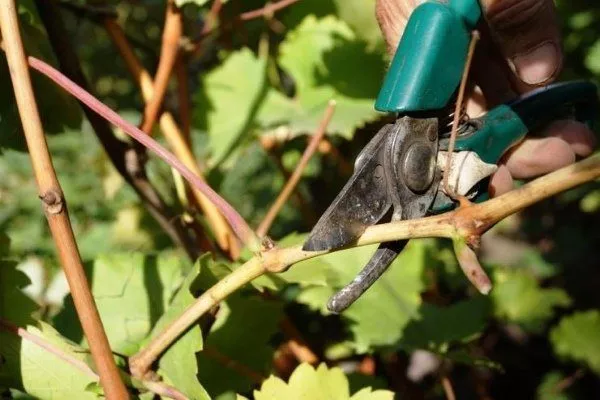
Large grape varieties must be rationed, otherwise the harvest will remain unripe, and the overloaded bush will not have time to prepare for winter.
Bird protection
There are two main ways to protect crops from birds: isolation and repelling:
- Insulation:
- ripening bunches are placed in protective bags (mesh plastic, vegetable nets, etc.);
- A small vineyard is covered completely using tulle, fishing net and other fine mesh materials.
- Scare away. Use sound, optical or combined effects:
- Plastic bags cut into strips are hung on the trellises (preferably blue - birds are afraid of blue and mirrored colors).
- They hang CDs and combine this protection with a noise effect, for example, by using ratchets.
- You can learn from the experience of European winegrowers and make deterrents from inflatable balloons. Blue, black, and orange balloons are all suitable. Paint huge eyes on them on all sides, then tie them to trellises.
Using scarecrows or CDs without accompanying noise is useless. Birds quickly adapt and are not afraid of such defenses.
Preparing for winter
In the fall, the shoots are cut back to 1/4 their length. When the temperature drops below -5°C, it's time to cover the grapes. After removing the supports, the vines are laid on the ground, pinned with garden staples, and covered with roofing felt, burlap, covering material, etc. A layer of soil up to 10 cm thick is added on top.
Cuttings and grafting
Grafting cuttings is another method for planting Preobrazhenie grapes. It's important to ensure the cuttings you select are healthy and suitable for planting:
- Each cutting should have at least 2-3 buds. The distance from the cut end of the cutting to the bottom bud should be no more than 3-5 mm. If the distance is greater, trim off the excess.
- Before planting, place the cuttings in a container of warm water with a few drops of growth stimulant added. Soak for 24 hours.
- If grafting is done in the fall, to increase frost resistance and retain moisture, the tip of the cutting is dipped in hot paraffin. Then, immediately immerse it in a container of cold water.
- The rootstock must be split to accommodate one scion. It is then trimmed until smooth.
- The junction of the rootstock and scion is tightly bound with cloth over the rootstock. The grafting site is coated with clay.
To prevent the grapes from freezing, they need to be wrapped up before the onset of frost.
Diseases, treatment and prevention
Transfiguration is not particularly resistant to diseases. The most common diseases and their control methods are presented in the table.
| Disease | Symptoms | How to fight? |
| Powdery mildew (oidium) | A fungal disease. A white coating appears on grape leaves and berries. The skins of the fruit crack, and the leaves wilt. The shoots then dry out, and the berries and leaves fall off. | The following fungicides are used: Topaz, Vitaros, Fundazol, Fitosporin-M, bio-fungicide Alirin-B and many others.
Folk remedy: dissolve 4 grams of washing soda and the same amount of soap in a liter of water. Spray twice, once a week. |
| Spotted necrosis | It appears after overwintering under cover. Dark, elongated spots of dead tissue appear on the wood, under the bark, and then the affected part of the plant dries up and dies. | Treatment and prevention:
|
| Downy mildew | The leaves become lighter in color, and small, round, reddish-yellow spots appear. The underside of the leaf then becomes covered with a white coating. In addition to the leaves, inflorescences, shoots, and berries are also affected. The bush may die. | Treatment is carried out in several stages:
Copper sulfate is an effective remedy in the early stages and for prevention. Preparations: Abiga-Peak, Strobi, bio-products Planriz or Alirin-B. In case of severe damage, organic fungicides with copper or sulfur are used: Ridomil Gold, Champion, Cabrio Top. |
| Bacterial cancer | It gets on the plant when it's handled with a non-sterile instrument. It causes the bark to crack and tumor-like growths to form. | There is no treatment; the infected bush is destroyed. |
Preventative measures, including treating plants with Bordeaux mixture, can help prevent the occurrence of many dangerous bacterial and fungal diseases of grapes.
The first treatment is carried out in the fall, after the leaves have fallen, spraying the grape vines and the ground beneath them. The second treatment is applied to unopened buds. The third treatment is applied to shoots 10-12 cm long.
Bordeaux mixture is used only as a preventative measure. If signs of disease appear on the leaves, more effective methods are used, including treating the grapes with the appropriate preparation.
Pests, control methods and prevention
Wasps, attracted by the high sugar content of the fruit, cause the most damage to Preobrazhenie grape vines. They flock to the vineyard in large numbers, eating the juicy, sweet pulp, causing the damaged berries to spoil and the grape clusters to lose their marketable appearance.
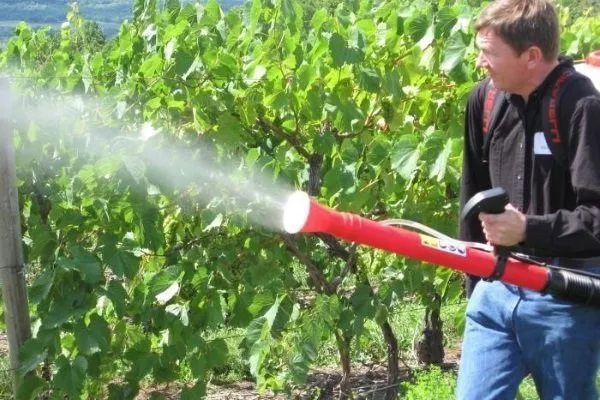
Controlling them is difficult and often futile. The following methods can be used to protect against wasps:
- Sweet baitsThey are made from plastic containers filled with honey water, fermented compote, or syrup. The bait is hung in sunny spots.
- Mesh bagsA bag made of gauze, tulle, or similar materials is placed on each bunch of grapes and tied at the top.
- SmokeYou can repel wasps with liquid smoke or smoke from a fire.
- Artificial repellerThey use the non-toxic product Sochva Zh. When it settles on fruits and leaves, it leaves a smoky scent that repels insects.
- Destruction of wasp nestsInsecticides are used against wasps. In the dark, the nest containing the insects is treated on all sides, especially the center. It is important to reliably protect all parts of the body with protective clothing. A flashlight with a red lens is used as a light source.
Besides wasps, other insects also cause significant damage to grape crops. The table below lists the most common ones.
| Pests | Damage caused | Control measures |
| Grape spider mite | It lives on the underside of leaves, actively devouring their tissue. Damaged leaves develop a whitish-yellow coating and light spots, which eventually dry out. |
|
| Pillow case | It feeds on sap by attaching itself to shoots and leaves. It produces a protective film that insecticides cannot penetrate. The plant loses strength and dies. | The most effective method is manual collection of insects. |
| Grape moth | It lays eggs on the underside of leaves. The hatched caterpillars feed on the sap and chew tunnels in the leaves. Light stripes form on the leaf blade. | Removing fallen leaves, loosening the soil around the grape bush and applying an insecticide. |
Reviews of Preobrazhenie grapes
With proper cultivation practices, the Preobrazhenie grape will surely reward you with a bountiful and beautiful harvest. Despite its young age, it's a worthy choice for both home gardening and commercial gardening.