
With proper care and nutrition, grapes produce a bountiful harvest. It's important to understand which fertilizers are appropriate for autumn use and when to apply them to prevent the plant from dying in winter.
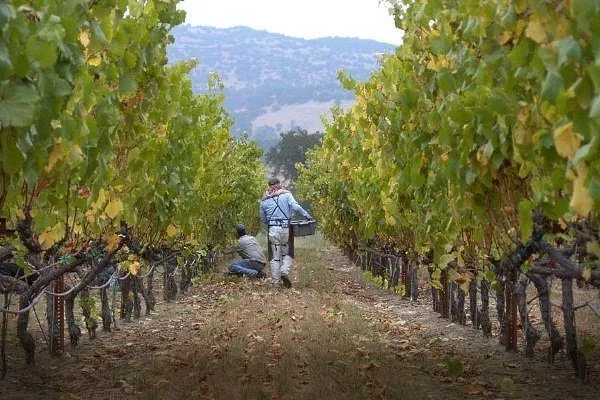
Time to fertilize grapes in autumn
Autumn fertilization has its own time frame. It should be carried out immediately after harvest, so the timing will vary for early- and late-ripening grape varieties.
- ✓ The optimal soil pH for fertilization should be in the range of 6.0-6.5.
- ✓ The soil temperature when applying fertilizer should not be below +10°C to ensure the absorption of the elements.
During this period, the shrub especially needs nutrients as it begins preparing for winter. The amount of potassium and phosphorus supplied determines the plant's metabolism, and therefore its ability to recuperate. Fertilizing in the fall is the key to a good harvest next year.
Too much fertilizer in the soil can have more serious consequences than too little.
Benefits of autumn feeding:
- Spring soil moisture, enriched with useful fertilizer substances, will provide comprehensive nutrition for grapes.
- The growing season will begin on time and proceed smoothly.
- When the soil is loosened during fertilizing, the grape roots receive additional care.
- Such measures prevent diseases and threats from plant pests.
In this video, an experienced gardener explains why and when to fertilize grapes:
Minerals for grape growth
Mineral fertilizers are essential for grapevines. When using them in the fall, carefully read the instructions to avoid harming the plant.
Nitrogen
In the fall, applying nitrogen-containing fertilizers is prohibited. This is because nitrogen stimulates the growth of young vines. This drains all of their energy, and the vines don't have time to prepare for the winter. Even the first frost can kill the vine. Nitrogen fertilizers are recommended for spring use.
Potassium
| Name | Potassium content | Phosphorus content | Application |
|---|---|---|---|
| Potassium sulfate | 50% | 0% | Autumn feeding |
| Potassium salt | 40% | 0% | Autumn feeding |
| Potassium magnesium sulfate | 30% | 0% | Autumn feeding |
Potassium is an essential element for grapes. It determines how well the plant will survive the cold period and whether the following season will produce a good harvest. This element influences the formation and ripening of grape clusters, prevents cracking of the fruit due to excess moisture, and helps the plant survive drought. If the plant lacks potassium, leaf margins die back.
Potassium sulfate holds the record for highest potassium content among fertilizers, at 50%. Another advantage of this fertilizer is its chlorine-free nature. Potassium sulfate contains 40% potassium, while potassium magnesium sulfate contains 30%. Combine potassium fertilizers with phosphorus fertilizers.
Phosphorus
| Name | Phosphorus content | Application | Peculiarities |
|---|---|---|---|
| Simple superphosphate | 21% | Autumn feeding | Suitable for various soil types |
| Double superphosphate | 50% | Autumn feeding | No gypsum in the composition |
| Phosphate rock flour | 23% | Autumn feeding | Long lasting action on acidic soil |
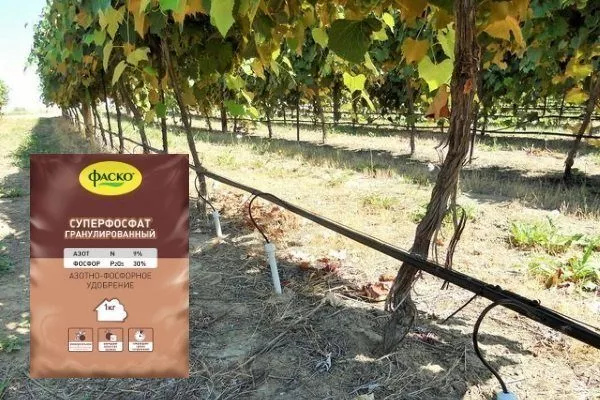
Phosphorus, accumulating in grape tissue after autumn application to the soil, promotes flowering and the formation of ovaries and abundant clusters. Simple superphosphate contains 21% phosphorus, is suitable for various soil types, and is easily soluble in water.
- ✓ Phosphorus fertilizers are most effective when applied to the root zone at a depth of 20-30 cm.
- ✓ To prevent phosphorus fixation in the soil, it is recommended to apply it together with organic fertilizers.
Acidic soils should be limed by adding chalk, limestone, or other slightly alkaline components to superphosphate. This is the most popular phosphorus fertilizer.
Double superphosphate contains 50% potassium. It differs from the previous product in that it does not contain gypsum.
Phosphate rock flour is used in large quantities because it contains up to 23% phosphorus oxide. This type of fertilizer is effective for a long time in acidic soils.
Complex
Complex fertilizers are created through a chemical reaction of elements or by simply mixing single-component fertilizers. In addition to nitrogen, potassium, and phosphorus, they contain additional components. For example, zinc and copper increase grape yields. Such fertilizers include "Nitrophoska," "Nitroammophoska," "Rost-1," "Florovit," and others.
Since complex fertilizers contain nitrogen, they must be applied in the spring, and depending on the plant's condition, in the summer. Their use is not recommended for preparing grapes for winter.
Organic fertilizers for grapes
If mineral fertilizers were applied in spring and summer, it is preferable to use organic fertilizers in autumn.
Ash
| Name | Ash type | Phosphorus content | Potassium content |
|---|---|---|---|
| Pine ash | Coniferous | High | Low |
| Leaf ash | Deciduous | Low | High |
The most suitable organic fertilizer for grapes is ash. It contains no nitrogen, so it won't cause any harm during the fall and winter. And the high levels of phosphorus, magnesium, calcium, and potassium help the plant prepare for winter.
The accumulation of nutrients and the growth of bark on young shoots will protect them from winter weather. Sunflower seed ash is the richest in nutrients.
The amount of the main component in the ash depends on the type of ash:
- pine ash - rich in phosphorus;
- deciduous - potassium.
In dry form, this fertilizer is used when digging up grape plantations.
To prepare the ash solution, follow these steps:
- Pour 300 g of ash into 10 liters of water;
- Let it brew for about a week, stirring the infusion occasionally;
- make a depression around the grapes no more than 10 cm;
- Pour the infusion into the furrow at the rate of 5 liters per bush.
The video below explains how to apply ash to grapes:
Compost
Rotting plant remains are rich in micronutrients. For top dressing, mix compost with peat. Place this mixture directly under the grape vine in a layer of at least 5 cm. Cover with soil.
You can place plant waste in a container and add water. As it rots, it will release minerals, which will be released into the soil when you water it.
Benefits of compost:
- makes the soil loose;
- prevents weed growth;
- retains moisture in the soil.
Bird droppings
Bird droppings contain a large number of readily available micronutrients. They reduce soil acidity and enrich it with beneficial bacteria. It takes time for the nitrogen to be released from the fertilizer and absorbed by the roots. This is why it's best to apply the droppings in the fall.
Chicken manure is used in the form of a solution or dry. To prepare liquid fertilizer
- add water to the droppings in a ratio of 1:4;
- put in a warm place for 10 days;
- dilute the infusion with water in a ratio of 1:10;
- water between the rows at the rate of 500 ml per bush.
Do not pour the solution directly under the grapes to avoid burning the root system.
It is recommended to water the soil before and after fertilizing to ensure rapid absorption of the fertilizer. Bird manure should be applied once or twice a year.
Manure
Manure (cow manure) supplies grapes with potassium, phosphorus, and nitrogen, enriching the soil with beneficial bacteria. The manure needs time to rot before being applied. The manure is then mixed with compost, and the resulting mixture is used to fill the furrows between the rows of the vineyard.
After applying fertilizer, cover the bush with soil. To avoid damaging the roots, make furrows every other row. Watering the furrows will ensure faster access of micronutrients to the bush's root system.
First, dilute the manure with water at a ratio of 1:4, let it sit, and then water the plantation. 7-10 liters of the solution per 1 square meter of soil is sufficient.
Don't use pure, fresh cow manure as fertilizer! It produces methane and ammonia.
Watch the following video to learn how to apply manure as fertilizer:
Features of fertilizing young and old grapes
If fertilizer was used when planting young grapes, they won't require any additional feeding for the next 2-3 years. Starting in the third year, organic fertilizers are applied first, followed by mineral fertilizers. Proper fertilization increases the grapes' frost resistance, prevents diseases and pests, and enriches the soil.
Before wintering, old grapevines are enriched with phosphorus and potassium fertilizers. The resulting bark on the stems and sufficient minerals help the plant survive frosts without shelter. In the spring, a healthy vine will actively enter the growing season.
Helpful tips
To ensure high-quality and effective autumn fertilization of grapes, it is worth listening to the following advice:
- To ensure that the fertilizer is absorbed by the main root system, dig a circle around each bush with a radius of 0.5 m and a depth of 35-40 cm. Don't worry about damaging the roots—they will quickly recover. If you apply fertilizer directly to the soil surface without digging in, it will be absorbed by the upper roots, not the main roots. This will lead to branching on the surface rather than strengthening the roots at depth, and the roots will freeze during the winter.
- Heavy watering in October, after harvest, will help the grapes accumulate nutrients and protect them from freezing temperatures. Furthermore, the potassium buildup will prevent cracking in the following season. There's no point in overwatering the plants. Maintaining soil moisture, based on weather conditions, is sufficient. The amount of water needed for irrigation is also determined by soil type: in sandy soils, grapes require up to 70 liters per plant, while in clay soils, 20-25 liters is sufficient.
- After autumn pruning and fertilizing, it is necessary to spray the grapes to prevent diseases and pests.
Applying autumn fertilizer to grapes will not only nourish the plant with nutrients but also prepare it for the coming winter. The plant will be much more resilient to the cold, and will spend less energy recovering in the spring.