
Grapes are a crop that bear fruit annually, without interruption. If vines fail to produce berries, there is a problem that the gardener must identify and address. Otherwise, they will not only miss out on a harvest this season but also risk losing it next season.
Reasons for the absence of ovaries on grapes
Fruiting is impossible without the formation of high-quality ovaries. Grapes are strong and resilient plants that can withstand various challenges, and a lack of ovaries is usually a response to nutritional problems, disease, adverse weather conditions, and other negative influences.
Lack of heat
Grapes are heat-loving plants, so they grow particularly well in southern regions. Despite the emergence of new, cold-hardy varieties cultivated in harsh climates, grape vines still react negatively to cold.
The following situations are especially dangerous for grapes:
- too early a drop in temperature in autumn – the plant has not yet had time to prepare for the cold, so it suffers from the sudden change in weather;
- premature autumn frosts - they can lead to freezing of fruit buds;
- A long, cold spring—low temperatures prevent the grape seed embryos from receiving adequate nutrition.
A lack of warmth can also negatively impact grapevines if they are planted incorrectly, too deeply. This means that in the spring, the roots of the vines take a long time to warm up to a temperature favorable for development and growth. As a result, the buds, suffering from a nutritional deficiency, develop into runners.
Nutritional deficiencies
A deficiency of any of the essential nutrients—nitrogen, phosphorus, or potassium—can result in a lack of fruit set, with fruiting buds degenerating into tendrils. If, at the beginning of cluster ripening, all the nutrients are devoted to fruit production, the bush suffers from malnutrition and will not have the energy to form fruit.
- ✓ The N:P:K ratio in fertilizers should be adapted to the growth phase of the grapes: more nitrogen in spring, phosphorus and potassium in summer and autumn.
- ✓ The critical soil pH level for nutrient absorption by grapes is 6.0-6.5. Deviations from this range require correction.
Under favorable conditions, grape vines will be able to form ovaries in the spring. But if you don't provide the plants with top dressing, the embryos of the brushes will continue to transform into tendrils - in the interests of preserving the strength and life of the bush.
Fattening bushes
Grapevine overgrowth is a common example of improper fertilization. Many inexperienced gardeners, with the best of intentions, overfeed grapes and other garden crops with nitrogen fertilizers—both mineral and organic.
Remember the rule: nitrogen fertilizers stimulate the growth of green mass, so they are applied in the fall or spring..
Excess nitrogen combined with heavy watering leads to vine fattening. Shoots grow vigorously, become brittle, and fail to produce flower buds. Excess nitrogen negatively impacts not only fruiting but also the grape's cold hardiness and immunity.
Freezing and recurrent frosts
Grape fruiting depends largely on how well the grapes survive the winter. The more severe the frost, the greater the risk of freezing and reduced yield.
Reasons for lack of ovaries:
- Cold and little snowy winterSevere frosts combined with light snow cover lead to the soil freezing too deeply.
- Long defrostingIt is observed both after cold winters and as a result of excessive mulching.
- Recurrent frosts. They primarily affect young and awakened buds, on which the future harvest depends.
Incorrect pruning
Grape fruiting depends directly on proper and regular pruning. The key is to promptly remove weak and dead vines, leaving only strong, fruit-bearing shoots. If you prune last year's light yellow branches, rather than the green ones that grew this year, there will be no harvest.
Short pruning
Flower stalk formation—their location depends on the grape variety. For example, Asian varieties and hybrids have their first bud and flower stalk at the 5th or 6th position from the shoot's base. If such a vine is pruned to 4 buds, the shoots that grow from it the following summer will be barren, without fruiting ovaries.
Short pruning is generally suitable for wine grape varieties, as their flower stalks form on almost all buds, including replacement buds. Pruning patterns for wine grape varieties should never be applied to table grapes.
Most table grape varieties have fruiting buds located between the 3rd and 8th buds. Varieties with buds starting between the 8th and 12th buds (Talisman and Muscat Amber) cannot be pruned short. Removing 6-8 buds from the vine will simply destroy the harvest.
It blooms but does not bear fruit.
Sometimes grape vines bloom profusely but produce no fruit. If the summer is rainy, grape flowers are poorly pollinated. When wet, the pollen becomes heavy and cannot be dispersed by the wind.
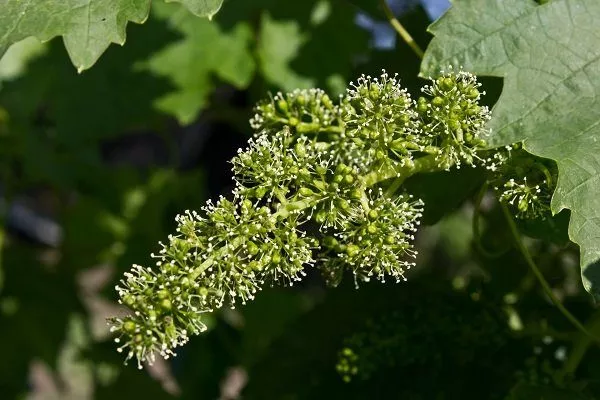
Insects also remain inactive during rainy weather, hiding in shelters and waiting for sunny weather. As a result, flowers are not pollinated and ovaries do not form.
Preventive measures
Before you begin growing grapes, carefully study the general agricultural practices, as well as the specific growing guidelines for the varieties you choose. To ensure full fruit production, gardeners must implement a comprehensive set of preventative measures to maintain the yield.
How to ensure grape fruiting:
- Choose varieties wisely. Consider the climate conditions and the characteristics of the species. There are drought-resistant grapes, frost-resistant, heat-loving. For your first attempt, it's recommended to choose varieties that are popular in the region—check what grapes grow in garden plots or private gardens.
- Follow the fertilization regime. Avoid applying nitrogen fertilizers in summer. Apply complex fertilizers before flowering and after fruit set. Continue adding ammonium nitrate solution throughout the ripening process.
In the fall, closer to harvest, apply potassium fertilizers—they increase frost resistance. Apply the fertilizer directly to the roots of the bush, at a depth of half a meter. For this purpose, use pipes buried in the ground. - Choose the landing site wisely. Grapes love not only warmth but also sun. If they don't get enough sunlight, they grow in the shade, the bush grows, but flowers fail to form.
- Observe the fertilizer dosage. Organic matter—rotted manure, compost, and humus—is recommended for application in the fall. These can be replaced with mineral nitrogen-containing fertilizers. In any case, the nitrogen dosage should be halved in the spring to prevent the bushes from becoming overfed.
- Prepare grapes for winter. To prevent roots from freezing in winter, it's essential to cover them by adding more soil around the trunk. If there was little rainfall in the fall, water the grapes generously before the onset of frost.
If the soil is dry, cold can penetrate it more easily. Frost cracks the soil, leaving roots literally exposed, freezing, and even dying from the cold. - Correct feeding. To stimulate fruit bud formation, fertilizers should contain minimal nitrogen starting in the second half of summer. During this period, grapevines require potassium, phosphorus, and micronutrients.
- Water regularly. Water is especially important during the period when grapes are filling out and ripening. If the plants lack moisture, the bunches will not fill out. Excessive water will also harm the harvest—the berries will crack.
The amount of water applied to the bushes is adjusted based on the current weather. It's important not to overwater or overdry the soil, and avoid sudden changes in its moisture content. - Stimulate pollination. If natural pollination isn't enough, try artificial methods—they can increase yields by almost half. Transfer pollen from flowering bushes to other bushes using a fluff brush.
Repeat this procedure several times during the flowering period, in the morning or on cloudy days. To stimulate flowering, alternate male and female plants in the plantings, and thin out side shoots and dense foliage.
If the variety is prone to frequent flower drop, pinch it back. Sprinkle with water during hot weather. - Form the bush correctly. Grape growers believe that ideal vines consist of 1-3 main trunks. Early in the spring or fall, annual shoots are pruned, counting 4-12 buds from the trunk (the exact number depends on the variety) and an additional 4 buds. The remaining shoots are then pruned.
Throughout the spring and summer, excess foliage is regularly removed. In addition to thinning shoots and foliage, cluster combing is used to remove poor-quality flowers and berries. Varieties prone to flower/berry drop are pinched. - Treat the bushes in a timely manner. Regularly inspect the grapes for signs of disease. Apply the appropriate fungicide based on symptoms. If insects are detected, use effective insecticides.
Obtaining a stepchild crop on empty shoots
Don't rush to remove vines that haven't yet produced fruit. Not all grape varieties are capable of producing fruit on side shoots, but many varieties respond well to methods for stimulating side shoot fruiting.
Varieties that are not capable of producing berries on side shoots:
- Hussein;
- Rizamat;
- Diameter.
Shoots growing in the leaf axils are called first-order side shoots. If the shoots are located in the axils of leaves growing on the side shoot itself, they are second-order elements. The harvest is obtained from second- and third-order side shoots.
The first method. Stimulation of side shoot fruiting is used if a shoot with 5-6 leaves has grown on the vine, but it does not produce inflorescences.
Procedure:
- Pinch the growth point of the problematic shoot (that has not produced ovaries) at 4-5 leaves.
- After 3-4 days, first-order side shoots begin to emerge from the axils of the pinched shoot. These, like the shoot itself, are uninitiated, so grow second- and third-order side shoots.
- Leave a couple of the strongest of the grown side shoots. When they develop 2-3 leaves, pinch off their growing points as well—this will stimulate the growth of second-order side shoots. These should produce inflorescences.
- After the flowers appear, pinch the shoot again, leaving one leaf at the top so that a new shoot will grow from its axil. Remove the remaining side shoots.
The second way. It's similar to the previous method, but unlike it, this one doesn't involve pinching the fruiting vine. The side shoots grow along with the vine's growth.
Procedure:
- Leave 2-3 first-order shoots on the shoot that hasn't set any ovaries. Pinch them above the first or second leaf to transition them to the second-order shoots. This will stimulate inflorescence formation.
- When inflorescences appear on the stepsons, leave 1-2 of the most powerful ones and pick off the rest.
- If the second-order side shoots fail to produce ovaries, wait for the third-order side shoots. Leave one leaf above and pinch the shoot.
Video on how to get a stepchild crop:
The second option, side-shoot fruiting, is preferable. It allows the main shoots to grow alongside the side-shoots without inhibiting their growth. The green mass then contributes to the ripening of the berries and the nutrition of the bushes.
Grapes are hardy and vigorous, but any negative factor can affect their fruiting. If you follow proper agricultural practices and take timely preventative measures against grapevine failure, you'll definitely enjoy a harvest.