
The Laura grape is a Tairov variety, also known as Flora. It is characterized by its refined flavor, ease of cultivation, and early ripening. It is widely grown in its native Ukraine, Belarus, and Russia.
Description of grapes
Only female flowers bloom on the Lora, so the shrub requires pollinators and insects. It's best to plant nearby grapes with similar budding times and a predominance of male flowers. The best varieties for the Flora are Kodryanka and Arkadia.
| Name | Ripening period | Disease resistance | Frost resistance |
|---|---|---|---|
| Laura | 110-115 days | High susceptibility to gray mold, average susceptibility to mildew, low susceptibility to oidium | -20-23 degrees |
| Codryanka | 110-120 days | High to mildew, average to oidium | -22 degrees |
| Arcadia | 115-125 days | High susceptibility to oidium, average susceptibility to mildew | -21 degrees |
- ✓ Ensure that pollinator plants are no more than 50 meters away from Laura grapes.
- ✓ Check for sufficient numbers of bees and other pollinators during the flowering period.
Bushes
The bushes are considered medium-sized, ranging in height from 150 to 200 cm. The shoots mature within a single season, resulting in almost 80% of the fruiting shoots on a single plant.
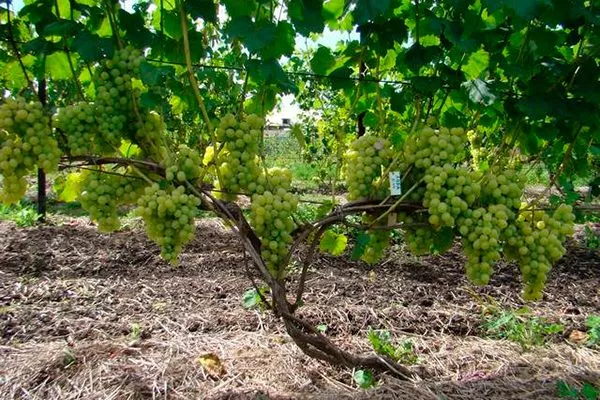
Other characteristic features of the shrub:
- shoots - when young they are colored in light brown tones, when mature they become reddish;
- the bark is quite rough;
- The leaves are five-lobed, small and green, with serrated edges, a smooth surface on top and pubescent underneath.
Berries
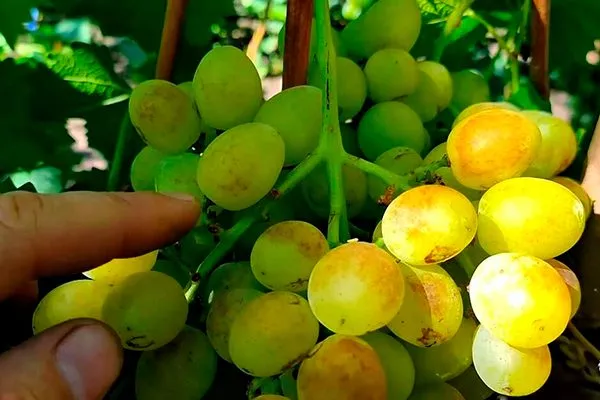
Laura is a variety with light-colored berries that are distinguished by the following characteristics:
- color - white-light green, with a slight blush forming on the sun side;
- plaque - pruinose white;
- shape – oval-elongated;
- weight – from 6 to 11-12 g;
- size – minimum 2.2 cm in diameter and 3 cm in length;
- the pulp is dense, juicy and crunchy;
- number of seeds – from 1 to 2 pcs.;
- The skin type is dense, but easy to chew.
Clusters
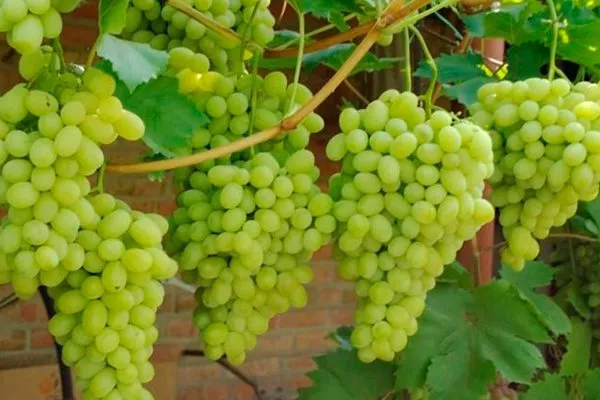
Flora's clusters are medium-loose—the density depends on growing conditions, adherence to agricultural practices, and the current weather. They are characterized as follows:
- shape – closer to conical;
- bunch weight – varies from 600 to 1000 g;
- the attachment of the berries to the stalk is strong, due to which the fruits do not fall off when ripening or overripening;
- brush length – 30-50 cm.
Taste
Based on the tasting score, the indicators are very high – 9.1 points out of a possible 10. Therefore, the taste qualities are considered high.
Consumers note the delicate flavor and notes reminiscent of Asian grape varieties. Specifically, it has a muscatel and slightly fruity aroma. This allows the berries to be used to produce valuable wines and other beverages.
Sugar content is also high—20% or more in hot climates with sunny summers. Acidity is very low, at a maximum of 7 g/l.
Drought and frost resistance
The variety easily tolerates short-term drought, but to ensure sweet fruits and a bountiful harvest, special attention must be paid to irrigation. Winter hardiness is average: shoots can withstand temperatures of -20 to -23 degrees Celsius without the risk of freezing.
Productivity, ripening time
The plant is highly productive – up to 9-9.2 tons can be harvested from one hectare, or up to 7.5 kg from one bush, provided that approximately 1,240 plants are planted per hectare. It reaches technical maturity early, within 110 to 115 days.
Resistance to diseases and pests
The variety is distinguished by its high resistance to gray mold, slightly lower to mildew, and lastly, to powdery mildew. Therefore, it is important to carry out preventative treatments twice a year. The only pests that pose a threat are wasps, which flock to the sweet berries. Birds, attracted by the nutmeg aroma, can also cause damage.
- In early spring, before the buds open, treat the bushes with a 3% solution of Bordeaux mixture.
- Before flowering, treat with a copper-containing fungicide.
- After harvesting, treat the bushes with a systemic fungicide to prevent overwintering forms of diseases.
History of selection and growing regions
The hybrid was bred at the V. E. Tairov Institute of Vegetable and Vine Crops in Odessa, Ukraine, in 2000. Several varieties were used simultaneously for the crossbreeding – the basis was Muscat de Saint-Vallier (a French variety), and it was pollinated using pollen from Muscat hamburgensis (an English selection) and Husayne (from Uzbekistan).
The Queen of Tairov grape (Odessa) was also used. Thus, the crossing was repeated, making Laura a hybrid.
The variety is recommended for cultivation in steppe zones, including Dagestan, Astrakhan, Stavropol, Kalmykia, Crimea, and the Krasnodar Krai. However, today, the crop is cultivated in almost all regions of the Russian Federation, particularly in the Kursk and Voronezh regions, the Moscow region, and the Central Black Earth Region.
Advantages
Flora is a table variety that has many positive qualities.
Flaws
Among the negative characteristics, the following are noted:
Landing
The planting requirements for the Laura variety are classic: in spring, the air temperature should be +15 degrees, and in autumn, the time is determined by the period of frost (2-3 weeks).
Please note other features:
- since the root system of this hybrid does not go very deep, the groundwater level can be as low as one and a half meters from the surface of the earth;
- the optimal location of the bushes is from the north side to the south;
- the distance between bushes in one row during mass planting is 2.5-3 m, an identical distance can be left between rows;
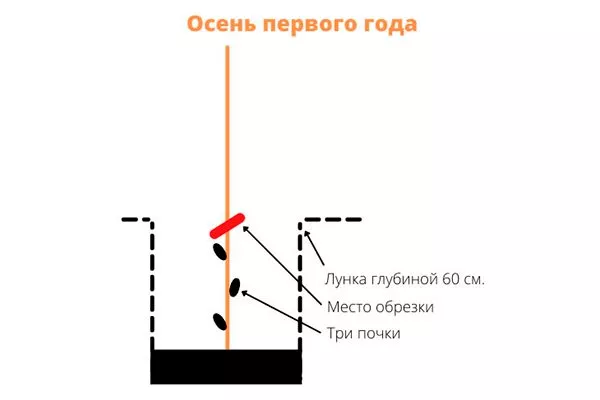
- the heel of the seedling should be deepened by 35-40 cm;
- Before planting, organic matter and minerals must be added.
Growing and care
The care procedures are also standard, but there are some nuances worth paying attention to:
- Watering. This should be done regularly, but not in excessive doses. For one bush, 50 liters at a time is sufficient (other varieties require much more). If the soil is overwatered, not only will the roots rot, but the berries will also begin to crack.
It's best to water the roots in furrows and mulch the area around the trunk with well-rotted manure. Mature bushes should be watered once every 2-3 weeks. - Loosening, weed control. Remove weeds after each watering, and loosen the soil to improve air exchange and moisture retention.
- Top dressing. Fertilize responsibly—yield and fruit flavor depend on it. Products such as Vinograd, Pure Leaf, Florovit, and Izuminka are excellent for Laura. Flora grape fertilizing schedule:
- in early spring, use nitrogen-based organic matter, such as mullein, diluted in a 1:3 ratio – 18 liters per bush;
- Before budding, apply foliar feeding with sodium humate and boric acid - 5-7 g of each substance per 10 liters of water;
- from mid-July, use complex preparations or fertilize with an ash solution - 400 g per 10 liters of water under each bush;
- Add potassium salt in the fall.
- Treatment against diseases and pests. Spraying of bushes begins in early spring and is repeated twice more. You can use the fungicide Ridomil Gold, Bordeaux mixture, Homecin, or Cuprozan. Insecticides such as Actellic, Sanmite, and Omite are useful against pests.
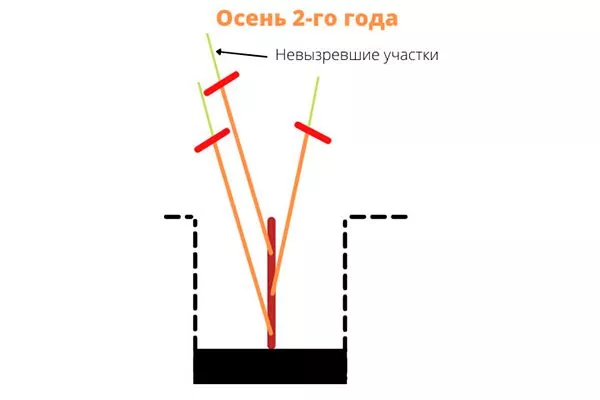
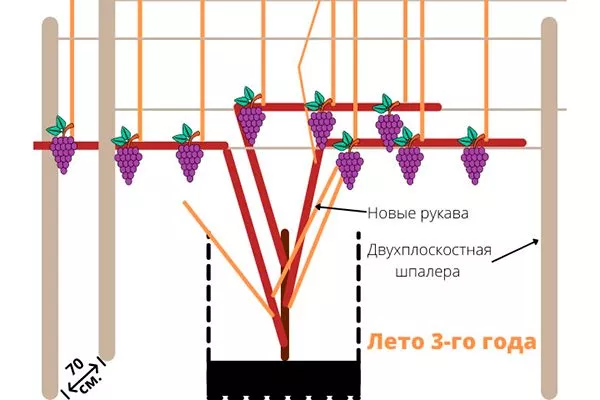
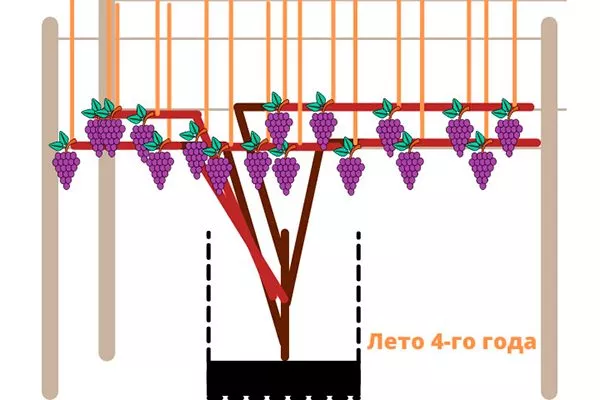
- Shaping, pruning. Flora shoots grow at a moderate rate, so pruning is only done twice a year. Experts recommend shaping the bushes as follows:

- Preparing for winter. Before wintering, plants are prepared by watering (approximately 100 liters of water per bush), pruning, fertilizing, hilling, and mulching. Non-woven materials are used as cover in cool climates. They are wrapped around the vines or covered with a special structure made of metal arches.

Reproduction
Laura propagates in three ways: cuttings, grafting, and layering. Any viable shoot is suitable for cuttings; for layering, the vine can be easily laid on the ground; and for grafting, it's best to use the mother rootstock.
Harvesting and use of crops
The Laura variety is versatile in its uses – it is consumed not only fresh, but also used to make delicious dessert wines, nutritious juices, and compotes.
The most important thing is to harvest the fruit correctly. To do this, the berries must reach biological maturity. If long-term storage and long-distance transportation are required, the fruit should be cut with sharp pruning shears a couple of weeks before full ripeness.
Gardeners' reviews
The Laura grape, also known as Flora, is an easy-to-grow white table grape variety widely grown not only in the CIS countries but throughout the world. It thrives particularly well in southern regions, as it prefers abundant sunlight and warmth.