
Kishmish is a popular dessert and table grape with sweet, seedless berries. With proper cultivation practices, this variety is successfully grown in Russia. Let's learn about the different varieties of Kishmish, how to plant and grow them in temperate climates.
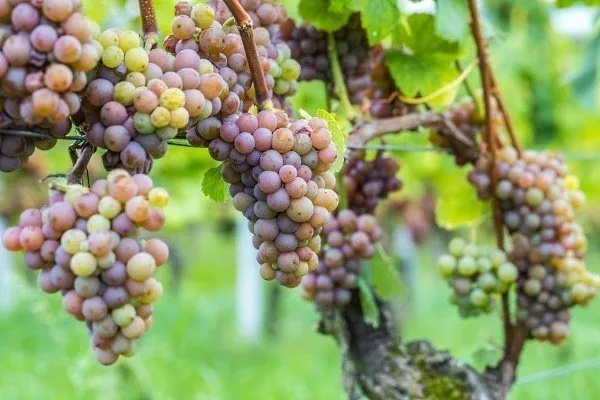
Origin and history of cultivation
The word "kishmish" comes from Persia. The literal translation is "dried grapes." The variety is believed to have originated in Central Asia, and the first mention of Kishmish appears in an ancient Uzbek tale from the 13th century.
Unlike other grape varieties, Kishmish has very small seeds, or none at all. This grape owes its origin to a natural mutation. Winegrowers, noticing the results of this natural "selection," continued experimenting. As a result, many Kishmish varieties and subspecies were developed—white, pink, and dark.
Botanical description
Kishmish unites a group of varieties with similar botanical features and characteristics:
- Clusters. Firm or slightly loose. The berries are medium-sized. Fruit color varies by variety.
- Berries. They have a dense structure and keep well. They are seedless. There are hybrid varieties in which the seeds are very small and undeveloped, and are practically invisible.
- Pulp. Very sweet, contains a lot of sugar – 18-25%.
Kishmish is a grape ideal for producing raisins. The sweet, seedless berries are perfect for this popular and valuable product.
Kishmish varieties and their characteristics
Thanks to selective breeding, many southern crops, previously unavailable in most regions of Russia, now thrive in temperate climates such as Siberia and the Urals. Let's look at the most popular sultana varieties that can withstand Russian frosts.
| Name | Ripening period | Weight of bunch | Color of berries | Frost resistance |
|---|---|---|---|---|
| Radiant | 125-130 days | 400 g | pink | not tall |
| Moldavian | 155 days | 600 g | light purple | up to -18°C |
| White | 160-175 days | up to 250 g | lemon or amber yellow | average |
| Rusball | 115-125 days | up to 1 kg | white | up to -25°C |
| Century | 120-125 days | 700-1200 g | yellow-green | up to -25°C |
| Jupiter | 105-125 days | 200-500 g | dark blue | up to -30°C |
| Zaporizhzhya | 110-120 days | up to 1.5 kg | dark purple | up to -26°C |
| Hungarian 342 | 110-115 days | 300-500 g | light green | up to -26°C |
| Veles | 95-105 days | up to 3 kg | light pink | up to -21°C |
Radiant
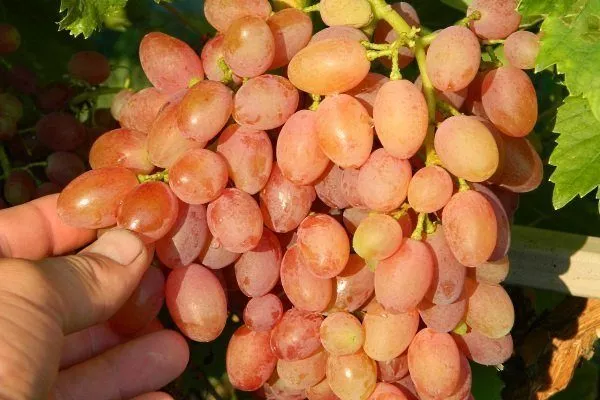
This is the only sultana variety currently included in the State Register. "Luchisty" is recommended for the Lower Volga and North Caucasus regions. It is a mid-season variety, ripening in 125-130 days. The bunches are cone-shaped, medium-sized, and weigh approximately 400 g. Individual specimens reach 1 kg in weight and 40 cm in length. The berries are elongated-ovoid, with a dense pink skin. Each berry weighs 2.5-4 g. They have a muscat flavor.
Pros:
- very tasty berries, tasting score – 9 out of 10;
- high yield – more than 120 centners per 1 hectare;
- resistance to gray mold, mildew and oidium;
- The berries tolerate transportation well.
Cons:
- low frost resistance;
- high yield turns into a disadvantage - under the weight of the bunches, the branches of the grapes often break;
- Due to the high yield, smaller berries and a decrease in their sugar content may also be observed.
Moldavian
Kishmish is a mid-season variety. It takes 155 days from bud break to ripening. The bushes are vigorous, with large clusters. The clusters weigh 600 g. The fruits are round or oval, light purple with a waxy coating. The berries weigh 4-6 g.
Pros:
- pleasant, harmonious taste;
- winter storage – 180 days;
- transports well.
Cons:
- low resistance to mildew, gray mold and leaf roller;
- Frost resistance is satisfactory – the variety can withstand frosts down to minus 18°C.
Watch a review of the "Moldavian" raisin variety in the video below:
White
Full ripening takes 160-175 days. This mid-late variety can be grown in temperate climates. The clusters are medium-sized, cylindrical, weighing up to 250 g. The fruits are small. The color is lemon or amber-yellow. The skin is transparent and thin. The berries are sweet and sour.
Pros:
- average frost resistance;
- tasty berries;
- no seeds.
Cons:
- low yields;
- low resistance to diseases and pests;
- poorly transported.
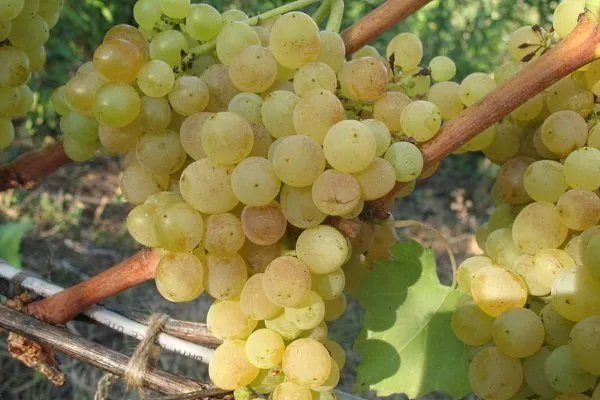
Due to the poor transportability of White Kishmish, it is more often used for drying than for making wines and juices.
Rusball
The grapes ripen in 115-125 days. They produce large, conical clusters, weighing up to 1 kg. The berries are oval, white, and very large, weighing 8-10 g. The flavor is pleasant. Rudimentary seeds are found in the pulp.
Pros:
- high frost resistance – up to minus 25°C;
- consistently high yields;
- resistance to fungal infections;
- obtaining high-quality raisins;
- attractive presentation;
- tolerates transportation well;
- Suitable for table consumption and for drying.
Cons:
- branches under the weight of the harvest can become overloaded and break – rationing is necessary;
- berries contain seeds;
- In rainy weather, berries may crack.
There's an improved version of Rusbol—Rusbol Improved, also known as 13-3-6-2 Elf. It ripens earlier.
Century
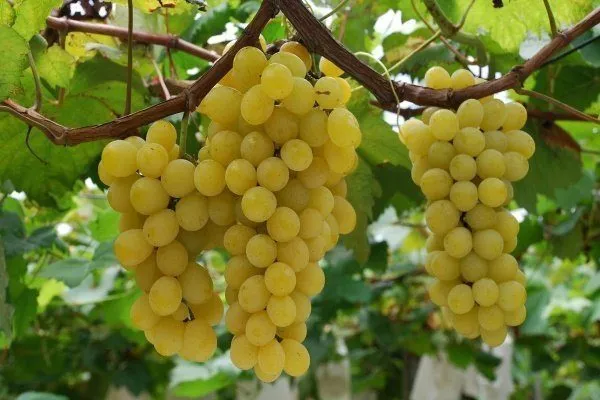
The Stoletie grape is an American sultana variety. It was bred in 1966 and remains very popular. It ripens in 120-125 days, making it a mid-season variety. The plant is vigorous, with conical, medium-dense bunches. The bunches weigh 700-1200 g. The berries are yellow-green in color and weigh 6-9 g.
Pros:
- large clusters;
- sweet, homogeneous, slightly crunchy pulp;
- balanced taste with a nutmeg aroma;
- resistance to berry cracking;
- a large number of bunches of grapes on the vine;
- the berries are suitable for producing raisins;
- good frost resistance – up to minus 25°C.
The downside is their poor shelf life. During storage, the berries quickly turn brown and lose their visual appeal.
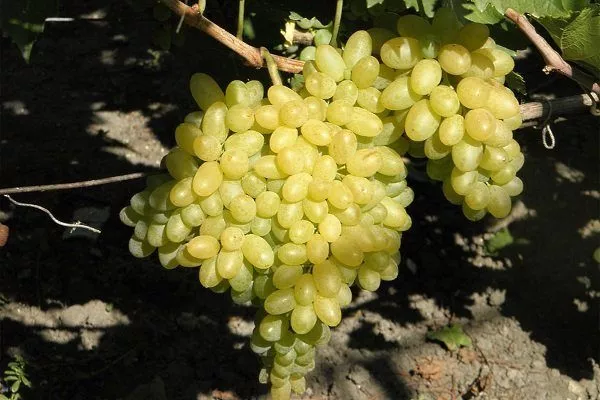
The variety "Stoletie" is better known to gardeners as "Senteniel Seedless", which translates as "a century without seeds".
Jupiter
This is one of the youngest sultana varieties. It was developed in the USA. The berries ripen in 105-125 days. The bushes are medium-sized, frost-hardy, and self-pollinating. The clusters are cylindrical, winged, and converge into a cone. The berries are large, oval, and dark blue, with a muscat aroma. The clusters weigh 200-500 g, and the berries weigh 4-7 g. This variety is used for drying and fresh eating.
Pros:
- the thick skin prevents wasps from damaging the berries;
- stable yield;
- withstands 30 degree frosts;
- good transportability.
Cons:
- the berries fall off if the bunches are not picked in time;
- Sometimes rudiments of seeds are found.
Watch the video below about Jupiter raisins:
Zaporizhzhya
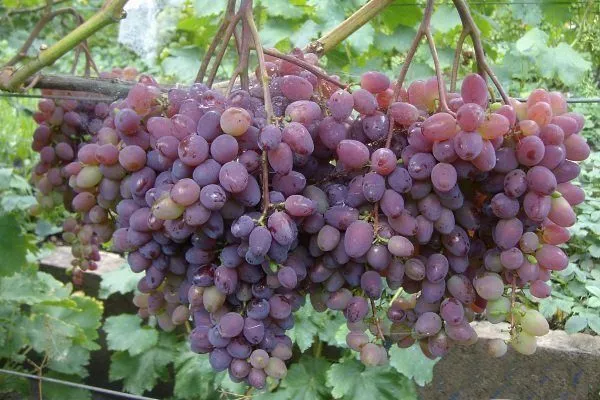
The variety was named after the city where it was bred. The clusters are cone-shaped and large, reaching up to 1.5 kg in weight. The berries weigh 2-2.5 g. The shape is oval and the color is dark purple. It ripens very quickly, in 110-120 days.
Pros:
- consistently abundant fruiting;
- easy to care for;
- beautiful and tasty fruits;
- self-pollinating, is a good pollinator for other varieties;
- not afraid of mildew, rot and oidium;
- withstands frosts down to minus 26°C.
Cons:
- small berries;
- Due to overload, branches may break off - large shoots need to be trimmed;
- the berries are somewhat watery;
- the fruits gain sugar content late;
- increased formation of stepsons;
- berries do not store well;
- The fruits are attacked by wasps – for some reason these insects love Zaporizhzhya raisins more than other varieties.
Hungarian 342
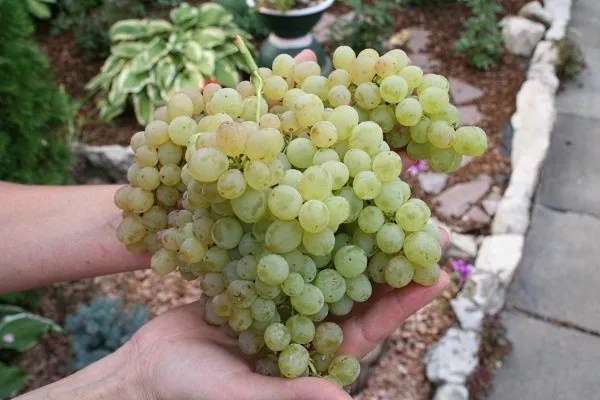
This is one of the most popular dessert varieties of sultanas. It is considered an early-ripening variety, with ripening taking 110 to 115 days. The plants are vigorous with large clusters. The clusters weigh 300-500 g. The flesh is delicate, with a distinct Muscat flavor. The berries are light green with a golden sheen. They weigh 2-3.5 g and are ovoid.
Pros:
- frost resistance – up to minus 26°C;
- the fruits are ideal for drying;
- increased resistance to fungal diseases;
- The skin is thin, the fruits are easily digestible, including by children's bodies.
Cons:
- bunches of grapes that are not picked in time lose their commercial properties;
- berries may have a rudimentary feature - seeds;
- small bunches.
Veles
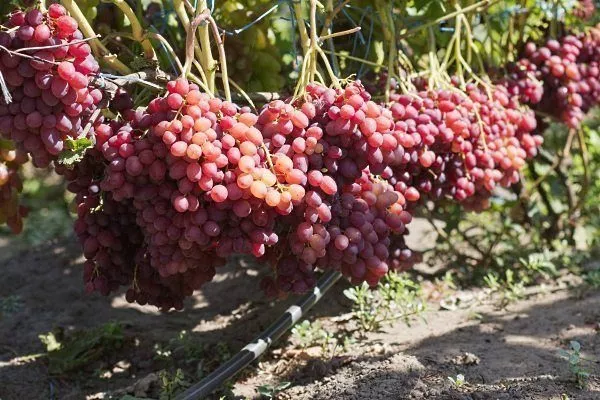
An early-ripening variety, ripening in 95-105 days. Self-pollinating, yield increases by 20% with pollinator varieties. The clusters are very large, weighing up to 3 kg. The clusters are cylindrical or conical. The berries are large, oval, light pink, with an amber hue. The berries appear translucent. Weight: 5 g. The aroma has muscat notes.
Pros:
- very thin skin;
- no seeds;
- high yield;
- ripe bunches, remaining on the vine, do not lose their taste properties for up to 45 days;
- pleasant taste, with a nutmeg hint;
- the berries, when ripe, do not fall off.
Cons:
- frost resistance is average – up to 21°C, the variety requires shelter;
- the bunches are attacked by bees;
- In rain and dampness the berries' marketable appearance deteriorates.
Where does it grow?
Kishmish grapes have long since moved beyond the confines of Central Asia—today, this grape is grown in a wide variety of climates. There are early-ripening and frost-resistant varieties that thrive in regions with harsh winters and short summers. But these grapes prefer sandy soils rich in potassium and phosphorus, and a gentle breeze.
Crimea offers ideal growing conditions for sultanas. The northern border of their distribution extends along the Kyiv-Saratov-Barnaul line. But this doesn't stop experienced gardeners—they manage to grow frost-resistant sultana varieties much further north. Naturally, sultanas in regions with frosty winters are always covered for the winter.
The main condition for raisins to bear fruit is at least 180 frost-free days a year.
The advantages and disadvantages of raisins in general
Kishmish is a popular group of varieties that winegrowers and amateur gardeners value for:
- seedless – the berries are convenient for eating fresh and for processing;
- versatility – the fruits are used to make raisins, wines, and juices;
- sweetness and excellent taste;
- relatively high frost resistance – up to minus 25°C;
- good pollination abilities – all varieties of raisins make excellent pollinators;
- the nutritional value and medicinal properties of berries - they support the heart muscle and normalize blood pressure;
- high yield – 200-250 centners per 1 hectare;
- early fruit bearing;
- good rooting of cuttings and high-quality ripening of fruits even in northern regions;
- preservation of product appearance and taste during long-term transportation;
- resistance of fruits to cracking due to changes in temperature and humidity;
- The plant's external attractiveness – raisins can be used for decorative purposes.
Flaws:
- Some varieties have fruits that are prone to falling off when they are overripe, so you have to carefully monitor their ripening to harvest them on time.
- Satisfactory resistance to gray mold, oidium and mildew – bushes require regular treatment.
Landing features
If you want to grow sweet sultanas in your garden, choose a variety suitable for your region. Then, select and prepare the site and gather all the necessary planting materials.
- ✓ Soil pH should be between 6.0-6.5 for optimal nutrient absorption.
- ✓ The depth of groundwater is at least 2.5 m to prevent root rot.
Deadlines
Kishmish grapes can be planted in both fall and spring. In the variety's native soil and in southern Russia, grapes are usually planted in the fall—in October or November. A month or a month and a half before frost, the grape's root system has time to adapt to the new conditions, and the seedlings have time to strengthen and establish roots.
In regions with frosty winters, it's preferable to plant Kishmish in the spring to prevent the seedlings from being damaged by sudden frosts. Spring planting is done before the sap begins to flow, when the plant is still dormant.
The optimal soil temperature is +10°C. Grapes should not be planted in colder soil, as the roots may freeze. These conditions typically occur in April-May.
Seedlings are planted in autumn; the best time for planting cuttings is spring.
Selecting a site
Recommendations for choosing a site for planting Kishmish:
- Good sunlight is required; this grape will not grow in dense shade.
- There should be no trees nearby, as this will cause competition for water and nutrients.
- Drafts and gusty winds are excluded; the grapes need peace and comfort.
- The best option is a sunny area facing south or southwest, level or with a slight slope.
- A good solution is planting near a structure that blocks the north. Grapes are commonly planted near the stone walls of sheds, garages, and the like. However, this should not be done near the walls of a residential building, as excessive watering can cause the foundation to settle.
- Kishmish grows in any type of soil, but produces its best fruit in loose, nutritious soils, which warm up quickly and allow moisture and oxygen to reach the roots.
These properties are typical of loamy and light loamy soils, as well as chernozems on calcareous and chalky bedrock. Sandstones are a suitable option, but it should be noted that they quickly lose water and nutrients. - Kishmish should not be planted in soils located closer than 1 m to rocky areas, or in swampy or saline areas.
The sweetness of Kishmish depends on the amount of sun. Some shade is acceptable only during the first few years of growth. This grape is characterized by vigorous vines, so they can easily be transplanted to areas with maximum sun exposure.
Soil preparation
Soil preparation begins in advance. If the grapes are to be planted in the spring, the plot is prepared in the fall. Follow these steps:
- Clear the area of all unnecessary items – remove stones, weeds and their roots, and level the surface.
- Dig the area to a depth of 65-70 cm. Add 3-4 kg of compost per square meter and 100 g of superphosphate per square meter.
- When digging, do not try to break up large clumps - they will accumulate a lot of moisture over the winter and will fall apart on their own in the spring.
- If necessary, adjust the soil composition: if it's acidic, add 1-1.5 kg of rock phosphate. If the soil is heavy and clayey, add coarse sand, humus, and crushed stones. Loose sandy soils require peat, manure, or black soil.
Selecting a seedling
The subsequent development and productivity of grapevines depend on the health of the planting material. How to choose seedlings for planting:
- Young planting material – 1-2 years old – tolerates transplantation best.
- The root system should be strong, robust, and free of defects and signs of disease. Have the seller cut off a piece of the root so you can examine the cut surface—if it's light-colored, the roots are alive.
- The trunk should be smooth and free of any signs of infection. If the trunk has spots, swellings, or bulges, the seedling is not suitable for planting.
- The seedling must have at least one year-old growth, which must be thick enough and have buds on it.
Planting methods and instructions
Before planting, soak the seedling's roots in water for a few days to allow them to absorb the required amount of moisture. Prepare the holes no later than 2-3 weeks before planting.
Planting raisin seedlings:
- Dig a hole 70-80 cm deep. The diameter should be approximately the same – 80-100 cm. This size is necessary to comfortably accommodate the root system – it will develop well only in loose, oxygen-rich soil.
- Mix the fertile soil removed when digging the hole with rotted manure (2-3 buckets), superphosphate (200-300 g) and potassium salt (100-200 g).
- Drive a support into the bottom of the hole and lay drainage material—broken brick or coarse gravel will do. Place the support on the north side.
- Pour the soil mixture into the hole and fill it with water so that it settles.
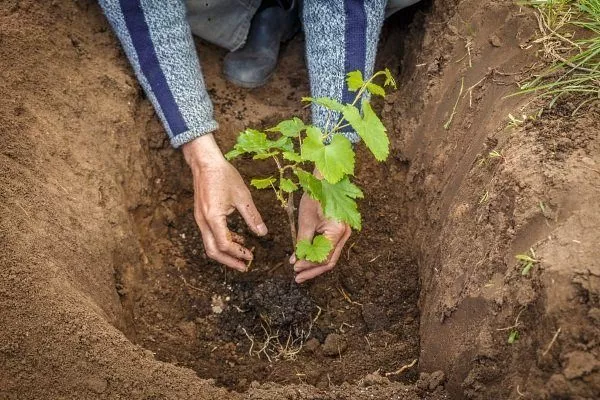
- When it's time to plant, make a hole in the loose soil mixture you've already filled. Adjust the depth so that only two buds remain above the soil surface of the planted seedling.
- Place the seedling so that its roots are vertical.
- Cover the roots with fertile soil and compact it with your hands.
- Water the seedling with warm water.
- Once the water has soaked in, sprinkle mulch around the seedling. You can read more about mulching here. here.
There should be a distance of 2.5-3 m between adjacent Kishmish seedlings, and the same between rows.
The planting depth is influenced by the climatic conditions of the region and the soil composition:
- In the south, seedlings are placed so that their heel is at a distance of 50-55 cm from the ground surface.
- In colder regions and on sandstones – at a distance of 60-65 cm.
Care Features
Caring for Kishmish involves a series of agricultural practices. The vines are pruned, watered regularly, fertilized, and prepared for winter in the fall.
Kishmish care schedule:
| Month, period | Works |
| May | The grown vine is tied up and pruned. |
| June | Pinch the plant back to 2 leaves, remove the shoots and apply fertilizer. |
| July | The following work is carried out:
|
| Beginning of August | Produced by:
|
| Late August or early September | Harvesting. |
| The entire growing season | Loosening and weeding – every 2-3 weeks. |
During harvesting, watering and fertilizing are stopped.
When and how to water?
Kishmish berries thrive on moisture, and if they experience a water shortage, their roots will begin to grow deeper—up to 2-2.5 meters. This will cause the vines to wither, the bunches to lose weight, and the berries to lose their juiciness. If there's no rain, water the Kishmish berries at least once a week.
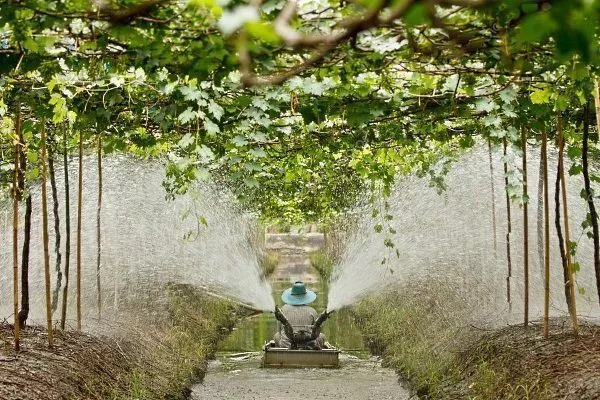
Kishmish must be watered during the following periods:
- beginning of the growing season;
- a week before flowering;
- after flowering;
- during fruit ripening.
Two weeks before harvesting, the watering rate is reduced by half to prevent the berries from cracking.
During particularly hot summer days, grapes are watered more frequently than usual—every 3-4 days. The watering rate is calculated based on soil conditions; on average, 2-3 buckets of water are poured under each vine.
To ensure even absorption of moisture, it is recommended to water the plant in two stages – morning and evening.
Fertilizers and application chart
Principles of feeding Kishmish:
- Fertilizer application is moderate, combining organic matter with complex fertilizers.
- In spring and early summer, nitrogen and organic matter are added to stimulate shoot growth.
- In the second half of summer, phosphorus and potassium are added—they are necessary for the formation of large, sweet berries. Nitrogen is not added in the second half of summer.
- It is advisable to apply liquid fertilizers during watering.
- In the first year after planting, add 50 g of superphosphate and 30 g of potassium salt under each bush at the beginning of the growing season.
- Repeat fertilizing in midsummer, reducing the dose by half.
Fertilizer application rates and periods:
| Period | Fertilizer application rates (dosage is calculated for 10 liters of water) |
| Early spring | For one bush, make a solution:
Instead of mineral fertilizer, you can add organic fertilizer – a manure solution. |
| Before flowering (about a week) |
Or add organic matter – 2 kg of manure per bucket of water. |
| Mid-July |
|
| Mid-October | Potassium and phosphorus fertilizers – 25 g each. |
Foliar treatment
Foliar feeding involves sprinkling nutrients over the leaves. This method is used when root feeding is ineffective or to maximize yield. This method requires caution to avoid burning the leaves or damaging the berries.
The first foliar feeding is done a week before flowering. It is applied regardless of whether root feeding has already been done. To save time, foliar feeding is mixed with a fungicide and insecticide.
Composition No. 1 of foliar feeding:
- 40 g urea;
- 20 g citric acid;
- 15 g boric acid;
- 1 g of ferrous sulfate.
Composition No. 2:
- 0.2% ammonium sulfate;
- 0.05% potassium permanganate;
- 0.6% potassium sulfate;
- 0.5% urea.
If you don't want to bother with preparing solutions, buy ready-made ones such as "Clean Sheet," "Novofert," "Ovary," and others. It's also recommended to use the berry and bunch growth stimulator "Gibberellin" for spraying.
Spray the grapes on a cloudy day or in the evening. You can add 30 g of glycerin or vegetable oil to the solution. This will slow down the evaporation of the solution.
The second feeding is done after flowering, when the grapes are sprayed against pests. Foliar feeding is stopped in August to prevent the growth of young shoots from intensifying.
Trimming
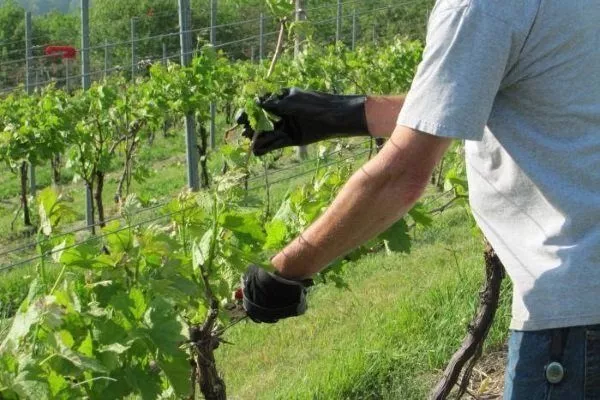
During the first 3-4 years, grapevines are shaped to ensure ease of maintenance and high yields. Pruning Kishmish grapes, regardless of planting time, begins in the spring. A cordon shape is typically used, with one or two branches, usually facing the same direction. Read about spring grape pruning. Here.
Principles of pruning Kishmish:
- To prevent the bush from being overloaded, no more than 10-12 vines are left per meter of height.
- Kishmish has vigorous bushes, so it is pruned long, leaving about 8-12 buds on the vine. The first 4-5 buds on the vine are sterile—this is a characteristic of Kishmish and other Central Asian grape varieties.
- Excess and weak shoots are cut off.
- No more than two clusters are left on each shoot.
Preparing for winter
In the southern regions, there is no need to cover Kishmish plantings, but starting from the central zone of Russia, winter insulation is a must.
The procedure for preparing Kishmish for winter:
- Weeding between rows – for better moisture retention and weed control.
- The last one is pre-winter feeding (phosphorus-potassium fertilizers are added).
- Covering the shoots. After untying them, they are laid on the ground, pinned with staples. A non-woven material is placed on top of the shoots, then covered with a layer of soil. Sometimes, plywood boxes are even built on top.
Diseases and pests
Diseases and pests cause crop yield losses. Timely preventative measures are essential to prevent losses.
Symptoms and measures to combat diseases and pests of Kishmish:
| Diseases/pests | Symptoms/harm | How to treat? | Prevention |
| White rot | It attacks the berry combs and stalks, then the berries themselves, and eventually the entire cluster. The vines develop black-bordered spots. Causes include sunburn, hail, and mildew. | Spraying with 4% Bordeaux mixture, 5% Captan solution or 1% TMTD suspension.
| Correct pruning – bushes must be well ventilated. |
| Gray mold | The berries have brown spots. They crack and become covered with a fluffy coating. | There is no effective treatment. | Breaking off and tying up shoots to ensure access to sunlight.
As soon as the first signs of damage appear, the entire crop is immediately harvested. |
| Rubella | Brownish spots appear on the leaves. The leaves dry up and fall prematurely. The disease begins in April-May. | If rubella appeared last season, then treatment begins next spring.
Spray with Bordeaux mixture. You can also use Zineb 0.5%. | Spraying with 1% Bordeaux mixture. Timely fertilizing and soil care. |
| Leaf roller | They damage ovaries and buds. Damaged berries spoil and rot. | To destroy caterpillars, use Vofatox (3 g per 1 sq. m). | Butterfly traps are set up—containers hung 0.7 m from the ground. They are filled with wine slurry diluted 1:3 with water. After removing the winter cover, the old bark is immediately scraped off—this is where the pupae overwinter—and burned. |
| Wasps | The berries spoil and become unsuitable for storage. | They use a full range of possible measures: traps, poisoned bait, pesticides. | Planting wasp-repellent plants near the grapes – lemon balm, basil, and mint are suitable. |
Useful information about the variety
Kishmish berries are delicious, healthy, and versatile, but their consumption requires supervision. To avoid harm to the body, consider the specific properties of sultanas.
Nutritional and energy value
Kishmish is rich in vitamins and microelements:
- It's rich in B vitamins, which are essential for a strong nervous system. Eating these grapes helps manage stress and depression.
- Nicotinic acid – normalizes metabolism.
- Ascorbic acid – strengthens the immune system.
- Potassium – has a beneficial effect on the cardiovascular system.
- Boron – reduces the risk of osteoporosis.
- Oleanolic acid – reduces the rate of bacterial growth in the oral cavity.
Caloric content of Kishmish berries is 69 kcal per 100 g. Energy value:
- proteins – 0.72 g;
- fats – 0.16 g;
- carbohydrates – 17.2 g.
Glycemic index
The glycemic index (GI) is a parameter that measures the rate at which carbohydrates are broken down, reflecting the magnitude of changes in blood glucose levels. For example, the GI of sultanas is 56. Grapes are often used in diets, but they are contraindicated for diabetics, as is any food with a GI above 50.
What vitamins does it contain?
Kishmish is rich in vitamins, particularly prized for its high content of vitamins A and C. However, these vitamins are only present in ripe and well-dried berries.
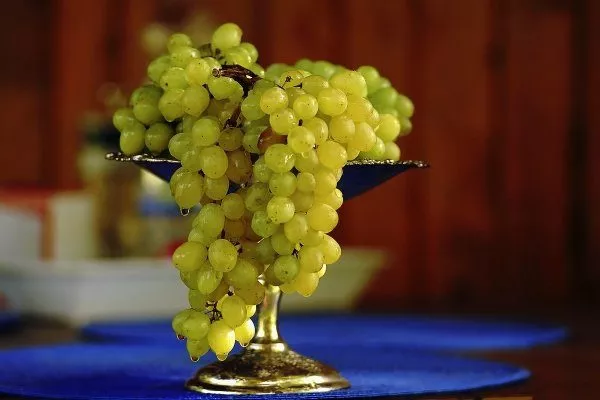
100 g of raisins contain:
- Vitamin C – 6 mg;
- Vitamin A – 5 mcg;
- vitamin PP – 0.3 mg;
- vitamin B9 – 2 mcg;
- beta-carotene – 0.03 mg;
- vitamin H – 1.5 mcg;
- E-vitamin – 0.4 mg.
Application
Kishmish is used:
- As a healthy, even medicinal, product, berries lift your mood, relieve fatigue, and have many other beneficial effects.
- In cooking. Used in baked goods, confectionery, and various dishes.
- For making homemade wine.
Harm from Kishmish
When consuming sultanas, be aware of their high glycemic index and the presence of organic acids. Sultanas are harmful in the following cases:
- obesity;
- diabetes mellitus;
- gastric ulcer;
- pancreatitis;
- cholecystitis.
The maximum daily dose of sultanas is 25 raisins. Exceeding this limit can lead to flatulence, nausea, and diarrhea—symptoms that can develop from overeating raisins, even in healthy individuals.
Marketability of berries
Kishmish grapes don't always have a good marketable appearance. A possible drawback of their clusters is insufficient density. Everything depends on the size of the clusters and their appearance – these parameters depend on the Kishmish variety, its shelf life, and the ability of the clusters to retain their marketable appearance after the berries ripen.
Reviews of Kishmish grapes
New Kishmish varieties are frost-hardy enough to grow in various regions of Russia. This easy-to-grow, versatile grape will not only enrich your table but also serve as a significant source of income.